Verse8's Self-Description: How to Support Creative Expression in the AI Era

深潮Опубликовано 2025-12-10Обновлено 2025-12-10

Введение

Verse8 is an AI-native creation layer that transforms ideas into interactive games and stories, where every creation can be owned, remixed, and accumulate value over time. Unlike OpenAI (chat), Runway (video), or Stability (image), Verse8 focuses on interactive content as the new expressive medium, starting with games as its first vertical. The platform was built to overcome the high barriers of traditional interactive content creation—long cycles, high costs, and complex coordination across coding, art, and design. By collapsing the entire production process into a single prompt, Verse8 eliminates creative friction, automates invisible work, and enables anyone to express ideas interactively. Its core architecture consists of two layers: - **Agent8**: A multi-agent system that acts as a full production team—handling art, code, design, and testing through a single prompt. It includes an AI-native web engine with templates (FPS, RPG, etc.), automated asset generation (2D/3D optimization, animation, audio), and built-in infrastructure (Git, servers, analytics, payments). - **Verse8 Ecosystem**: A global deployment network where creators can instantly publish, share, and remix content. Integrated with Story Protocol, it enables on-chain IP ownership and programmable rights, allowing derivative works while rewarding original authors. Verse8 aims to democratize creativity—enabling everyone to create, not just consume. It supports instant world-building, prompt-based cr...

Verse8 is an AI-native creation layer that transforms your ideas into interactive games and stories. Every creation can be owned, remixed, and continuously accumulates value. Just as OpenAI started with chat, Runway rose with video, and Stability broke through with images, Verse8 begins with the most representative form: interactive content. Gaming is just the first vertical where this new medium shines. We believe creation should be for everyone, not just developers.

Why We Built Verse8
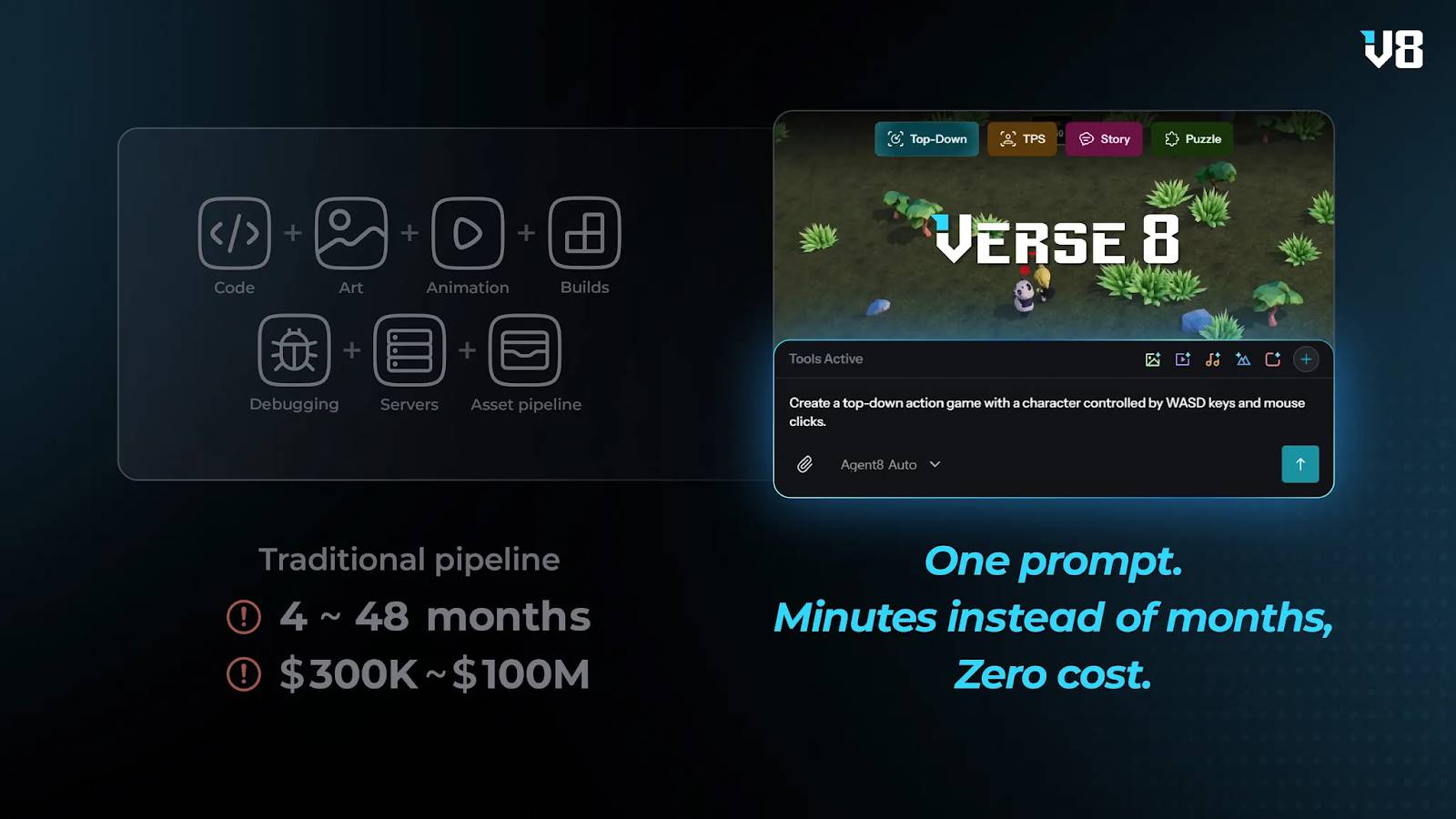
Interactive content creation has always been one of the hardest fields to enter: long production cycles, high upfront costs, and a complex workflow requiring collaboration between code, design, and art. The current system is not creator-friendly. However, creativity should not be constrained.

When we realized that the entire production pipeline could be folded into a single prompt, we knew we had to build a system:
——To eliminate creative friction,
——Automate invisible work,
——And allow anyone to express ideas interactively.

Thus, Verse8 was born. Since Verse8's stealth launch, our user and creator community has grown rapidly, confirming one thing: the world is ready for a new creative medium.
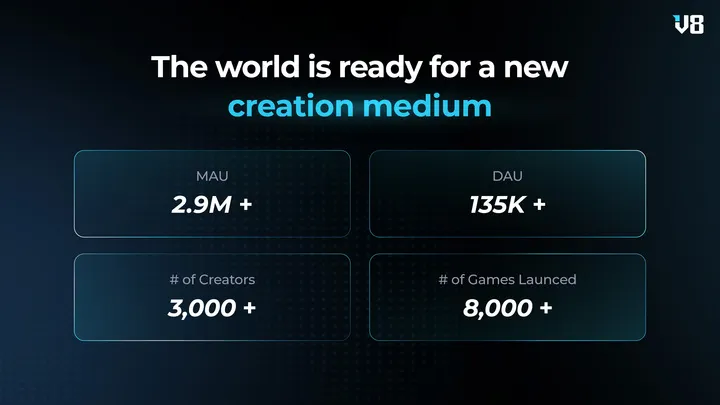
The Architecture of Verse8

Verse8 consists of two core layers.
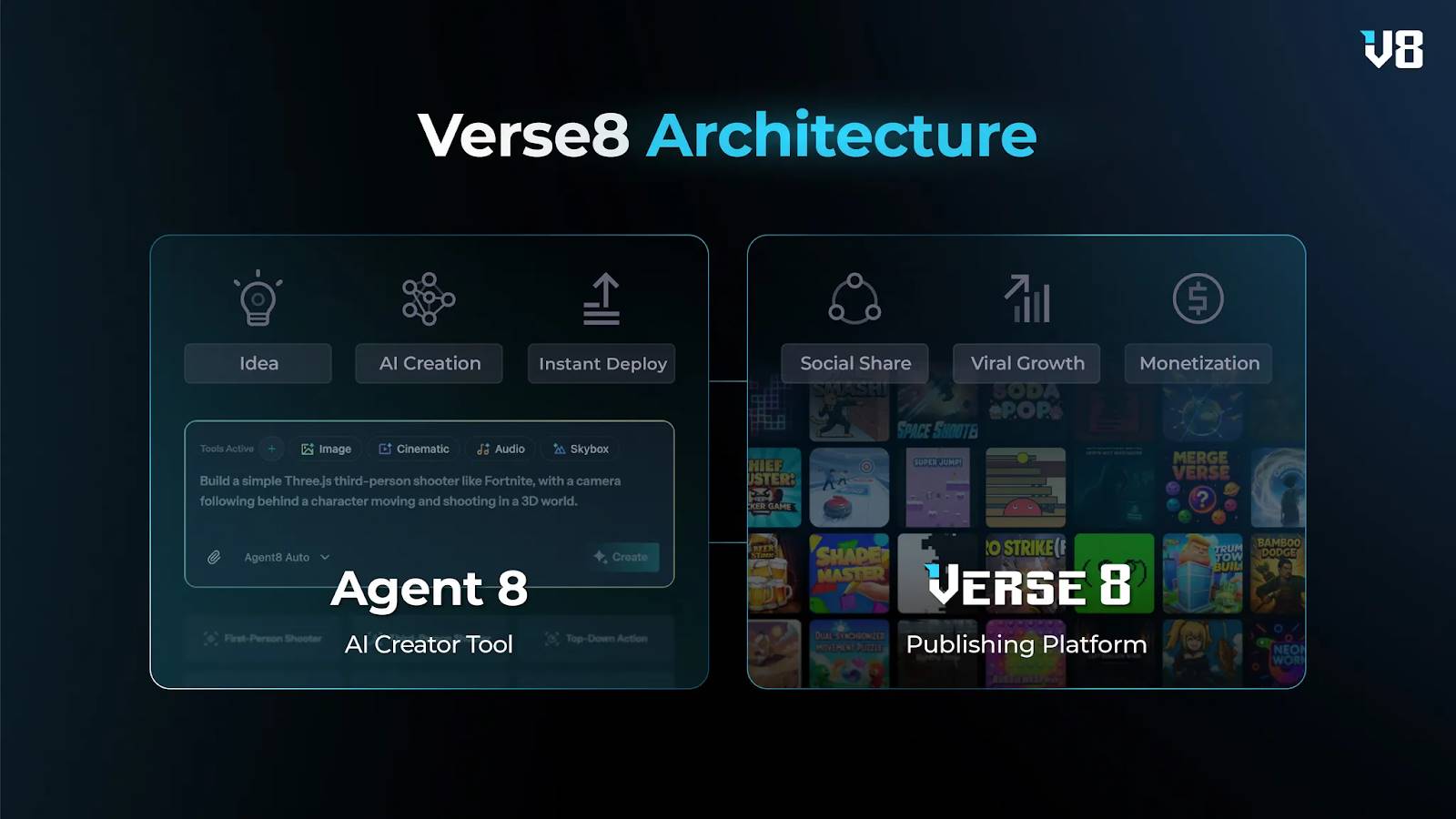
Agent8: Compressing an Entire Production Team into a Single Prompt
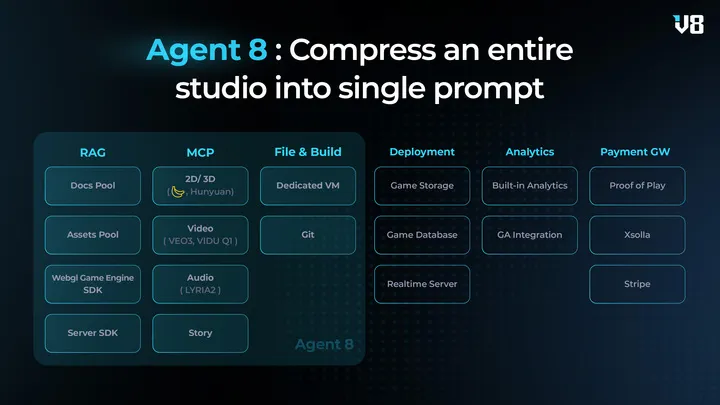
Multi-Agent Collaborative Creation System: Art, code, design, and testing agents collaborate via MCP servers, drastically reducing production costs. A single text prompt can build a complete 2D/3D multiplayer game.

AI-Native Web Content Engine: Built-in templates for various game genres (FPS, platformer, idle, RPG, etc.), integrated with React Three Fiber + WebGL engine, supports real-time publishing. Games can be deployed instantly, no build process or server hosting required.

Automated Content Asset Pipeline: Integrates top generative models. 2D assets are automatically optimized for the target platform. 3D models are automatically rigged, formatted, and optimized for WebGL, eliminating bottlenecks in modeling, animation, and audio production.

Operations and Infrastructure Automation: Built-in Git, database, real-time server, data analysis, and payment gateway. AI can autonomously operate and update live games, supporting "infinite content generation" with no additional manual cost.

Verse8: Accelerating the Creator Economy

After creation, it needs a "home"—a space to publish, access, remix, and realize value transformation. Verse8 is such an ecosystem. Creators can deploy instantly to a global content network without building their own servers, connecting with communities worldwide.

IP Ownership and Programmable IP

Verse8 integrates Story Protocol, an on-chain IP and ownership layer. Every game, asset, and derivative content is automatically registered and ownership is established. The Spin system allows anyone to copy, adapt, and extend existing IP. The more derivatives, the more the original creator benefits.

On-Chain Distribution

On-chain infrastructure unlocks capabilities impossible in Web2: global, permissionless, programmable distribution.

Encouraging Creation, Not Just Consumption

We built Verse8 to enable everyone to become a creator—not just players, not just consumers.

Verse8 empowers people to:
——Instantly create their own interactive worlds;
——Turn ideas into interactive content with a single prompt;
——Reuse and reshape the creations of others.

This is a new medium of expression, where creativity continuously appreciates in value through collaboration, remixing, and shared ownership.

- Website: https://verse8.io
- X: https://x.com/Verse_Eight
- Discord: https://discord.gg/verse8-official

Связанные с этим вопросы

QWhat is Verse8 and what does it aim to achieve?

AVerse8 is an AI-native creation layer that transforms ideas into interactive games and stories. It aims to make creation accessible to everyone, not just developers, by eliminating creative resistance, automating hidden work, and allowing anyone to express their ideas interactively. Every creation can be owned, remixed, and accumulate value over time.

QWhat are the two core layers of Verse8's architecture?

AVerse8's architecture consists of two core layers: Agent8, a multi-agent collaborative creation system that compresses an entire production team into a single prompt, and the Verse8 ecosystem itself, which serves as a home for creations to be published, accessed, remixed, and monetized on a global content network.

QHow does Agent8 simplify the interactive content creation process?

AAgent8 simplifies creation by using a multi-agent system (art, code, design, and testing agents) that collaborate through an MCP server. A single text prompt can build a complete 2D/3D multiplayer game. It automates asset generation, optimization, and infrastructure (like Git, databases, and servers), eliminating bottlenecks in modeling, animation, and audio production.

QHow does Verse8 handle intellectual property (IP) and ownership for creators?

AVerse8 integrates with Story Protocol, an on-chain IP and ownership layer. Every game, asset, and derivative is automatically registered and assigned ownership. Its Spin system allows anyone to copy, adapt, and extend existing IP, with the original creator benefiting more as derivatives increase.

QWhat capabilities does on-chain distribution unlock for Verse8?

AOn-chain infrastructure enables global, permissionless, and programmable distribution, which are capabilities not possible in Web2. This allows for instant global deployment and connection to communities worldwide without the need for creators to set up their own servers.

Похожее

From Airdrop Myth to King of Derivatives: A Look Back at Hyperliquid's 2025 Conquest

Reviewing crypto's growth in 2025, Hyperliquid stands out. It began the year with an epic airdrop and strong price performance, capturing attention. By year's end, it transformed into a top-four revenue-generating platform in crypto, earning over $650M and at one point capturing 70% of all perp trading volume. Its success was no accident. In Q1, it solidified its reputation by being first to list new assets like the TRUMP perp and launched HyperEVM, a smart contract layer. Q2 saw explosive growth: HYPE token surged 4x from April lows, and HyperEVM's TVL grew from $350M to $1.8B. The platform gained mainstream media coverage. In Q3, major wallets like Phantom and MetaMask integrated via Hyperliquid's builder codes, routing $158B in volume and earning partners nearly $50M. A high-profile stablecoin bid war was won by Native Markets, aligning with Hyperliquid's bootstrapped ethos. However, new competitors like Aster and Lighter emerged with aggressive airdrops. Q4 brought permissionless listings via HIP-3, enabling new markets like stock perps and yield-bearing collateral. Yet, HYPE fell nearly 50% from its September peak due to market conditions, a rare ADL event during a crash, and the start of team token unlocks. As perps go mainstream in 2026, Hyperliquid's true test begins. Its success came from building a superior product and ecosystem without shortcuts. Maintaining leadership will require doing it all over again in a crowded field.

marsbit16 мин. назад

From Airdrop Myth to King of Derivatives: A Look Back at Hyperliquid's 2025 Conquest

marsbit16 мин. назад

ETC Olympia Development Part 1: Implementing ECIP-1111 and ECIP-1112

ETC Olympia Development Series Part 1: Implementing ECIP-1111 and ECIP-1112 This article introduces the first part of the Ethereum Classic Olympia development series, focusing on the implementation of ECIP-1111 and ECIP-1112. These two proposals are the only components within the broader Olympia framework that modify consensus behavior. ECIP-1111 modernizes the fee market by introducing an EIP-1559-style mechanism with a base fee and optional priority tip (miner tip). A key difference from Ethereum is that the base fee is not burned but is instead redirected to a treasury address defined by ECIP-1112. It also adds support for Type-2 transactions and the BASEFEE opcode (0x48), ensuring compatibility with modern EVM tooling and wallets. Crucially, it does not change miner rewards, monetary policy, or existing transaction types. ECIP-1112 defines an immutable, deterministic treasury smart contract that will receive the redirected base fees. This vault is designed to be receive-only upon activation, meaning it can accumulate value but cannot distribute funds until a separate, subsequent governance layer (defined in other ECIPs) is deployed and activated on the contract layer. The article emphasizes the modular architecture of Olympia. While the suite includes five ECIPs (1111-1115), only these two affect consensus. This separation ensures that the core protocol remains minimal and auditable, while future governance and funding mechanisms can evolve independently at the contract level without requiring further hard forks. The implementation is currently in the draft stage per the ECIP-1000 process. Any decision to move forward with mainnet activation will require extensive testing on the Mordor testnet and full community review.

金色财经21 мин. назад

ETC Olympia Development Part 1: Implementing ECIP-1111 and ECIP-1112

金色财经21 мин. назад

Торговля

Спот
Фьючерсы
活动图片