Valentine’s Day Crypto Warning: US Attorney Issues Crypto-Fueled Romance Scam Alert

ccn.comОпубликовано 2026-02-14Обновлено 2026-02-14

Введение

The US Department of Justice has issued a Valentine’s Day warning about cryptocurrency-fueled romance scams. Fraudsters typically approach victims on dating sites or social media, using fake profiles and stolen photos to build emotional trust over weeks or months. They then fabricate emergencies and request payments in crypto, gift cards, or wire transfers—methods that are difficult to reverse. Recent cases include a Colorado man who lost $1.4 million after meeting a woman on a dating app who persuaded him to invest in crypto. According to Chainalysis, crypto scams received at least $14 billion in 2025, with impersonation scams surging by 1,400% compared to the previous year. Authorities advise conducting reverse image searches, consulting trusted friends before sending money, and reporting suspicious activity to the FBI.

Key Takeaways

  • The Department of Justice has issued a crypto warning as Valentine’s Day hits.
  • Real-world losses are escalating.
  • Crypto scam activity surged in 2025.

U.S. federal prosecutors are warning Americans not to let Valentine’s Day turn into a costly heartbreak, as romance scammers increasingly demand payment in cryptocurrency.

The U.S. Attorney’s Office for the Northern District of Ohio on Thursday urged the public to remain vigilant against online crypto romance scams that exploit victims’ trust and emotions.

Try Our Recommended Crypto Exchanges
Sponsored
Disclosure
We sometimes use affiliate links in our content, when clicking on those we might receive a commission at no extra cost to you. By using this website you agree to our terms and conditions and privacy policy.
"}' data-trk="6970dbafcbd599f15ce64045" href="https://links.ccn.com/links?code=6985b71f73f50d4865cba0f2" rel="nofollow" target="_blank">
ChangeNow<\/h3>"}' data-trk="6970dbafcbd599f15ce64045" href="https://links.ccn.com/links?code=6985b71f73f50d4865cba0f2" rel="nofollow" target="_blank">

ChangeNow

promotions
Receive 0.4% of the volume from each transaction with your referral link.<\/strong>"}' data-trk="6970dbafcbd599f15ce64045" href="https://links.ccn.com/links?code=6985b71f73f50d4865cba0f2" rel="nofollow" target="_blank"> Receive 0.4% of the volume from each transaction with your referral link.
Coins
217
Claim Offer
"}' data-trk="6899b9831836d97539c51aa6" href="https://links.ccn.com/links?code=693293fa4a5bcb6231949c97" rel="nofollow" target="_blank">
Bitunix<\/h3>"}' data-trk="6899b9831836d97539c51aa6" href="https://links.ccn.com/links?code=693293fa4a5bcb6231949c97" rel="nofollow" target="_blank">

Bitunix

promotions
Receive up to $100,000 worth of exclusive gifts for newcomers upon registration.<\/strong>"}' data-trk="6899b9831836d97539c51aa6" href="https://links.ccn.com/links?code=693293fa4a5bcb6231949c97" rel="nofollow" target="_blank"> Receive up to $100,000 worth of exclusive gifts for newcomers upon registration.
Coins
151
Claim Offer
"}' data-trk="67adf8d4f12aaec7e4808bf5" href="https://links.ccn.com/links?code=693291aa4a5bcb62319448b2" rel="nofollow" target="_blank">
Bitget<\/h3>"}' data-trk="67adf8d4f12aaec7e4808bf5" href="https://links.ccn.com/links?code=693291aa4a5bcb62319448b2" rel="nofollow" target="_blank">

Bitget

promotions
New user rewards up to 6,200 USDT.<\/strong>"}' data-trk="67adf8d4f12aaec7e4808bf5" href="https://links.ccn.com/links?code=693291aa4a5bcb62319448b2" rel="nofollow" target="_blank"> New user rewards up to 6,200 USDT.
Coins
89
Claim Offer
Explore All Offers

DOJ Flags Valentine’s Day Crypto Warning

Federal prosecutors said fraudsters typically approach victims on dating websites, social media platforms, and messaging apps, posing as romantic partners.

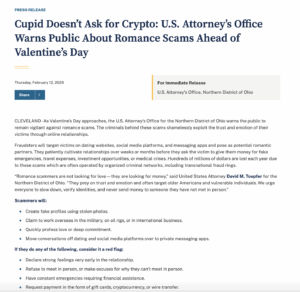
In a stark warning , titled “Cupid Doesn’t Ask for Crypto,” the DOJ explained how bad actors cultivate relationships over weeks or months before fabricating emergencies, travel needs, or medical crises.

Among the clearest warning signs, according to the Justice Department, are requests for payment in crypto, gift cards, or wire transfers, methods favored by scammers because they are hard to reverse.

The office said scammers frequently create fake profiles using stolen photos, claim to work overseas in the military or international business, and profess deep affection quickly.

The DOJ has issued a Valentine’s Day warning about crypto. | Source: DOJ

They often move conversations off mainstream dating platforms to private messaging apps and avoid meeting in person.

“Romance scammers are not looking for love — they are looking for money,” said U.S. Attorney David M. Toepfer for the Northern District of Ohio.

Adding: “They prey on trust and emotion and often target older Americans and vulnerable individuals. We urge everyone to slow down, verify identities, and never send money to someone they have not met in person.”

Regional Cases Underscore Growing Threat

Victims are advised to conduct reverse image searches of profile photos, consult trusted friends before sending funds, and report suspicious activity to the FBI’s Internet Crime Complaint Center (IC3).

In the report, authorities cited recent regional cases, including a Ghanaian national charged in an alleged scheme that took more than $8 million from elderly victims.

Last September, a Colorado man was also reported to have lost $1.4 million after falling victim to a crypto-linked romance scam.

The man, who first spoke to 9News , said he met a woman on Ashley Madison, a website marketed to married people seeking affairs.

After weeks of video chatting and exchanging photos, their conversations shifted to the woman’s interest in crypto and her view of it as a good opportunity for him.

Over roughly six weeks, the man said he made four separate cryptocurrency transfers, ultimately losing $1.4 million in retirement funds and life savings.

Crypto Scams Surge in 2025

The warning comes amid a broader surge in cryptocurrency-related fraud.

Blockchain analytics firm Chainalysis said in its 2026 report that crypto scams received at least $14 billion in on-chain funds last year, up sharply from initial 2024 estimates of $9.9 billion.

Based on historical trends, the firm projected that the 2025 total could exceed $17 billion as more illicit wallets are identified.

The average scam payment rose to $2,764 in 2025 from $782 in 2024, a 253% year-on-year increase, according to Chainalysis.

Impersonation scams, also known as Pig Butchering scams, recorded a 1,400% surge in inflows compared with the previous year.

Top Trending Crypto Articles
  • Best Exchanges Check Out Our Recommended Exchanges Here
  • Buy Crypto Fast How To Buy Crypto with a Credit Card Now
  • Safe Crypto Gambling See Our Picks for the Best Crypto Gambling Sites

Связанные с этим вопросы

QWhat is the main warning issued by the U.S. Department of Justice regarding Valentine's Day?

AThe U.S. Department of Justice has issued a warning about romance scammers who increasingly demand payment in cryptocurrency, urging the public to remain vigilant against online crypto romance scams that exploit victims' trust and emotions.

QWhat are some of the red flags mentioned by the DOJ to identify crypto romance scams?

ARed flags include requests for payment in cryptocurrency, gift cards, or wire transfers; scammers creating fake profiles using stolen photos; claiming to work overseas in the military or international business; professing deep affection quickly; and moving conversations off mainstream platforms to private messaging apps while avoiding in-person meetings.

QHow much did crypto scams receive in on-chain funds in 2025 according to Chainalysis?

AAccording to Chainalysis, crypto scams received at least $14 billion in on-chain funds in 2025, with projections that the total could exceed $17 billion as more illicit wallets are identified.

QWhat was the average scam payment in 2025 compared to 2024?

AThe average scam payment rose to $2,764 in 2025, which is a 253% increase from the $782 average in 2024.

QWhat advice does the DOJ give to avoid falling victim to these scams?

AThe DOJ advises victims to conduct reverse image searches of profile photos, consult trusted friends before sending funds, and report suspicious activity to the FBI’s Internet Crime Complaint Center (IC3). They also emphasize never sending money to someone they have not met in person.

Похожее

Stuck Polymarket: The Real Test After Riding the Traffic Boom Has Arrived

Polymarket, a leading prediction market platform, is facing significant technical challenges as its growth outpaces its current infrastructure on Polygon. Users are experiencing laggy transactions, unresponsive orders, and delayed confirmations, severely impacting the trading experience. In response, DeFi Engineering VP Josh Stevens outlined a comprehensive engineering overhaul. The plan includes reducing on-chain data delays, fixing order cancellation issues, rebuilding the central limit order book (CLOB), improving website performance, and developing a unified SDK and API. A major revelation was the ongoing "chain migration," indicating a potential move away from Polygon. The core issue is that Polymarket has evolved from a simple prediction market into a high-frequency trading platform, making Polygon's limitations—such as block space, gas fees, and block time—a ceiling for further growth. The migration is not just a simple chain switch but a fundamental rebuild of its trading system to support more complex products like perpetual contracts (Perps). This announcement has sparked competition among chains like Solana, Sui, and Algorand, all vying to host Polymarket. For Polygon, losing this key application, which contributes significantly to its gas fee revenue, would be a major setback. The real test for Polymarket is no longer attracting users but proving it can provide a stable, reliable trading environment that retains them.

Odaily星球日报33 мин. назад

Stuck Polymarket: The Real Test After Riding the Traffic Boom Has Arrived

Odaily星球日报33 мин. назад

Lowering Expectations for BTC's Next Bull Market

The author, Alex Xu, explains his decision to significantly reduce his Bitcoin holdings (from full to ~30% of his portfolio) during the current bull cycle, citing a lowered long-term outlook for BTC's price appreciation in the next cycle. He outlines six key reasons for this reduced expectation: 1. **Diminished Growth Drivers:** The narrative of exponential user adoption has largely played out with institutional ETF adoption. The next major growth phase—adoption by sovereign national reserves or central banks—seems unlikely in the near future. 2. **Personal Opportunity Cost:** More attractive investment opportunities have emerged in other assets, such as undervalued companies. 3. **Industry-Wide Contraction:** The broader crypto industry is struggling, with most Web3 business models (SocialFi, GameFi, DePIN) failing. This overall萧条 (depression) reduces the fundamental demand and consensus for Bitcoin. 4. **Strain on Major Buyer:** MicroStrategy, a major corporate buyer of BTC, faces rising financing expenses for its debt, which could slow its purchasing rate and create significant marginal pressure on the market. 5. **Increased Competition from Gold:** The emergence of "tokenized gold" has closed the functional gap (portability, divisibility) between physical gold and Bitcoin, offering a strong competitor in the non-sovereign store-of-value space. 6. **Security Budget Concerns:** The block reward halving continues to exacerbate the long-standing issue of funding Bitcoin's network security, with new fee source explorations like Ordinals and L2s largely failing. The author's decision to hold a significant (though reduced) position reflects a cautious, not bearish, outlook. He remains open to increasing his exposure if the fundamental reasons for his skepticism change or if new positive catalysts emerge.

marsbit1 ч. назад

Lowering Expectations for BTC's Next Bull Market

marsbit1 ч. назад

Can Iran 'Control' the Strait of Hormuz?

Iran has announced a comprehensive plan to assert control over the strategic Strait of Hormuz, a critical global oil shipping chokepoint. The proposed measures include requiring all vessels to obtain Iranian permission for passage, imposing fees for security, environmental protection, and navigation management—preferably paid in Iranian rials—and absolutely banning Israeli ships. Vessels from countries deemed hostile by Iran’s top security bodies may also be barred. Analysts suggest Iran’s motives are multifaceted: increasing pressure on the U.S. and Israel by leveraging control over oil transit to influence global prices and inflation; creating a new revenue stream, potentially exceeding $7.7 billion annually, to counter Western sanctions and support postwar reconstruction; and using transit permissions as bargaining chips in future negotiations, notably with the U.S. However, the plan faces significant practical and diplomatic challenges. Enforcing comprehensive interception and fee collection in the busy waterway, patrolled by international military forces, would be difficult. The U.S. has already countering with a blockade of Iranian ports and threats to intercept any ship paying fees, potentially strangling Iran’s oil exports and fee revenue. Broad international opposition, led by European and Gulf states, and legal controversies further complicate implementation. The proposal may ultimately serve more as a negotiating tactic than a feasible policy, with its execution remaining highly uncertain.

marsbit2 ч. назад

Can Iran 'Control' the Strait of Hormuz?

marsbit2 ч. назад

Торговля

Спот
Фьючерсы
活动图片