USD1 Hits $5 Billion Market Cap As Trump Hails ‘Built In America’ Stablecoin

bitcoinistОпубликовано 2026-01-31Обновлено 2026-01-31

Введение

USD1, a stablecoin issued by World Liberty Financial, has surpassed a $5 billion market cap, becoming one of the largest dollar-pegged tokens. It maintained its $1 peg despite increased market interest, aided by new exchange listings and incentives. The milestone was celebrated by the Trump family on social media, boosting mainstream attention. Growth was driven by improved liquidity, institutional adoption, and large fund movements. However, questions remain about reserve transparency and regulatory compliance, with the issuer seeking a U.S. banking charter. Notably, while USD1 thrived, other related speculative tokens fell sharply, highlighting a market shift toward stability over volatility.

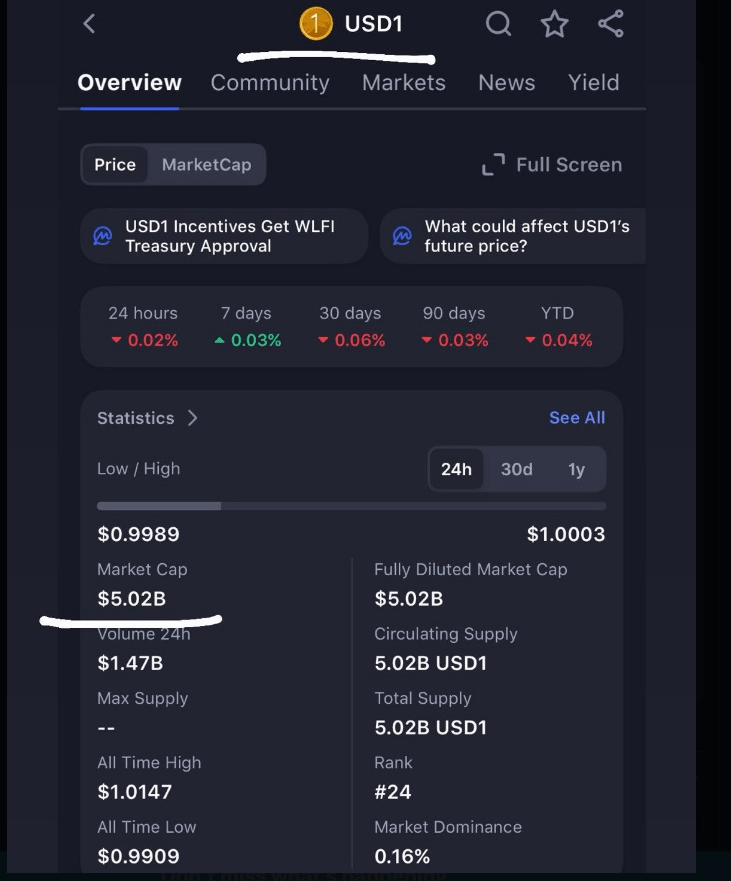
USD1 has pushed past a $5 billion market cap, a rapid climb that has attracted wide attention across crypto markets. Reports say the stablecoin, issued by World Liberty Financial, now ranks among the largest dollar-pegged tokens.

Trading has stayed close to the $1 peg even as overall market interest spiked. Some exchanges have added new pairs and incentives, which helped volume swell over recent weeks.

Market Milestone Reached

Reports note that members of the Trump family celebrated the milestone on social feeds, calling USD1 “Built in America.” US President Donald Trump was quoted praising the token as an example of American engineering and finance coming together.

That message boosted mainstream interest and brought a fresh round of headlines. At the same time, other tokens linked to the same circle have fallen sharply, showing mixed fortunes across related projects.

How The Coin Grew

Liquidity and listings matter. Based on exchange disclosures, USD1 gained listings and earning programs that made the stablecoin easier for traders and institutions to hold massive balances.

This lowered technicalities for movement and helped the coin’s market valuation rise quickly. On-chain activity shows large inflows at times, while prices stayed steady around the dollar peg.

Reports say some big holders moved funds between platforms, which pushed reported market cap numbers higher on public trackers.

Trust And Regulation

There remain some queries over transparency in reserves, along with some queries from banking regulators and observers about a clearer audit and a specific banking arrangement for issuance.

Total crypto market cap currently at $2.78 trillion. Chart: TradingView

According to reports, the issuer has applied for charter and is taking steps to be in compliance with US requirements. While this has reassured some of the investors, others claim they still need proof to gain their trust.

The regulatory angle is shaping future plans for expansion and institutional use.

Comparisons And Contrast

USD1’s rise has not lifted every project tied to the same names. One meme token linked to the group dropped more than 90% from its peak.

Investors are splitting between stable, utility-style holdings and speculative bets that have lost steam. Reports say the stablecoin’s steady peg made it attractive to users fleeing volatility elsewhere.

This split highlights a broader shift: some money prefers a token that holds value closely to the dollar, while other funds chase quick gains.

Featured image from Unsplash, chart from TradingView

Связанные с этим вопросы

QWhat is the current market cap of the USD1 stablecoin and why has it attracted attention?

AThe USD1 stablecoin has reached a market cap of $5 billion, attracting wide attention due to its rapid growth and its position as one of the largest dollar-pegged tokens.

QWhich company issued the USD1 stablecoin and how did the Trump family react to its milestone?

AThe USD1 stablecoin was issued by World Liberty Financial. Members of the Trump family, including Donald Trump Jr., celebrated the $5 billion market cap milestone on social media, hailing it as 'Built in America'.

QWhat are two key factors that contributed to the rapid growth of USD1's market valuation?

ATwo key factors were increased liquidity through new exchange listings and earning programs, which made it easier for traders and institutions to hold large balances, and large on-chain inflows that pushed the reported market cap higher.

QWhat are some of the regulatory concerns or queries surrounding the USD1 stablecoin?

AThere are queries over the transparency of its reserves and calls from banking regulators and observers for a clearer audit and a specific banking arrangement for its issuance. The issuer has applied for a charter and is taking steps to comply with US requirements.

QHow does the performance of USD1 contrast with other tokens linked to the same group, and what does this highlight?

AWhile USD1 has grown steadily, other tokens like a related meme coin dropped over 90% from its peak. This contrast highlights a broader market shift where some investors prefer stable, utility-style holdings, while others chase speculative, volatile bets.

Похожее

Anthropic's IPO Launch: Commercial Miracle or Valuation Bubble?

Anthropic has confidentially filed for an IPO, led by Morgan Stanley and Goldman Sachs, potentially going public by October. Following its latest $650 billion funding round, its pre-IPO valuation stands at $965 billion, with projections reaching up to $2 trillion at listing, which would make it the highest-valued private company ever. The article, written by Fu Sheng, addresses skepticism that this represents an AI bubble akin to the 2000 dot-com crash. It argues the current situation differs fundamentally. Unlike the internet bubble era, which relied on speculative narratives with little revenue, Anthropic's valuation is backed by unprecedented, measurable financial performance. Key data points include: * **Revenue Growth:** ARR skyrocketed from $10 billion in early 2025 to $470 billion by May 2026, targeting $100 billion by year-end—a growth curve unmatched in business history. * **Profitability:** It achieved operating profitability in Q2 2026 with an estimated $5.6 billion profit. * **Efficiency:** With ~3,000 employees and ~$470 billion ARR, its revenue per employee exceeds $10 million. Products like Claude Code, launched less than a year ago, already generate $25 billion in annualized revenue. * **Enterprise Adoption:** It boasts a strong enterprise client base, with 8 of the Fortune 10 and over 1,000 large firms spending over $1 million annually on Claude. The valuation is framed using a traditional SaaS model (e.g., a 10x Price-to-Sales multiple on $100 billion revenue). The author contends the core question for analysts has shifted from "How big could this be?" to "How much is it earning and will earn next quarter?" The discussion extends beyond Anthropic to a broader paradigm shift: the transition from a "carbon-based" to a "silicon-based" economy. Companies are increasingly prioritizing investment in compute and AI capabilities over human resources, as these directly scale productivity and competitive advantage. Anthropic's IPO is thus positioned not just as a corporate milestone, but as a price anchor for this new economic era.

链捕手2 ч. назад

Anthropic's IPO Launch: Commercial Miracle or Valuation Bubble?

链捕手2 ч. назад

Near Returns to the AI Stage: Transformation into a Public Chain Due to 'Payroll Difficulties,' Agent and Privacy Emerge as New Growth Narratives

NEAR Returns to AI Origins: From Payroll Struggles to Blockchain, Now Focusing on AI Agents and Privacy NEAR Protocol's journey began not with grand blockchain ambitions, but from a practical hurdle: its AI startup founders, including Transformer paper co-author Illia Polosukhin, couldn't efficiently pay international developers in 2017. This led them to pivot and build a high-performance, scalable blockchain. After years navigating various crypto narratives like sharding and cross-chain interoperability, NEAR is now leveraging its AI roots to re-enter the AI arena. A key driver is its "NEAR Intents" layer, which abstracts complex cross-chain transactions. Users simply state their goal (e.g., swap BTC for ETH), and a solver network finds the optimal route. This system has processed over $20B in cross-chain volume, generating significant fee revenue. A major growth area is private transactions via "Confidential Intents/Swaps," which hide trade details until settlement to protect against MEV and front-running. Remarkably, private swaps recently accounted for over 40% of NEAR's transaction volume, highlighting strong demand but also potential regulatory scrutiny. With its AI-founder pedigree, NEAR is positioning itself at the intersection of blockchain, AI agents, and privacy, aiming to become infrastructure for the emerging agent economy while navigating the challenges of its rapid adoption.

marsbit5 ч. назад

Near Returns to the AI Stage: Transformation into a Public Chain Due to 'Payroll Difficulties,' Agent and Privacy Emerge as New Growth Narratives

marsbit5 ч. назад

Торговля

Спот
Фьючерсы
活动图片