Underlying Algorithms and Social Robustness: A Christmas Reflection on the Evolution of Principles and Their Game Theory Logic

深潮Опубликовано 2025-12-29Обновлено 2025-12-29

Введение

Bridgewater founder Ray Dalio reflects on the importance of principles as core intangible assets that serve as underlying algorithms for decision-making. He argues that principles shape individual utility functions and define what people are willing to live and die for. Dalio examines the compatibility of modern behavioral norms with religious teachings, emphasizing that while supernatural elements may lack empirical support, the core ethical principles across religions—such as reciprocity, empathy, and social cooperation—are remarkably consistent and serve as public goods that reduce societal transaction costs. He defines “good” as behavior that maximizes total social utility (positive externalities) and “evil” as actions that harm collective well-being. Good character, in economic terms, is an asset that commits to maximizing group welfare. However, Dalio warns that society is on a “downward trajectory,” where consensus on shared principles has eroded. Self-interest maximization has replaced moral frameworks, leading to a loss of social capital and increased systemic risks like inequality, violence, and institutional distrust. He concludes that although technology offers powerful tools for progress, it is a double-edged sword. The key to solving systemic crises lies in rebuilding a shared rulebook grounded in reciprocal altruism and collective optimization—not in technical advancement alone.

Written by:Ray Dalio

Compiled by: Bruce

Merry Christmas to all (even if you are not a Christian)!

Yesterday was Christmas. While enjoying family time with three generations, I couldn't help but have the following reflections. These reflections focus on: the importance of principles as a core asset, the definition of positive and negative externalities (good and evil), and the "descent into hell" caused by the loss of social capital.

I. Principles: The Most Core Intangible Asset

In my view, the most important asset in life is a set of excellent "principles," as they constitute the underlying algorithms for individual decision-making. Principles shape our utility function and its realization path. The most fundamental principles concern our value hierarchy and even determine our game preferences in extreme博弈 (i.e., the convictions we are willing to live and die for).

Based on this, I conducted the following audit and reflection:

  • What is the compatibility of our current code of conduct with the teachings of Christianity and other religions?

  • Do we have consensual contractual principles, or will we fall into a "zero-sum game" due to conflicting principles?

  • Which universal principles can be shared as public goods by all humanity?

  • What is the source of these principles?

  • How have these principles evolved along their path as civilization has progressed?

From the perspective of historical evolution, since the formation of human society, regional civilizations have developed principles and religions in relatively isolated living environments. Although the environments varied geographically, the core demand of all societies was highly consistent: the need for a set of informal institutions to constrain individual behavior, reduce transaction costs, and achieve social coordination. These guidelines were encoded into "scriptures." In other words, the origin of religion was to provide incentive mechanisms for social governance, guiding individual behavior towards collective optimization.

The vast majority of religions—whether those with transcendental beliefs or those like Confucianism focused on worldly ethics—are hybrid contracts consisting of the following two parts:

  1. Social Governance Guide: Interaction guidelines aimed at enhancing total social welfare;

  2. Supernatural Assumptions: A belief system that transcends logical empiricism.

These supernatural assumptions (such as virgin birth, resurrection from the dead), if interpreted literally, often lack empirical support. But if viewed as metaphors, they reflect their cross-cultural isomorphism. In contrast, the non-supernatural principles concerning "social collaboration" in major religions are strikingly similar. If we focus only on the冗繁 forms and ignore these core incentive guidelines, religious holidays will become consumption symbols devoid of meaning.

Although I am not a believer due to a lack of faith in supernatural forces (I am not inclined to accept unverified a priori assumptions), I highly appreciate the evolutionary wisdom contained within religions. For example, "love your neighbor as yourself" and "karma" essentially embody reciprocal altruism in game theory.

From the perspective of mechanism design, when an individual adopts a strategy of "giving more than taking" in interactions, it generates极高的 value-added: the cost to the helper is often far lower than the marginal benefit to the recipient. The叠加 of such positive externalities creates a non-zero-sum "win-win relationship," greatly enhancing total social output and welfare.

For me, "spirituality" means an individual's awareness that they are a subset of the overall system and their tendency to pursue system optimization rather than local optimization (i.e., extreme self-interest at the expense of the whole). This is not only a moral requirement but also an efficient operational logic. Unfortunately, this consensus on good and evil is suffering severe credit impairment in today's society.

Of course, I am not advocating absolute peace. When it comes to irreconcilable conflicts at the survival level, struggle is a necessary external constraint. But the principle I suggest is: do not engage in futile consumption (deadweight loss) over supernatural assumptions or marginal trivialities, and never blur the underlying definition of positive and negative externalities (good and evil).

II. The Definition of Good and Evil and the Moral Attribute of Human Capital

What exactly are good and evil?

In the modern context, people often mistakenly simplify "good and evil" into "gains or losses to personal interests." From an economic perspective, "good" is behavior that maximizes total social utility (positive externality), while "evil" is behavior that damages the overall interests of the system (negative externality).

Character evaluation is an extension of this logic. Good character is a psychological propensity asset that can承诺 and achieve the maximization of collective interests; bad character results from weaknesses or deviant behaviors that cause damage to social welfare.

I firmly believe that there is a behavioral pattern that can achieve Pareto improvement for both individuals and society. Although religious discourses differ, the推崇 of qualities such as "courage," "integrity," and "temperance" is a global consensus because they are necessary protocols for maintaining the operation of a complex society.

III. The Current Social Situation on a "Downward Track"

I personally believe that we are in a metaphorical "hell process." This means that most members of society have lost the anchor of consensus on good and evil, and this loss of consensus will cause society to pay an极其昂贵的代价 (hellacious price).

More specifically, the consensus of our social contract is disintegrating. The prevailing principle has been simplified to mere self-interest maximization: the absolute plunder of money and power. This value drift is vividly reflected in cultural products: we lack morally inspiring role models.

When bad behavior is packaged as a shortcut to success, and when young children grow up in an environment lacking correct "incentive templates," the consequences are disastrous. Drug abuse, violence, suicide, and the widening opportunities gap are both symptoms and causes of the collapse of social principles.

Ironically, throughout history, many believers have abandoned the collaborative principles in their doctrines due to争夺 over supernatural interpretation or personal gain. Because of this言行背离 (moral hazard), people, while抛弃 religious superstitions, have also mistakenly liquidated the beneficial social guidelines within them, leading to an institutional vacuum.

Summary

Although technological progress and productivity have achieved exponential growth, I believe that technology is only a lever that can amplify both welfare and destruction. History shows that innovations in technological means have not eliminated conflicts.

The good news is: because our existing technological toolbox is extremely powerful, as long as we can reconstruct a healthy set of principles (rulebook) about "reciprocal win-win," we have the ability to solve all systemic crises.

Связанные с этим вопросы

QWhat does Ray Dalio consider the most important asset in life and why?

ARay Dalio considers a set of excellent 'principles' to be the most important asset in life because they form the underlying algorithms for individual decision-making, shaping our utility function, its implementation path, and even our fundamental values and博弈 preferences in extreme situations.

QHow does the article define 'good' and 'evil' from an economic perspective?

AFrom an economic perspective, the article defines 'good' as behavior that maximizes total social utility (positive externality) and 'evil' as behavior that damages the overall interests of the system (negative externality).

QAccording to the author, what is the current dominant principle leading society into a 'downward track' or 'hellacious process'?

AThe current dominant principle is simplified to pure self-interest maximization, characterized by the absolute pursuit of money and power, which has led to a loss of consensus on good and evil and the disintegration of the social contract.

QWhat two main components do most religions consist of, as described in the article?

AMost religions consist of a mix of two parts: 1) a guide to social governance, which aims to improve total social welfare through interaction guidelines, and 2) supernatural assumptions or superstitions, which are belief systems that transcend logical empiricism.

QWhat is the 'good news' or positive potential the author sees despite the current societal challenges?

AThe 'good news' is that our powerful technological toolbox provides the capability to solve all systemic crises, provided we can reconstruct a healthy set of principles or 'rulebook' centered on 'reciprocal win-win' outcomes.

Похожее

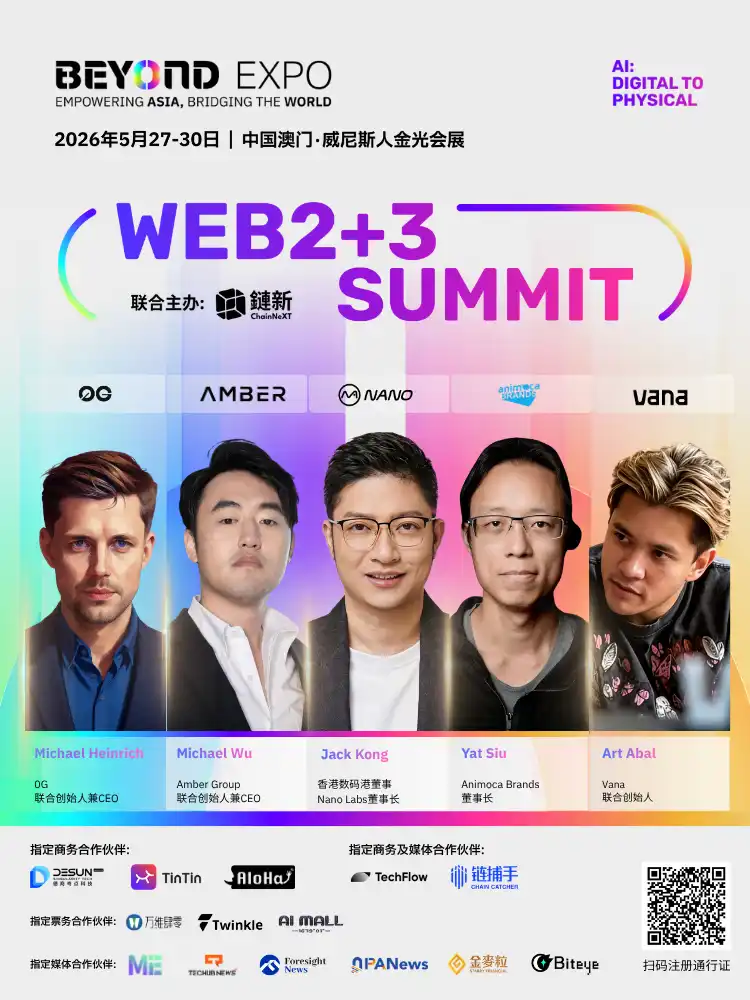
First Batch of Keynote Speakers and Partners Announced! Web2+3 Summit: Defining the Next Generation of Digital Economy

Web2+3 Summit: Defining the Next Generation of Digital Economy The 6th BEYOND International Technology Innovation Expo (BEYOND Expo 2026), Asia's largest tech and ecosystem exhibition, is launching a dedicated Web2+3 stage for the first time. Co-hosted by BEYOND Expo and ChainNeXT Group, the Web3 Summit will take place from May 28–30, 2026. Against the backdrop of accelerating global tech integration, the boundaries between Web2 and Web3 are rapidly blurring. With clearer global regulations for blockchain-driven internet (Web3) and the special issuance of a Hong Kong dollar stable币 license by the Hong Kong SAR government on April 10, 2026, Web3's decentralized principles are quickly merging with traditional industries (Web2) such as e-commerce, finance, and artificial intelligence. Focused on blockchain-driven digital economy elements, the summit will center on three core principles—implementability, commercial viability, and compliance. It will bring together top Web3 experts to discuss key integration areas like stablecoin payment finance (PayFi), real-world asset tokenization (RWA), and decentralized AI (DeAI), unveiling new opportunities for industrial innovation. The first wave of confirmed speakers includes Jack Kong (Director of Hong Kong Cyberport, Chairman of Nano Labs), Yat Siu (Chairman of Animoca Brands), Michael Wu (Co-founder & CEO of Amber Group), Michael Heinrich (Co-founder & CEO of 0G), and Art Abal (Co-founder of Vana). More Web3 ecosystem pioneers, AI, and fintech experts will be announced soon. Core forum topics include: - Web2+DeAI: New AI Paradigms Driven by Decentralized Infrastructure - Web2+RWA: Real-World Asset Tokenization and Global Liquidity - Web2+PayFi: Cross-Border Payments and Financial Innovation Powered by Crypto Infrastructure - Web2+3 AI: Autonomous Agents and the Crypto Economy - Web2+3 Wealth: On-Chain and Off-Chain Integrated Investment Ecosystems - Web2+3 Commerce: A New Landscape for Global Trade Driven by Stablecoins Additional agenda details will be released in the near future.

marsbit3 ч. назад

First Batch of Keynote Speakers and Partners Announced! Web2+3 Summit: Defining the Next Generation of Digital Economy

marsbit3 ч. назад

Торговля

Спот
Фьючерсы

Популярные статьи

Как купить EDGE

Добро пожаловать на HTX.com! Мы сделали приобретение edgeX (EDGE) простым и удобным. Следуйте нашему пошаговому руководству и отправляйтесь в свое крипто-путешествие.Шаг 1: Создайте аккаунт на HTXИспользуйте свой адрес электронной почты или номер телефона, чтобы зарегистрироваться и бесплатно создать аккаунт на HTX. Пройдите удобную регистрацию и откройте для себя весь функционал.Создать аккаунтШаг 2: Перейдите в Купить криптовалюту и выберите свой способ оплатыКредитная/Дебетовая Карта: Используйте свою карту Visa или Mastercard для мгновенной покупки edgeX (EDGE).Баланс: Используйте средства с баланса вашего аккаунта HTX для простой торговли.Третьи Лица: Мы добавили популярные способы оплаты, такие как Google Pay и Apple Pay, для повышения удобства.P2P: Торгуйте напрямую с другими пользователями на HTX.Внебиржевая Торговля (OTC): Мы предлагаем индивидуальные услуги и конкурентоспособные обменные курсы для трейдеров.Шаг 3: Хранение edgeX (EDGE)После приобретения вами edgeX (EDGE) храните их в своем аккаунте на HTX. В качестве альтернативы вы можете отправить их куда-либо с помощью перевода в блокчейне или использовать для торговли с другими криптовалютами.Шаг 4: Торговля edgeX (EDGE)С легкостью торгуйте edgeX (EDGE) на спотовом рынке HTX. Просто зайдите в свой аккаунт, выберите торговую пару, совершайте сделки и следите за ними в режиме реального времени. Мы предлагаем удобный интерфейс как для начинающих, так и для опытных трейдеров.

281 просмотров всегоОпубликовано 2026.03.31Обновлено 2026.03.31

Как купить EDGE

Что такое фьючерсы на акции США?

Фьючерсы на акции США представляют собой токенизированные бессрочные фьючерсы на американские акции, торгуемые на криптовалютных биржах (например, HTX).

1.1k просмотров всегоОпубликовано 2026.04.08Обновлено 2026.04.08

Что такое фьючерсы на акции США?

Обсуждения

Добро пожаловать в Сообщество HTX. Здесь вы сможете быть в курсе последних новостей о развитии платформы и получить доступ к профессиональной аналитической информации о рынке. Мнения пользователей о цене на A (A) представлены ниже.

活动图片