Trust Wallet Hacked: What Crypto Users Should Do Now

bitcoinistОпубликовано 2025-12-26Обновлено 2025-12-26

Введение

Trust Wallet has confirmed a security incident specifically affecting its Chrome browser extension version 2.68, advising users to immediately disable and upgrade to version 2.69. Mobile-only users and those on other extension versions are not impacted. The breach was first flagged by on-chain investigator ZachXBT, who reported multiple users had funds drained. Cybersecurity firm PeckShield estimates losses exceeded $6 million, with a portion sent to centralized exchanges. Trust Wallet is directing affected users to contact support, and Binance founder Changpeng Zhao has stated that Trust Wallet will cover the estimated $7 million in losses. Users are urged to update their extensions and avoid using version 2.68 until upgraded.

Trust Wallet says a “security incident” hit only one slice of its product stack: the Chrome browser extension on version 2.68. If you are a mobile-only user, the company says you’re not affected. If you are on any other extension version, the company says you’re not affected either. The problem, per Trust Wallet’s own wording, is tightly scoped, even if the fallout doesn’t feel that way when you’re staring at an emptied address.

The first public flare went up on Dec. 25 via on-chain investigator ZachXBT, who posted a Telegram warning that “a number of Trust Wallet users have reported that funds were drained from wallet addresses within the past couple of hours.”

He stressed that “the exact root cause has not been determined,” then pointed out an uncomfortable coincidence: “the Trust Wallet Chrome extension pushed a new update yesterday.” In the same message, he asked victims to DM him on X so he could “update the list of theft addresses below as I verify more,” and he began publishing alleged theft destinations across multiple chains. His list included multiple EVM addresses and a Solana address.

Trust Wallet Confirms The Hack

The wallet firm later confirmed the incident on X. “We’ve identified a security incident affecting Trust Wallet Browser Extension version 2.68 only. Users with Browser Extension 2.68 should disable and upgrade to 2.69,” the company wrote, linking users to the official Chrome Web Store listing.

It added: “Please note: Mobile-only users and all other browser extension versions are not impacted.” The post closed with the kind of line every security team ends up typing sooner or later: “We understand how concerning this is and our team is actively working on the issue. We’ll keep sharing updates as soon as possible.”

Then the guidance got more urgent, and more specific. Trust Wallet warned users who hadn’t updated to 2.69: “please do not open the Browser Extension until you have updated. This may help to ensure the security of your wallet and prevent further issues.”

In a follow-up, it spelled out a step-by-step that boils down to: don’t open the extension, go to Chrome’s extensions page for Trust Wallet, toggle it off if it’s still on, enable Developer mode, hit “Update,” and confirm you’re on version 2.69 before doing anything else. It’s not glamorous, but it’s actionable, which is what matters when you’re in incident mode.

As the claims and counterclaims swirled, cybersecurity firm PeckShield put an early dollar figure on the damage. “The Trust Wallet exploit has drained >$6M worth of cryptos from victims,” PeckShield wrote, adding that while about “~$2.8M of the stolen funds remain in the hacker’s wallets (Bitcoin/EVM/Solana), the bulk – >$4M in cryptos – has been sent to CEXs,” with a breakdown of “~$3.3M to ChangeNOW, ~$340K to Fixed Float, & ~$447K to Kucoin.”

One more pressure point surfaced quickly: compensation. ZachXBT said, “I currently have many concerned victims contacting me via DM so can your team please clarify if you will be offering any compensation for Trust Wallet Browser Extension users.” Trust Wallet did not answer that directly in public. Instead, it replied that its customer support team was already in touch with impacted users regarding next steps and directed people to reach out via its support channel.

So what should users do now, in plain terms? If you are on extension version 2.68, Trust Wallet’s instruction is to stop using it as-is: disable it and upgrade to 2.69 before you open it again. If you think you were affected, the company is routing users to support, while independent investigator ZachXBT is asking for reports to help map theft flows.

UPDATE: Binance founder Changpeng Zhao confirmed via X that user will be compensated for the hack. “So far, $7m affected by this hack. Trust Wallet will cover. User funds are SAFU. Appreciate your understanding for any inconveniences caused. The team is still investigating how hackers were able to submit a new version,” Zhao wrote today.

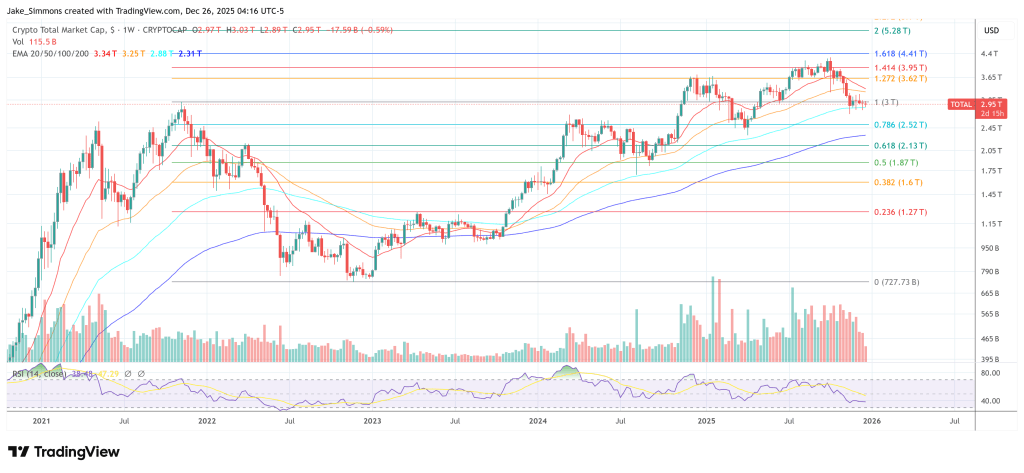
At press time, the total crypto market cap stood at $2.95 trillion.

Total crypto market cap sits below the 2021 high, 1-week chart | Source: TOTAL on TradingView.com

Связанные с этим вопросы

QWhich specific version of the Trust Wallet extension was affected by the security incident?

AThe security incident affected Trust Wallet Browser Extension version 2.68 only.

QWhat is the primary action users of the affected extension version should take immediately?

AUsers on version 2.68 should disable the extension and upgrade to version 2.69 before opening it again.

QAccording to cybersecurity firm PeckShield, what was the estimated value of crypto drained in the exploit?

APeckShield reported that the exploit drained over $6 million worth of cryptocurrencies from victims.

QWho first publicly reported the potential issue with Trust Wallet on December 25th?

AOn-chain investigator ZachXBT first reported the issue via a Telegram warning.

QDid Trust Wallet or its parent company commit to compensating affected victims?

AYes, Binance founder Changpeng Zhao confirmed via X that Trust Wallet would cover the losses, stating that user funds are SAFU.

Похожее

Will the Next Crypto Bull Run Start with On-Chain Trading of SpaceX?

This article presents a scenario-based forecast for the crypto industry from 2026 to 2029, arguing that the next major cycle will be driven not by technological narratives but by legal access to real-world assets. The author predicts that by mid-2026, pre-IPO perpetual contracts for top private companies like SpaceX, OpenAI, and Anthropic on platforms like Hyperliquid will become the primary gateway for accessing quality assets, as most crypto-native tokens fail to capture real value. The much-hyped AI x Crypto intersection largely fails except for prediction markets, which thrive on betting on AI model supremacy. By 2027, public blockchain foundations are forced to choose between catering to retail speculation or building compliant infrastructure for institutions, with many opting for the latter. Growth in stablecoins and tokenized private credit/equity hits a "triple ceiling" due to regulatory and political uncertainty rather than market demand. The pivotal shift is forecast for 2028. A major liquidation event in pre-IPO perpetuals exposes the structural flaw of synthetic markets lacking a real underlying asset anchor. In response, regulatory changes finally allow the public solicitation of private securities resales to verified accredited investors. This creates a legitimate secondary market for real company equity, which then becomes the core asset class of the new bull market, relegating synthetic perps to a niche role. By 2029, the industry becomes "boring" but foundational. Tokens without claims on real cash flows or assets cease trading. Stablecoin growth is steady but politically capped. Crypto infrastructure fades from view as it gets absorbed into traditional finance backends. The article's central thesis is that the key bottleneck for crypto's next phase is legal and regulatory channels for real asset ownership, not technology.

marsbit1 ч. назад

Will the Next Crypto Bull Run Start with On-Chain Trading of SpaceX?

marsbit1 ч. назад

The Value Distribution of Stablecoins

**Summary: The Value Distribution of Stablecoins** The article argues that stablecoins are evolving from mere trading tools into broader channels for dollar access. It divides the stablecoin ecosystem into four layers to analyze how value is distributed: 1. **Issuance Layer:** Mints stablecoins, holds reserve assets, and captures the spread between reserve yield and user costs (e.g., Tether, Circle). This layer currently earns the largest profit margin. 2. **Infrastructure Layer:** Connects stablecoins to the traditional financial system, handling fiat on/off-ramps, banking integration, compliance (KYC/AML), and asset management (e.g., Bridge, BVNK). This is the "unglamorous" but critical work, building the essential bridges between crypto and real-world finance. 3. **Acquiring/Distribution Layer:** Integrates stablecoins into merchant systems, manages payment flows, and provides enterprise financial software (e.g., Stripe, Coinbase). They act as the access point for businesses. 4. **Application Layer:** The end-users and businesses that ultimately use stablecoins for payments, settlements, or as a store of value. They benefit from convenience but have little pricing power. The core thesis is that while the issuance layer currently dominates profits, the often-overlooked **infrastructure layer holds significant long-term potential**. The real challenge and barrier to mass adoption is not the on-chain transfer of stablecoins (which is simple), but the complex "last mile" integration into existing business workflows, banking systems, and regulatory frameworks across different countries. Companies in this layer are currently in a "land grab" phase, investing heavily to build networks, secure bank partnerships, and establish compliance pathways. While their position is currently pressured by the profitable issuers above and distribution platforms below, the article suggests that if stablecoins become a default financial rail for businesses, the infrastructure providers who have done the hard work of integration will ultimately gain strong pricing power and become entrenched, essential players.

marsbit7 ч. назад

The Value Distribution of Stablecoins

marsbit7 ч. назад

The Value Distribution of Stablecoins

The Value Distribution of Stablecoins The article argues that stablecoins are evolving from a mere trading tool into a broad "dollar channel." It analyzes the industry's value chain through four layers: 1. **Issuance Layer (e.g., Tether, Circle):** The top layer that mints stablecoins, holds reserve assets, and captures the thickest interest rate spread. 2. **Infrastructure Layer (e.g., Bridge, BVNK):** Connects stablecoins to the traditional financial system, handling critical but complex "dirty work" like fiat on/off-ramps, banking integration, compliance (KYC/AML), and cross-border settlement. 3. **Acquiring/Distribution Layer (e.g., Stripe, Coinbase):** Embeds stablecoins into merchant systems, manages payment flows, and integrates with enterprise software. 4. **Application Layer:** End-users and businesses that ultimately use stablecoins for payments, settlement, or storing value. The author posits that while the issuance layer currently captures the most profit, the most overlooked and potentially critical layer is infrastructure. The core challenge for stablecoin adoption isn't the on-chain transfer (which is simple), but bridging the gap between blockchain and the real-world financial system. This involves solving practical problems for businesses: fiat conversion, reconciliation, tax handling, and user onboarding. Infrastructure companies are currently in a difficult "land-grab" phase—building networks, securing banking relationships, and achieving compliance country-by-country. They face pressure from both the profitable issuance layer above and distribution platforms below. However, the author suggests this layer is building a crucial moat. Once stablecoins become a default business rail, the infrastructure players who have done the hard work of integration may gain significant, durable value and pricing power.

链捕手7 ч. назад

The Value Distribution of Stablecoins

链捕手7 ч. назад

Торговля

Спот
Фьючерсы
活动图片