Trump to begin interviews with Fed chair finalists this week: FT

cointelegraphОпубликовано 2025-12-10Обновлено 2025-12-10

Введение

President Trump is set to interview finalists for the next Federal Reserve chair this week, with a decision expected in January. Treasury Secretary Scott Bessent has presented a shortlist of four candidates, including former Fed governor Kevin Warsh and National Economic Council director Kevin Hassett, who is considered the frontrunner. Other potential candidates include Fed governors Christopher Waller and Michelle Bowman, and BlackRock’s Rick Rieder. Trump has hinted he already has a preferred candidate in mind. Prediction markets currently give Hassett around a 73% chance of being selected. The appointment is expected to influence crypto markets, and Hassett has stated he would maintain an apolitical approach if chosen.

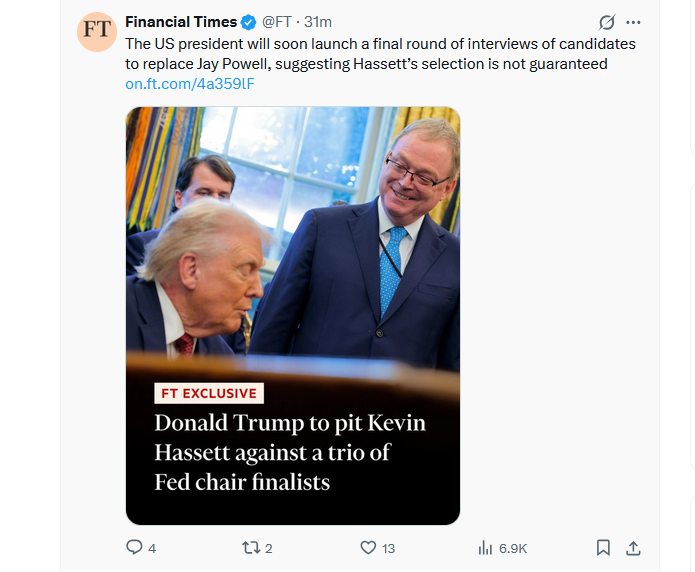
The race for the new US Federal Reserve chair is nearing the finish line, with US President Donald Trump reportedly set to begin interviewing finalists for the top job this week.

According to a report from the Financial Times (FT) on Tuesday, Treasury Secretary Scott Bessent has presented a list of four names to the White House.

One of these is former Fed governor Kevin Warsh, whom Bessent is scheduled to meet with on Wednesday. Another is National Economic Council director Kevin Hassett, who is seen as the frontrunner for the role.

Another two names would be picked from a list of other finalists, which includes Fed governors Christopher Waller and Michelle Bowman, and BlackRock chief investment officer Rick Rieder.

Source: Financial Times

Trump and Bessent are expected to hold at least one interview next week, as a decision looks likely to be announced in January.

However, Trump has revealed he already has his eye on one particular candidate.

“We’re going to be looking at a couple different people, but I have a pretty good idea of who I want,” Trump said to journalists on Air Force One on Tuesday.

Kevin Hassett is a frontrunner for Fed chair role

The upcoming round of interviews suggests that Hassett may not be the clear lock in for the role as previously thought, though he is seen as the favorite.

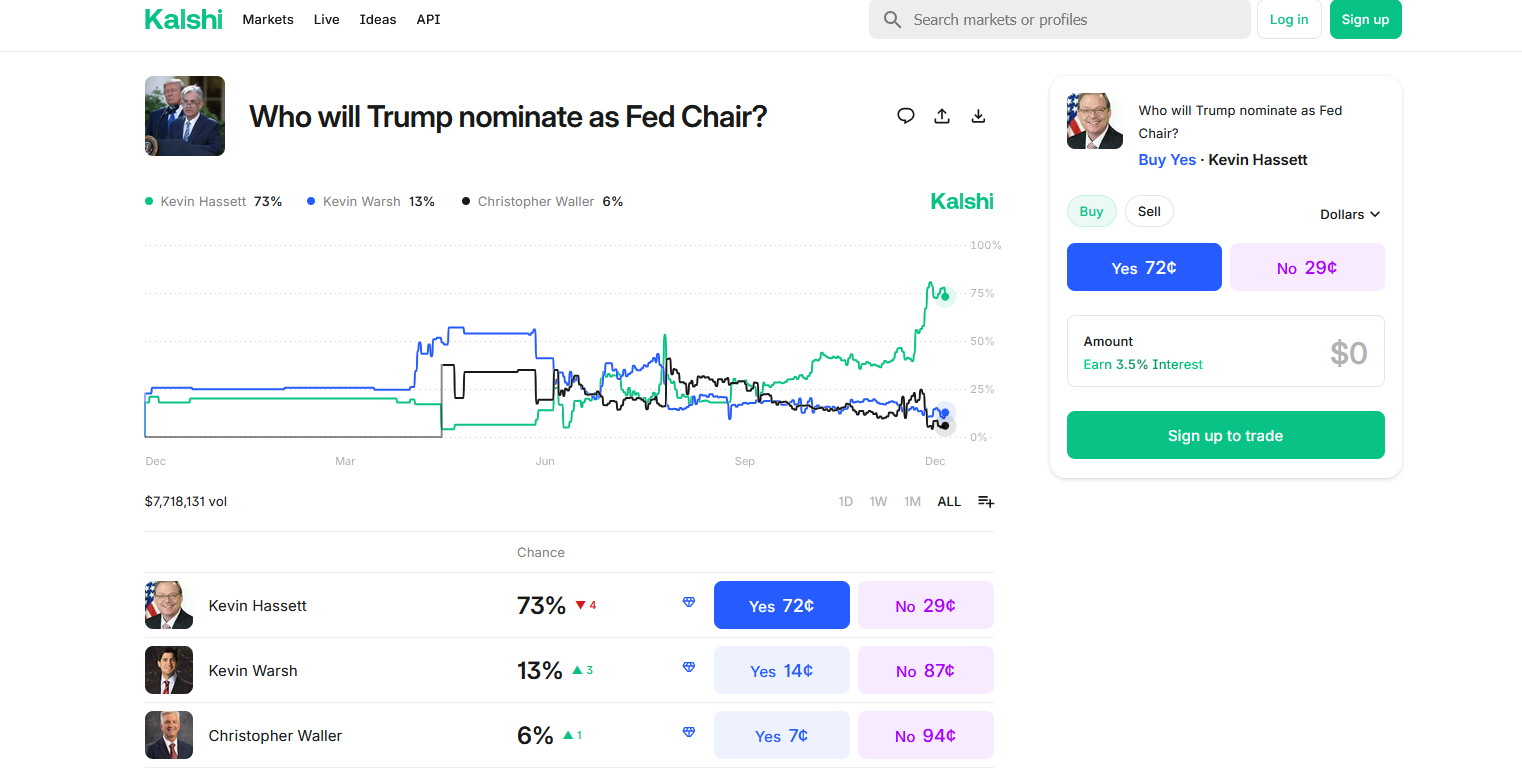
Earlier this month, prediction market odds on Kalshi and Polymarket shot up for Hassett significantly following comments from Trump at the White House on Dec. 2.

While welcoming guests, Trump labeled Hassett as “potential Fed chair” leading many to assume the president had let a major hint slip.

Related: Trump’s national security strategy is silent on crypto, blockchain

With Hassett’s odds spiking to 85% after Trump’s comments last week, they have since declined to around 73% for Hassett, while Warsh’s odds sit at 13% on Kalshi at the time of writing, which has floated around this range over December.

Odds for next Fed chair. Source: Kalshi

Regardless of who ends up taking over as chair, the move is bound to impact crypto markets under the new leadership.

If elected, Hassett has asserted that he will be apolitical in terms of running the Fed, despite his close ties to Trump. Speaking with The Wall Street Journal this week, Hassett said that “You just do the right thing” when asked if he would blindly follow orders from Trump.

“Suppose that inflation has gotten from, say, 2.5% to 4%. You can’t cut,” Hassett said, adding that he would rely on his own “judgment, which I think the president trusts.”

Magazine: The one thing these 6 global crypto hubs all have in common...

Похожее

When AI Begins to Audit the World: From Claude Discovering the ZEC Vulnerability, Watching the Encryption Industry Enter the 'Recursive Security Era'

**When AI Audits the World: From Claude's Discovery of a ZEC Vulnerability, Viewing the Crypto Industry Entering a "Recursive Security Era"** This article examines a pivotal shift in the blockchain security landscape, triggered by the convergence of two events: Anthropic's research on AI's "Recursive Self-Improvement" and Claude Opus 4.8's discovery of a critical vulnerability in Zcash's code. Traditionally, crypto security has relied on human experts and automated tools for periodic audits. However, the article argues AI is transitioning from a mere tool to an active participant in understanding and analyzing complex systems. Claude's ability to identify a subtle flaw in Zcash's zero-knowledge proof system demonstrates AI's potential to dramatically lower the cost and time required for risk discovery. This goes beyond finding a single bug; it signals a change in the very mechanism of how vulnerabilities are found. The core thesis introduces the concept of "Recursive Security," drawing a parallel to Anthropic's "Recursive Self-Improvement." Just as AI can accelerate its own development through feedback loops, security systems are evolving towards a continuous cycle of analysis, risk identification, remediation, and re-analysis. Security is becoming a persistent, evolving capability integrated into a system's lifecycle, rather than a one-time pre-launch audit. This shift is particularly urgent for the crypto industry, where system complexity from Layer-2 networks, modular architectures, and ZK-proofs is growing faster than human analysis capacity. AI excels at the pattern recognition and contextual understanding needed to navigate this complexity. Importantly, the article cautions that AI augments both defenders and potential attackers, accelerating the entire threat landscape. The future competitive advantage may not lie in having zero vulnerabilities, but in having the fastest risk discovery, validation, and response capabilities. The Claude-Zcash incident is thus an early signal of an era where AI-driven, recursive security systems become essential for managing risk in an increasingly complex digital world.

marsbit1 ч. назад

When AI Begins to Audit the World: From Claude Discovering the ZEC Vulnerability, Watching the Encryption Industry Enter the 'Recursive Security Era'

marsbit1 ч. назад

From MSTR to STRC+: Where Is the Limit of the Strategy Universe?

From MSTR to STRC+: The Evolution and Limits of the Strategy Universe This article examines the transformation of Strategy (formerly MicroStrategy) from a simple "Bitcoin treasury" company into a complex financial engineering firm building a BTC-backed credit system. **Core Thesis:** Strategy's true significance lies not just in its massive BTC holdings (~844k BTC), but in its attempt to transform this static reserve into a multi-layered credit curve within traditional capital markets and, subsequently, into on-chain yield infrastructure. **The MSTR Flywheel:** The initial model was a reflexive loop: BTC price rises → MSTR stock rises → company raises capital (debt/equity) at a premium → buys more BTC → increases per-share BTC exposure → MSTR premium grows. This "amplified Bitcoin" equity (MSTR) thrives on bullish momentum but is vulnerable to tightening premiums and rising funding costs. **Building the Credit Curve:** Strategy's innovation is slicing its single BTC balance sheet into different risk/return profiles via specialized securities: * **MSTR:** High-volatility equity layer absorbing full BTC upside/downside. * **STRC:** Key product. A perpetual preferred stock designed as "short duration high yield credit," offering ~11.5% floating monthly dividends. It attracts fixed-income investors seeking yield without direct BTC exposure, funding Strategy's operations. * **STRD/STRK/STRF:** Other preferred/share classes with varying durations, conversion rights, and fixed dividends. **Risks of the STRC Model:** STRC's high yield is not risk-free. Its stability depends on: 1) Sufficient BTC asset coverage, 2) Strategy's continued ability to pay dividends, and 3) Market faith in the MSTR/STRC funding flywheel. Stress points include deep BTC price declines eroding the asset buffer, rising dividend costs if STRC trades below par, and a broken flywheel if MSTR's premium (mNAV) falls persistently. **On-Chain Expansion: STRC+:** Projects like **Saturn** and **Apyx** aim to package STRC's (and other DAT preferred stock) cash flows into on-chain stablecoin yield (e.g., sUSDat, apyUSD). They offer DeFi a new yield source distinct from trading fees or incentives—cash dividends from traditional securities. However, this introduces compounded risks: off-chain custody, issuer credit risk, BTC volatility, and protocol execution risk. **Conclusion: The Ultimate Boundary** Strategy's endgame is not infinite BTC accumulation. It is the market's long-term acceptance of a new credit system where BTC serves as collateral for tradable securities whose cash flows can power on-chain financial applications. Its "universe" expands if this BTC-native credit curve gains legitimacy, but contracts if these instruments are repriced purely as high-risk, yield-bearing credit assets without stablecoin mythology.

marsbit1 ч. назад

From MSTR to STRC+: Where Is the Limit of the Strategy Universe?

marsbit1 ч. назад

Торговля

Спот
Фьючерсы
活动图片