Tonight's Non-Farm Payrolls Report Is Unconventional! October Data 'Missing', But November Unemployment Rate Set to Soar?

marsbitОпубликовано 2025-12-16Обновлено 2025-12-16

Введение

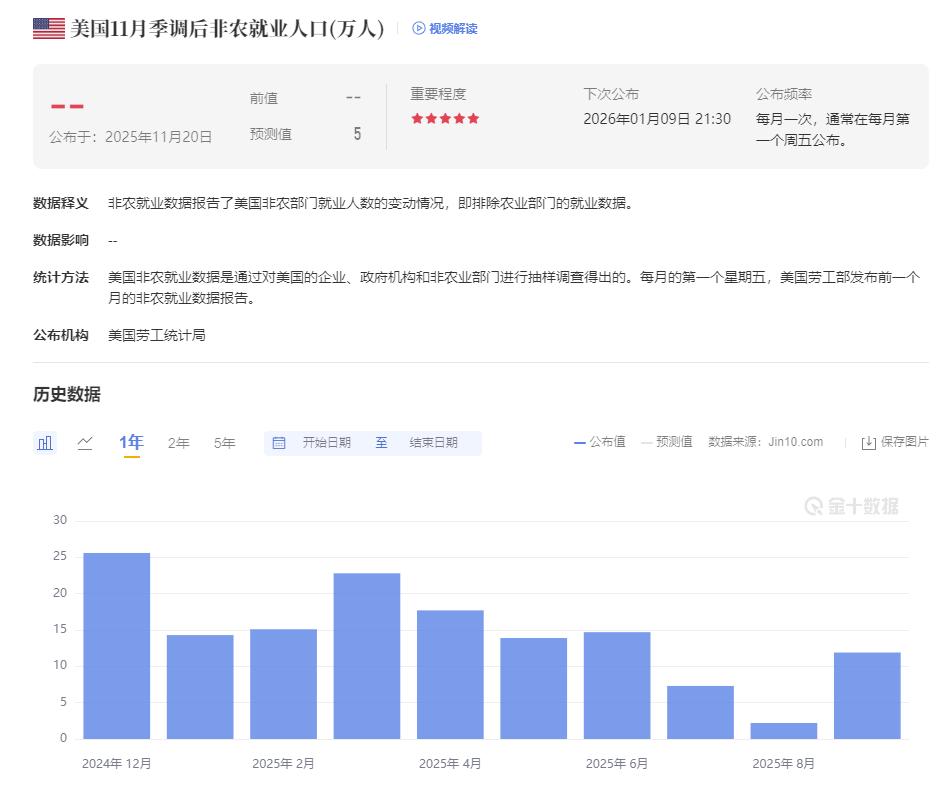
The US November nonfarm payrolls report, unusually delayed to a Tuesday in mid-December due to the government shutdown, is the market's key focus. This release will include both November data and October's job growth figures, though October's unemployment rate is missing due to the shutdown's disruption. Economists expect a modest 50,000 job gain in November, with the rate holding at 4.4% or potentially rising. The report is expected to be volatile and complex due to the shutdown's impact, including federal worker furloughs and extended data collection windows. Beyond the headline numbers, details on sectoral job growth, wage trends, and labor force participation will be crucial for assessing the economy's health. The data will significantly influence the Federal Reserve's future interest rate decisions. Bitcoin may see volatility in reaction, with strong data potentially pressuring prices via a stronger dollar, while weak data could boost expectations for rate cuts.

This week, the US economic calendar welcomes a dense release period, with the November Non-Farm Payrolls (NFP) report, originally scheduled for 9:30 PM Beijing Time on Tuesday, undoubtedly becoming the focal point of market attention.

The release of this data has been unusually postponed to a Tuesday in mid-December due to the impact of the government shutdown, breaking the conventional practice of being released on the first Friday of each month.

Over the past month, the backlog of economic data due to the government shutdown is gradually being released, creating a situation this week where multiple important data sets will be unveiled consecutively: over the next three days, heavyweight reports on retail sales, inflation, and the labor market will be released, providing the market with crucial evidence to assess the state of the US economy.

Technical Background of the Unconventional Data Release

The uniqueness of this NFP report lies in the fact that it will essentially contain "two" sets of data—besides the new employment numbers and unemployment rate for November, the Bureau of Labor Statistics (BLS) will also release the October non-farm payroll data concurrently.

As the statistical agency cannot retrospectively collect unemployment rate information for October, the October unemployment rate data will definitely be absent from this report. This "buy one, get half" release format stems from the previous federal government shutdown that lasted 43 days. This historically long shutdown prevented the BLS from conducting the collection and processing of October data according to the常规流程 (conventional process).

The market普遍预期 (widely expects) that November non-farm payrolls will increase by 50,000, with the unemployment rate预计 (expected) to remain at 4.4%.

However, the importance of this report lies not only in revealing the true state of the US labor market but also in providing key guidance for the Federal Reserve's interest rate policy path next year.


Data Expectations and Potential Volatility

In recent months, US employment data has shown significant volatility, swinging between declines and robust growth.

Economists expect Tuesday's report may continue this trend and appear particularly chaotic due to the后续影响 (knock-on effects) of the government shutdown.

Following stronger-than-expected job growth in September, some analysts predicted October employment could turn negative. This expectation primarily stems from approximately 144,000 federal workers accepting "delayed resignation plans" and leaving government positions after September 30th. Goldman Sachs economists estimate this factor will lead to a decrease of 70,000 in October employment and another 10,000 decrease in November. Despite the uncertainty, most economists still expect positive job growth, but the forecast range is unusually wide, spanning from a decrease of 20,000 to an increase of 127,000.

Nancy Vanden Houten, Chief US Economist at Oxford Economics, pointed out that healthcare and private education services sectors are likely to be the main drivers of job growth for the month.

Daniel Zhao, Chief Economist at Glassdoor, stated: "Government shutdowns don't happen often, so there's always some uncertainty when dealing with a large-scale statistical operation like the BLS. Caution should be exercised when interpreting this report, and one should be prepared for various possible outcomes." He believes the pace of job growth is most likely to remain steady, but同时强调 (simultaneously emphasized) that "there's a big variable on top of this."


Impact of Statistical Technical Factors on the Data

The BLS is known for its transparency and usually adds explanatory notes to its reports to account for major contextual or technical issues. Shruti Mishra, an economist at Bank of America, noted in a recent report that despite over 700,000 federal workers being furloughed during the shutdown, a scenario of sharply negative October data followed by a surge in November employment is not expected.

Mishra explained: "The establishment survey counts workers who were paid or expected to be paid for any part of the reference week.

Historical experience shows that the 2013 and 2019 government shutdowns had minimal impact on employment numbers." Daniel Zhao further pointed out that due to the extended timeframe for data submission and collection, the October and November employment data might actually be more complete, with less room for subsequent revisions. Although the October unemployment rate data is confirmed missing, economists expect the November unemployment rate to either remain at 4.4% or face upward pressure. In the three months leading up to September, the unemployment rate had climbed consecutively each month due to a subdued hiring environment and rising labor force participation. Meanwhile, recent layoff announcements have increased significantly, with the October layoff indicator reaching its highest level since early 2023. Some forecasters believe that the decline in federal government employment could push the November unemployment rate higher, potentially to 4.5% or even 4.6%.

Bloomberg Economics also noted that the absence of October unemployment data and the later-than-usual collection cycle for November data could trigger the "technical issues" mentioned by Fed Chair Jerome Powell, such as distortions in seasonal adjustments.


Report Details and Related Data Indicators

Beyond the two core indicators of overall employment numbers and the unemployment rate, economists believe the internal details of the establishment survey and household survey provide a more important perspective for understanding the performance of key sectors of the US economy. Dean Baker, Senior Economist at the Center for Economic and Policy Research, emphasized that the breakdown of job growth by industry deserves close attention. He expects employment in the goods-producing sector may decline again, while healthcare and the restaurant industry are expected to continue leading job growth. Meanwhile, slowing wage growth is expected to put further pressure on consumer spending. Cory Stahle, an economist at Indeed Hiring Lab, pointed out that the labor force participation rate, the employment-population ratio, and the trajectory of unemployment data are crucial indicators for measuring how Americans perceive the job market. "Ultimately, if 100,000 jobs are created every month, but the unemployment rate is rising, or people are saying 'can't find any work, not planning to search anymore,' that will eventually come back to bite the labor market." At the same time on Tuesday, the US Commerce Department will also release October retail sales data. Excluding auto and gasoline sales, economists expect accelerating支出 (spending) to show robust consumer demand at the start of the fourth quarter. Unadjusted overall retail sales are预计 (expected) to grow by just 0.1%. Later this week, the BLS will also release the November Consumer Price Index (CPI) report. The October CPI report was canceled due to insufficient price data collection during the government shutdown. Due to the lack of a comparable October baseline, the statistical agency cannot release the month-over-month figures for the CPI and core measures; investors will need to focus on the year-over-year indicators for signals on the direction of inflation.


Bitcoin Price Forecast

As an asset highly sensitive to macroeconomic data, Bitcoin's price may react noticeably to this NFP data. If the NFP data is significantly stronger than expected, especially if the unemployment rate remains stable and wage growth is robust, it could strengthen the Fed's stance on maintaining high interest rates, thereby boosting the US Dollar Index and creating short-term pressure on non-yielding assets like Bitcoin.

Conversely, if employment data is weak, showing a significant cooling in the labor market, it could strengthen market expectations for an earlier Fed rate cut, potentially benefiting Bitcoin's price.

Given that the market has already priced in considerable rate cut expectations, any data that deviates significantly from forecasts could trigger剧烈波动 (sharp volatility) in Bitcoin's price. Technically, Bitcoin needs to hold the key support level at $85,000; a break below could lead to a further test of the $83,000-$84,000 region.

However, from a medium-to-long-term perspective, Bitcoin's fundamental factors, including the upcoming halving event and the持续提升 (continually increasing) rate of institutional adoption, still provide a solid foundation. Every pullback caused by macroeconomic data could potentially offer strategic entry opportunities for long-term investors.


Связанные с этим вопросы

QWhy was the November non-farm payroll report unusually delayed and what is its special format?

AThe report was delayed to a Tuesday in December due to the government shutdown, breaking the usual first-Friday-of-the-month release pattern. It will contain November's new employment numbers and unemployment rate, plus October's new non-farm payroll data, but the October unemployment rate will be missing.

QWhat is the market consensus for the key figures in the November non-farm payroll report?

AThe market generally expects an increase of 50,000 in non-farm payroll employment for November, with the unemployment rate expected to remain at 4.4%.

QHow did the government shutdown specifically impact the collection and reporting of the October employment data?

AThe 43-day federal shutdown prevented the Bureau of Labor Statistics from collecting and processing October data through its常规流程. This is why the October unemployment rate is unavailable, and the data for that month is being released alongside November's figures.

QWhat potential impact could a significantly stronger or weaker than expected non-farm payroll report have on Bitcoin's price?

AA significantly stronger report (e.g., higher job growth, stable unemployment, strong wage growth) could strengthen the case for the Fed maintaining high interest rates, potentially boosting the USD and putting short-term downward pressure on Bitcoin. A weaker report, signaling a labor market cool-down, could increase expectations for earlier Fed rate cuts, potentially benefiting Bitcoin's price.

QBesides the headline unemployment rate and payroll numbers, what other details in the report do economists consider crucial for assessing the economy?

AEconomists emphasize the details within the establishment and household surveys, particularly the breakdown of job growth by sector (e.g., goods-producing vs. healthcare/leisure), the labor force participation rate, the employment-population ratio, and the trajectory of unemployment data to gauge the true health of the labor market.

Похожее

Stuck Polymarket: The Real Test After Riding the Traffic Boom Has Arrived

Polymarket, a leading prediction market platform, is facing significant technical challenges as its growth outpaces its current infrastructure on Polygon. Users are experiencing laggy transactions, unresponsive orders, and delayed confirmations, severely impacting the trading experience. In response, DeFi Engineering VP Josh Stevens outlined a comprehensive engineering overhaul. The plan includes reducing on-chain data delays, fixing order cancellation issues, rebuilding the central limit order book (CLOB), improving website performance, and developing a unified SDK and API. A major revelation was the ongoing "chain migration," indicating a potential move away from Polygon. The core issue is that Polymarket has evolved from a simple prediction market into a high-frequency trading platform, making Polygon's limitations—such as block space, gas fees, and block time—a ceiling for further growth. The migration is not just a simple chain switch but a fundamental rebuild of its trading system to support more complex products like perpetual contracts (Perps). This announcement has sparked competition among chains like Solana, Sui, and Algorand, all vying to host Polymarket. For Polygon, losing this key application, which contributes significantly to its gas fee revenue, would be a major setback. The real test for Polymarket is no longer attracting users but proving it can provide a stable, reliable trading environment that retains them.

Odaily星球日报Только что

Stuck Polymarket: The Real Test After Riding the Traffic Boom Has Arrived

Odaily星球日报Только что

Lowering Expectations for BTC's Next Bull Market

The author, Alex Xu, explains his decision to significantly reduce his Bitcoin holdings (from full to ~30% of his portfolio) during the current bull cycle, citing a lowered long-term outlook for BTC's price appreciation in the next cycle. He outlines six key reasons for this reduced expectation: 1. **Diminished Growth Drivers:** The narrative of exponential user adoption has largely played out with institutional ETF adoption. The next major growth phase—adoption by sovereign national reserves or central banks—seems unlikely in the near future. 2. **Personal Opportunity Cost:** More attractive investment opportunities have emerged in other assets, such as undervalued companies. 3. **Industry-Wide Contraction:** The broader crypto industry is struggling, with most Web3 business models (SocialFi, GameFi, DePIN) failing. This overall萧条 (depression) reduces the fundamental demand and consensus for Bitcoin. 4. **Strain on Major Buyer:** MicroStrategy, a major corporate buyer of BTC, faces rising financing expenses for its debt, which could slow its purchasing rate and create significant marginal pressure on the market. 5. **Increased Competition from Gold:** The emergence of "tokenized gold" has closed the functional gap (portability, divisibility) between physical gold and Bitcoin, offering a strong competitor in the non-sovereign store-of-value space. 6. **Security Budget Concerns:** The block reward halving continues to exacerbate the long-standing issue of funding Bitcoin's network security, with new fee source explorations like Ordinals and L2s largely failing. The author's decision to hold a significant (though reduced) position reflects a cautious, not bearish, outlook. He remains open to increasing his exposure if the fundamental reasons for his skepticism change or if new positive catalysts emerge.

marsbit38 мин. назад

Lowering Expectations for BTC's Next Bull Market

marsbit38 мин. назад

Can Iran 'Control' the Strait of Hormuz?

Iran has announced a comprehensive plan to assert control over the strategic Strait of Hormuz, a critical global oil shipping chokepoint. The proposed measures include requiring all vessels to obtain Iranian permission for passage, imposing fees for security, environmental protection, and navigation management—preferably paid in Iranian rials—and absolutely banning Israeli ships. Vessels from countries deemed hostile by Iran’s top security bodies may also be barred. Analysts suggest Iran’s motives are multifaceted: increasing pressure on the U.S. and Israel by leveraging control over oil transit to influence global prices and inflation; creating a new revenue stream, potentially exceeding $7.7 billion annually, to counter Western sanctions and support postwar reconstruction; and using transit permissions as bargaining chips in future negotiations, notably with the U.S. However, the plan faces significant practical and diplomatic challenges. Enforcing comprehensive interception and fee collection in the busy waterway, patrolled by international military forces, would be difficult. The U.S. has already countering with a blockade of Iranian ports and threats to intercept any ship paying fees, potentially strangling Iran’s oil exports and fee revenue. Broad international opposition, led by European and Gulf states, and legal controversies further complicate implementation. The proposal may ultimately serve more as a negotiating tactic than a feasible policy, with its execution remaining highly uncertain.

marsbit1 ч. назад

Can Iran 'Control' the Strait of Hormuz?

marsbit1 ч. назад

Торговля

Спот
Фьючерсы

Популярные статьи

Как купить S

Добро пожаловать на HTX.com! Мы сделали приобретение Sonic (S) простым и удобным. Следуйте нашему пошаговому руководству и отправляйтесь в свое крипто-путешествие.Шаг 1: Создайте аккаунт на HTXИспользуйте свой адрес электронной почты или номер телефона, чтобы зарегистрироваться и бесплатно создать аккаунт на HTX. Пройдите удобную регистрацию и откройте для себя весь функционал.Создать аккаунтШаг 2: Перейдите в Купить криптовалюту и выберите свой способ оплатыКредитная/Дебетовая Карта: Используйте свою карту Visa или Mastercard для мгновенной покупки Sonic (S).Баланс: Используйте средства с баланса вашего аккаунта HTX для простой торговли.Третьи Лица: Мы добавили популярные способы оплаты, такие как Google Pay и Apple Pay, для повышения удобства.P2P: Торгуйте напрямую с другими пользователями на HTX.Внебиржевая Торговля (OTC): Мы предлагаем индивидуальные услуги и конкурентоспособные обменные курсы для трейдеров.Шаг 3: Хранение Sonic (S)После приобретения вами Sonic (S) храните их в своем аккаунте на HTX. В качестве альтернативы вы можете отправить их куда-либо с помощью перевода в блокчейне или использовать для торговли с другими криптовалютами.Шаг 4: Торговля Sonic (S)С легкостью торгуйте Sonic (S) на спотовом рынке HTX. Просто зайдите в свой аккаунт, выберите торговую пару, совершайте сделки и следите за ними в режиме реального времени. Мы предлагаем удобный интерфейс как для начинающих, так и для опытных трейдеров.

1.2k просмотров всегоОпубликовано 2025.01.15Обновлено 2025.03.21

Как купить S

Sonic: Обновления под руководством Андре Кронье – новая звезда Layer-1 на фоне спада рынка

Он решает проблемы масштабируемости, совместимости между блокчейнами и стимулов для разработчиков с помощью технологических инноваций.

2.2k просмотров всегоОпубликовано 2025.04.09Обновлено 2025.04.09

Sonic: Обновления под руководством Андре Кронье – новая звезда Layer-1 на фоне спада рынка

HTX Learn: Пройдите обучение по "Sonic" и разделите 1000 USDT

HTX Learn — ваш проводник в мир перспективных проектов, и мы запускаем специальное мероприятие "Учитесь и Зарабатывайте", посвящённое этим проектам. Наше новое направление .

1.8k просмотров всегоОпубликовано 2025.04.10Обновлено 2025.04.10

HTX Learn: Пройдите обучение по "Sonic" и разделите 1000 USDT

Обсуждения

Добро пожаловать в Сообщество HTX. Здесь вы сможете быть в курсе последних новостей о развитии платформы и получить доступ к профессиональной аналитической информации о рынке. Мнения пользователей о цене на S (S) представлены ниже.

活动图片