The Underlying Logic of Bottleneck Propagation in the AI Computing Power Industry Chain

marsbitОпубликовано 2026-05-22Обновлено 2026-05-22

Введение

The article analyzes the evolving bottleneck progression within the AI compute supply chain. Initially constrained by GPU chip and advanced packaging capacity (2022-2024), the primary bottleneck shifted to HBM memory (2024-2025) due to massive model parameter growth. As cluster scale expands, physical limits of copper interconnects are making optical interconnect technologies the next critical phase (2025-2026). The ultimate, emerging constraint is power delivery and advanced liquid cooling (from 2026 onward), driven by skyrocketing rack power densities exceeding traditional infrastructure limits. The core thesis is that AI compute demand follows a "Leontief" production function where solving one bottleneck immediately exposes the next in the sequence: Compute (GPU) → Memory (HBM) → Interconnect (Optics) → Power & Cooling. Each shift reallocates value and investment across the semiconductor and infrastructure landscape.

Author: qinbafrank

In February, in the article "What Does This War of Capital Expenditure Mean?", it was discussed that key segments in the computing power industry chain can still capture the greatest value: chips, packaging & testing, memory, optical modules, etc. Those with capacity that is difficult to expand rapidly or those with extremely high moats will enjoy the红利 of massive capital expenditures.

There is still significant room for efficiency optimization: Distillation, quantization, MoE, dedicated chips, liquid cooling, nuclear fusion (long-term) on the inference side may reduce the energy consumption and cost per unit of computing power by another 10–100 times. Opportunities should be sought in these segments.

Recently, multiple investment banks including Morgan Stanley, J.P. Morgan, Bank of America, Goldman Sachs, UBS, Citi, Bernstein, and HSBC have published update reports on AI/semiconductors/power/memory. The bottlenecks for AI hardware have expanded from the single dimension of "GPU supply" to collective tension across five dimensions: power, chips, memory, equipment, and materials.

The scale of AI demand has broken through the forecast intervals of all traditional power planning, semiconductor equipment capacity, memory price models, and robot installation assumptions.

Morgan Stanley's global thematic research review points out that the global weekly large language model token consumption soared from 6.4 trillion to 22.7 trillion within 3 months, an increase of 2.5 times. The U.S. data center power gap for 2025-28 is 55 GW; J.P. Morgan's inaugural coverage of data center high-performance computing project debt directly gives a "122 GW financing gap in the next 5 years" figure. U.S. 5-year power planning has surged from 101 GW to 230 GW, with 44% of new projects experiencing grid connection wait times exceeding 4 years; Bank of America's latest target price report for Alphabet directly revises its 2026 capital expenditure upward to $181.5 billion, doubling year-on-year, with free cash flow declining 62%. These three sets of data are not outputs from the same framework, but independent portraits from three separate institutions on different research paths.

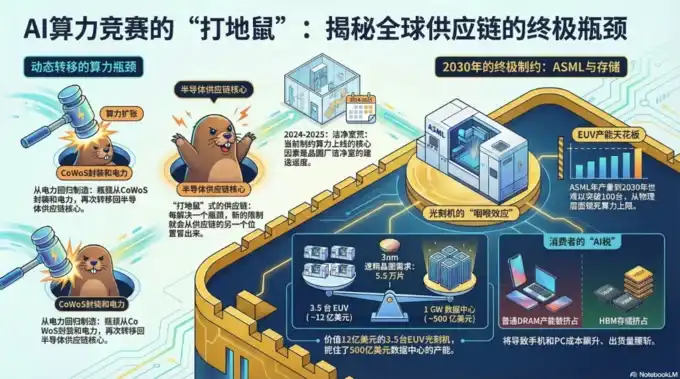
The evolution of bottlenecks in the semiconductor industry chain (especially in the AI computing power field) precisely progresses in this clear sequential order: "Computing (GPU) → Memory (HBM, etc.) → Optical Interconnect → Power/Liquid Cooling". This is the industry consensus for 2025-2026. As AI training/inference clusters scale from single cabinets (dozens of GPUs) to super-large scale (thousands to hundreds of thousands of GPUs), each time a bottleneck in one segment is resolved, the next physical/supply chain constraint is immediately exposed, forming "Leontief-style" complementary constraints (if one is missing, nothing can be shipped).

It is necessary to understand why this evolution occurs, the current status, and the underlying physical/engineering reasons:

1. First Phase Bottleneck: GPU Computing (Dominant from 2022-2024) Core Constraint:

High-end GPU (e.g., NVIDIA Hopper H100 → Blackwell B200 → Rubin) wafer capacity itself + advanced packaging.

Why it was the bottleneck: AI large models require massive parallel computing. TSMC's 4nm/3nm/2nm logic processes + CoWoS (2.5D/3D packaging) capacity once became the biggest choke point. Even if front-end wafers were sufficient, the back-end capability to package logic chips + HBM stacks couldn't keep up, preventing the entire GPU from being produced.

Easing situation: TSMC aggressively expanded CoWoS (capacity doubling 2024-2025), NVIDIA Blackwell is shipping in large volumes. But this only unlocked the "computing" segment, immediately exposing new problems.

2. Second Phase Bottleneck: Memory (HBM High Bandwidth Memory, becoming the tightest from 2024-2025)

Core Constraint: HBM3/HBM3e/HBM4 capacity.

Why it became the next bottleneck: GPU computing power increased, but model parameters exploded (trillions to tens of trillions of parameters), making data movement (memory bandwidth) the "memory wall." HBM can transmit several TB of data per second, over 20 times faster than conventional DDR memory. Because HBM is adjacent to the logic chip, data doesn't need to travel far, thus saving energy.

A single B200 GPU requires 192GB+ of HBM3e. A single cabinet (NVL72) HBM total capacity has reached 30-40TB, and bandwidth demands far exceed traditional DRAM.

Supply chain status: Only SK Hynix, Samsung, and Micron can mass-produce HBM, with complex processes (TSV + stacking). 2025 supply is already sold out, 2026 remains in short supply, with prices soaring 246% year-on-year. Even if GPU chips are ready, without HBM, assembly and delivery are impossible, causing delays in entire AI cluster deployments.

Result: Memory transformed from a "commodity" into a strategic choke point, potentially accounting for 30% of capital expenditures.

3. Third Phase Bottleneck: Optical Interconnect (Transition underway in 2025-2026)

Core Constraint: Physical limits of copper cables (NVLink/NVSwitch) in bandwidth, distance, power consumption, and weight.

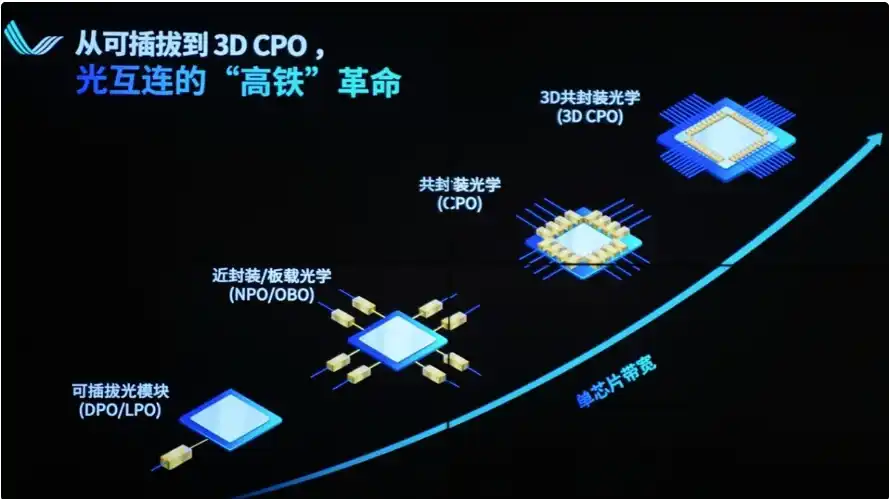
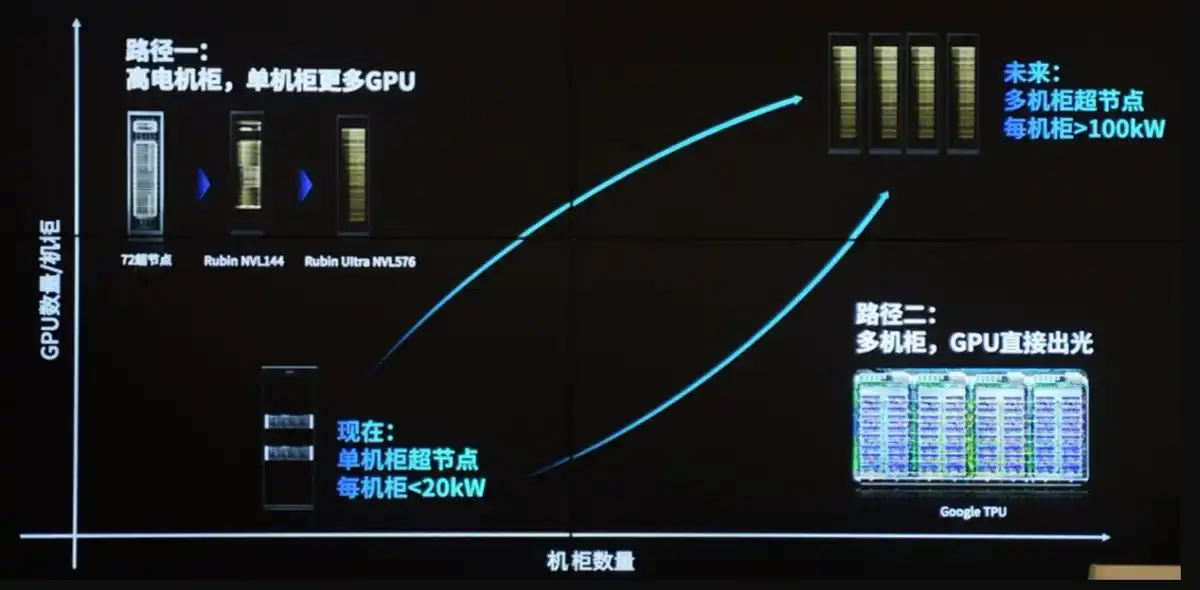
Why a shift to optics is inevitable: Copper can still work within a single cabinet (72 GPUs), but when scaling to multi-cabinet or even thousands of GPU interconnects, copper cable attenuation is severe (effective distance <1 meter at 1.8TB/s bandwidth), weight explodes (NVL72 cabinet copper cables exceed 5,000, total weight 1.36 tons), and power consumption is high (replaceable optical modules replacing copper add an extra 20,000W). Signal integrity, latency, and cooling cannot support larger clusters.

Solution: Shift to optical interconnect (CPO Co-Packaged Optics + Silicon Photonics). Embedding optical engines directly next to the GPU/ASIC, using fiber optics for scale-out, achieving higher bandwidth density, lower per-bit power consumption, and longer distances.

NVIDIA heavily bet on this at GTC 2026, having invested in optical companies. Demand for 800G/1.6T optical modules is exploding. Companies like Lumentum, Broadcom, Coherent, Ayar Labs become new winners.

Current progress: Copper has reached its limit. Optics are shifting from "optional" to "mandatory," breaking through AI data center performance ceilings.

4. Fourth Phase Bottleneck (The Current Frontier): Power + Liquid Cooling (Becoming the ultimate physical constraint from 2026 onwards) Core Constraint: Power Wall + Cooling Wall + Grid Access.

Why it's the ultimate bottleneck: Each GPU's power consumption rose from 300W→700-1200W. Single cabinet power surged from 10-20kW (CPU era) to 120-200kW+ or even higher. Traditional air cooling has a physical limit of only 20-50kW, with unacceptable noise, airflow, and energy consumption.

Power side: Data centers require GW-level power supply, with grid connection queues potentially lasting years. Delivery cycles for transformers, solid-state transformers, and other equipment are extending to 100 weeks. Microsoft's CEO once bluntly stated, "We have GPUs but no electricity to plug them into."

Liquid cooling side: Must switch to Direct-to-Chip liquid cooling or immersion cooling, combined with microfluidics, cold plates, and other technologies. TSMC has demonstrated silicon-based liquid cooling on the CoWoS platform, supporting >2.6kW TDP. Liquid cooling/thermal management companies like Vertiv (VRT) are becoming new infrastructure core players.

Chain reaction: PUE (Power Usage Effectiveness) requirements are <1.2. Waste heat recovery, nuclear/new energy grid integration have become new topics. Even if all previous segments are solved, without power and cooling, cabinets cannot be racked and operated.

The Essential Logic of AI Computing Power Industry Chain Bottleneck Shifts AI computing power is not a "single-point" issue, but a systemic Leontief production function — GPU, HBM, interconnect, power, cooling must match based on the lowest-capacity component. Hyperscalers (Google, Microsoft, Meta, etc.) each time they solve one, immediately push capital and innovation to the next segment.

Currently (2026), we are in the transition period of "accelerated optical interconnect deployment + large-scale commercialization of power/liquid cooling." New bottlenecks may yet emerge (e.g., lasers, fiber materials, or grid transformers), but this chain of "computing → memory → optics → power/cooling" has become the recognized industry path.

This also explains why the investment logic is shifting from NVIDIA/TSMC to the HBM trio (SK Hynix, etc.), optical manufacturers (Lumentum, Coherent), and liquid cooling/power infrastructure companies (Vertiv, related power supply companies).

Every bottleneck shift is reshaping the value distribution across the entire semiconductor + data center industry chain.

Связанные с этим вопросы

QWhat are the four sequential bottleneck stages in the AI computing power supply chain as described in the article, and which one is identified as the 'ultimate bottleneck'?

AThe four sequential bottleneck stages are: 1) GPU/Computing, 2) Memory (HBM), 3) Optical Interconnect, and 4) Power + Liquid Cooling. The article identifies the fourth stage, Power and Liquid Cooling, as the 'ultimate bottleneck' or final physical constraint, as even if all other components are ready, a lack of power and cooling prevents the AI clusters from running.

QWhy did High Bandwidth Memory (HBM) become a critical bottleneck after the initial GPU shortage was alleviated?

AHBM became the critical bottleneck because as GPU computing power increased to handle massive AI models with trillions of parameters, the need for faster data transfer (memory bandwidth) created a 'memory wall.' HBM, which is much faster than traditional DDR memory, is essential for feeding data to these powerful GPUs. Its complex manufacturing process (involving TSVs and stacking) and limited suppliers (SK Hynix, Samsung, Micron) made its supply unable to keep up with explosive demand, delaying entire AI cluster deployments even when GPU chips were available.

QAccording to the article, what is the fundamental reason the industry is transitioning from copper cables to optical interconnects for scaling AI clusters?

AThe fundamental reason is the physical limitations of copper cables. While usable within a single server rack, copper cables face severe signal attenuation, excessive weight (e.g., over 1.36 tons for an NVL72 rack), high power consumption for signal integrity, and distance constraints when scaling to multi-rack clusters with thousands of GPUs. Optical interconnects (like CPO and silicon photonics) offer higher bandwidth density, lower power per bit, and longer transmission distances, making them a necessity for breaking the performance ceiling of large-scale AI data centers.

QHow does the article characterize the nature of bottlenecks in the AI computing power supply chain, and what investment shift does this logic explain?

AThe article characterizes the bottlenecks as forming a system-level 'Leontief production function,' where components like GPU, HBM, interconnect, power, and cooling are complementary constraints—the system's capacity is determined by the lowest-performing (most bottlenecked) component. This logic explains the shift in investment focus from earlier leaders like NVIDIA and TSMC to companies in subsequent bottleneck areas: HBM suppliers (SK Hynix, etc.), optical component makers (Lumentum, Coherent), and power/cooling infrastructure providers (Vertiv, power companies), as each bottleneck转移 reshapes value distribution in the产业链.

QWhat specific data points from major investment banks does the article cite to illustrate the scale and unpredictability of current AI infrastructure demand?

AThe article cites several independent data points: Morgan Stanley noted a 2.5x increase in global weekly LLM token consumption in 3 months. J.P. Morgan identified a 122 GW financing gap for data center projects over 5 years and that 44% of new U.S. power projects face over 4-year grid connection waits. Bank of America significantly raised Alphabet's 2026 CAPEX forecast to $181.5 billion (a doubling year-over-year), expecting a 62% drop in free cash flow. These figures from different research paths collectively show AI demand has exceeded all traditional planning models for power, semiconductor equipment, and memory pricing.

Похожее

A Nation Blocks Chips, a Giant Buys a Nuclear Power Plant: Why It's Time to Seriously Consider DeAI

**Title: Great Powers Blockade Chips, Giants Buy Nuclear Plants: Why It's Time to Seriously Consider DeAI** In May 2026, the US closed loopholes for Chinese firms to acquire advanced NVIDIA chips via overseas subsidiaries. That same month, Kenya halted a $1B geothermal data center project involving Microsoft, fearing its immense energy consumption. Meanwhile, Huawei announced mass production of its Ascend AI chip. These disparate events underscore a new reality: the competition for computing power ("compute") has escalated beyond the tech industry, becoming a geopolitical and infrastructural battleground. A new era of oligopoly is forming, with control over the AI stack—from GPU chips (NVIDIA) and cloud platforms (AWS, Azure, Google Cloud) to foundational models (OpenAI, Anthropic)—concentrating in a few Western "AI Octopus" corporations. This centralization creates systemic risks: pricing power and platform lock-in for users, infrastructure fragility, and a widening "compute divide" that threatens to marginalize nations without independent AI capacity. An "AI Iron Curtain" is deepening through export controls. In response, some nations like Saudi Arabia and the UAE are investing heavily to buy compute power, aiming to transition from oil to AI economies. The EU seeks to triple its compute capacity by 2030 to reduce dependency. However, the spending gap is vast, with four US tech giants alone planning ~$750B in AI capex for 2026. The race is increasingly constrained by energy, with AI tasks consuming up to 1000x more power than web searches, pushing firms to even acquire nuclear plants. This landscape is fueling interest in Decentralized AI (DeAI). It proposes a third way: using open protocols to coordinate a global network of idle GPUs, independent developers, and data centers, creating an AI infrastructure without a single controlling entity. Leveraging blockchain and cryptographic verification, DeAI aims to break market concentration, disperse energy demands, reduce geopolitical dependencies, and enhance transparency. While still nascent in performance and stability, DeAI's core promise is not immediate superiority but providing a crucial alternative architecture to resist monopoly, censorship, and centralized power. As specialized AI hardware costs fall and open-source models flourish, the window to build this foundation is open. The very existence of such competition serves as a vital check against the inevitable abuse of concentrated power.

marsbit11 мин. назад

A Nation Blocks Chips, a Giant Buys a Nuclear Power Plant: Why It's Time to Seriously Consider DeAI

marsbit11 мин. назад

Outpoll Review: A Prediction Market Platform Built for Active Traders

Outpoll Review: A Prediction Market Platform Built for Active Traders In recent years, prediction markets have grown from a niche sector to a mainstream arena, attracting billions in trading volume and institutional capital. However, the user experience and tools for traders have not kept pace. Outpoll, a new global prediction market platform, aims to fill this gap by providing enhanced trading infrastructure for active and professional traders. Built on standard prediction market principles, Outpoll allows users to trade on the outcome of specific events. It uses fully collateralized contracts with USDC settlement, charges a competitive 0.1% fee per trade, and provides clear settlement rules upfront to minimize disputes. A key focus for Outpoll is its professional-grade trading tools. The platform supports limit and market orders, as well as take-profit and stop-loss orders for open positions—features uncommon in prediction markets. For automated trading, Outpoll offers comprehensive REST and WebSocket APIs, enabling portfolio management, price arbitrage, and integration with existing tools. The platform also features a creator-led market model, where approved experts and community leaders can create and manage markets for niche topics under platform supervision. Its integrated interface combines news feeds directly with trading functions, allowing users to monitor events and manage positions seamlessly. Outpoll launched with a native Android app (available on Google Play) and plans an iOS version later this year. In summary, Outpoll distinguishes itself with trader-focused tools, practical APIs, transparent and collateralized markets, integrated news, and an expanding creator program. For active traders, its advanced order types and API access alone make it a platform worth watching. Outpoll is now globally accessible via outpoll.com and Google Play.

marsbit19 мин. назад

Outpoll Review: A Prediction Market Platform Built for Active Traders

marsbit19 мин. назад

Bitwise: Crypto Becomes a Contrarian Investment, Three Logics to Understand the Current Market

**Summary** Matt Hougan, Bitwise's CIO, analyzes the current crypto market through three key lenses, arguing it has shifted from a momentum-driven to a contrarian investment. **1) Crypto Becomes a Contrarian Play:** The market is weak, with major assets like Bitcoin and Ethereum down significantly. Capital has moved to hot sectors like AI, leaving crypto as an "unloved" asset class. This transforms crypto investing from trend-following to a test of patience and fundamental analysis. Investors now favor projects with solid fundamentals (e.g., Hyperliquid) over speculative ones. **2) Regulatory Overhang:** The uncertain fate of the U.S. CLARITY Act, a major crypto regulatory framework, is a key headwind. With its passage in 2024 seen as far from guaranteed (estimates range from 30-55%), institutional capital remains on the sidelines, choosing less risky alternatives like AI stocks. The market needs clarity—whether the bill passes or fails—more than any specific outcome to move decisively. **3) Capital Rotates to New Fundamentals:** This cycle differs from past bear markets where money fled to Bitcoin. Now, capital seeks smaller assets with strong use cases. While major cryptos fell in May 2024, tokens like Hyperliquid (+72%), Zcash (+50%), and XLM (+44%) rallied on their specific fundamentals. This rotation confirms the new contrarian, fundamentals-driven logic and signals the bear market may be in its later stages. **Conclusion:** Short-term pressure persists due to regulatory uncertainty and competition from AI narratives. Investing in crypto now requires a contrarian mindset—acting against the crowd and focusing on fundamental value. Patience and targeting high-quality projects based on their merits are essential for capturing long-term gains.

marsbit1 ч. назад

Bitwise: Crypto Becomes a Contrarian Investment, Three Logics to Understand the Current Market

marsbit1 ч. назад

ChatGPT Might Be Disappearing Soon

OpenAI announced at its "Intelligence at Work" event that its coding assistant, Codex, will be fully integrated into the ChatGPT app within weeks. This move marks a strategic shift from a conversational AI (Chat) towards a unified "agentic" platform capable of execution. Codex, originally launched to compete with Anthropic's Claude Code, has grown rapidly to 5 million weekly active users, with 20% being non-developers like analysts and designers. Its enterprise revenue now constitutes 40% of OpenAI's total. The integration is the first step in creating a super-app combining ChatGPT (interface), Codex (execution engine), and the Atlas browser (web access). OpenAI also unveiled new Codex features: specialized Agent plugins for six professional roles, an "Annotations" tool for direct document editing, and a "Sites" function to turn work into shareable web apps. Internally, this reflects a power shift; the Codex team now leads core product strategy. While the ChatGPT brand remains for its vast user base, the platform's future is focused on autonomous agents that perform tasks, not just chat. The article notes that competition with Claude Code pushed OpenAI's development, with Codex competing on cost-effectiveness and accessibility rather than raw coding quality. It concludes that the essence of "ChatGPT" is evolving from a chatbot into an AI agent platform, with the name potentially becoming a legacy symbol of its original function.

marsbit1 ч. назад

ChatGPT Might Be Disappearing Soon

marsbit1 ч. назад

Торговля

Спот
Фьючерсы

Популярные статьи

Неделя обучения по популярным токенам (2): 2026 может стать годом приложений реального времени, сектор AI продолжает оставаться в тренде

2025 год — год институциональных инвесторов, в будущем он будет доминировать в приложениях реального времени.

1.8k просмотров всегоОпубликовано 2025.12.16Обновлено 2025.12.16

Неделя обучения по популярным токенам (2): 2026 может стать годом приложений реального времени, сектор AI продолжает оставаться в тренде

Обсуждения

Добро пожаловать в Сообщество HTX. Здесь вы сможете быть в курсе последних новостей о развитии платформы и получить доступ к профессиональной аналитической информации о рынке. Мнения пользователей о цене на AI (AI) представлены ниже.

活动图片