The Market's Biggest Misconception About 'Quantum Computing': It's Still 'Too Early'

marsbitОпубликовано 2026-02-09Обновлено 2026-02-09

Введение

This article, based on a Barclays research report, addresses the common market misconception that quantum computing is still a distant, futuristic technology. The report argues that the field is approaching a critical inflection point, with "quantum advantage" expected to be demonstrated within the next 12-24 months when systems can stably operate 100 logical qubits. It corrects several key misunderstandings: quantum computers will not replace classical systems like GPUs but will instead require them for error correction, creating a symbiotic relationship that could generate over $100 billion in incremental demand for classical computing by 2040. The report also highlights the differentiation in hardware approaches, noting the current lead of trapped ions, the scaling potential of silicon spin qubits, and the quantity advantage of neutral atoms. It dismisses fears of imminent encryption breaches and emphasizes that the investment universe is broader than often perceived, encompassing over 45 public companies across the entire quantum supply chain.

Author: Long Yue

Source: Wall Street News

Investors generally believe that quantum computing is still in the realm of science fiction, but Barclays' latest research report points out that this "too early" misconception might cause you to miss the most critical trend in the next 12 months.

According to Wind Trading Desk news, Barclays' analyst team recently released a research report titled "Quantum Computing: Correcting the Biggest Misconception Among Investors".

The core logic of the report is very straightforward: Wall Street underestimates the speed of technological breakthroughs and completely misunderstands the relationship between quantum and classical computing power (like NVIDIA). Barclays believes we are on the eve of transitioning from a "lab toy" to a "commercial tool".

Misconception 1: Quantum Computing is "Too Early"

Barclays' first correction is: Don't treat quantum computing as a purely long-term theme that "won't yield results for another decade."

The current market consensus is that perfectly functioning "Fault-Tolerant Quantum Computing" (FTQC) won't arrive until after 2030. This is correct, but Barclays reminds investors not to ignore the intermediate "tipping points".

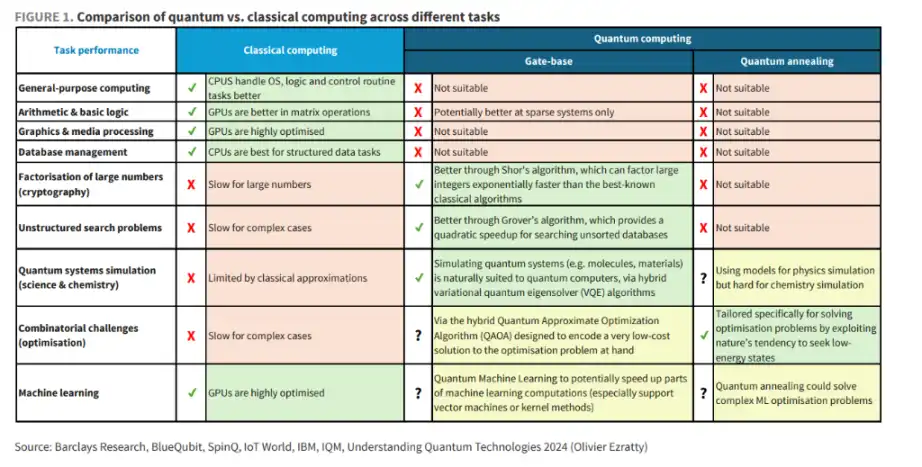
Barclays points out that 2026 to 2027 will be the industry's watershed moment, when "Quantum Advantage" will be achieved.

More importantly is "how to define advantage". Barclays believes that "advantage is only proven when a system targets 100 logical qubits". It also cautions that any "claim of advantage" needs to be backed by "strong technical evidence", otherwise it's more like marketing than an inflection point.

"We expect major announcements within the next 12 months...... Quantum advantage will be proven when a system can stably run 100 logical qubits."

This is like the Wright brothers' first flight; although it couldn't carry passengers (commercialization), it proved that airplanes were better than horse-drawn carriages (quantum advantage). Once this signal appears, the valuation logic in the capital markets will be instantly reshaped.

Misconception 2: Quantum will replace classical computing, so NVIDIA is finished?

This is the market's biggest cognitive bias. The report points out that many people think quantum computers are so powerful they will replace current CPUs and GPUs. Barclays refutes this: it's not a replacement relationship, but a "strongest assistant" relationship.

"Quantum computers will not replace classical computers as general-purpose machines, but will complement them."

The core logic behind this lies in "error correction": Qubits are very fragile and unstable (prone to errors). To make them work properly, an extremely powerful classical computing system is needed to monitor and correct them in real-time.

Barclays' research reveals a startling data relationship:

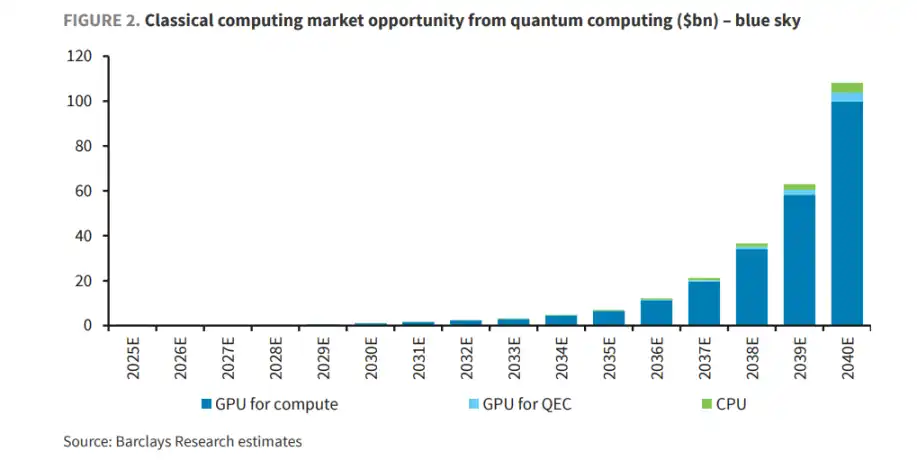
"Each logical qubit may require one GPU for error correction and control."

What does this mean? If you build a quantum computer with 1000 logical qubits, you would need to purchase 500 to 2000 GPUs to support it.

This is no longer competition, but symbiosis. The stronger the quantum computer, the more explosive the demand for chips from NVIDIA and AMD becomes. Barclays calculates that this "derived demand" could bring over $100 billion in incremental value to the classical computing market by 2040 in a blue-sky scenario.

Misconception 3: Quantum hardware is all similar, like buying a lottery ticket?

The truth about this misconception is that the field has already diverged, with clear strengths and weaknesses.

Quantum hardware approaches are not singular. Barclays categorizes mainstream physical qubit paths into electronic (superconducting, electron spin), atomic (trapped ions, neutral atoms), and photonic, among others, noting that their pros and cons stem from trade-offs between speed, accuracy, coherence time, external infrastructure (cryogenics, lasers, vacuum), and scalability.

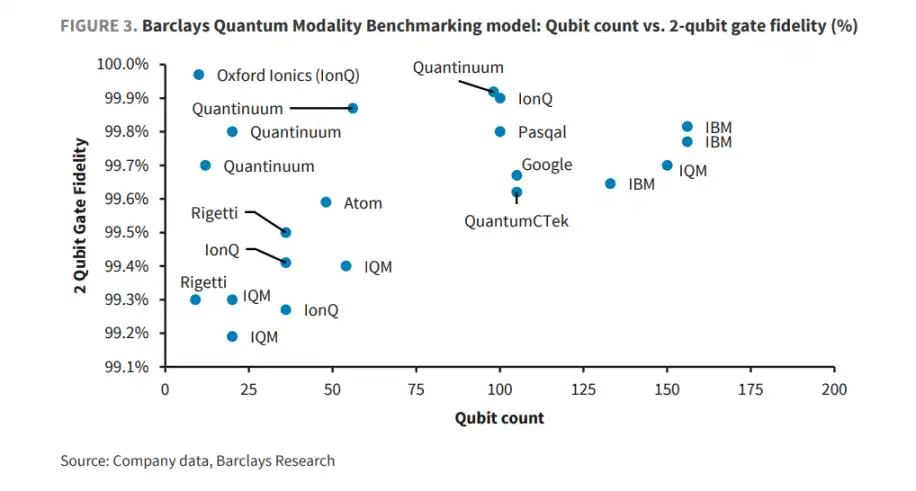
Using a "quantum benchmarking model," Barclays highlights key points in the currently chaotic hardware landscape:

  • Current "Accuracy King" — Trapped Ions: Represented by companies like Quantinuum and IonQ. Their advantage is accuracy, low error rates, and relatively mature technology.
  • Future "Mass Production Dark Horse" — Silicon Spin: The direction Intel is pursuing. Although performance is modest now, it can leverage existing semiconductor fabs for manufacturing. Once breakthroughs occur, it's the easiest to mass-produce.
  • Winning by Numbers — Neutral Atoms: Have a natural advantage in stacking large numbers of qubits.

Barclays concludes:

"Our testing indicates trapped ions are currently in the lead...... but the scalability of silicon spin warrants long-term attention."

Misconception 4: Encryption is about to be broken?

Regarding the panic that "quantum computers will crack bank passwords tomorrow," Barclays pours cold water on the idea: Think again, the computing power isn't there yet.

Cracking current RSA encryption requires thousands of perfect logical qubits, while humanity's top devices currently have only a few dozen. Barclays states bluntly:

"Quantum computers are not yet powerful enough...... modern encryption standards are not yet under threat."

Misconception 5: The quantum theme has "only two or three companies worth investing in"

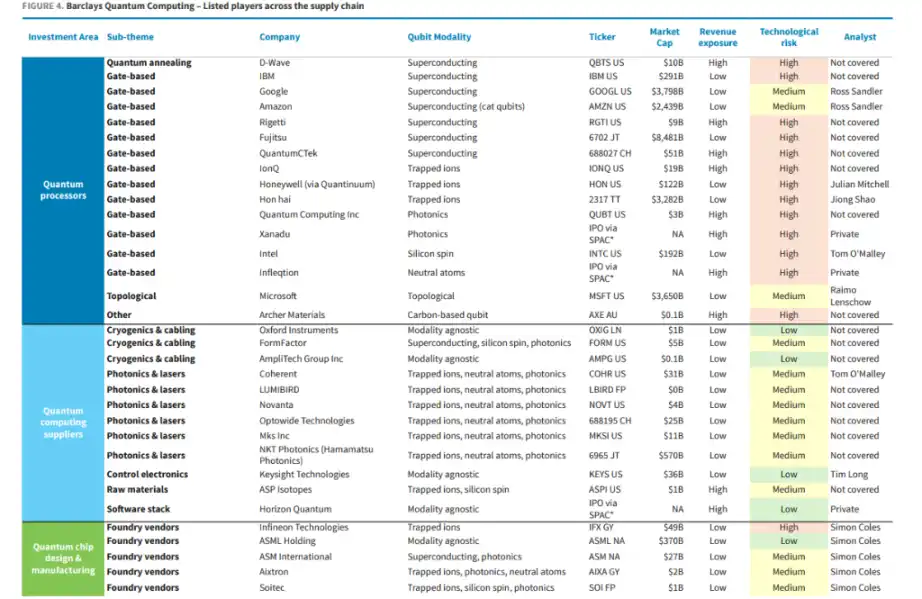
The market often perceives investment targets in this field as scarce, limited to a few well-known companies. But Barclays梳理 (sorted through) the entire industry chain, identifying 45 listed companies and over 80 private enterprises. They are mainly distributed across four areas:

1) Quantum Processors (system sales or QCaaS cloud access)

2) Quantum Supply Chain (cryogenics, lasers/optics, control electronics, materials, etc.)

3) Quantum Chip Design and Manufacturing (overlap with traditional semiconductor manufacturing)

4) Ecosystem Enablers (cloud, data center infrastructure, quantum simulators, quantum-classical integration: GPU/CPU/servers, etc.)

The framework provided by the report leans more towards "risk pricing": short-term often correspond to "higher revenue exposure" paired with "higher technical risk". It roughly categorizes technical risk as high (single approach), medium (few approaches), low (approach agnostic) based on whether the business model is tied to a single approach.

This also explains why the quantum narrative easily "focuses solely on pure quantum hardware stocks": their revenue exposure is most direct, but path uncertainty is also greatest; whereas the supply chain, semiconductor equipment & EDA, cloud & data centers, and hybrid integration segments might better transmit the "quantum progress → capital expenditure and supporting demand" linkage.

Связанные с этим вопросы

QWhat is the core argument of Barclays' report regarding the market's perception of quantum computing?

ABarclays argues that the market underestimates the speed of technological advancement in quantum computing and misunderstands its relationship with classical computing, emphasizing that we are on the verge of transitioning from 'lab toys' to 'commercial tools'.

QWhen does Barclays predict quantum advantage will be achieved, and how is it defined?

ABarclays predicts quantum advantage will be achieved between 2026 and 2027, defined as when a system can stably operate with 100 logical qubits, supported by strong technical data.

QHow does Barclays describe the relationship between quantum computers and classical computing hardware like GPUs?

ABarclays states that quantum computers will not replace classical computers but will complement them, requiring GPUs for error correction and control—each logical qubit may need one GPU, creating a symbiotic relationship.

QWhat are the three leading quantum hardware paths highlighted by Barclays, and their key strengths?

AThe three paths are: 1) Trapped Ions (e.g., Quantinuum, IonQ) for high accuracy and low error rates, 2) Silicon Spin (e.g., Intel) for potential mass production using semiconductor fabs, and 3) Neutral Atoms for scalability in qubit count.

QAccording to Barclays, how many companies are involved in the quantum computing ecosystem, and what are the four main areas they operate in?

ABarclays identifies 45 public and over 80 private companies across four areas: 1) Quantum processors (system sales or QCaaS), 2) Quantum supply chain (cryogenics, lasers, control electronics, materials), 3) Quantum chip design and manufacturing, and 4) Ecosystem enablers (cloud, data centers, quantum-classical integration).

Похожее

First Batch of Keynote Speakers and Partners Announced! Web2+3 Summit: Defining the Next Generation of Digital Economy

Web2+3 Summit: Defining the Next Generation of Digital Economy The 6th BEYOND International Technology Innovation Expo (BEYOND Expo 2026), Asia's largest tech and ecosystem exhibition, is launching a dedicated Web2+3 stage for the first time. Co-hosted by BEYOND Expo and ChainNeXT Group, the Web3 Summit will take place from May 28–30, 2026. Against the backdrop of accelerating global tech integration, the boundaries between Web2 and Web3 are rapidly blurring. With clearer global regulations for blockchain-driven internet (Web3) and the special issuance of a Hong Kong dollar stable币 license by the Hong Kong SAR government on April 10, 2026, Web3's decentralized principles are quickly merging with traditional industries (Web2) such as e-commerce, finance, and artificial intelligence. Focused on blockchain-driven digital economy elements, the summit will center on three core principles—implementability, commercial viability, and compliance. It will bring together top Web3 experts to discuss key integration areas like stablecoin payment finance (PayFi), real-world asset tokenization (RWA), and decentralized AI (DeAI), unveiling new opportunities for industrial innovation. The first wave of confirmed speakers includes Jack Kong (Director of Hong Kong Cyberport, Chairman of Nano Labs), Yat Siu (Chairman of Animoca Brands), Michael Wu (Co-founder & CEO of Amber Group), Michael Heinrich (Co-founder & CEO of 0G), and Art Abal (Co-founder of Vana). More Web3 ecosystem pioneers, AI, and fintech experts will be announced soon. Core forum topics include: - Web2+DeAI: New AI Paradigms Driven by Decentralized Infrastructure - Web2+RWA: Real-World Asset Tokenization and Global Liquidity - Web2+PayFi: Cross-Border Payments and Financial Innovation Powered by Crypto Infrastructure - Web2+3 AI: Autonomous Agents and the Crypto Economy - Web2+3 Wealth: On-Chain and Off-Chain Integrated Investment Ecosystems - Web2+3 Commerce: A New Landscape for Global Trade Driven by Stablecoins Additional agenda details will be released in the near future.

marsbit1 ч. назад

First Batch of Keynote Speakers and Partners Announced! Web2+3 Summit: Defining the Next Generation of Digital Economy

marsbit1 ч. назад

Торговля

Спот
Фьючерсы

Популярные статьи

Как купить S

Добро пожаловать на HTX.com! Мы сделали приобретение Sonic (S) простым и удобным. Следуйте нашему пошаговому руководству и отправляйтесь в свое крипто-путешествие.Шаг 1: Создайте аккаунт на HTXИспользуйте свой адрес электронной почты или номер телефона, чтобы зарегистрироваться и бесплатно создать аккаунт на HTX. Пройдите удобную регистрацию и откройте для себя весь функционал.Создать аккаунтШаг 2: Перейдите в Купить криптовалюту и выберите свой способ оплатыКредитная/Дебетовая Карта: Используйте свою карту Visa или Mastercard для мгновенной покупки Sonic (S).Баланс: Используйте средства с баланса вашего аккаунта HTX для простой торговли.Третьи Лица: Мы добавили популярные способы оплаты, такие как Google Pay и Apple Pay, для повышения удобства.P2P: Торгуйте напрямую с другими пользователями на HTX.Внебиржевая Торговля (OTC): Мы предлагаем индивидуальные услуги и конкурентоспособные обменные курсы для трейдеров.Шаг 3: Хранение Sonic (S)После приобретения вами Sonic (S) храните их в своем аккаунте на HTX. В качестве альтернативы вы можете отправить их куда-либо с помощью перевода в блокчейне или использовать для торговли с другими криптовалютами.Шаг 4: Торговля Sonic (S)С легкостью торгуйте Sonic (S) на спотовом рынке HTX. Просто зайдите в свой аккаунт, выберите торговую пару, совершайте сделки и следите за ними в режиме реального времени. Мы предлагаем удобный интерфейс как для начинающих, так и для опытных трейдеров.

1.1k просмотров всегоОпубликовано 2025.01.15Обновлено 2025.03.21

Как купить S

Sonic: Обновления под руководством Андре Кронье – новая звезда Layer-1 на фоне спада рынка

Он решает проблемы масштабируемости, совместимости между блокчейнами и стимулов для разработчиков с помощью технологических инноваций.

2.2k просмотров всегоОпубликовано 2025.04.09Обновлено 2025.04.09

Sonic: Обновления под руководством Андре Кронье – новая звезда Layer-1 на фоне спада рынка

HTX Learn: Пройдите обучение по "Sonic" и разделите 1000 USDT

HTX Learn — ваш проводник в мир перспективных проектов, и мы запускаем специальное мероприятие "Учитесь и Зарабатывайте", посвящённое этим проектам. Наше новое направление .

1.8k просмотров всегоОпубликовано 2025.04.10Обновлено 2025.04.10

HTX Learn: Пройдите обучение по "Sonic" и разделите 1000 USDT

Обсуждения

Добро пожаловать в Сообщество HTX. Здесь вы сможете быть в курсе последних новостей о развитии платформы и получить доступ к профессиональной аналитической информации о рынке. Мнения пользователей о цене на S (S) представлены ниже.

活动图片