The Eve of the Storm: Powell Holds Rates, Trump Announces New Fed Chair?

Odaily星球日报Опубликовано 2026-01-28Обновлено 2026-01-28

Введение

The Federal Reserve is widely expected to hold interest rates steady in its first policy decision of 2026, with markets pricing in a near-100% probability of no change. While this outcome is largely anticipated, the focus has shifted to future policy direction and the potential announcement of a new Fed Chair by former President Trump. Key uncertainties remain regarding the pace of potential rate cuts in 2026. Although the Fed began a rate-cutting cycle in late 2025 due to a softening labor market, persistent inflation at 2.8%—above the 2% target—has led to a more cautious stance. The composition of the voting members on the Federal Open Market Committee (FOMC) has also shifted, with two new "hawkish" regional bank presidents joining, which may influence future decisions. Chair Powell’s post-meeting remarks will be closely watched for signals on the duration of the pause and the likelihood of further easing. Simultaneously, Trump has indicated he may soon nominate a new Fed Chair, with candidates narrowed down to four individuals. Rick Rieder, BlackRock’s Global Chief Investment Officer of Fixed Income and a proponent of lower rates, is currently the betting favorite. Trump may choose to announce his nominee around the time of the FOMC meeting to shift market attention away from any potentially hawkish signals from Powell and instead emphasize a more dovish long-term outlook. The timing and choice of nominee could significantly influence market sentiment and expectations fo...

Original | Odaily Planet Daily (@OdailyChina)

Author | Golem (@web 3_golem)

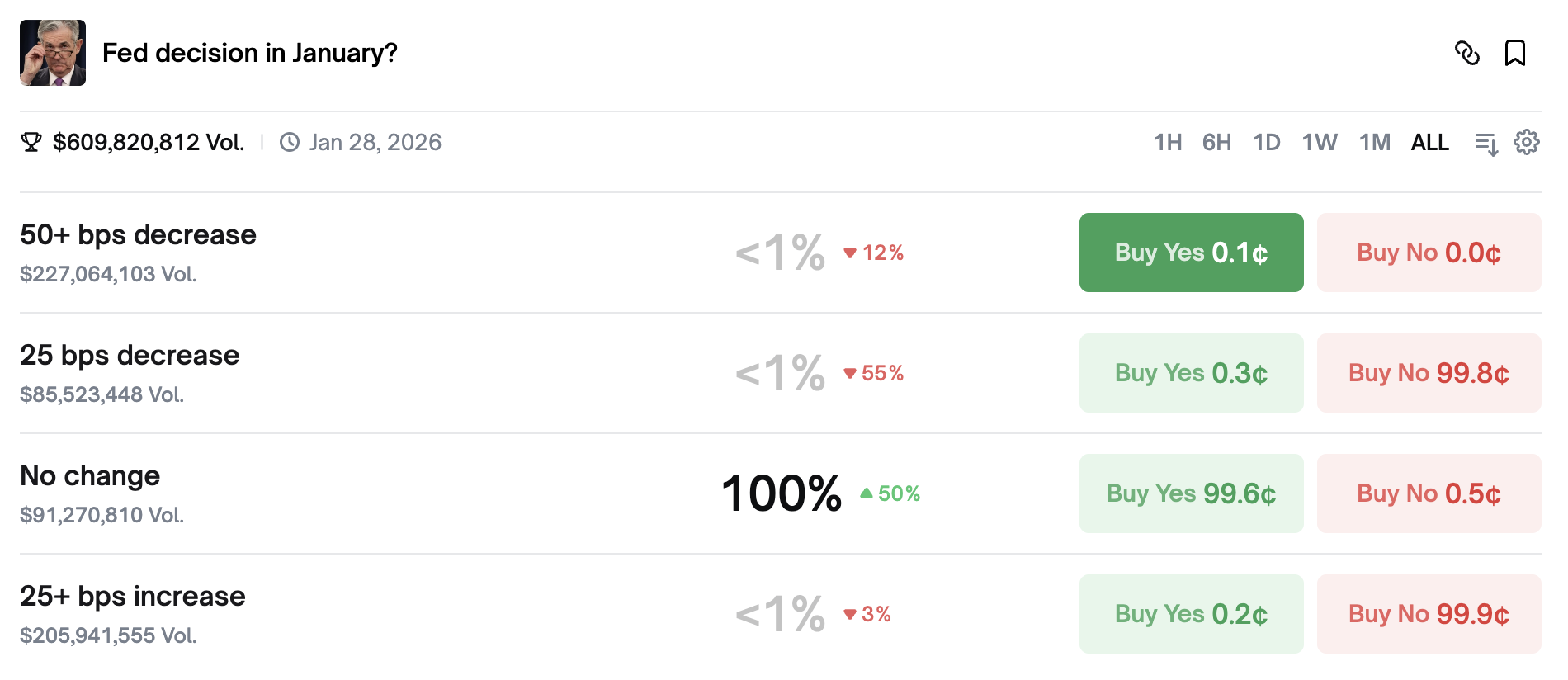
At 3:00 AM Beijing time on January 29 (this Thursday), the Federal Reserve is set to announce its first interest rate decision of 2026; half an hour later, current Fed Chair Jerome Powell will hold a monetary policy press conference. However, there is little suspense surrounding this Fed rate decision, as the market widely expects the Fed to keep rates unchanged. Data from Polymarket shows that the probability of maintaining rates is close to 100%.

Such a high probability has allowed the market to digest in advance the negative impact of the Fed's announcement of "no rate cut" this time. OKX data shows that BTC has fallen by only 0.39% in the past 7 days, basically in a sideways trend, but this period of market "silence" may be broken tonight.

On one hand, although the market almost unanimously believes the Fed will keep rates unchanged this week, there is significant divergence regarding the fiscal path for the remainder of 2026, making this still an important meeting to watch. The Fed's future key policy tendencies, such as whether it will continue to cut rates in 2026 and the frequency of cuts, will affect the market. Should Powell make hawkish remarks like "further observation is needed" during his speech, the market might "drop in response."

On the other hand, the announcement of the successor to the Fed Chair will also have a long-term impact on the market. The shortlist has been narrowed down to four individuals. Trump previously stated he has a preferred candidate but is waiting for the right time to announce, and this right time could very well be tonight.

2026 Rate Cut Direction Remains Uncertain

Since last September, the Federal Reserve initiated a new rate-cutting cycle, implementing three consecutive rate cuts. If rates are held unchanged this week, it would be the first pause since the cycle began. At this point, the market is not concerned about the reasons for holding rates steady, but rather whether this is a brief pause to observe before continuing rate cuts, or the beginning of a prolonged pause, or even the start of a rate-hiking cycle?

Previously, the general market view was that 2026 would be a year of further quantitative easing by the Fed.

Reason one: From a data perspective, the US labor market indeed shows signs of weakness. Non-farm payrolls increased by only 50,000 in December 2025, with an unemployment rate of 4.4%. While there hasn't been "massive layoffs," it remains in a state of "low hiring and cooling demand." Reason two: The Fed might still believe that Trump's tariff policies will not have a long-term impact on inflation (Odaily: Powell cut rates in September 2025 based on this factor). Reason three: Trump has publicly stated that he would choose a "dovish" figure as the next Fed Chair.

However, some in the market believe there is uncertainty about the Fed continuing to cut rates in 2026. Some analysts argue that unless the job market deteriorates significantly, it will be difficult to see rate cuts before mid-year, as the pace of inflation decline is not sufficient to convince hawkish members.

The Fed's mandate, simply put, is to curb inflation and promote employment. However, in 2025, the US experienced a phenomenon of both a weak labor market and high inflation. The Fed ultimately chose to prioritize the employment issue, thus initiating the rate-cutting cycle. Yet, the reality is that the US inflation rate remains stuck at 2.8%, far above the Fed's 2% target, forcing the Fed to reconsider the impact of tariffs on inflation. Holding rates unchanged this week would also indicate the Fed is beginning to "observe."

Furthermore, although the next Fed Chair chosen by Trump is destined to be "dovish," the new rotating chairs of the Fed's rate-setting committee are predominantly "hawkish." At the beginning of each year, four of the 12 regional Fed presidents rotate onto the rate-setting committee and gain voting rights for the next eight policy meetings. This year's rotating members include Dallas Fed President Lorie Logan, Cleveland Fed President Loretta Mester (referred to as Hammack in the text, likely a reference to Mester's previous role or a mistranslation; Mester is known as a hawk), Philadelphia Fed President Patrick Harker (referred to as Paulson in the text, likely a mistranslation; Harker is considered moderate), and Minneapolis Fed President Neel Kashkari.

Among them, Logan and Mester are seen as "hawkish" figures, both having publicly stated that the Fed should focus on inflation. Harker is seen as "dovish," having expressed a "cautiously optimistic attitude" towards inflation. Kashkari's stance is relatively neutral. The addition of new "hawkish" members might disrupt the previous balance of policy inclinations within the Fed. Even if Trump chooses a "dovish" Chair, they may not be able to sway the entire rate-setting committee.

Moreover, the Fed Chair might not completely follow Trump's wishes in leading rate cuts. Years ago, Trump personally appointed Powell as Fed Chair, but last year, even though Trump promoted Powell, Powell did not "repay" Trump with sustained and significant rate cuts. Under US law, the Fed is independent and can make interest rate decisions based on the current economic situation, not government wishes. Therefore, even if the new Fed Chair promises Trump rate cuts, they might "go their own way" once in office.

This kind of meaningless "political promise" is also a concern for Trump. Last week, Trump said in a speech at the World Economic Forum in Davos, Switzerland, "It's amazing how people change once they get this job," meaning candidates say what sounds good during the interview but emphasize their independence once confirmed.

Considering these factors, Powell's speech after tonight's FOMC meeting will also be closely watched by investors for hints on how long the Fed might pause rate cuts.

This Week's FOMC Meeting Could Be One of the Best Times for Trump to Announce the Fed Chair Successor

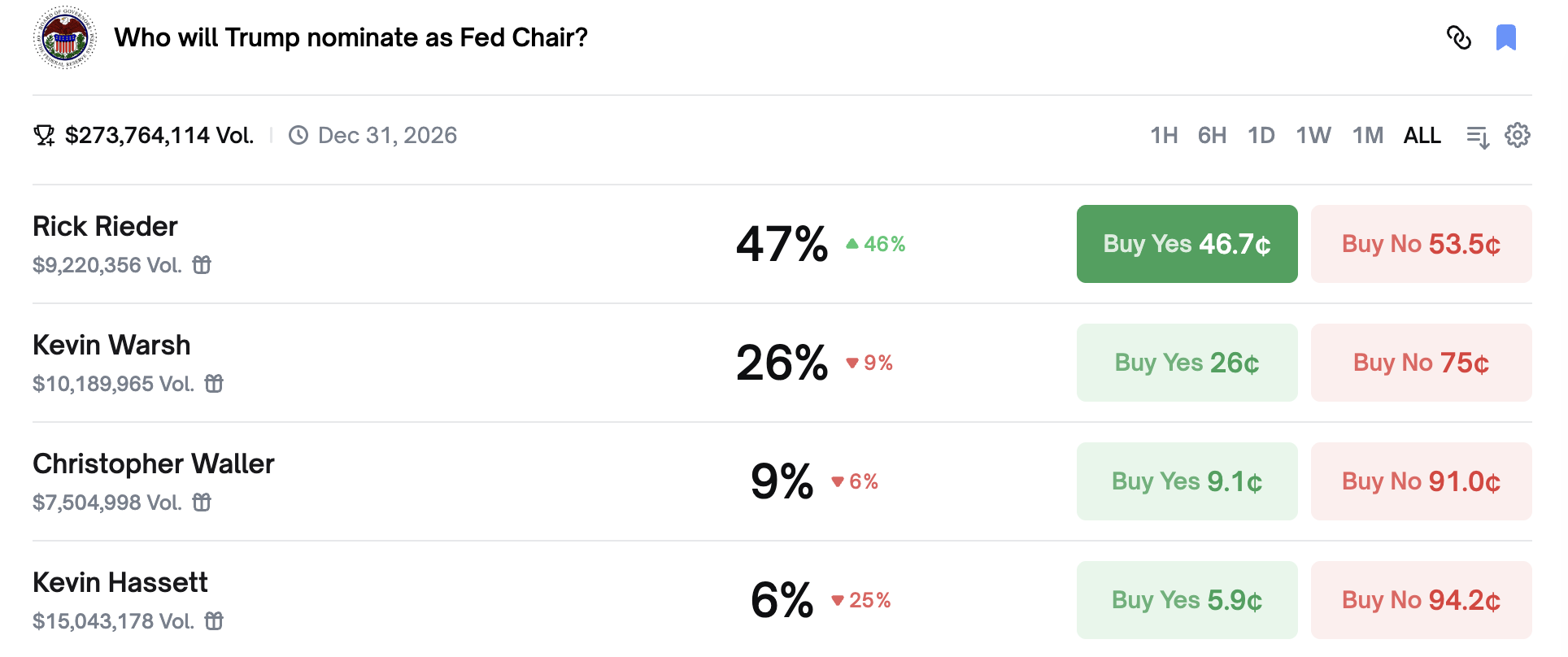
Besides this week's FOMC meeting, the successor to the Fed Chair is another macro event that can influence the market. The shortlist has been narrowed down to four: Kevin Hassett, Kevin Warsh, Rick Rieder, and Christopher Waller. According to Polymarket data, Rick Rieder currently has the highest probability of being nominated by Trump at 47%; Kevin Hassett has the lowest probability at 6%.

Rick Rieder is BlackRock's Chief Investment Officer of Global Fixed Income. Although he doesn't have much government experience, he has consistently advocated for supporting low interest rates based on his understanding of the market rather than politics. This resume might attract Trump, who is worried about the new Fed Chair becoming "disobedient" upon taking office. Economists at Evercore ISI, including Krishna Guha, even believe that "if Rick Rieder becomes the new Fed Chair, he might advocate for three rate cuts this year." (Odaily Note: For more information on Rick Rieder, read 《The Last Seat on the Fed Chair Candidate List, What is Rick Rieder's Attitude Towards Crypto?》)

Hassett was once considered the most likely candidate to become the new Fed Chair, with a probability一度 (once) over 80%. But Hassett is Trump's economic advisor, and there were外界 (external) concerns that nominating Hassett would damage the Fed's independence. Additionally, Trump publicly stated that he did not want to lose Hasset within his administration. Therefore, Hassett's probability of selection has declined, though some still believe his nomination probability is higher than 6%.

Trump has repeatedly publicly stated that he would announce his nominee in January. In late December 2025, Trump told reporters in Florida that he would announce the next Fed Chair人选 (candidate) sometime in January; On January 14, 2026, Trump said in an interview with Reuters that he would announce the candidate within the next few weeks; Two weeks later, on January 27, Trump said in a speech in Iowa that he would announce the new Fed Chair candidate soon, but has not done so yet.

Although Trump's answers have been vague each time, it is almost certain that the probability of an announcement in January is very high, and the best timing for the announcement could very well be during this week's FOMC meeting.

As mentioned earlier, Powell's speech tonight will be a key focus for investors. If Powell does not make dovish-leaning remarks, financial markets could suffer, a scenario Trump显然 (obviously) does not want to see. Therefore, if Trump wishes to shift market attention away from the uncertain Powell, he might announce his nominee for the next Fed Chair during tonight's FOMC meeting. This would release the positive news of a "dovish chair" to the market, reducing attention on Powell's speech or mitigating potential negative market impacts.

Tonight, let's wait and see!

Связанные с этим вопросы

QWhat is the market's expectation for the Federal Reserve's interest rate decision on January 29, 2026, and why?

AThe market widely expects the Federal Reserve to maintain the current interest rate, with Polymarket data showing the probability of no rate change is close to 100%. This is because the decision is highly anticipated and already priced in by investors.

QWhat are the two main factors discussed in the article that could break the market's 'silent period'?

AThe two main factors are: 1) The future policy direction for the remainder of 2026, including the frequency of potential rate cuts, which could cause market volatility if Chair Powell's remarks are perceived as hawkish. 2) The announcement of the new Federal Reserve Chair nominee by former President Trump, which could have long-term market impacts.

QAccording to the article, who is the most likely candidate to be nominated as the next Federal Reserve Chair based on Polymarket data, and what is his background?

ABased on Polymarket data, Rick Rieder is the most likely candidate with a 47% probability. He is the Chief Investment Officer of Global Fixed Income at BlackRock, advocates for low interest rates based on market understanding rather than politics, and has limited government experience.

QWhy might the Federal Reserve's decision to pause rate cuts be more than just a temporary观望, according to the analysis in the article?

AThe pause might not be temporary due to persistent inflation at 2.8% (above the 2% target), leading the Fed reassessing the impact of tariffs on inflation. Additionally, new 'hawkish' members rotating into the利率决策委员会 could shift internal policy balance, making further rate cuts less likely.

QWhy does the article suggest that Trump might announce his Fed Chair nominee during the FOMC meeting?

ATrump might announce the nominee during the FOMC meeting to shift market attention away from any potentially hawkish or uncertain remarks by Chair Powell. This could release a 'dovish'利好 to the market, mitigating potential negative impacts and reducing focus on Powell's speech.

Похожее

The Waged Worker Driven to Poverty by AI Subscriptions

"AI Membership: The Hidden Cost Pushing Workers Toward 'Poverty'" The widespread corporate push for AI adoption is creating a hidden financial burden for employees. Companies, from giants like Alibaba to small firms, are mandating AI use, often tying token consumption to KPIs, but frequently refuse to cover the costs. Workers are forced to pay for subscriptions out of pocket to stay competitive and avoid being replaced. Front-end developer Long Shen spends up to 2000 RMB monthly on tools like Cursor and ChatGPT Plus, seeing it as a necessary 3% salary investment to handle 90% of his coding tasks. While it boosted his performance and led to promotions, he now faces idle time at work, pretending to be busy. Designer Peng Peng navigates strict company firewalls by using personal devices and accounts for AI image generation tools like Midjourney, spending hundreds monthly without reimbursement, while her boss demands faster, more numerous revisions. The pressure creates workplace anxiety and suspicion. Programmer Li Huahua, after a friend's experience of raised KPIs following AI success, fears being branded a "traitor" for using it yet worries about falling behind if she doesn't. The dynamic allows management to demand results without understanding the tools or covering expenses, treating employees like AI "agents." While some, like entrepreneur Jin Tu, find high value in paid AI, building entire systems and winning competitions, for most, it's a trap. Free tools like Kimi and Doubao are introducing fees, closing off alternatives. The initial efficiency gains individual advantage, but as AI becomes ubiquitous, the personal edge disappears, workloads increase, and a cycle of dependency begins. Workers like Long Shen realize they cannot maintain AI-generated code without AI, making stopping harder than continuing to pay. The tool promising liberation is instead becoming a compulsory, costly chain in the modern workplace.

marsbit37 мин. назад

The Waged Worker Driven to Poverty by AI Subscriptions

marsbit37 мин. назад

SK Hynix's Trillion-Won Empire: The Successors

"SK Hynix's Trillion-Won Empire and Its Heirs" explores the unconventional succession narrative within SK Group, South Korea's second-largest conglomerate, following SK Hynix's dramatic market rise. Unlike traditional chaebol scripts prioritizing the eldest son, ownership, and political marriages, Chairman Choi Tae-won's three children from his first marriage are charting distinct paths. The eldest daughter, Choi Yun-jeong, is considered the most visible candidate. With a background in biology, consulting, and a PhD, she holds executive roles at SK Bioscience and SK Inc.'s growth strategy unit, focusing on biopharma and new businesses. Her marriage is to an AI infrastructure entrepreneur, not a traditional chaebol heir. The second daughter, Choi Min-jeong, took a unique route by voluntarily serving as a South Korean naval officer, including a tour in the Gulf of Aden. She later worked on policy and strategy for SK Hynix in Washington D.C. before co-founding an AI-driven healthcare startup in San Francisco. She married a former U.S. Marine Corps officer, connecting the family to U.S. defense and policy networks. The son, Choi In-geun, who has Type 1 diabetes, followed a more classic preparatory path with a physics degree and a stint at SK E&S but left to join McKinsey's Seoul office. He remains publicly silent and holds no SK shares, defying the traditional "crown prince" archetype. Their paths unfold against the backdrop of their parents' high-profile, contentious divorce and a record-setting asset division lawsuit. The article argues that as SK Hynix becomes a geopolitical asset in the AI era, the conventional rules of chaebol inheritance are changing. The heirs are being groomed not simply to take over, but to navigate a complex global landscape defined by AI, biotech, geopolitics, and policy, forging legitimacy through their own expertise and networks rather than birth order alone.

marsbit45 мин. назад

SK Hynix's Trillion-Won Empire: The Successors

marsbit45 мин. назад

BitMart Research Institute Weekly Highlights: A Comprehensive Review of Macro Environment, Crude Oil, AI Tech Stocks, and Crypto Market

**Weekly Market Review: Macro, Oil, AI Tech Stocks & Crypto Market** **Macroeconomic & Traditional Finance** The April U.S. Non-Farm Payrolls report of 115K new jobs exceeded expectations, but the data's quality was questioned. Growth was heavily concentrated in healthcare, while other sectors contracted, and manufacturing employment turned negative. A statistical model accounted for a large portion of the gains, conflicting with household survey data showing a loss of 226K jobs. Meanwhile, AI's impact on jobs is emerging, with information sector roles declining, though overall unemployment remains at ~4.3%. Oil prices hovered near $100 per barrel. Global oil buffer inventories have drawn down significantly, supporting prices, but high costs are suppressing demand. China's recent reduction in crude imports acted as a market stabilizer. Geopolitically, the U.S. and Iran are likely to reach a tentative agreement to keep the Strait of Hormuz open and avoid price spikes. For AI tech stocks, short-term prospects are mixed. A potential SpaceX IPO in June could pressure current index heavyweights like Nvidia, while smaller components might benefit. The mid-term focus shifts to Q2 earnings, emphasizing AI's return on investment. Long-term risks include potential election policy shifts and massive IPOs from companies like OpenAI, which could test the sector's sustainability. **Crypto Market & Ecosystem** Crypto markets rose moderately, with BTC climbing from ~$77K to ~$82K, driven by improved risk sentiment. Spot trading volumes remain low, but buying pressure is evident. ETF inflows continued (~$791M last week). However, institutional purchases of BTC and ETH were more modest than expected. The derivatives market shows lingering bearish bets, particularly on alts and ETH. A key trend is the "dual-track" model where projects pursue public listings for traditional funding while also building their own blockchains/tokens to capture crypto liquidity, as seen with Circle's ARC chain. Stablecoins and institutional chains present significant future opportunities. *Disclaimer: This is market analysis, not investment advice.*

marsbit1 ч. назад

BitMart Research Institute Weekly Highlights: A Comprehensive Review of Macro Environment, Crude Oil, AI Tech Stocks, and Crypto Market

marsbit1 ч. назад

Торговля

Спот
Фьючерсы
活动图片