The Code Was Fine, But It Was Still Hacked: What Is the 'DVN Configuration Vulnerability' Behind the Biggest Hack of 2026?

marsbitОпубликовано 2026-04-19Обновлено 2026-04-19

Введение

Title: Code Was Secure, Yet $293M Stolen: The 2026 DVN Configuration Breach Explained On April 18, 2026, Kelp DAO’s restaking protocol was exploited, losing 116,500 rsETH (worth $293M at the time) due to a configuration flaw—not a smart contract vulnerability. The attacker used a forged cross-chain message to drain funds via LayerZero’s bridge, then dispersed the stolen rsETH across Aave V3, Compound V3, and Euler to borrow real assets, ultimately escaping with $236M in WETH. The root cause was a critical misconfiguration in Kelp’s LayerZero V2 setup: the protocol used a 1-of-1 Decentralized Verifier Network (DVN) threshold, meaning only one node approval was needed to validate cross-chain messages. The attacker compromised that single node, allowing unauthorized minting of rsETH on Ethereum. This configuration choice—permitted by LayerZero but highly risky—left zero fault tolerance. In contrast, protocols like ApeChain using multi-node validation (e.g., 2-of-3 or 5-of-9) remained secure. This incident highlights a blind spot in DeFi security audits: tools like Slither and Mythril scan code for logic flaws but ignore configuration parameters. The 2022 Nomad hack ($190M loss) also stemmed from a config error, bringing total losses from such issues to ~$482M—rivaling private key breaches. The Kelp exploit underscores the need for standardized config audits and higher baseline security in cross-chain designs.

On April 18, 2026, attackers drained 116,500 rsETH, worth approximately $293 million at the time, from the cross-chain bridge of Kelp DAO's liquid restaking protocol within hours. The entire process was unusually efficient—from forging cross-chain messages to dispersing the stolen funds across three lending protocols, Aave V3, Compound V3, and Euler, to borrow real assets. The attackers exited the same day with $236 million in WETH. Aave, SparkLend, and Fluid promptly froze all rsETH markets.

This was the largest DeFi attack incident of 2026 to date.

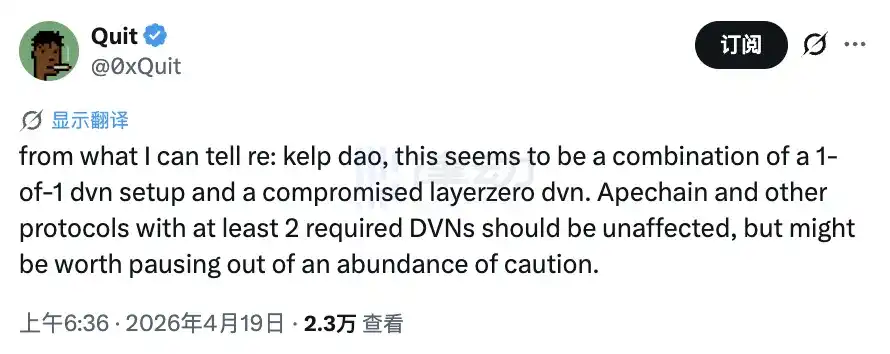
But one thing set this attack apart from most hacking incidents. Kelp DAO's smart contract code had no vulnerabilities. Security researcher @0xQuit, who participated in the investigation, wrote on X, "From what I've gathered so far, this is the result of two issues叠加: a 1-of-1 DVN configuration and the DVN node itself being compromised." LayerZero's official statement also did not mention contract code, framing the issue as an "rsETH vulnerability" rather than a "LayerZero vulnerability."
$293 million, not found in a single line of code. It was hidden in a configuration parameter filled in incorrectly during deployment.

The general logic of DeFi security auditing is: find the contract, read the code, find the vulnerability. This logic works quite smoothly when dealing with code logic vulnerabilities; tools like Slither and Mythril have mature detection capabilities for known patterns like reentrancy attacks and integer overflows. LLM-assisted code auditing, heavily promoted in recent years, also has some capability against business logic vulnerabilities (such as flash loan arbitrage paths).
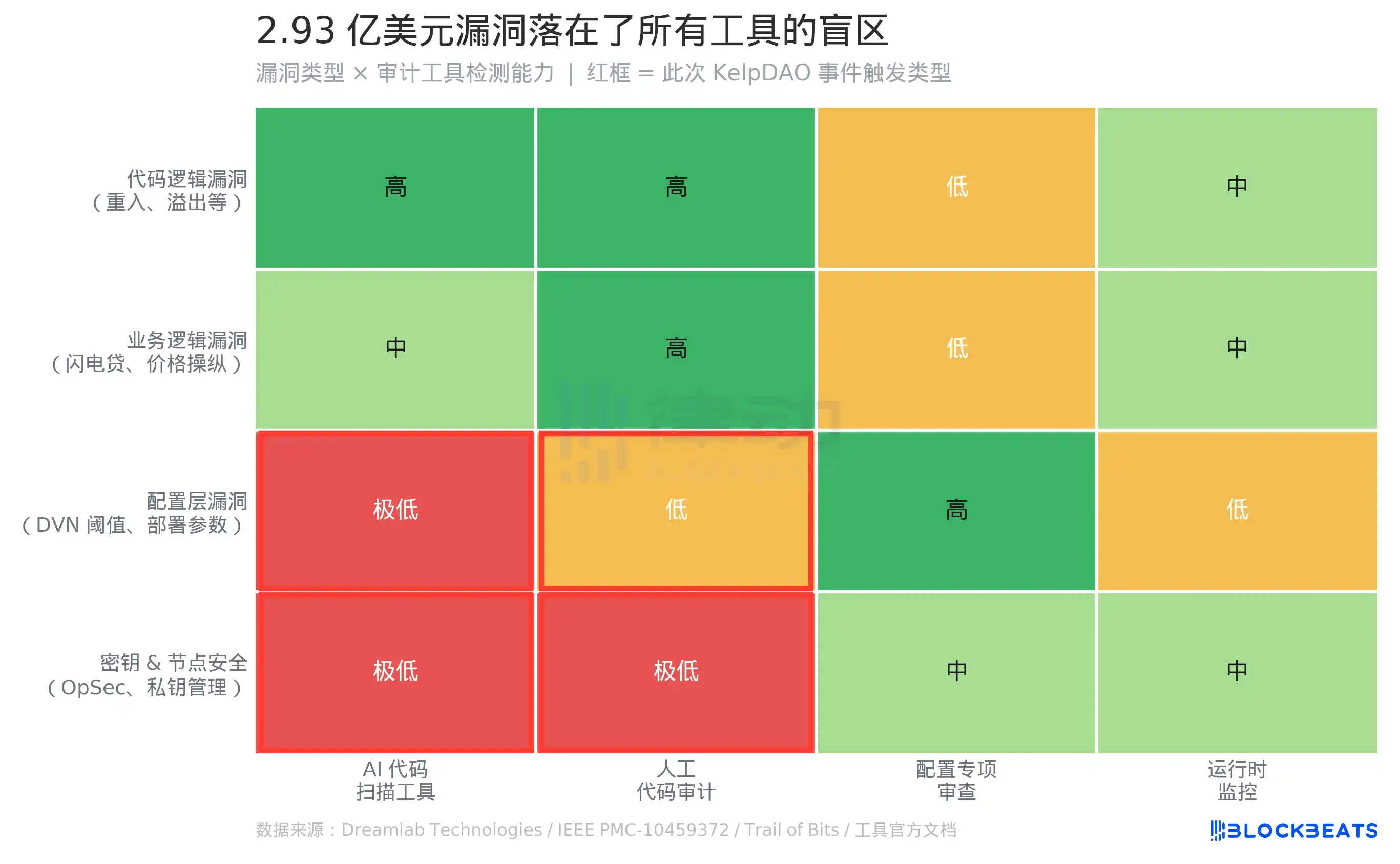
But two rows in this matrix are red.

Configuration-layer vulnerabilities are a structural blind spot in tool-based auditing. The problem with Kelp DAO was not in the .sol files, but in a parameter written during protocol deployment—the DVN threshold. This parameter determines how many validator nodes need to confirm a cross-chain message before it is deemed legitimate. It doesn't enter the code, doesn't enter Slither's scan range, and doesn't enter Mythril's symbolic execution path. According to comparative research by Dreamlab Technologies, Slither and Mythril detected 5/10 and 6/10 vulnerabilities in the tested contracts, respectively, but this achievement is based on the premise that "the vulnerability is in the code." According to IEEE research, even at the code level, existing tools can only detect 8%-20% of exploitable vulnerabilities.

From the perspective of current auditing paradigms, there is no tool that can "detect whether the DVN threshold is reasonable." To detect such configuration risks, what is needed is not a code analyzer, but a specialized configuration checklist: "Number of DVNs used by the cross-chain protocol ≥ N?", "Is there a minimum threshold requirement?" Such questions currently have no standardized tool coverage, nor even widely accepted industry standards.

Also in the red zone are key and node security. @0xQuit's description mentioned the DVN node being "compromised," which falls under operational security (OpSec), beyond the detection boundaries of any static analysis tool. Neither any first-tier auditing firm nor AI scanning tools have the ability to predict whether a node operator's private key will be leaked.

This attack triggered both red zones in the matrix simultaneously.
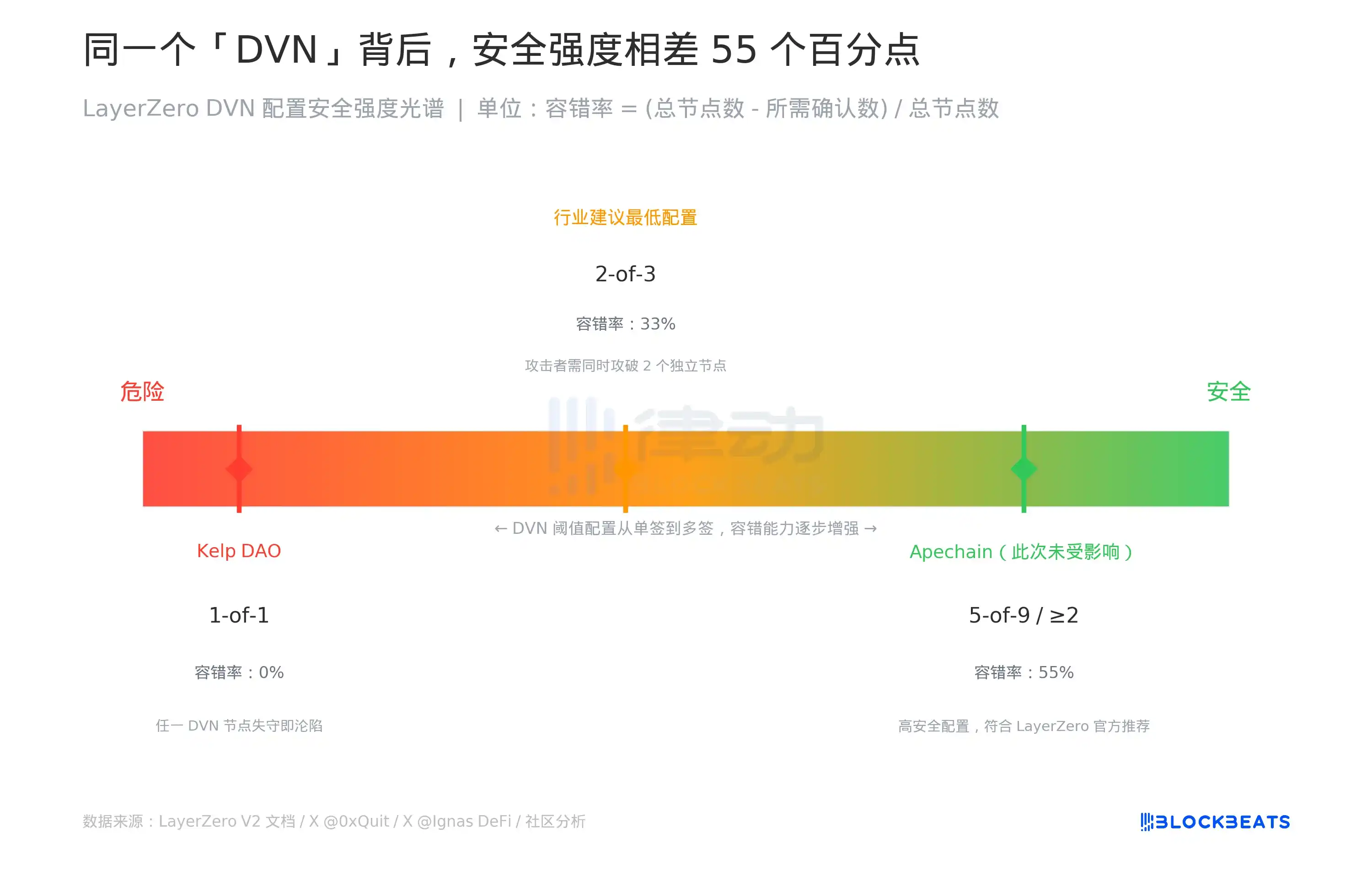
DVN is LayerZero V2's cross-chain message verification mechanism, short for Decentralized Verifier Network. Its design philosophy is to give security decision-making power to the application layer: each protocol integrated with LayerZero can choose how many DVN nodes need to confirm simultaneously before allowing a cross-chain message to pass.

This "freedom" creates a spectrum.

Kelp DAO chose the far left end of the spectrum: 1-of-1, requiring confirmation from only one DVN node. This meant a fault tolerance of zero; the attacker only needed to compromise that one node to forge any cross-chain message. In contrast, Apechain, also integrated with LayerZero, configured more than two required DVNs and was unaffected in this incident. LayerZero's official statement used the wording "all other applications remain secure," the subtext of which is: security depends on which configuration you chose.

The normal industry recommendation is at least 2-of-3, requiring an attacker to compromise two independent DVN nodes simultaneously to forge a message, increasing fault tolerance to 33%. High-security configurations like 5-of-9 can achieve 55% fault tolerance.

The problem is, external observers and users cannot see this configuration. Both might be called "powered by LayerZero," but behind it could be 0% fault tolerance or 55% fault tolerance. Both are called DVN in the documentation.

Veteran crypto investor Dovey Wan, who experienced the Anyswap incident, wrote directly on X: "LayerZero's DVN is actually 1/1 validator...... All cross-chain bridges should immediately conduct a comprehensive security review."
In August 2022, a vulnerability was discovered in the Nomad cross-chain bridge. Someone copied the first attack transaction, made slight modifications, found it also worked—so hundreds of addresses successively began copying, draining $190 million within hours.

Nomad's post-mortem wrote that the vulnerability source was "initializing the trusted root to 0x00 during a routine upgrade." This was a configuration error that occurred during the deployment phase. The Merkle proof verification logic was fine, the code itself was fine; the problem was an initial value filled in incorrectly.

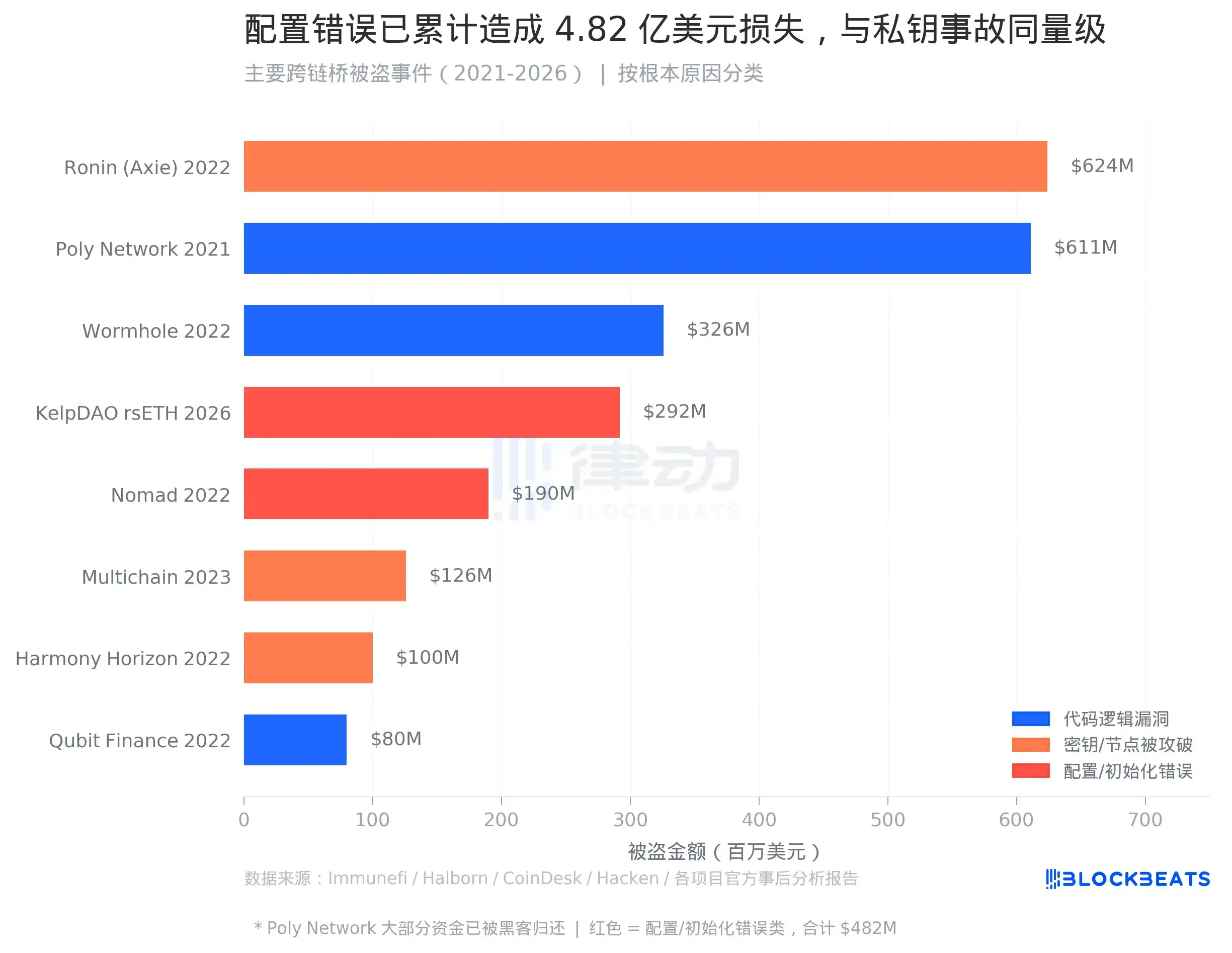
This time, combined with Nomad, configuration/initialization class vulnerabilities have caused approximately $482 million in losses. In the entire history of cross-chain bridge thefts, this category's scale is now comparable to key leak class (Ronin $624 million, Harmony $100 million, Multichain $126 million, totaling approximately $850 million).

But the product design of the code auditing industry has never been targeted at this category.

The most discussed topics in the industry are still code logic vulnerabilities. Wormhole's $326 million hack due to signature verification bypass, Qubit Finance's $80 million theft due to fake deposit events. These cases have complete vulnerability analysis, CVE number analogies, reproducible PoCs, suitable for the training and optimization of auditing tools. Configuration-layer problems are not written in the code and struggle to enter this production cycle.

A noteworthy detail is that the triggering methods of the two configuration-class events were completely different. Nomad accidentally filled in a wrong initial value during a routine upgrade, a mistake. Kelp DAO's 1-of-1 was an active configuration choice—the LayerZero protocol did not prohibit this option, and Kelp DAO did not violate any protocol rules. A "compliant" configuration choice and a "mistaken" initial value ultimately led to the same consequence.
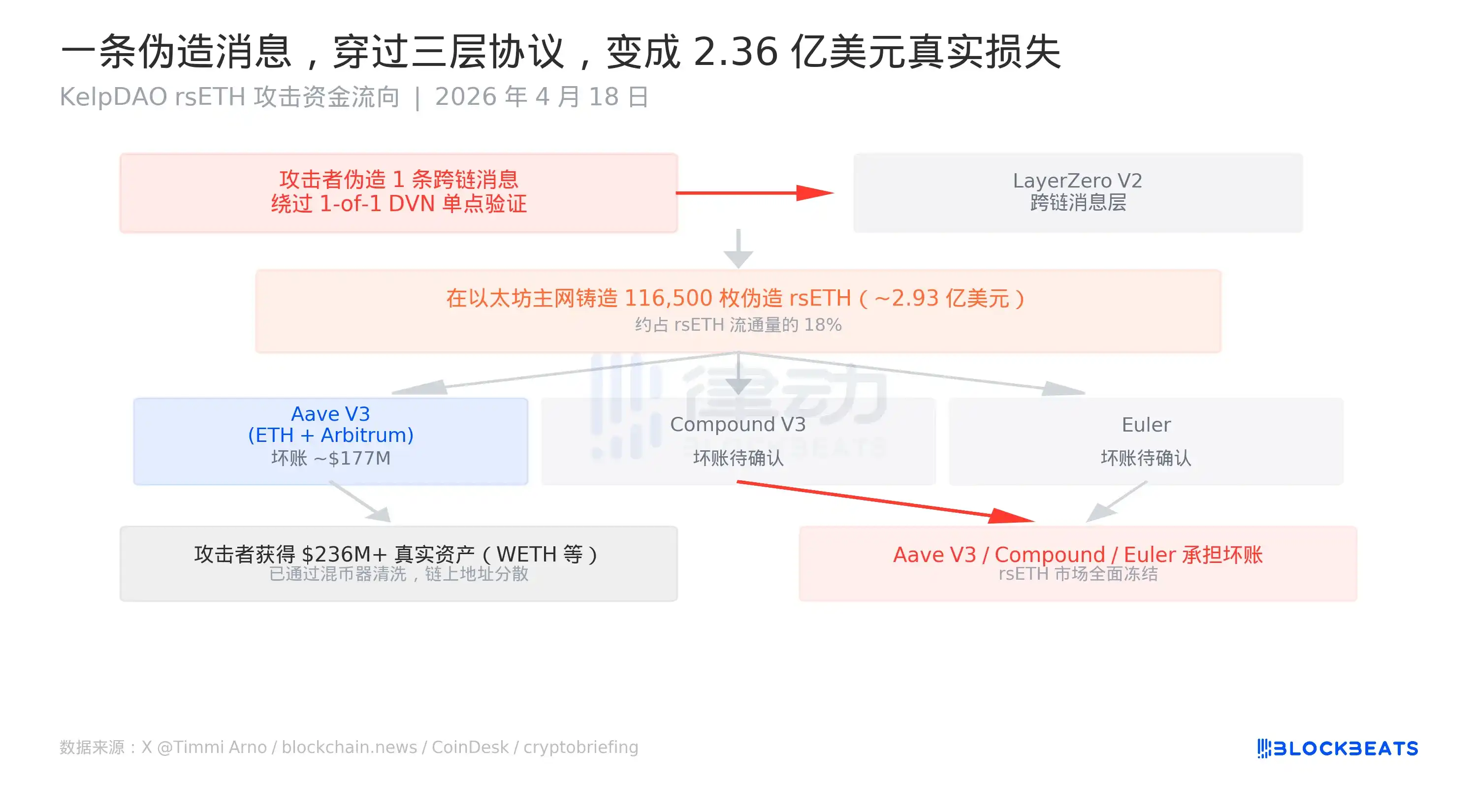
The execution logic of this attack was simple: a forged cross-chain message told the Ethereum mainnet that "equivalent assets have been locked on another chain," triggering the minting of rsETH on the mainnet. The minted rsETH itself had no actual backing, but its on-chain record was "legitimate" and could be accepted as collateral by lending protocols.

The attacker then dispersed the 116,500 rsETH into Aave V3 (Ethereum and Arbitrum), Compound V3, and Euler, borrowing over $236 million in real assets. According to multiple reports, Aave V3 alone faced an estimated bad debt of approximately $177 million. Aave's safety module, Umbrella, has a WETH reserve of about $50 million available to absorb bad debt, covering less than 30%, with the remaining portion to be borne by aWETH stakers.

This bill ultimately fell on those who just wanted to earn a little WETH interest.

LayerZero officials, as of writing, are still jointly investigating with the security emergency response organization SEAL Org, stating they will release a post-mortem report with Kelp DAO after obtaining all information. Kelp DAO stated it is conducting "active remediation."

The $293 million vulnerability was not in the code. The phrase "audit passed" did not cover the location of that parameter.


Связанные с этим вопросы

QWhat was the root cause of the Kelp DAO hack in April 2026, and why was it unusual?

AThe root cause was a configuration vulnerability, specifically a 1-of-1 DVN (Decentralized Verifier Network) threshold setting chosen by Kelp DAO, combined with the compromise of that single DVN node. It was unusual because the smart contract code itself had no vulnerabilities; the flaw was entirely in a deployment configuration choice.

QWhat is a DVN in the context of LayerZero V2, and what security risk did Kelp DAO's configuration introduce?

AA DVN (Decentralized Verifier Network) is LayerZero V2's mechanism for verifying cross-chain messages. It allows applications to choose how many independent DVN nodes must confirm a message for it to be considered valid. Kelp DAO's configuration of a 1-of-1 threshold meant it had zero fault tolerance. An attacker only needed to compromise that one specific node to forge any cross-chain message, creating a critical single point of failure.

QHow do configuration vulnerabilities like the one at Kelp DAO differ from code logic vulnerabilities, and why are they hard to detect with standard auditing tools?

AConfiguration vulnerabilities exist in deployment parameters and initial settings (e.g., DVN threshold), not in the smart contract code itself. Standard auditing tools like Slither and Mythril are designed to scan .sol files for code logic flaws (e.g., reentrancy attacks) but are structurally blind to configuration choices made outside the code during deployment. There are no widely adopted standardized tools or industry norms for auditing these types of risks.

QWhat was the financial impact of the attack on the broader DeFi ecosystem, particularly on lending protocols?

AThe attacker stole 116,500 rsETH (worth ~$293M at the time) by forging a cross-chain message. They then used this unbacked rsETH as collateral to borrow over $236 million in real assets (WETH) from Aave V3, Compound V3, and Euler. Aave V3 faced an estimated $177 million in bad debt, which its safety module could not fully cover, meaning losses were ultimately borne by aWETH stakers.

QHow does the Kelp DAO incident compare to the 2022 Nomad hack, and what do they reveal about a growing category of DeFi risks?

ABoth the Kelp DAO (2026, $293M) and Nomad (2022, $190M) hacks were caused by configuration/initialization vulnerabilities, not code bugs. Together, they represent nearly $4.82 billion in losses from this category. This highlights a significant blind spot in DeFi security, as traditional code audits are not designed to catch misconfigurations or poor parameter choices made during protocol deployment, making them a major and growing risk class alongside key leaks and code exploits.

Похожее

После трёх кварталов падения: получится ли у крипторынка стабилизироваться в третьем квартале?

Криптовалютный рынок пережил худший квартал с 2022 года, общая капитализация упала на 12,6% до $2,1 трлн, а дневные объемы торгов снизились на 20,9%. Впервые за три года сократилась и капитализация стейблкоинов. Основные факторы спада — отток средств из биткоин-ETF, распродажа биткоинов корпоративным казначейством Strategy и ужесточение монетарной политики ФРС. Второй квартал завершился чистым оттоком $46,7 млрд из ETF, при этом в июне отток достиг рекордных $45 млрд. Ключевым событием третьего квартала станет заседание ФРС 28–29 июля. Мягкий сигнал может поддержать биткоин в диапазоне $68 000–84 000 и вернуть приток в ETF, тогда как жесткая риторика способна сместить торговый диапазон к $50 000–56 000. Законодательная неопределенность также давит на рынок: прогресс по закону CLARITY Act, определяющему регуляторные границы, замедлился, и вероятность его принятия в 2026 году упала до 40–45%. Несмотря на общий спад, два сегмента показали рост: объемы на рынках предсказаний выросли на 48,7%, а торговля токенизированными коллекционными предметами увеличилась на 143%. Сектор RWA продолжает стабильно развиваться, достигнув $28,1 млрд. Рынок, вероятно, миновал фазу острой распродажи, но для устойчивого восстановления необходимы ясность от ФРС и регуляторный прогресс.

marsbit16 ч. назад

После трёх кварталов падения: получится ли у крипторынка стабилизироваться в третьем квартале?

marsbit16 ч. назад

BIT Торговые часы: BTC по-прежнему под давлением 200 EMA на недельном графике, после отскока возможен перезапуск нисходящего движения; секторы хранения данных и полупроводников, выросшие ночью, начали падение в вечерней сессии

**Краткий обзор рынка: BTC под давлением, коррекция на рынке акций, внимание к данным и событиям** Рынок криптовалют демонстрирует осторожное восстановление. Bitcoin торгуется около $66 000, сталкиваясь со значительным сопротивлением в районе $68 000, где сосредоточены объемные "застрявшие" позиции. Ключевые технические уровни — 200-недельная скользящая средняя (~$63 333) и 200-недельная EMA (~$68 328). Аналитики отмечают низкую ликвидность, характерную для летнего периода. На фондовом рынке после сильного роста во вторник наблюдается коррекция. Фьючерсы на основные индексы США снижаются. Акции полупроводниковой и памяти, которые резко выросли накануне, падают в ночных торгах. Исключением стал SMCI, который вырос более чем на 15% после оптимистичного прогноза. На общий настрой негативно влияют рост цен на нефть (более $91 за баррель Brent) и доходности государственных облигаций США (10-летние — около 4,64%), что возрождает инфляционные опасения. Азиатские рынки показали нестабильную динамику. Индекс KOSPI в Корее вырос на 0,74%, а японский Nikkei 225 снизился на 0,18%. Основной риск для региона — ослабление японской иены до минимумов с 1986 года, что повышает вероятность вмешательства властей. **Ключевые события для наблюдения:** * **24 июля:** Финансовые отчеты Alphabet (Google), Tesla, IBM. Событие AMD, посвященное ИИ. * **25 июля:** Решение по процентной ставке ЕЦБ и пресс-конференция Кристин Лагард. Финансовые отчеты Intel, American Airlines, Honeywell и других. Данные по числу первичных заявок на пособие по безработице в США.

marsbit16 ч. назад

BIT Торговые часы: BTC по-прежнему под давлением 200 EMA на недельном графике, после отскока возможен перезапуск нисходящего движения; секторы хранения данных и полупроводников, выросшие ночью, начали падение в вечерней сессии

marsbit16 ч. назад

Бывший глава CFTC и президент Circle Тарберт: призывает к долгосрочной стратегии, но сам выводит $30 млн

Бывший председатель CFTC и президент Circle Хит Тарберт, публично пропагандируя долгосрочное видение компании для инвесторов на фоне падения акций на 70% с пиковых значений, сам активно распродавал свои акции CRCL. С момента IPO Circle он по плану 10b5-1 продал более 360 тысяч акций, выручив около 30 миллионов долларов, и при этом ни разу не докупал акции на открытом рынке. Эта разница между его публичными заявлениями и личными действиями вызвала критику. Карьера Тарберта демонстрирует классическое использование «вращающейся двери» между регулирующими органами и частным сектором. Уйдя с поста председателя CFTC в 2021 году, через 27 дней он занял должность главного юрисконсульта в маркет-мейкере Citadel Securities, который в тот момент находился под пристальным вниманием из-за скандала с акциями GameStop. Позже, уже работая в Citadel, Тарберт выступал за расширение полномочий CFTC на крипторынок, в то время как его работодатель планировал выход на этот рынок. В 2023 году Тарберт присоединился к Circle, где его опыт и связи сыграли ключевую роль в успешном проведении IPO компании в 2025 году. Однако его последующие массовые продажи акций, совпавшие с падением котировок и его же призывами к долгосрочным инвестициям, ставят под сомнение искренность его уверенности в будущем компании. Критики видят в его карьере образец превращения регуляторного опыта и политических связей в личную выгоду, в то время как риски несут обычные инвесторы, верящие его нарративам.

marsbit16 ч. назад

Бывший глава CFTC и президент Circle Тарберт: призывает к долгосрочной стратегии, но сам выводит $30 млн

marsbit16 ч. назад

Gate Research: Взлет «уолл-стритизации» криптофинансовых продуктов — это конкуренция или интеграция?

**Аналитический обзор Gate Research Institute: Волна "уолл-стритизации" криптофинансовых продуктов — конкуренция или интеграция?** Создание биткоина в 2009 году было ответом на финансовый кризис и стремлением построить децентрализованную систему без доверенных посредников. Однако к 2026 году значительная часть биткоинов (около 7,14%) хранится через ETF таких гигантов, как BlackRock. Это символизирует глубокую интеграцию традиционных финансов (TradFi) и крипторынка. С появлением биткоин-ETF, фьючерсов, RWA (токенизированных реальных активов) и государственных облигаций на блокчейне, традиционные институты получают всё больше влияния на выпуск, ценообразование, кастодию и дистрибуцию криптоактивов. Однако это не одностороннее поглощение, а взаимодополняющая конвергенция. Криптосфера приносит TradFi глобальную 24/7 ликвидность и программируемость, а TradFi предоставляет криптосфере регулируемые каналы, институциональное доверие и массовый доступ. Яркий пример — две противоположные, но ведущие к одной цели траектории: * **Путь А:** Криптобиржи, такие как Gate, начинают с токенизированных акций и CFD, а затем напрямую подключаются к инфраструктуре традиционных брокеров, предлагая реальную торговлю акциями США, Гонконга и Кореи за стейблкоины. * **Путь Б:** Традиционные брокеры, такие как Robinhood, интегрируют криптоактивы, а затем создают собственные Layer 2 для токенизации своих акций, стремясь к круглосуточной торговле. Обе стратегии нацелены на создание **универсального финансового аккаунта будущего** — единой точки доступа к акциям, криптовалютам, ETF, токенизированным облигациям и другим активам. Ключевой конкурентной борьбой становится не между CEX и брокерами, а между этими "супераккаунтами". Параллельно, слой RWA и токенизированных гособлигаций растёт даже на медвежьем рынке, становясь "прослойкой" для объединения капиталов. Хотя этот рынок (около $150 млрд токенизированных казначейских облигаций) ещё мал по сравнению с традиционным ($30 трлн), он демонстрирует устойчивый структурный тренд, привлекающий крупнейшие финансовые институты (JPMorgan, DTCC и др.). **Вывод:** "Уолл-стритизация" — это не поражение идеалов децентрализации, а формирование новой гибридной модели. Децентрализованные протоколы продолжают работать на базовом уровне, в то время как на уровне приложений и пользовательского опыта формируется более эффективный, глобальный и свободный объединённый рынок капитала, где активы TradFi и DeFi торгуются бок о бок в одном интерфейсе. Уолл-стрит не завоевала криптосферу, а криптосфера не обошла Уолл-стрит — они совместно строят новые финансовые рельсы.

marsbit16 ч. назад

Gate Research: Взлет «уолл-стритизации» криптофинансовых продуктов — это конкуренция или интеграция?

marsbit16 ч. назад

S&P Dow Jones и Pantera выпускают криптоиндекс, биткоин оставлен за бортом из-за «отсутствия прибыли»

Стандард энд Пурс (S&P Dow Jones Indices) совместно с Pantera Capital запускает индекс S&P Pantera Digital Asset Index. Новый индекс включает 18 токенов, но исключает биткоин, XRP и мем-токены. Критерием отбора послужила «финансовая жизнеспособность», по аналогии с S&P 500: протокол должен демонстрировать положительный доход в течение нескольких кварталов и распределять стоимость среди держателей токенов. Это первое применение фундаментального подхода к оценке криптоактивов со стороны крупнейшего в мире провайдера индексов. В первую пятерку активов вошли Ethereum (ETH), BNB, Solana (SOL), TRON (TRX) и Hyperliquid (HYPE). Pantera отмечает, что совокупный годовой доход всех протоколов индекса превышает $30 млрд. Биткоин был исключен по трем причинам: он рассматривается как монетарный актив, доступный через отдельные ETF; он не генерирует доход протокола; а смешивание его в индексе с доходными активами затрудняет фундаментальный анализ для институциональных инвесторов. Пока индекс является эталонным, но Pantera ведет переговоры о создании на его основе ETF и других инвестиционных продуктов. Компания также отмечает значительный разрыв на рынке: многие институциональные инвесторы готовы к аллокации в криптоактивы, но им не хватает структурированных продуктов, фокусирующихся на активах с реальной экономической деятельностью.

marsbit16 ч. назад

S&P Dow Jones и Pantera выпускают криптоиндекс, биткоин оставлен за бортом из-за «отсутствия прибыли»

marsbit16 ч. назад

Торговля

Спот
活动图片




