Telegram Takes Direct Control of TON, Social Traffic Reshapes Public Chain Narrative

Odaily星球日报Опубликовано 2026-05-11Обновлено 2026-05-11

Введение

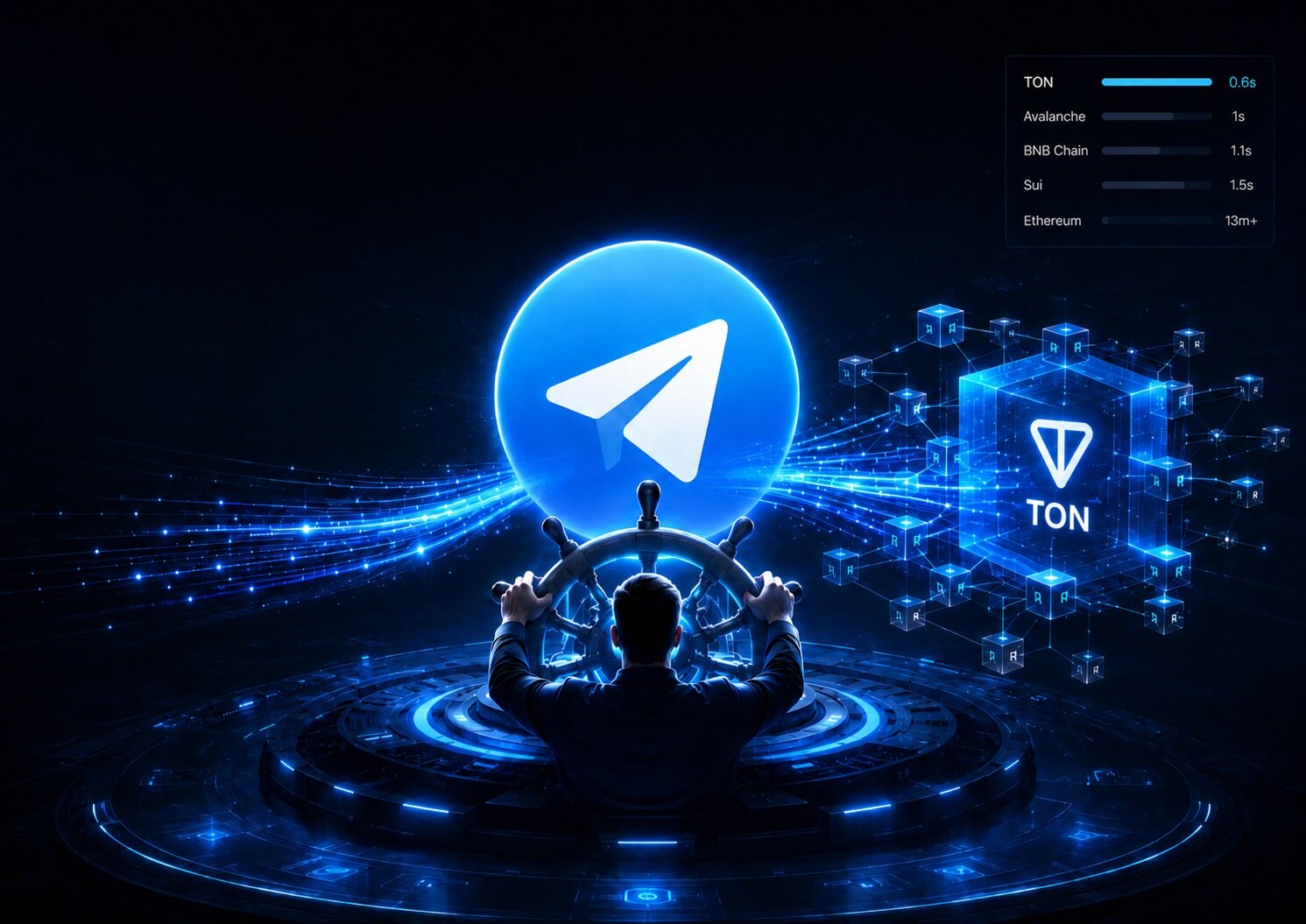
Telegram's founder, Pavel Durov, has announced a major shift in the development of The Open Network (TON). Telegram will now become the core driver of TON, replacing the TON Foundation and becoming its largest validator. The focus will be on technical upgrades over the next few weeks, including slashing network fees by six times to near-zero and improving finality time to 0.6 seconds. This move signifies a deeper integration between Telegram and TON, moving beyond just providing a user base. The goal is to transform Telegram's vast social traffic and built-in features—like Mini Apps, payments, and bots—into sustainable, on-chain usage scenarios. The reduced fees and faster speeds are crucial for enabling the small, frequent transactions typical of social interactions. While this promises stronger execution and product alignment, it raises questions about centralization. Durov argues Telegram's involvement will attract more validators, enhancing decentralization, but the outcome remains to be seen. Additionally, TON's high annual staking reward of 18.8% aims to retain capital within the ecosystem. The key challenge for TON is no longer just leveraging Telegram's entry point, but becoming an invisible, seamless infrastructure layer within Telegram's daily use. Its success hinges on converting viral attention into lasting, embedded utility.

Original | Odaily Planet Daily(@OdailyChina)

Author | Asher(@Asher_ 0210)

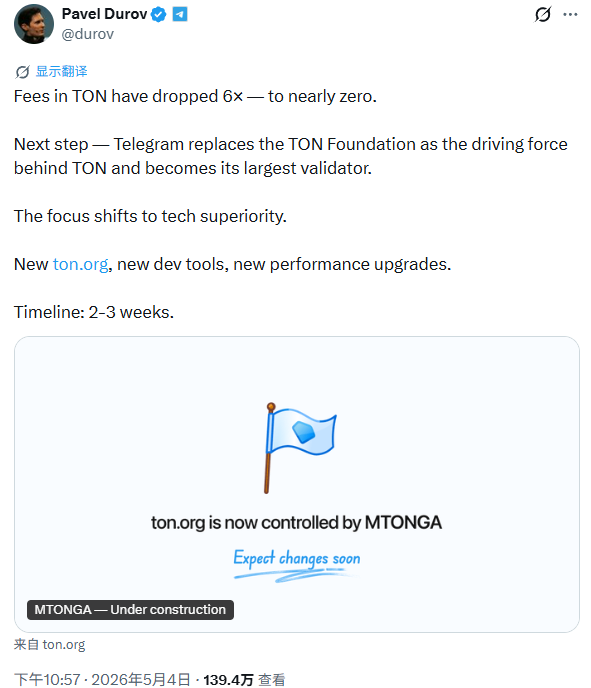
On May 4th, Pavel Durov, the founder of Telegram, stated on platform X that TON network fees have been reduced sixfold, now nearly zero. More crucially, he announced that Telegram will replace the TON Foundation to become the new core driver of the TON network and its largest validator. TON's upcoming focus will shift to technical advantages, including a new ton.org, new developer tools, and performance upgrades, all within the next 2 to 3 weeks.

Telegram Founder: TON Fees Reduced 6x, Telegram to Become Largest Validator

Previously, the relationship between TON and Telegram was more like a strong binding with weak leadership. Telegram provided the entry point, while the Foundation and community were responsible for driving progress, maintaining a certain distance. But this time, Telegram is not just continuing to bring users to TON; it's starting to enter more fundamental positions like validator, technical roadmap, and development tools. TON is no longer just a chain adjacent to the Telegram ecosystem; it's being reintegrated into Telegram's product system.

TON Never Lacked an Entry Point; It Lacked Turning That Entry into Usage Scenarios

Past market discussions about TON often revolved around Telegram's user scale. But for a public chain, having an entry point does not equal having an ecosystem, and having user reach does not equal having long-term usage. The unique aspect of TON is its inherent connection to a high-frequency social platform, where Mini Apps, wallets, channels, bots, games, and payments already exist within Telegram. This means TON doesn't have to start from scratch to find users like most Layer1s. However, if these scenarios cannot translate into sustained on-chain interactions, Telegram's traffic can only bring waves of short-term hype.

Projects like Notcoin and Dogs have already proven that Telegram can quickly generate viral spread. Simple gameplay combined with social connections can indeed attract a massive number of users into crypto applications in a short time. But such explosions come and go quickly. TG mini-games and airdrops can bring attention but can hardly sustain a long-term ecosystem alone.

Therefore, the fee reduction, speed improvements, developer tools, and validator role emphasized by Pavel Durov this time point not to a single technical upgrade, but to TON addressing its most crucial missing piece — turning Telegram's entry point into sustainable usage scenarios. When fees are low enough, confirmation speeds are fast enough, and developer integration is simple enough, actions like channel tipping, Mini App tasks, game rewards, creator revenue, ad revenue sharing, bot calls, and small group payments have the potential to evolve from product features into on-chain activities.

TON doesn't need to repeat the story of "backed by Telegram." What it truly needs to prove is whether the high-frequency behaviors within Telegram can be supported by TON.

Fee Reduction and Speed Boost Are for Smaller, Higher-Frequency Transactions

The fee reduction by TON this time cannot be understood merely as a regular public chain cost optimization. Viewed within the context of Telegram, it genuinely addresses whether small, high-frequency interactions can be viable.

Potential on-chain behaviors within Telegram are mostly not large transfers but more fragmented daily operations. The amount per transaction is small, but the frequency is high. If users have to perceive fees, wait for confirmations, and repeatedly handle wallet interactions with every button click, such scenarios would struggle to truly take off.

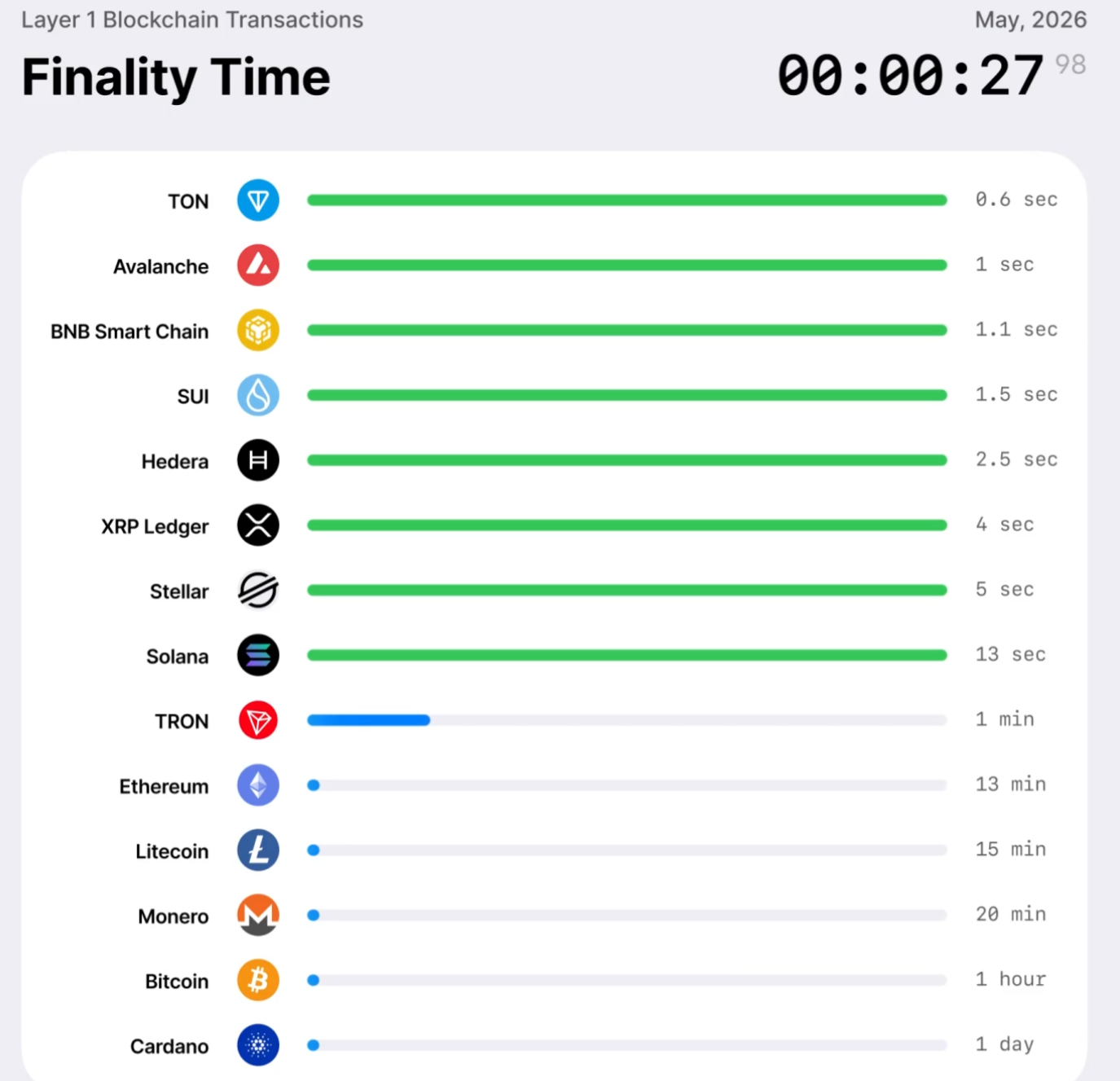
Therefore, fee reduction and speed improvement must be considered together. Near-zero fees lower the barrier to entry; reducing final confirmation time to 0.6 seconds lowers the perception of waiting. For Telegram, the chain shouldn't be an extra layer perceived by users; it should be hidden behind product actions like sending messages, clicking buttons, and balance changes as much as possible.

Comparison of "Finality Time" Among Mainstream Public Chains

This is also where TON differs from many Layer1s. It's not solely about making DeFi transactions faster or transfers cheaper; it's about embedding the chain into Telegram's daily usage. Only when costs, wait times, and wallet operations are sufficiently minimized can TON potentially evolve from a Telegram-related public chain into an underlying network directly accessible by the Telegram application layer.

From Entry Point to Validator, Telegram Begins Delving into TON's Core

Telegram becoming TON's largest validator is the most significant step in this change. It signifies that Telegram is no longer just providing TON with an entry point and brand endorsement; it's entering the network's security and operational mechanisms. Previously, TON was driven by the Foundation and community, which offered greater openness but a more dispersed pace. Now, with Telegram directly involved, products, wallets, Mini Apps, payments, and developer tools have the opportunity to be realigned under a single vision.

Efficiency will increase, but so will controversy. Telegram replacing the TON Foundation as the primary driving force and becoming the largest validator will inevitably lead to renewed discussions about TON's centralization risks. In response, Pavel Durov stated that Telegram's participation would attract more large-scale participants into the validator pool, thereby enhancing decentralization. This logic isn't unfounded, but the outcome matters more than the statement.

The truly important aspects going forward are whether the validator structure can become more diverse, whether governance information is sufficiently transparent, whether the Foundation and community still have independent space, and whether ecosystem projects can continue to develop without depending on Telegram's will.

Therefore, Telegram's return isn't purely positive news; it's a trade-off. For TON to enter the mainstream application layer, it needs Telegram's strong execution capability. But the more prominent Telegram becomes, the more TON needs to prove it's not merely an internal settlement chain serving Telegram.

High Staking Rewards Retain More Value for TON

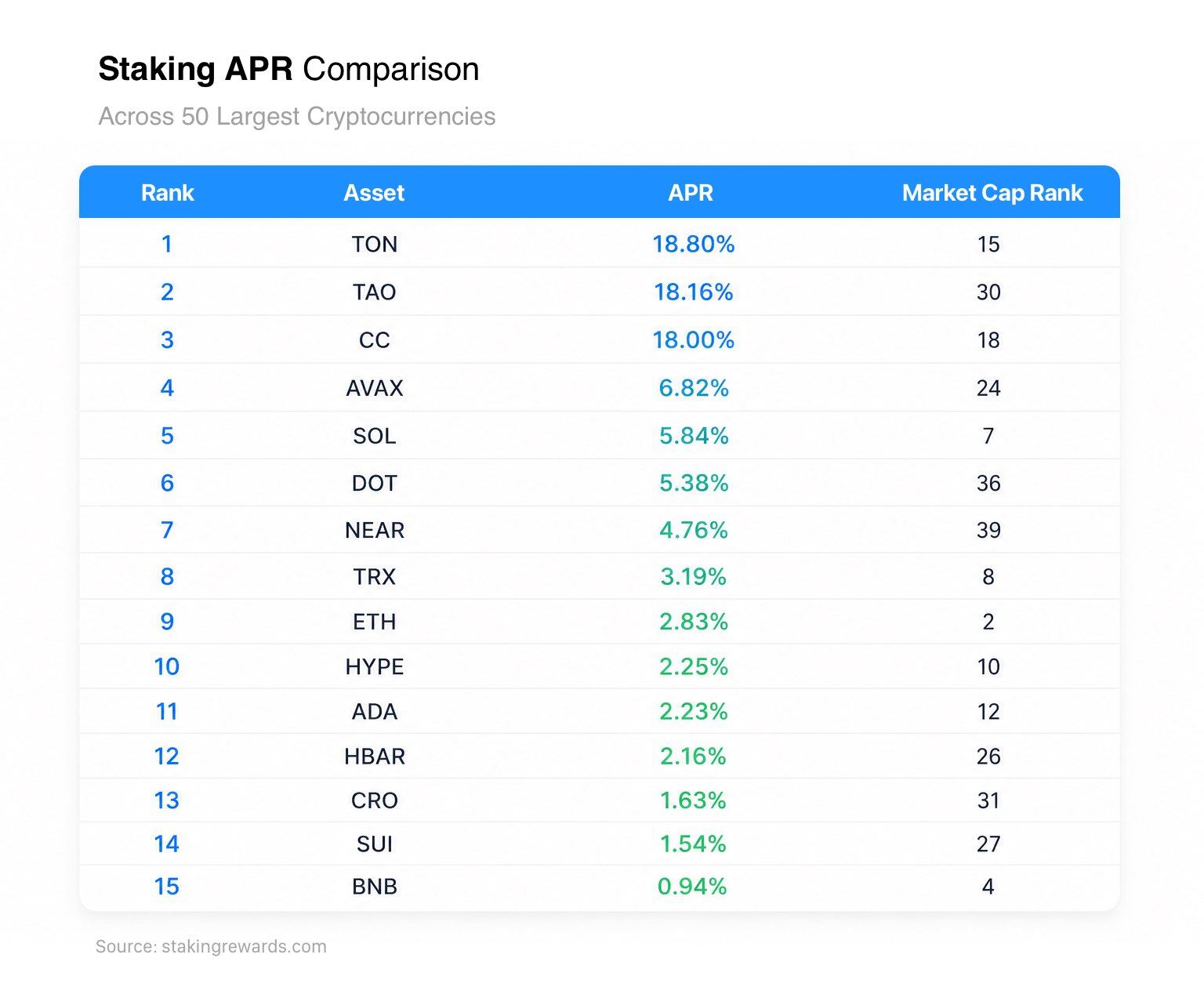
Pavel Durov subsequently emphasized that TON ranks first in annual staking rewards among the top 50 cryptocurrencies by market cap, with a high rate of 18.8%. Compared to fee reductions and speed improvements, high staking rewards are more likely to stir capital sentiment, giving TON an additional reason for holding in the eyes of the market.

TON Annual Staking Reward Ranks First Among Top 50 Cryptocurrencies

This also makes TON's story somewhat more complete. It doesn't just rely on Telegram's user entry to attract attention or improve experience through technical upgrades; it's also using staking rewards to keep capital within the ecosystem. The simultaneous emergence of entry point, performance, validator role, and yield gives this change more weight than a single positive factor.

Of course, high yield itself is not the end goal; it's more like buying TON a longer observation period. If subsequent developer tools and performance upgrades are delivered, and more capital is locked into the network, it could form a positive feedback loop with real usage. For TON, the value of staking rewards isn't just about increasing holding returns; it's about making the market willing to continue waiting for it to truly convert Telegram's entry advantage.

TON Returning to Telegram Is Not the Finish Line, But a More Difficult Hurdle

The key for TON going forward is not to continue leveraging Telegram for traffic, but to truly become part of Telegram's application ecosystem. If Telegram's chatting, payments, applications, creator economy, and automated interactions are gradually handled by TON, then TON's competitors would not just be other Layer1s, but all networks attempting to become the next-generation application infrastructure.

TON isn't just retelling the social traffic story; it's beginning to attempt to turn social traffic into on-chain order. The entry point is just the beginning; usage is the answer. Telegram can bring TON to the forefront, but whether it stays depends ultimately on TON's ability to become that layer of infrastructure operating behind user perception, within application mechanics.

If past TON was proving how close it was to Telegram, now it must prove how deeply it can integrate into Telegram's daily usage. True mainstream adoption isn't making users aware they're using a chain; it's making the chain an integral part of the application experience.

TON's opportunity lies here, and so does its pressure.

Связанные с этим вопросы

QWhat are the key changes announced by Telegram regarding the TON network according to the article?

AThe article states that Telegram founder Pavel Durov announced that TON network fees have been reduced sixfold, to near-zero levels. Crucially, Telegram will replace the TON Foundation as the network's core driver and become its largest validator. The focus will shift to technical advantages like a new ton.org, new developer tools, and performance upgrades over the next 2-3 weeks.

QHow does the article explain the previous relationship between TON and Telegram, and what is the significance of the new change?

APreviously, the relationship was described as 'strongly bound but weakly led.' Telegram provided the entry point, while the Foundation and community drove development, with a layer of separation. The new change signifies that Telegram is moving beyond just providing users and is now entering more foundational layers like validation, technical direction, and development tools. TON is being reintegrated into Telegram's product system.

QAccording to the article, why are the fee reduction and speed increase on TON particularly important in the context of Telegram?

AThe fee reduction and speed increase are crucial for enabling small-scale, high-frequency transactions within Telegram's ecosystem. Potential on-chain activities in Telegram, such as tipping, mini-app rewards, and group payments, involve small, frequent amounts. Near-zero fees lower the usage barrier, and a faster finality time (0.6 seconds) reduces the perception of waiting, allowing the blockchain to operate seamlessly behind user actions.

QWhat potential concern does the article raise about Telegram becoming the largest validator for TON?

AThe article raises concerns about increased centralization risk. Telegram replacing the TON Foundation as the main driving force and becoming the largest validator could lead to debates about TON's decentralization. While Pavel Durov argued this would attract more large participants to the validator pool, the article emphasizes the need to judge by results—such as validator diversity, transparent governance, and the independent space for the community—rather than just statements.

QWhat is the 'harder challenge' TON faces now, as described in the article's conclusion?

AThe article concludes that the harder challenge is for TON to move beyond leveraging Telegram for traffic and truly become an integral part of Telegram's application ecosystem. It must prove it can integrate deeply into daily Telegram use—like chat, payments, apps, and automated interactions—becoming the underlying infrastructure for application experience. True mainstream adoption means users don't perceive they are using a blockchain; the chain is just part of the app.

Похожее

U.S. Government Bans Foreign Nationals from Using Fable 5, Anthropic Issues Rebuttal

U.S. Government Bans Foreign Access to Fable 5, Anthropic Issues Rebuttal On June 12th, the U.S. government ordered AI company Anthropic to immediately suspend all foreign access—including foreign nationals within the U.S. and Anthropic's own foreign employees—to its newly released Fable 5 and Mythos 5 AI models, citing national security concerns. This forced Anthropic to temporarily disable access to both models for all users globally, as it cannot technically differentiate user nationality at scale. The models, released just three days prior, represent Anthropic's highest public capability tier. Fable 5 is the first publicly available model from the advanced "Mythos" family, while Mythos 5 is a less-restricted version for approved cybersecurity and critical infrastructure partners. The government's directive was reportedly triggered by claims from another company that it could "jailbreak" Mythos 5, raising alarm within the Trump administration. Anthropic, in a detailed public statement, strongly challenged this rationale. The company argues the demonstrated "jailbreak" is a narrow, non-generalized technique that merely involves identifying minor, known software vulnerabilities—a capability common to other publicly available models like OpenAI's GPT-5.5 and routinely used by cybersecurity defenders. Anthropic stated it has complied with the order but disagrees with the government's standard, warning that applying it industry-wide would halt all new frontier model deployments. The company criticized the lack of a transparent, fact-based legal process and expressed confidence the situation stems from a misunderstanding. It is working to restore access and will release more technical details within 24 hours. Other Anthropic models remain unaffected.

链捕手18 мин. назад

U.S. Government Bans Foreign Nationals from Using Fable 5, Anthropic Issues Rebuttal

链捕手18 мин. назад

The Revelation from the Raydium Theft Incident: New DeFi Vulnerabilities Lurking in Forgotten Old Contracts

**Raydium Exploit Reveals DeFi's Hidden Risk: Forgotten "Zombie" Contracts** A recent attack on Raydium's deprecated V3 AMM pools resulted in a loss of approximately $1.34 million. The hacker exploited pools that were no longer supported by Raydium's current UI or SDK but remained fully functional and accessible on-chain. This incident highlights a critical, often overlooked category of risk in DeFi: inactive or legacy smart contracts that projects fail to properly decommission. Since March 2025, there have been at least 8 publicly reported attacks targeting such abandoned contracts, with total losses around $10.8 million. Including older pools and deprecated features, the count rises to 10 incidents with roughly $22.5 million in losses. These "zombie contracts" represent a lifecycle management failure rather than a code vulnerability, yet they are typically misclassified under general "code bug" categories in security reports, masking the true scale of the problem. The root cause is that projects often merely document a contract as "deprecated" without taking essential technical steps to secure it: withdrawing remaining assets, disabling external call functions, and implementing ongoing monitoring. These forgotten, under-monitored components become prime targets for attackers. To address this, the industry needs to recognize "zombie contracts" as a distinct risk category and establish standardized decommissioning protocols. Essential steps should include: 1) a formal retirement announcement, 2) removal of all front-end integrations, 3) withdrawal of locked assets, 4) disabling key contract functions, 5) ongoing security monitoring, 6) clear user communication, and 7) a post-mortem analysis. The value of a DeFi project lies not only in its current TVL but also in the security of its historical codebase, which has now become a new attack surface.

Foresight News2 ч. назад

The Revelation from the Raydium Theft Incident: New DeFi Vulnerabilities Lurking in Forgotten Old Contracts

Foresight News2 ч. назад

Robots Begin to 'Consume Data': The Hidden Production Chain from Indian Data Factories to Billion-Dollar Humanoid Robots

Robots have started to 'consume data,' driving the formation of a new industrial supply chain focused on producing training data for embodied AI. Unlike large language models, which are trained on vast internet text corpora, embodied AI models face a 'data desert' in the physical world. This has created a massive demand for first-person perspective video data (Ego Data), captured by workers wearing cameras in places like Indian garment factories. Companies like Neocambrian AI are establishing 'data factories' where workers perform standardized tasks (e.g., sorting clothes, kitchen organization) to generate thousands of hours of video. Research, such as NVIDIA's EgoScale, demonstrates that scaling this human demonstration data predictably improves robot performance, particularly for dexterous manipulation. This has validated a training path combining large-scale human data for pre-training with smaller amounts of robot-specific data for fine-tuning. The value of different data types varies significantly, forming a 'data pyramid.' The base consists of low-cost, large-scale internet and Ego Data. Higher layers include more expensive motion-capture data (e.g., from data gloves), simulation/synthetic data, and the most costly and scarce layer: real robot teleoperation data. This demand has spawned a layered ecosystem of data suppliers: low-cost data factories, motion capture and alignment specialists, robot-native teleoperation service providers, simulation data companies, and platforms aiming for data standardization. Robot companies themselves are adopting a 'layered procurement' strategy: outsourcing generic Ego Data while building in-house capabilities for robot-specific adaptation data and the critical deployment/failure data generated in real-world applications. The industry is shifting focus from hardware and basic mobility to the data pipelines required for general-purpose capability. While parallels exist to data labeling companies like Scale AI in the LLM boom, the physical complexity of robot data—involving action success ambiguity and sim-to-real gaps—requires more integrated solutions for data collection, annotation, and a continuous feedback loop. The race is on to build the data engines that will teach robots to operate reliably in the unstructured real world.

marsbit4 ч. назад

Robots Begin to 'Consume Data': The Hidden Production Chain from Indian Data Factories to Billion-Dollar Humanoid Robots

marsbit4 ч. назад

Торговля

Спот
Фьючерсы

Популярные статьи

Как купить TON

Добро пожаловать на HTX.com! Мы сделали приобретение TONCOIN (TON) простым и удобным. Следуйте нашему пошаговому руководству и отправляйтесь в свое крипто-путешествие.Шаг 1: Создайте аккаунт на HTXИспользуйте свой адрес электронной почты или номер телефона, чтобы зарегистрироваться и бесплатно создать аккаунт на HTX. Пройдите удобную регистрацию и откройте для себя весь функционал.Создать аккаунтШаг 2: Перейдите в Купить криптовалюту и выберите свой способ оплатыКредитная/Дебетовая Карта: Используйте свою карту Visa или Mastercard для мгновенной покупки TONCOIN (TON).Баланс: Используйте средства с баланса вашего аккаунта HTX для простой торговли.Третьи Лица: Мы добавили популярные способы оплаты, такие как Google Pay и Apple Pay, для повышения удобства.P2P: Торгуйте напрямую с другими пользователями на HTX.Внебиржевая Торговля (OTC): Мы предлагаем индивидуальные услуги и конкурентоспособные обменные курсы для трейдеров.Шаг 3: Хранение TONCOIN (TON)После приобретения вами TONCOIN (TON) храните их в своем аккаунте на HTX. В качестве альтернативы вы можете отправить их куда-либо с помощью перевода в блокчейне или использовать для торговли с другими криптовалютами.Шаг 4: Торговля TONCOIN (TON)С легкостью торгуйте TONCOIN (TON) на спотовом рынке HTX. Просто зайдите в свой аккаунт, выберите торговую пару, совершайте сделки и следите за ними в режиме реального времени. Мы предлагаем удобный интерфейс как для начинающих, так и для опытных трейдеров.

3.2k просмотров всегоОпубликовано 2024.03.29Обновлено 2026.06.02

Как купить TON

Обсуждения

Добро пожаловать в Сообщество HTX. Здесь вы сможете быть в курсе последних новостей о развитии платформы и получить доступ к профессиональной аналитической информации о рынке. Мнения пользователей о цене на TON (TON) представлены ниже.

活动图片