‘Technologically impossible’: Could Kentucky bill threaten crypto self-custody?

ambcryptoОпубликовано 2026-03-20Обновлено 2026-03-20

Введение

Kentucky's proposed HB 380 amendment aims to regulate cryptocurrency kiosks but includes a controversial provision requiring hardware wallet providers to reset users' seed phrases upon request. The Bitcoin Policy Institute warns this measure would effectively outlaw self-custody, calling it "technologically impossible" and a violation of Bitcoin’s core security principles. They argue it would push users toward centralized custodians, increasing vulnerability to hacks. The amendment, added last minute, has drawn criticism for potentially infringing on residents' rights to secure their digital assets. Meanwhile, only seven U.S. states have established strategic Bitcoin reserves, with the federal government holding the largest share globally.

Kentucky is under scrutiny ahead of its planned passage of a key crypto legislation that would ban self-custody wallets.

According to the Bitcoin Policy Institute, a research and advocacy group, Kentucky’s HB 380 amendment would harm residents. The firm noted,

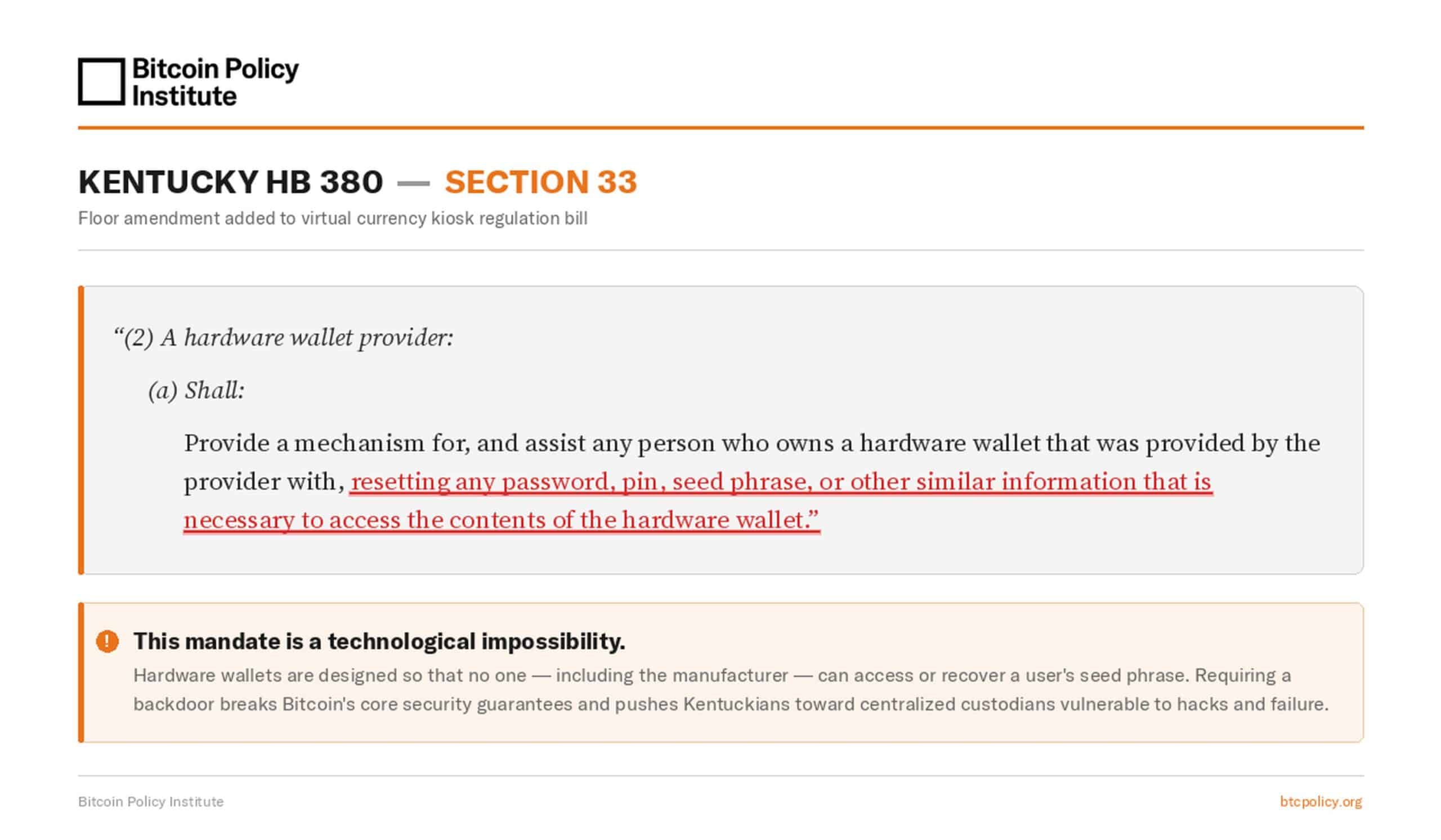
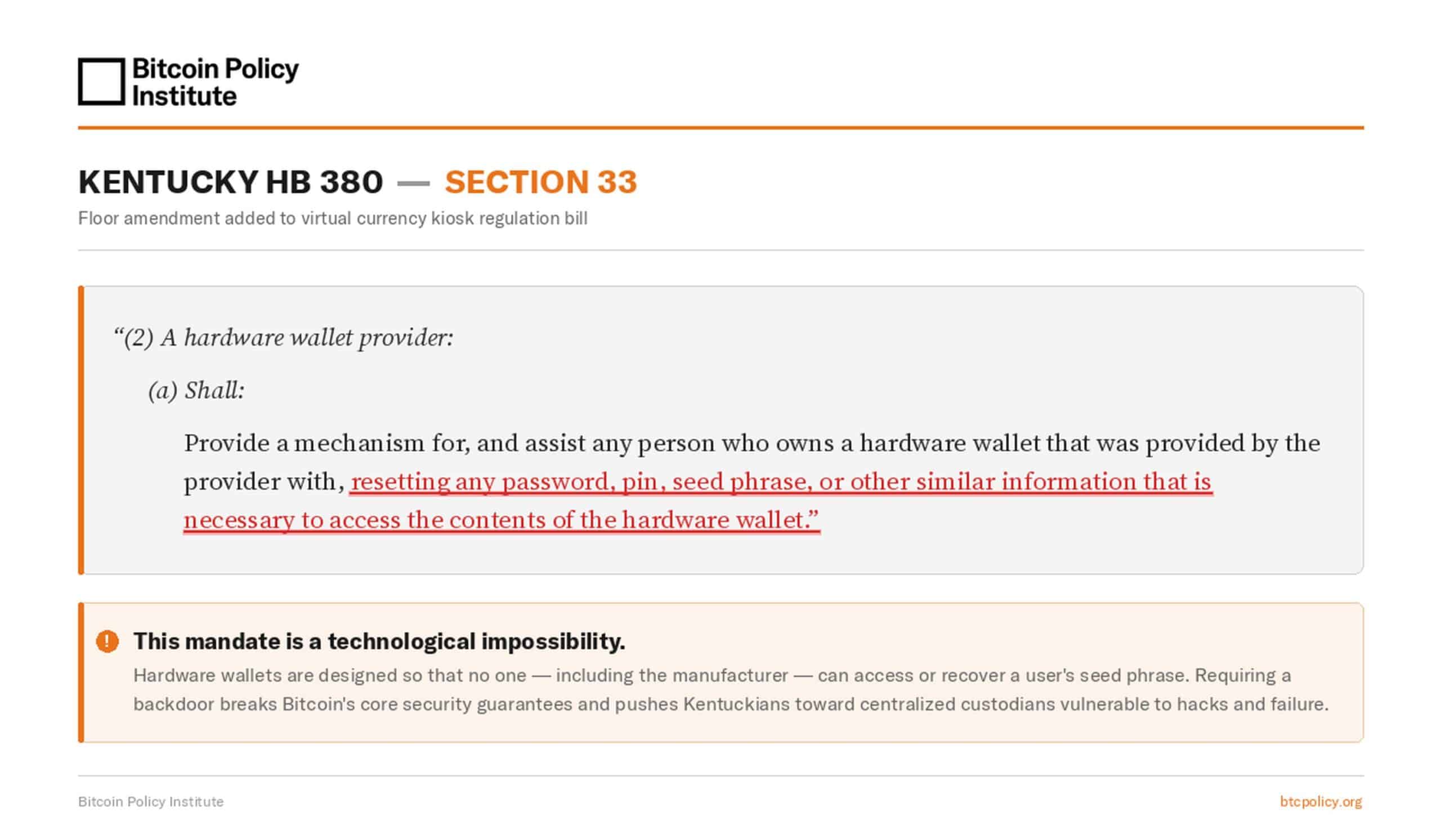
BPI has just learned of an amendment buried in Kentucky HB 380 that would require hardware wallet providers to reset users’ seed phrases on request. This would effectively outlaw self-custody in Kentucky.
Source: BPI

Kentucky crypto plans

The HB 380 is an amendment to the 77-page virtual currency kiosk legislation, part of a broader effort to regulate crypto ATMs, especially those that facilitate BTC transfers.

It was a last-minute amendment added in January. It requires hardware providers to be able to reset and recover users’ hardware wallet passwords and seed phrases, something BPI called ‘technologically impossible.’

The mandate is technologically impossible for non-custodial wallets. Requiring a backdoor for seed phrase recovery breaks Bitcoin’s fundamental security guarantees and pushes users toward centralized custodians that are vulnerable to hacks and failures.

The advocacy group wrote to the Kentucky Senate, informing it of the harmful nature of the amendment’s language. It added that the legislators should “protect Kentucky constituents’ right to secure their property.”

However, one analyst noted that ‘commercial hardware wallets’ are vulnerable to government overreach because their parent firms are legal entities operating in different jurisdictions.

Race for strategic Bitcoin reserve

Last year, at the state level, the race for the strategic Bitcoin reserve (SBR) became hot. But, as of 2026, only a handful of states in the U.S. have managed to codify the plans into law. Currently, only seven states have approved an SBR, including Arizona, Texas, and New Mexico.

At the federal level, however, there’s been little commitment or update on whether the U.S. SBR will be established. Even so, the U.S. now holds 328,272 BTC, about 1.5% of the total supply.

This was nearly half of the total 650,296 BTC held by governments, making the U.S. the top holder, followed by China at 190,000 BTC and the UK at 61,245 BTC.


Final Summary

  • The Bitcoin Policy Institute pressed the Kentucky Senate to reconsider its recent amendment on crypto ATM rules to safeguard self-custody.
  • There are about 7 U.S. states with approved strategic BTC reserve frameworks.

Связанные с этим вопросы

QWhat is the main concern raised by the Bitcoin Policy Institute regarding Kentucky's HB 380 amendment?

AThe Bitcoin Policy Institute is concerned that the amendment would require hardware wallet providers to reset users' seed phrases on request, which they call 'technologically impossible' and argue it would effectively outlaw self-custody in Kentucky.

QWhy does the Bitcoin Policy Institute claim the mandate in HB 380 is 'technologically impossible'?

AThey state it is technologically impossible for non-custodial wallets because requiring a backdoor for seed phrase recovery breaks Bitcoin's fundamental security guarantees.

QWhat is the primary purpose of the broader HB 380 legislation that this amendment is a part of?

AHB 380 is an amendment to virtual currency kiosk legislation, which is part of a broader effort to regulate crypto ATMs, especially those that facilitate BTC transfers.

QHow many U.S. states have approved a strategic Bitcoin reserve (SBR) framework as of 2026, according to the article?

AAs of 2026, seven U.S. states have approved a strategic Bitcoin reserve framework.

QWhich country is the largest government holder of Bitcoin, and how much does it hold?

AThe United States is the largest government holder of Bitcoin, with 328,272 BTC, which is about 1.5% of the total supply.

Похожее

Why Do You Always Lose Money on Polymarket? Because You're Betting on News, While the Pros Read the Rules

Why do you always lose money on Polymarket? Because you bet on news, while the pros study the rules. This article explains how top traders ("che tou") profit by meticulously analyzing market rules, not just predicting events. Polymarket, a prediction market platform, often sees disputes over event outcomes due to ambiguous rule wording. For instance, a market asking "Who will be the leader of Venezuela by the end of 2026?" was misinterpreted by many who bet on Delcy Rodríguez, assuming she held power. However, the rules specified "officially holds" as the formally appointed, sworn-in individual. Since Nicolás Maduro was still recognized as president officially, he won the market—even being in prison. To resolve such disputes, Polymarket uses a decentralized arbitration system via UMA protocol. The process involves: 1. Proposal: Anyone can propose a market outcome by staking 750 USDC, earning 5 USDC if unchallenged. 2. Dispute: A 2-hour window allows challenges with a 750 USDC stake; successful challengers earn 250 USDC. 3. Discussion: A 48-hour period on UMA Discord for evidence and debate. 4. Voting: UMA token holders vote in two 24-hour phases (blind then public). Outcomes require >65% consensus and 5M tokens voted; otherwise, four re-votes occur before Polymarket intervention. 5. Settlement: Results are final and automatic. Unlike traditional courts, Polymarket’s system lacks separation between arbitrators and stakeholders—voters often hold market positions, creating conflicts of interest. This leads to herd mentality in discussions and non-transparent outcomes without explanatory rulings, preventing precedent formation. Thus, success on Polymarket hinges on deep rule interpretation, not just event prediction, exploiting gaps between reality and contractual wording.

marsbit35 мин. назад

Why Do You Always Lose Money on Polymarket? Because You're Betting on News, While the Pros Read the Rules

marsbit35 мин. назад

DeepSeek Funding: Liang Wenfeng's 'Realist' Pivot

DeepSeek, a leading Chinese AI company, has initiated its first external funding round, aiming to raise at least $300 million at a valuation of no less than $10 billion. This move marks a significant shift from its founder Liang Wenfeng’s previous idealistic stance of rejecting external capital to maintain independence. Despite strong financial backing from its parent company, quantitative trading firm幻方量化 (Huanfang Quant), which provided an estimated $700 million in revenue in 2025 alone, DeepSeek faces mounting challenges. Key issues include a 15-month gap in major model updates, delays in its flagship V4 release, and the loss of several core researchers to competitors offering significantly higher compensation. The company is also undergoing a strategic pivot by migrating its infrastructure from NVIDIA’s CUDA to Huawei’s Ascend platform, a move aligned with China’s push for technological self-reliance amid U.S. export controls. However, DeepSeek lags behind rivals like智谱AI and MiniMax—both now publicly listed—in areas such as product ecosystem, multimodal capabilities, and commercialization. The funding round, though relatively small in scale, is seen as a way to establish a market-validated valuation anchor, making employee stock options more competitive and facilitating talent retention. It also signals DeepSeek’s transition from a pure research-oriented organization to a commercially-driven player in the global AI ecosystem.

marsbit1 ч. назад

DeepSeek Funding: Liang Wenfeng's 'Realist' Pivot

marsbit1 ч. назад

Торговля

Спот
Фьючерсы
活动图片