Suspending IPO but Accelerating Expansion: Kraken's 'Strategic Retreat for Advancement'

比推Опубликовано 2026-03-19Обновлено 2026-03-19

Введение

Kraken has paused its IPO plans, initially filed confidentially with the SEC in November 2025, citing unfavorable market conditions. The decision comes amid a significant crypto market downturn, with Bitcoin falling over 52% from its October 2025 high and total market capitalization dropping 42.5%. Other recently listed crypto firms like Gemini and Bullish also saw steep stock declines. Despite the IPO delay, Kraken continues to expand its services. Recent initiatives include a partnership with Nasdaq to develop tokenized stocks, approval for a Federal Reserve master account enabling direct access to Fedwire, and the launch of new products like crypto-backed loans and regulated tokenized stock perpetual futures. Financially, Kraken’s parent company Payward reported strong 2025 results with a 33% increase in adjusted revenue and 26% growth in adjusted EBITDA. However, regulatory developments and ongoing market volatility have created uncertainty, leading Kraken to adopt a wait-and-see approach. The move reflects broader industry challenges as crypto firms navigate shifting regulations and investor sentiment while expanding beyond pure trading into diversified financial services.

Author: Nicky, Foresight News

Original Title: Kraken Suspends IPO Plans, Can Exchanges Not Navigate Bull and Bear Markets?


On March 18, according to CoinDesk, cryptocurrency exchange Kraken has temporarily shelved its IPO plans after confidentially submitting an application to the U.S. Securities and Exchange Commission in November 2025. Sources indicated that the company may reconsider when market conditions improve. This decision follows the surge in crypto company listings in 2025—firms like Circle, Bullish, and Gemini collectively raised $146 billion last year, making Kraken's pause particularly notable.

Kraken's suspension of its IPO is closely tied to the current downturn in the crypto market. According to Bitget data, Bitcoin's price has been declining since hitting an all-time high of $126,200 on October 6, 2025, dropping to around $60,000 by February 6, 2026, a maximum decline of over 52%. As of March 19, it is still hovering near $70,000. During the same period, the total market capitalization of cryptocurrencies shrank from $4.23 trillion to $2.43 trillion, a decrease of 42.5%.

Coinbase, a bellwether for crypto in the U.S. stock market, also experienced significant volatility. After reaching a historic high of $444.6 on July 18, 2025, its stock price fell to a near one-year low of $139.36 on February 12, 2026, a maximum drop of 68.65%. It closed at $202.29 on March 18, with a market cap of $53.42 billion, but market confidence has not fully recovered.

Other recently listed crypto companies are also facing severe challenges. Since its listing on September 12, 2025, Gemini's stock price has fallen from its first-day close of $32 to a low of $5.57 on February 23, 2026, a decline of nearly 82.6%. It closed at $5.96 on March 18, with a market cap of approximately $701 million.

Bullish, after listing on August 13, 2025, saw its stock price drop from $68 to a historic low of $24.79 on February 5, 2026, a decline of 63.5%. It closed at $38.28 on March 18, with a market cap of $5.754 billion.

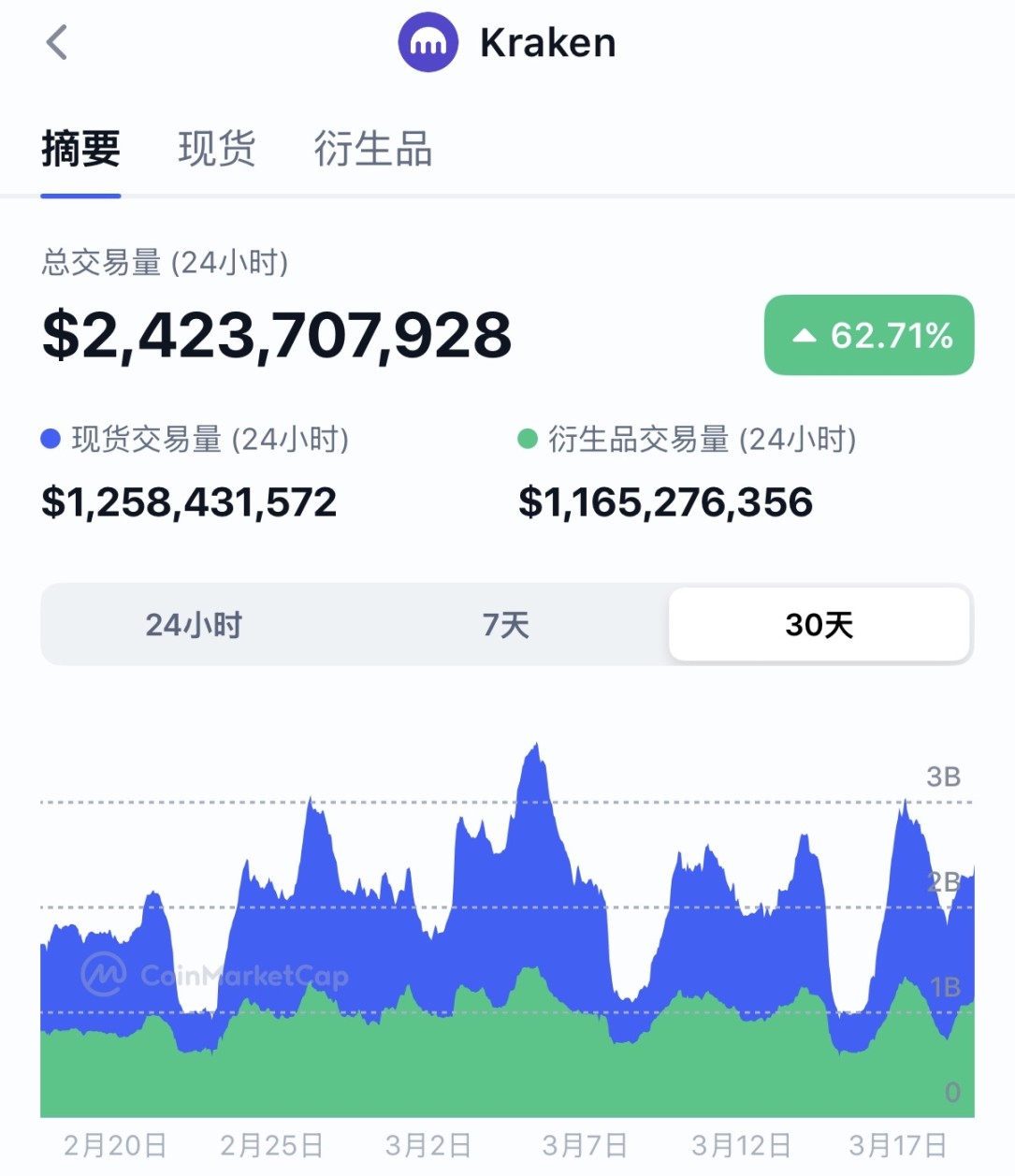
In terms of business scale, Kraken ranks in the middle globally among exchanges. According to CoinMarketCap data, Kraken's spot trading volume in the last 24 hours is approximately $1.2 billion, ranking 14th globally; its derivatives trading volume is about $1.1 billion, ranking 10th. In comparison, Coinbase's spot trading volume in the last 24 hours is around $1.86 billion, ranking second globally, while Binance leads with over $10 billion in spot trading volume and $65.18 billion in derivatives trading volume.

Financially, Kraken's parent company Payward reported 2025 results with adjusted revenue of $2.2 billion, a 33% year-over-year increase; adjusted EBITDA grew 26% to $531 million. Trading business revenue accounted for 47% of total revenue, with the remainder coming from non-trading businesses such as custody, payments, and financing. Total annual trading volume increased 34% to $2 trillion, platform assets grew 12% to $48.5 billion, and the number of customer accounts rose 50% to 5.7 million.

Despite the IPO plans being shelved, Kraken has been active in business expansion and regulatory compliance in recent months. On March 9, 2026, Nasdaq announced a partnership with Kraken to develop tokenized stocks and exchange-traded products, expected to launch in early 2027, focusing on using blockchain technology to streamline corporate governance processes.

On March 4, Kraken received approval for a Federal Reserve master account, becoming the first cryptocurrency company to access the Fed's core payment system, allowing direct use of the Fedwire interbank payment network. On February 25, the company launched its crypto asset staking loan service Flexline, enabling professional traders to access liquidity without selling their holdings. On February 24, Kraken announced the launch of regulated tokenized stock perpetual futures contracts, available to qualified non-U.S. users in over 110 countries, with initial products covering tokenized versions of major indices like the S&P 500 and Nasdaq 100.

Changes in the regulatory environment have added uncertainty to Kraken's path to listing. On March 18, the U.S. Securities and Exchange Commission and the Commodity Futures Trading Commission jointly issued interpretive guidance clarifying the classification standards for crypto assets, ending over a decade of regulatory ambiguity. This document provides clearer compliance guidance for the market but also means companies need to reassess how their business structures align with regulatory requirements. Meanwhile, cryptocurrency market structure legislation advancing in Congress is expected to pass in 2026, further clarifying the regulatory归属 of digital assets.

Kraken's decision to pause its IPO reflects the structural challenges crypto companies face in capital markets. On one hand, the industry is expanding from pure cryptocurrency trading to broader financial services, including stock trading, tokenized assets, and payment infrastructure; on the other hand, market volatility and regulatory uncertainty make investors cautious about valuing such assets.

For the entire cryptocurrency industry, Kraken's delayed listing may signal a turning point. Laura Katherine Mann, a partner at international law firm White & Case, previously noted that 2025 was a test year for crypto company IPOs, and 2026 would be the key node to test the long-term sustainability of digital asset IPOs. The market is judging whether crypto IPOs are a sustainable asset class or a cyclical trade that only during bullish markets. In the current market environment, Kraken's choice to wait for a more opportune moment may be a more prudent strategy.

It is worth noting that other leading players in the crypto industry are also actively adjusting their strategies to adapt to market changes. On March 19, Kris Marszalek, CEO of crypto trading platform Crypto.com, announced that the company is全面推进 its AI transformation, integrating AI tools and talent to enhance operational scale and precision. As part of this strategic adjustment, the company has targeted a reduction of about 12% of positions不适应 the new landscape.


Twitter:https://twitter.com/BitpushNewsCN

Bitpush TG Discussion Group:https://t.me/BitPushCommunity

Bitpush TG Subscription: https://t.me/bitpush

Original Link:https://www.bitpush.news/articles/7621233

Связанные с этим вопросы

QWhy did Kraken decide to pause its IPO plans according to the article?

AKraken paused its IPO plans due to the current downturn in the cryptocurrency market and unfavorable market conditions, with the possibility of reconsidering when conditions improve.

QWhat significant partnership did Kraken announce in March 2026 regarding tokenized assets?

AIn March 2026, Kraken announced a partnership with Nasdaq to develop tokenized stocks and exchange-traded products, leveraging blockchain technology to simplify corporate governance processes.

QHow did the performance of other recently listed crypto companies like Gemini and Bullish compare in the market?

AGemini's stock price fell nearly 82.6% from its first-day close, while Bullish experienced a 63.5% decline from its IPO price, both reflecting severe market challenges.

QWhat regulatory development in the U.S. was highlighted as adding uncertainty to crypto asset classification?

AThe SEC and CFTC jointly issued interpretive guidance clarifying the classification standards for crypto assets, ending over a decade of regulatory ambiguity and requiring companies to reassess their compliance.

QHow does Kraken's business diversification strategy extend beyond cryptocurrency trading?

AKraken has expanded into services such as custody, payments, financing, crypto-asset staking loans, and regulated tokenized stock perpetual futures, aiming to become a broader financial services provider.

Похожее

In-Depth Report on the On-Chain Lending Market: When Off-Chain Credit Meets On-Chain Liquidation

The on-chain lending market has evolved from a peripheral DeFi niche into core financial infrastructure. As of early 2026, total value locked (TVL) in on-chain lending protocols has reached $64.3 billion, accounting for 53.54% of total DeFi TVL, making it the largest and most mature vertical within decentralized finance. Aave dominates the sector with approximately $32.9 billion in TVL, commanding nearly half of the market—a leadership position that is unlikely to be challenged in the foreseeable future. However, the path of on-chain lending forward is not without risk. Liquidation cascades, credit defaults, and cross-chain vulnerabilities remain systemic threats hanging over the industry. At the same time, a deeper structural transformation is underway: on-chain lending is shifting from a “leverage tool for crypto-native users” to a “compliant gateway for institutional capital”. The scale of RWA (Real World Asset) lending has surpassed $18.5 billion, with U.S. Treasuries and government securities increasingly serving as core collateral. Institutional capital inflows are reshaping both the user base and risk appetite of the sector. This report systematically analyzes the evolution of on-chain lending definitions, competitive dynamics, core risks, and future trends, providing a comprehensive industry outlook for investors and trade practitioners. Key findings suggest that the “one dominant player with several strong challengers” structure will persist in the short term, while fixed-rate lending, compliant collateral, and institutional credit underwriting will define the next phase of competition. For investors focused on DeFi infrastructure, three key opportunity tracks stand out, namely, the Aave ecosystem (Morpho, Spark), RWA lending protocols (Ondo, Maple) and fixed-rate innovation (Notional, Pendle).

HTX Learn1 ч. назад

In-Depth Report on the On-Chain Lending Market: When Off-Chain Credit Meets On-Chain Liquidation

HTX Learn1 ч. назад

Fu Peng's First Public Speech in 2026: What Exactly Are Crypto Assets? Why Did I Join the Crypto Asset Industry?

Fu Peng, a renowned macroeconomist and now Chief Economist at New火 Group, delivered his first public speech of 2026 at the Hong Kong Web3 Festival. He explained his perspective on crypto assets and why he joined the industry, framing it within the context of macroeconomic trends and financial evolution. Fu emphasized that crypto assets are transitioning from an early, belief-driven phase to a mature, institutionally integrated asset class. He drew parallels to the 1970s-80s, when technological advances (like computing) revolutionized traditional finance, leading to the rise of FICC (Fixed Income, Currencies, and Commodities). Similarly, current advancements in AI, data, and blockchain are reshaping finance, with crypto assets becoming part of a new "FICC + C" (C for Crypto) framework. He noted that institutional capital, including traditional hedge funds, avoided early crypto due to its speculative nature but are now engaging as regulatory clarity emerges (e.g., stablecoin laws, CFTC classifying crypto as a commodity). Fu predicted that 2025-2026 marks a turning point where crypto becomes a standardized, financially viable asset for diversified portfolios, akin to commodities or derivatives in traditional finance. Fu defined Bitcoin not as "digital gold" in a simplistic sense but as a value-preserving, financially tradable asset. He highlighted that crypto's future lies in regulated, institutional adoption, moving away from retail-dominated trading. His entry into crypto signals this maturation, where traditional finance integrates crypto into mainstream asset management.

marsbit2 ч. назад

Fu Peng's First Public Speech in 2026: What Exactly Are Crypto Assets? Why Did I Join the Crypto Asset Industry?

marsbit2 ч. назад

Justin Sun Sues Trump Family: What $75 Million Bought Was Only a Blacklist

Justin Sun, founder of Tron, has filed a lawsuit in federal court against World Liberty Financial (WLF), alleging he was made the "primary target of a fraudulent scheme" after investing $75 million. Sun claims the investment secured him an advisor title and WLFI tokens, which were later frozen by WLF, causing "hundreds of millions in losses." The dispute began in late 2024 when Sun's investment helped revive WLF's struggling token sale, which ultimately raised $550 million. Shortly after, the SEC dropped its lawsuit against Sun following Donald Trump's inauguration. However, relations soured when Sun refused WLF's demands for additional funding. In August 2025, WLF added a "blacklist" function to its smart contract, allowing it to unilaterally freeze tokens. Sun's holdings, worth approximately $107 million, were frozen, and he was threatened with token destruction. The lawsuit highlights WLF's structure, which directs 75% of token sale profits to the Trump family, who had earned $1 billion by December 2025. WLF's CEO is Zach Witkoff, son of U.S. Middle East envoy Steve Witkoff. The project faces scrutiny for opaque operations, including a controversial loan arrangement on the Dolomite platform, co-founded by a WLF advisor. Despite Sun's history with the SEC, the case underscores centralization risks within DeFi, as WLF controls governance and holds powers to freeze assets arbitrarily. Sun's tokens remain frozen as legal proceedings begin.

marsbit2 ч. назад

Justin Sun Sues Trump Family: What $75 Million Bought Was Only a Blacklist

marsbit2 ч. назад

Торговля

Спот
Фьючерсы
活动图片