Stocks slide while crypto steadies — is market correlation starting to break?

ambcryptoОпубликовано 2026-03-31Обновлено 2026-03-31

Введение

Stocks are undergoing a controlled correction with the S&P 500 trending lower amid cooling risk appetite, while the crypto market has stabilized and entered a consolidation phase instead of continuing its decline. This divergence suggests a potential short-term loosening of the historically strong correlation between the two asset classes. Although both remain influenced by broader macroeconomic conditions, equities are currently pricing in uncertainty through a gradual pullback, whereas crypto may have already absorbed significant risk during its earlier drop. The current price action indicates a period of positioning rather than strong directional momentum in crypto markets.

A divergence is emerging between traditional equities and the crypto market, with recent price action suggesting a subtle shift in how both asset classes are responding to broader macro conditions.

The S&P 500 has entered a corrective phase, trending lower from its recent highs amid building selling pressure across major sectors.

In contrast, the broader crypto market — measured by total market capitalization excluding stablecoins — has entered a period of consolidation rather than continuing its earlier decline.

Equities show signs of a controlled correction

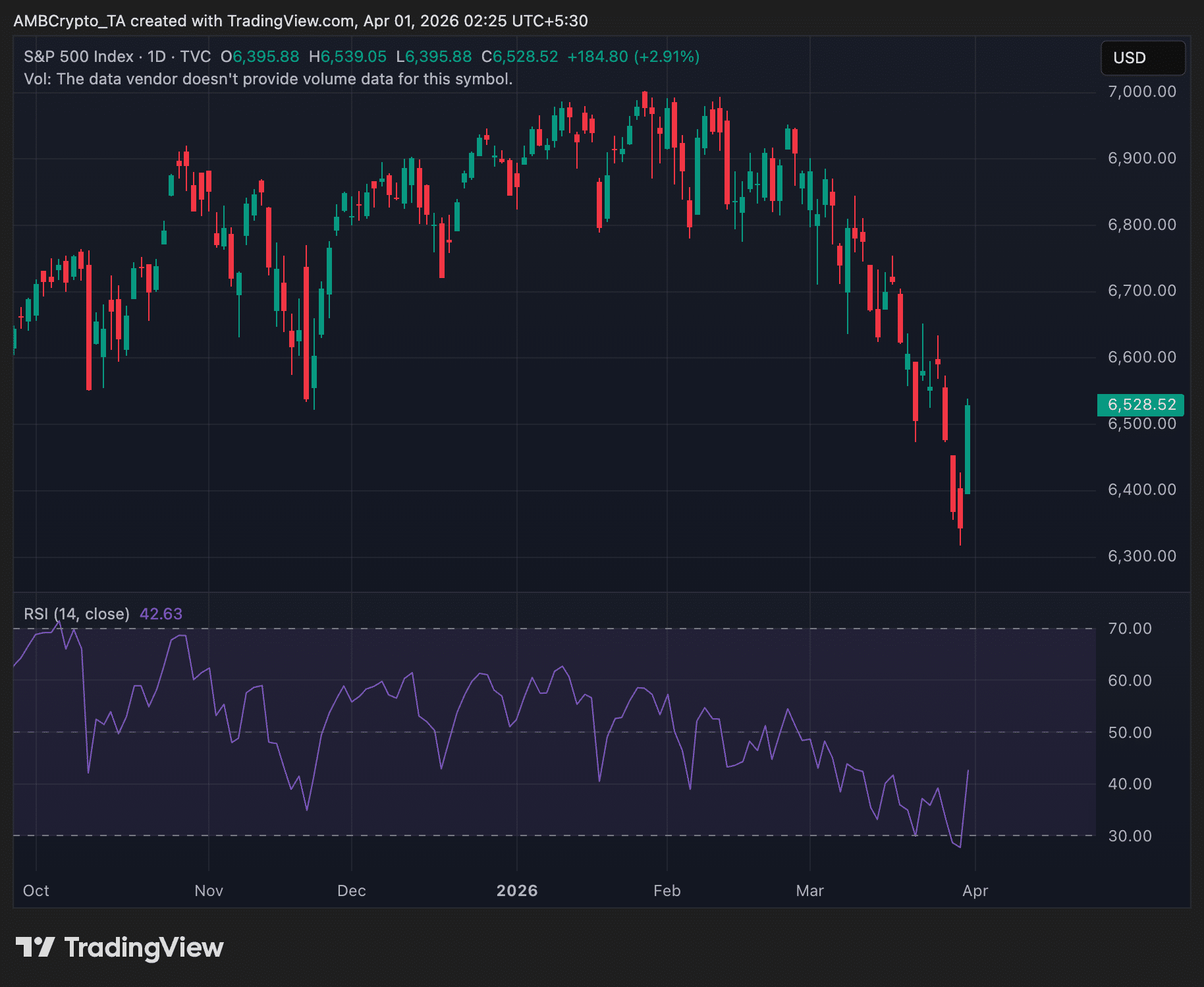
The S&P 500’s recent structure reflects a gradual deterioration in momentum, with a series of lower highs and lower lows forming since late February.

While the pullback has not yet turned disorderly, the trend indicates a cooling of risk appetite in traditional markets.

Momentum indicators such as the Relative Strength Index [RSI] have also declined toward neutral levels after previously signaling overbought conditions.

Source: TradingView

As of this writing, it was trading up almost 3% to over $6,500. However, the trend suggests that equities are undergoing a controlled reset, rather than a sharp risk-off event.

Crypto market stabilizes after sharp drop

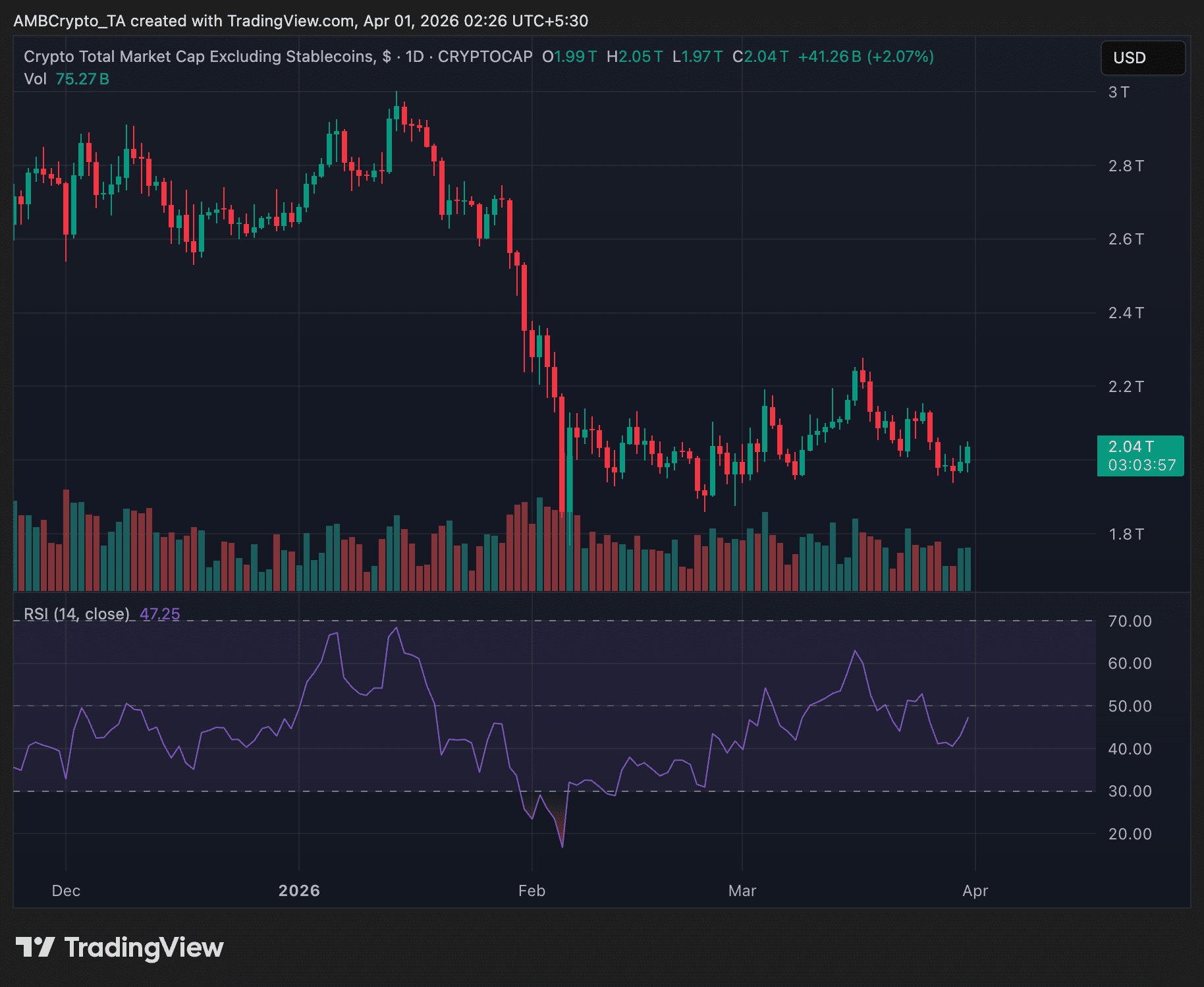
In contrast, crypto markets appear to be entering a holding pattern. As of this writing, the market capitalization was around 2.03 trillion, up over 2% in the last 24 hours.

Source: TradingView

After a steep decline earlier in the quarter, total crypto market capitalization has largely stabilized within a defined range. Price action has remained contained between key support and resistance zones, while RSI readings hover near neutral levels.

This lack of follow-through selling indicates that downside momentum has weakened, with the market neither committing to a recovery nor extending its decline.

A subtle shift in correlation dynamics

Historically, crypto has behaved as a high-beta extension of equities, often amplifying moves seen in traditional markets.

However, the current setup presents a more nuanced picture. While equities continue to trend downward, crypto markets have not mirrored the move with equivalent intensity. Instead, they have transitioned into sideways consolidation.

This divergence may signal a loosening of the correlation, at least in the short term.

What this means for market structure

The divergence does not necessarily imply that crypto is immune to broader macro pressures. Instead, it suggests that markets may be in different phases of adjustment.

Equities are pricing in macro uncertainty through a steady correction, while crypto markets may have already absorbed a significant portion of that risk during earlier declines.

As a result, current price action in crypto could reflect a phase of positioning and balance rather than directional conviction.


Final Summary

  • Equities are trending lower in a controlled correction, while crypto markets are consolidating rather than extending losses.
  • The divergence suggests a potential short-term loosening of correlation, though both markets remain influenced by broader macro conditions.

Связанные с этим вопросы

QWhat is the main divergence observed between traditional equities and the crypto market according to the article?

AThe main divergence is that traditional equities (like the S&P 500) are trending lower in a controlled correction, while the crypto market has entered a period of consolidation and stabilization instead of continuing its decline.

QWhat does the current price action in the crypto market suggest about its downside momentum?

AThe current price action, characterized by consolidation within a defined range and RSI readings near neutral levels, suggests that the downside momentum has weakened significantly.

QHow has the historical correlation between crypto and equities potentially changed based on recent activity?

AThe recent activity suggests a potential short-term loosening of the correlation. Crypto is not mirroring the equity market's downward trend with equivalent intensity but is instead moving sideways, indicating a more nuanced relationship.

QWhat is the article's explanation for why crypto markets might be stabilizing while equities correct?

AThe article suggests that crypto markets may have already absorbed a significant portion of the macro risk during their earlier steep declines, and are now in a phase of positioning and balance rather than directional conviction.

QWhat key technical indicator is mentioned as having declined toward neutral levels for the S&P 500?

AThe Relative Strength Index (RSI) is mentioned as having declined toward neutral levels for the S&P 500 after previously signaling overbought conditions.

Похожее

What Are Some Good Paths for Chinese Web3 Entrepreneurship? (Part 5)

This article explores pathways for Chinese Web3 teams to pivot toward AI, building on a previous discussion. It focuses on two specific team profiles: **Security & Risk Control Teams:** These teams, skilled in smart contract auditing, wallet security, and on-chain monitoring, can transition to providing **Agent behavior auditing and AI security governance**. As AI Agents automate tasks, access data, and trigger payments, enterprises will need solutions to monitor permissions, audit logs, control data access, and prevent anomalies—creating a strong B2B demand. **Application & Community-Focused Teams:** Instead of completely rebranding as AI companies, these teams should use AI to **enhance their existing products**. For example, research platforms can use AI to summarize information and identify signals; community tools can automate user support and analysis; and educational products can create personalized learning paths. The key is integrating AI to solve existing user pain points, like information overload or high operational costs. The article also advises against certain AI directions for Chinese Web3 teams, such as building general-purpose large language models (too resource-intensive), creating overly broad Agent platforms (hard to monetize), developing AI traders/automated yield products (high regulatory and risk sensitivity), or simply adding superficial AI features without genuine value. The core conclusion: Successful migration depends not on chasing AI hype, but on **identifying how a team's existing Web3 capabilities—be it in data, payments, security, or user operations—can address real needs in new AI application scenarios.**

marsbit3 ч. назад

What Are Some Good Paths for Chinese Web3 Entrepreneurship? (Part 5)

marsbit3 ч. назад

Торговля

Спот
Фьючерсы
活动图片