| |
|
极速发展的AI:能力飞升,其他一切都在脱节" alt="">
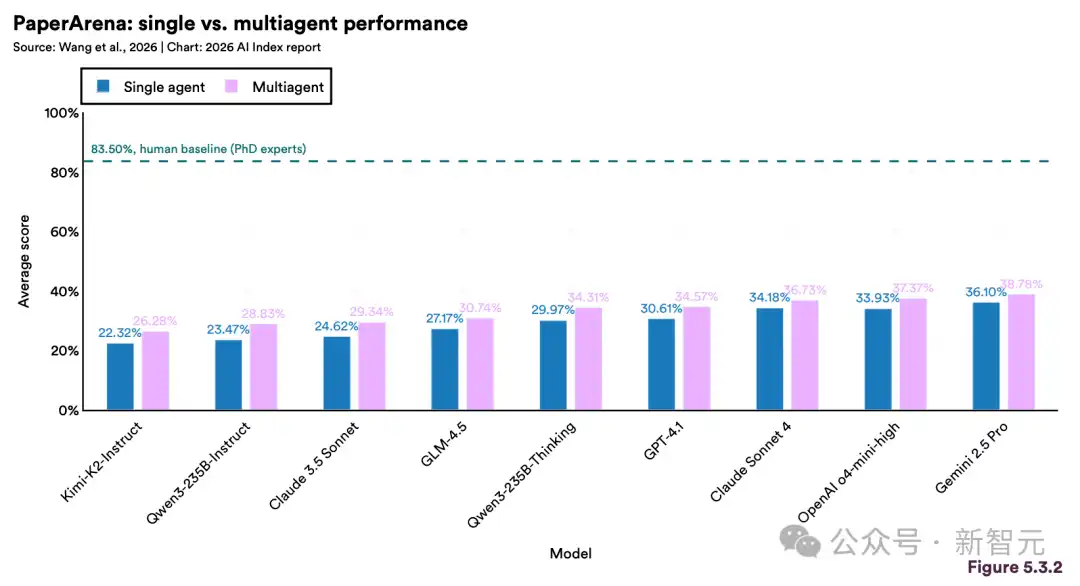
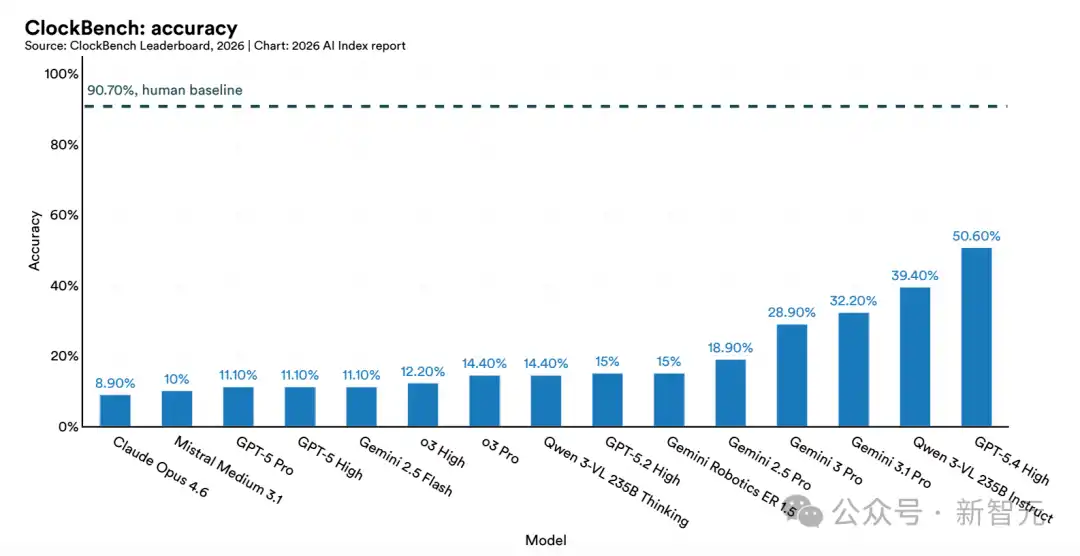
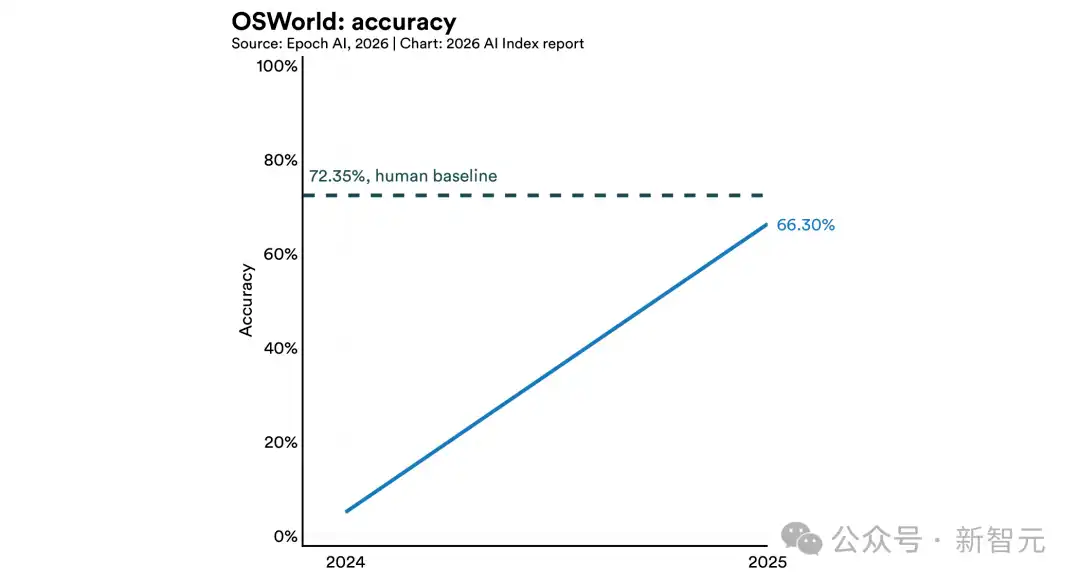
Also, in agent tasks, in the OSWorld test, frontier AI strength (66.3%) is approaching the human baseline.
However, in the PaperArena test专门评估科研逻辑, the strongest AI-powered Agent scored only 39%, half the capability of a PhD student.
But this unevenness doesn't stop companies from integrating AI into production lines.
Another number from the AI Index is that the global enterprise AI adoption rate has reached 88%. Ninety percent of companies have integrated AI into some workflow.
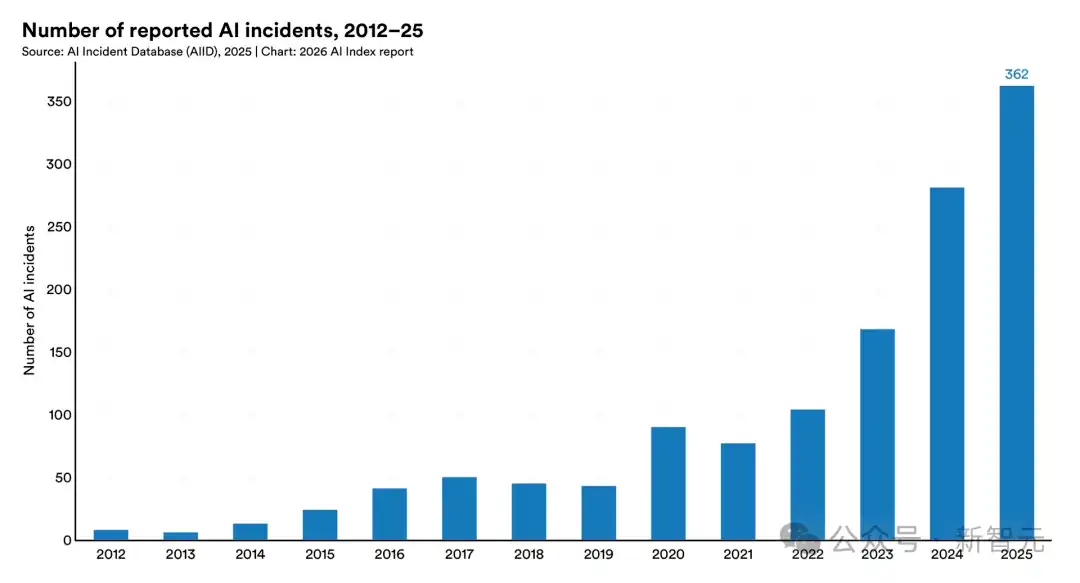
The cost is rising simultaneously. Recorded AI-related incidents increased from 233 in 2024 to 362.
Money is Accelerating: $581.7 Billion Poured into AI
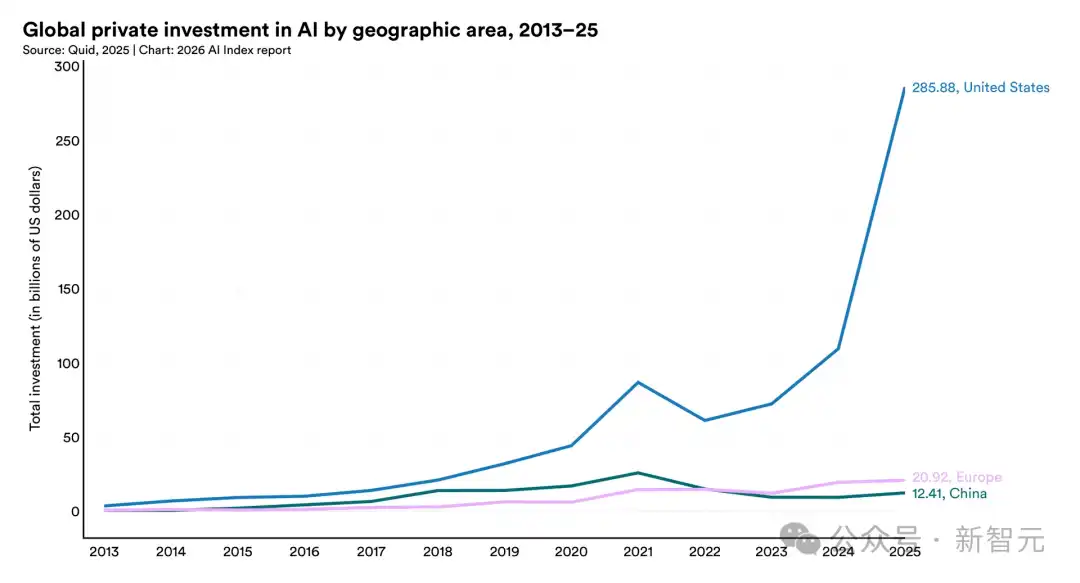
Global corporate AI investment in 2025 reached $581.7 billion, a year-on-year increase of 130%.其中, private investment was $344.7 billion, up 127.5% year-on-year.
Both curves almost doubled.
By country, the US is in a league of its own. US private AI investment in 2025 was $285.9 billion. And it added 1,953 AI startups in one year, also more than 10 times the number of the second-ranked country.
Money is accelerating into the US. But another core US resource is moving in the opposite direction.
People are Flowing Out: AI Researchers Entering the US Fell 89%
There's a set of numbers that makes one pause.
From 2017 to now, the number of AI researchers and developers entering the US has fallen by 89%.
More critically, this decline is accelerating. In the past year alone, the drop was 80%.极速发展的AI:能力飞升,其他一切都在脱节" alt="">
The US still has the highest density of AI researchers globally, but the inflow tap is tightening.
The curves of money and people are starting to反向. This is a situation not seen in the past decade.
Computing Power Rose 30-Fold in 3 Years, Lifelines in One Company's Hands
The AI capability curve is accelerating, but the computing power curve behind it is running even faster.
From 2021 to now, global AI computing power has increased 30-fold. Over the past three years, it has tripled every year.
This curve is supported by a few companies.
NVIDIA's GPUs alone account for over 60% of the world's AI computing power. Amazon and Google rank second and third with their own chips, but combined they are far behind NVIDIA.
And almost all these chips come from one foundry, TSMC. The steeper the computing power curve, the narrower the lifeline.
Meanwhile, the cost is also increasing.
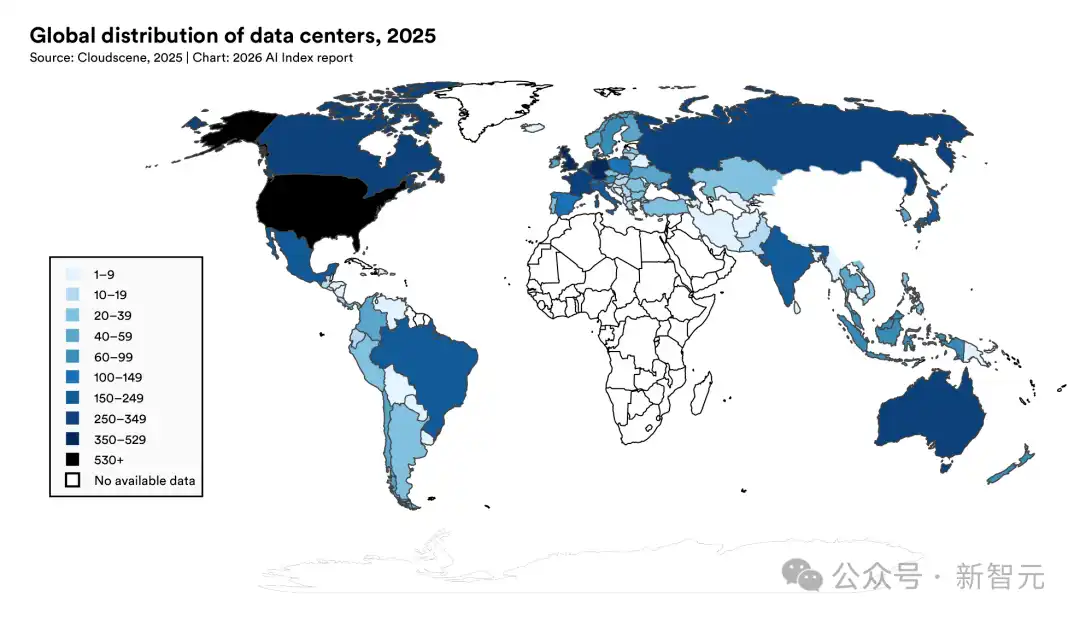
The total power of global AI data centers has reached 29.6 GW, equivalent to New York State's entire peak electricity demand. The estimated carbon emission for one training run of xAI Grok 4 is 72,816 tons of CO2 equivalent, equal to the tailpipe emissions of 17,000 cars driving for a year.
Where data centers are built, where electricity comes from, where chips are produced—these three questions have become the most headache-inducing issues on every AI company CEO's desk this year.
Generative AI Penetrated 53% in Three Years, Chinese Workplace Usage Exceeds 80%
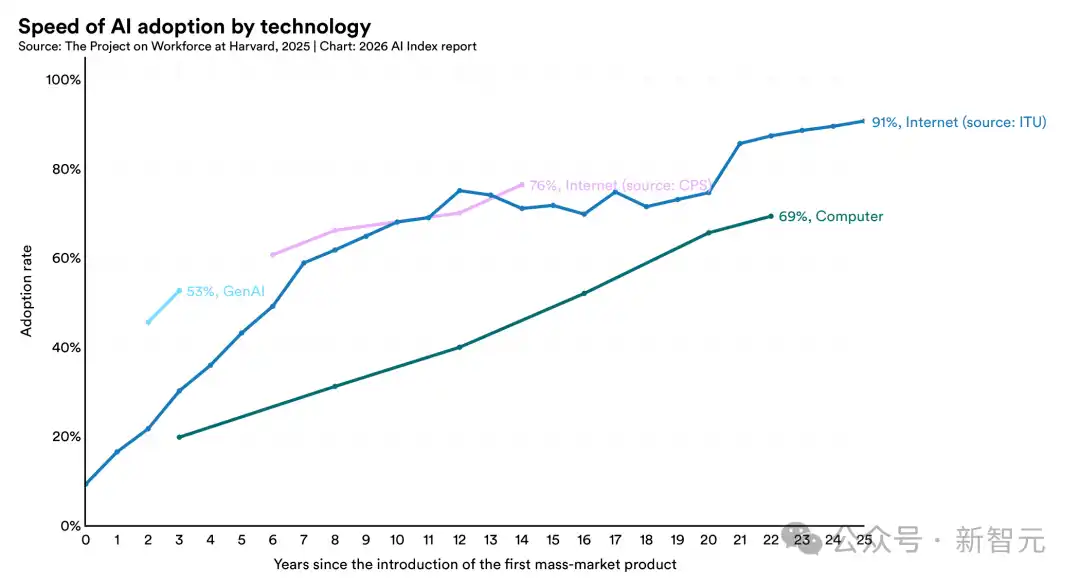
Generative AI reached a global population penetration rate of 53% within three years.
This speed is faster than personal computers, faster than the internet.
But penetration speed is highly correlated with country. Singapore 61%, UAE 54%, both ahead of the US. The US ranks only 24th among the surveyed countries, with a penetration rate of 28.3%.
If we change the dimension from consumers to the workplace, the contrast is greater.
Another set of data in the report shows that in 2025, 58% of employees globally had already started using AI regularly at work. But in five countries—China, India, Nigeria, UAE, Saudi Arabia—this proportion exceeded 80%.
China's workplace AI penetration rate is already more than 20 percentage points higher than the global average.
Even more interesting is consumer value.
AI Index estimates that by early 2026, generative AI tools create $172 billion in value annually for US consumers. From 2025 to 2026, the median value per user tripled.
The vast majority of users are still using the free version.
Entry-Level Positions Sharply Reduced, 22-25 Year-Old Dev Jobs Slashed 20%
The part of the entire AI Index that might be most沉默 for Chinese readers is probably the section on youth employment.
The number of employed software developers aged 22 to 25 has fallen by about 20% since 2024.
During the same period, older peer groups actually grew.
Not just development roles. Other high-AI-exposure industries like customer service are also showing the same pattern.
More worrying are the results of corporate surveys. Respondent executives generally expect future layoffs to be larger than in the past few months.
This isn't about the macro unemployment rate; it's about entry-level positions being precisely cut off.
If the first job is gone, the entire career ladder loses a rung. The long-term impact of this is something no one can calculate yet.
AI is Rewriting the Way Science is Done
If the employment section is cold, the science section is hot.
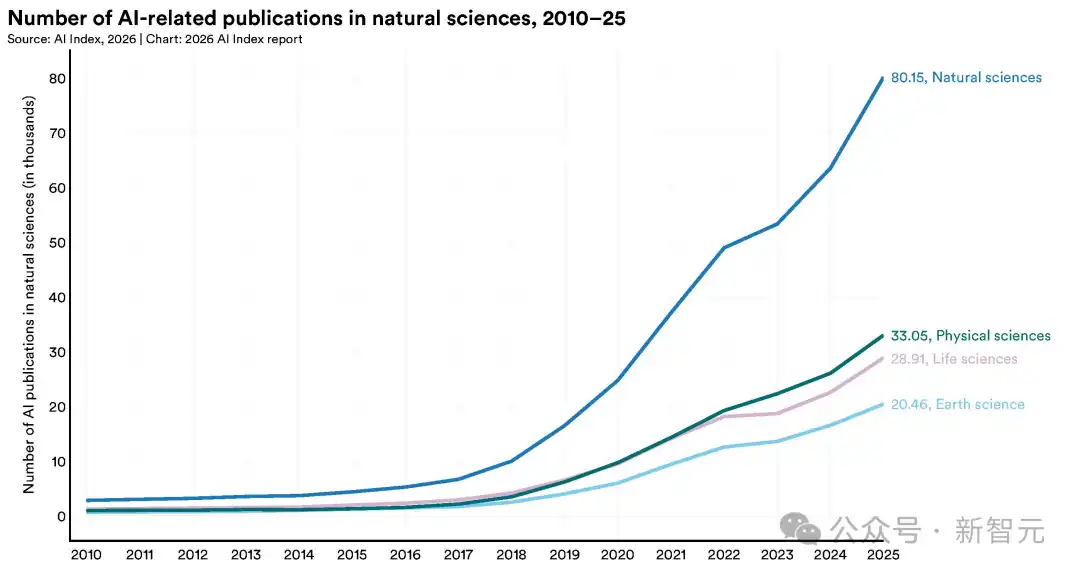
AI-related papers in natural sciences, physical sciences, and life sciences grew by 26% to 28% year-on-year in 2025.
Specifically in application, this year for the first time an AI completely ran an end-to-end weather forecasting process. From raw meteorological observation data directly outputting final forecasts for temperature, wind speed, humidity, with no traditional numerical models介入.
AI is moving from "helping you write papers" "helping you calculate numbers" to "making discoveries itself".
It's the same in hospitals. In 2025, many hospitals began deploying AI tools that can automatically generate clinical records from consultation dialogues. Doctors in multiple hospital systems reported that time spent writing medical records was reduced by up to 83%, with significant decreases in burnout.
But the same index pours cold water on medical AI. A review of over 500 clinical AI studies found that nearly half relied on exam-style datasets, and only 5% used real clinical data.
AI can reduce doctors' typing time, that's certain. AI's clinical value on real patients currently has many question marks.
Self-Learning Wave Explodes Globally, Formal Education Has Fallen Behind
Formal education can't keep up with AI.
4/5 of US high school and college students now use AI to complete school assignments. But only half of secondary schools have AI usage policies, and only 6% of teachers think these policies are clear.
Students are running ahead, teachers are still in place, rules haven't appeared yet.
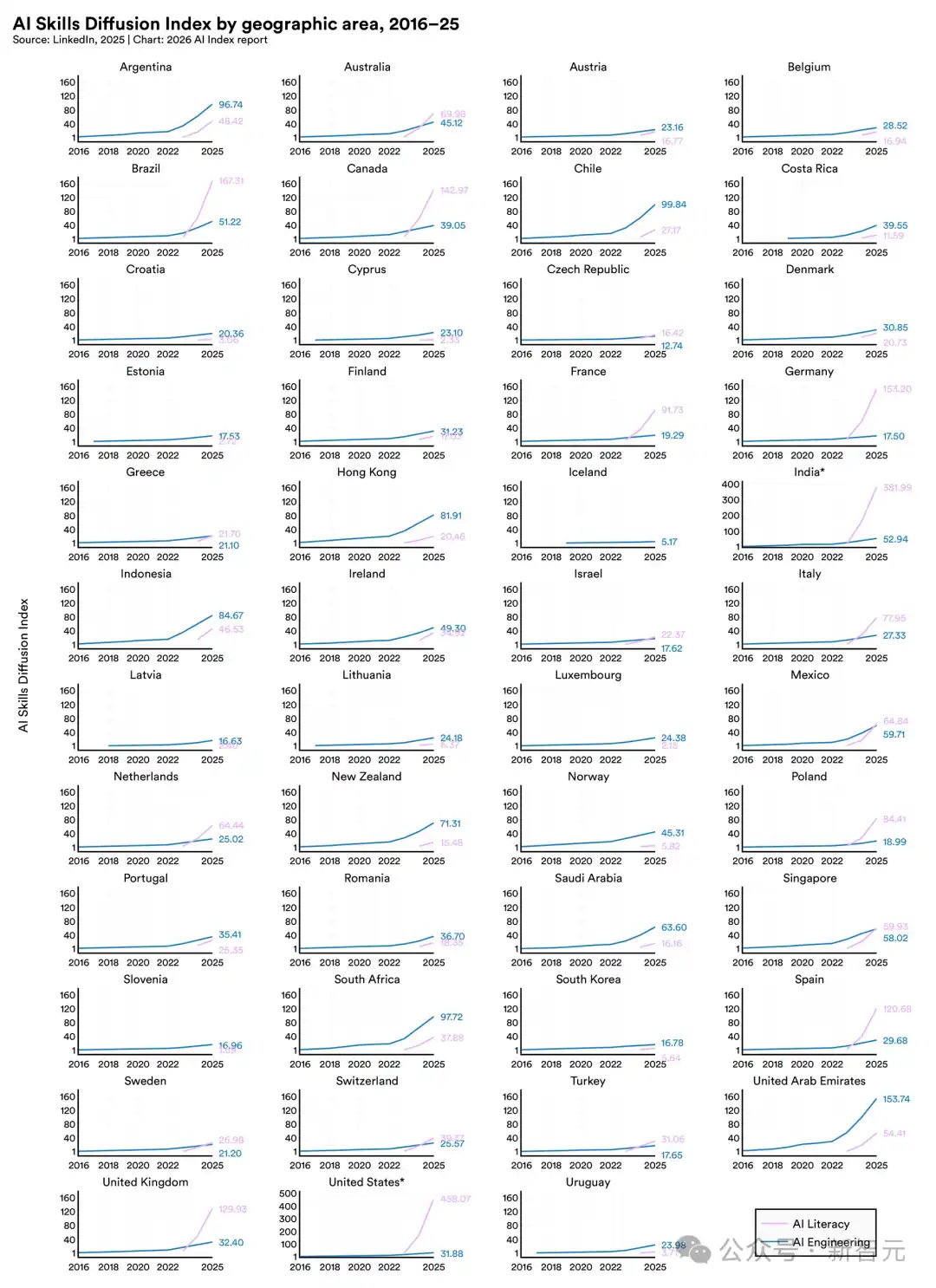
While formal education falls behind, the self-learning wave is exploding globally. It says the three countries with the fastest growth in learning AI engineering skills are the UAE, Chile, and South Africa.
Not the US, not Europe.
The steepest part of the skill curve is growing in places no one is looking.
极速发展的AI:能力飞升,其他一切都在脱节" alt="">
Strongest Models Become the Most Opaque, Experts and Public are分裂
The strongest models are becoming the most opaque models.
The Foundation Model Transparency Index's average score fell from 58 last year to 40 this year. The AI Index directly点名, Google, Anthropic, OpenAI have all stopped公开 the training data scale and training duration of their latest models.
Of the 95 most representative models released last year, 80 did not公开 training code.
Public sentiment has also become more complex.
Globally, the proportion believing AI's benefits outweigh the risks rose from 52% to 59%. But during the same period, the proportion feeling nervous about AI rose from 50% to 52%.
Both directions are growing simultaneously.
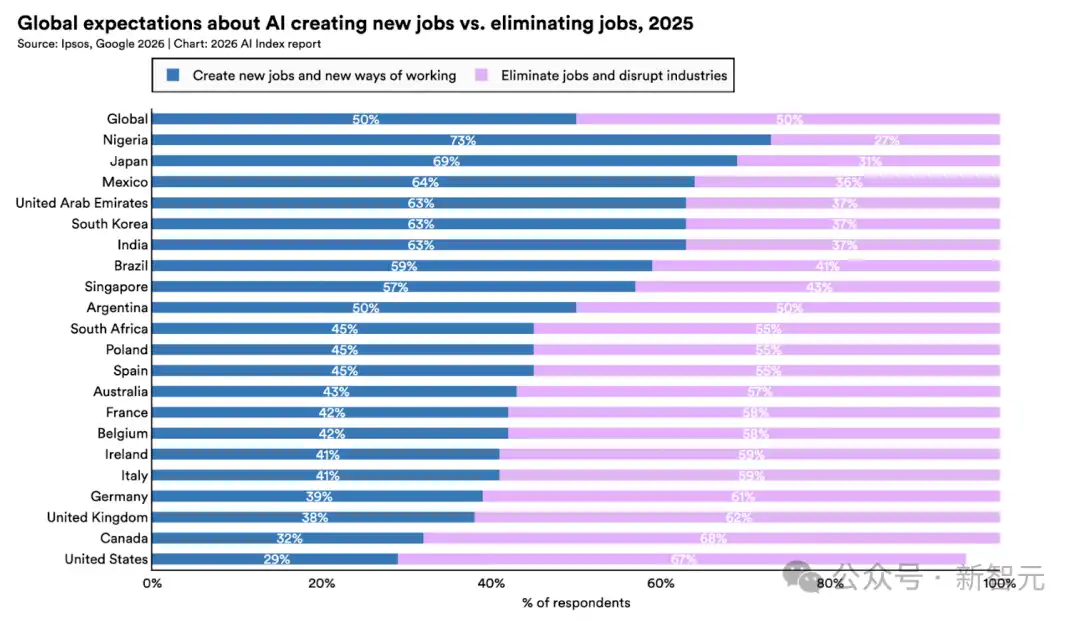
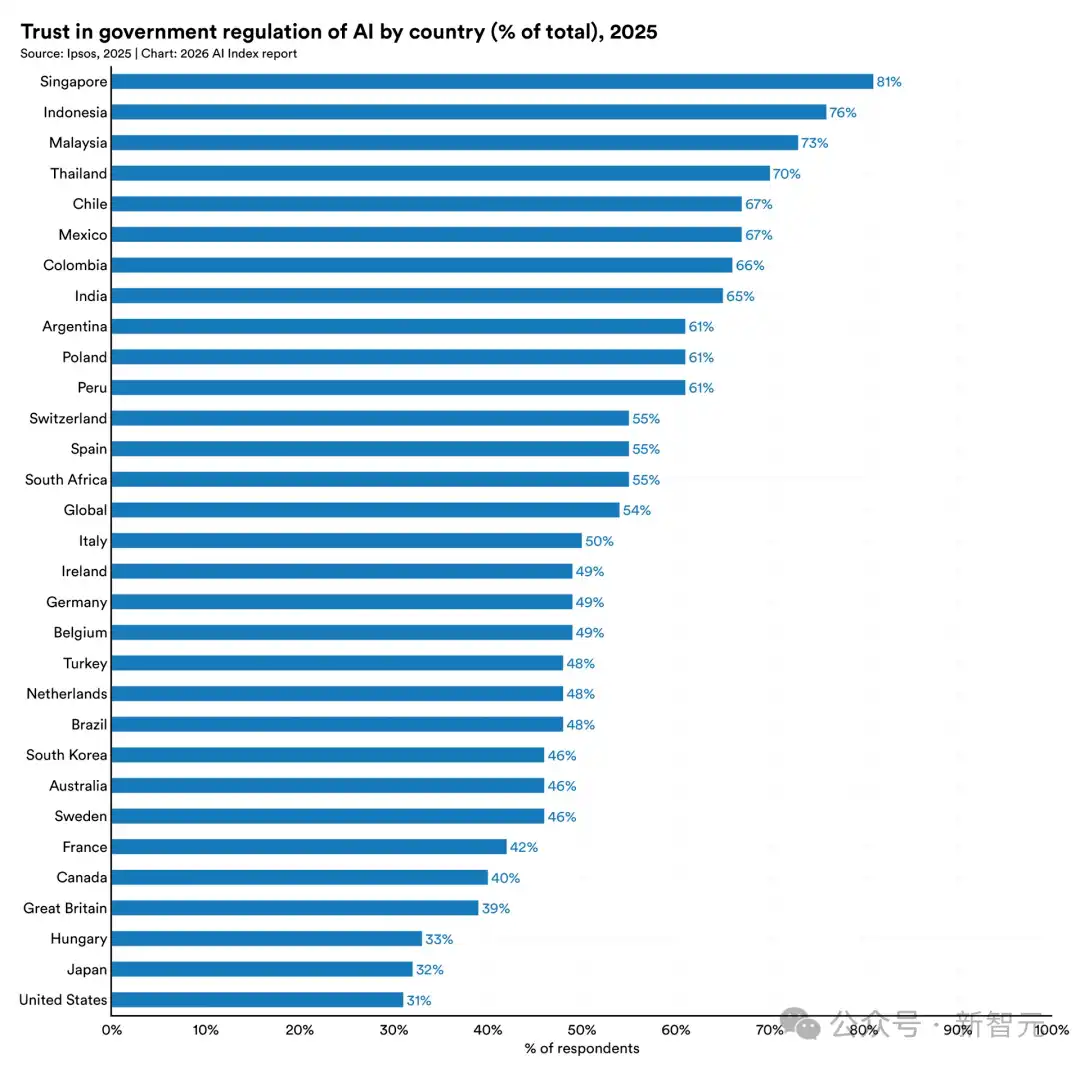
The most分裂 is the US. Only 33% of Americans think AI will make their jobs better, the global average is 40%. Americans' trust in their own government to regulate AI is the lowest among surveyed countries, 31%.
Singaporeans' trust in their government to regulate AI is 81%.
After the recent incident at Sam Altman's house was袭击, Silicon Valley insiders were "surprised to find" that ordinary people in the Instagram comments were not sympathetic, some even felt "it should be more intense".
They didn't realize things had gotten this bad.
The Pew and Ipsos data cited in the report show that the perception gap between experts and the public on the impact of AI on employment, healthcare, economy, etc.,普遍 exceeds 30 percentage points, with the largest gap reaching 50 percentage points.
On one side, the curves in the lab are soaring; on the other, ordinary people's unease is accumulating.
There is no bridge in between.
In Conclusion
The 423-page report has hundreds of charts, but it really only draws one picture.
The horizontal axis is time, the vertical axis is capability.
The model capability curve is flying, the computing power curve is flying, the investment curve is flying, the adoption rate curve is flying. Everything else is stagnating or moving downward.
This is the entire content of the 2026 AI Index.
AI is accelerating. Everything else is decoupling.
If you are in this industry, the question to ask now is not "what will the future be like", but "which curve are you standing on".
Связанные с этим вопросы
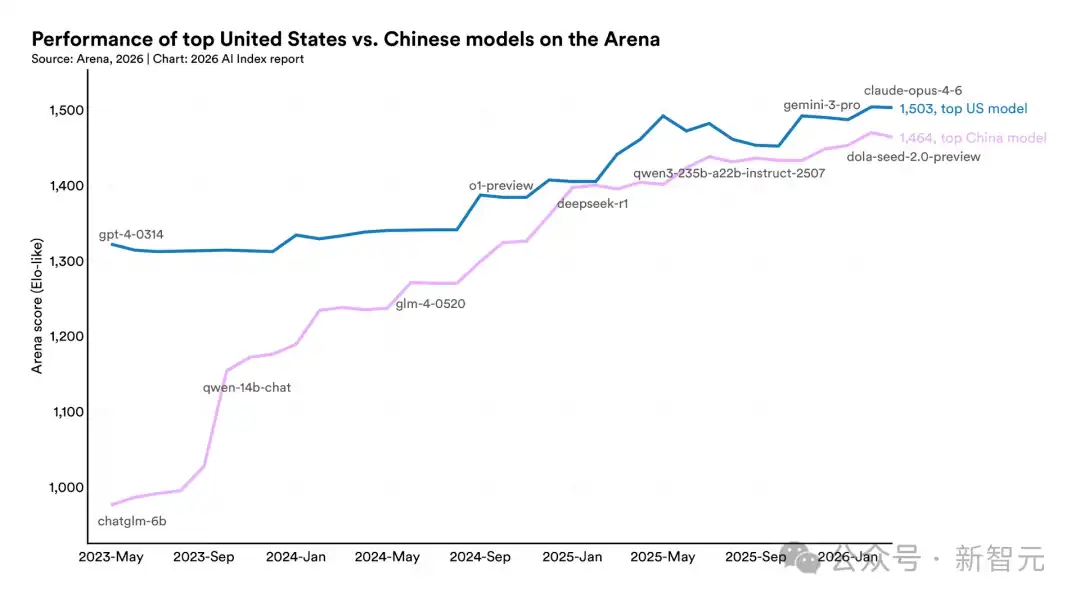
QWhat is the performance gap between the top AI models of the US and China according to the Stanford AI Index Report 2026?
AThe performance gap between the top AI models of the US and China has narrowed to just 2.7%.
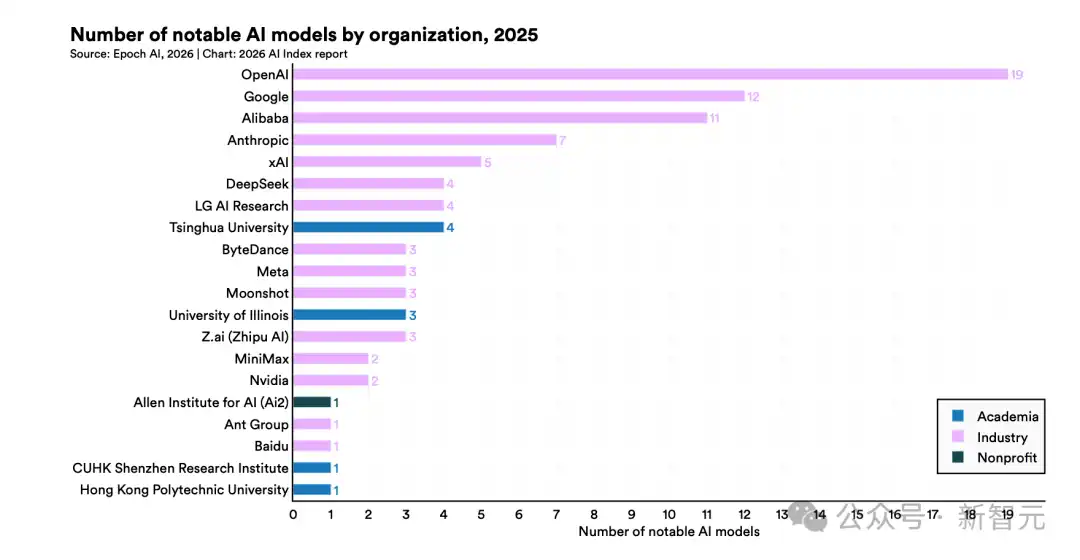
QWhich Chinese institutions or companies are ranked in the global top 10 for AI models?
AAlibaba, DeepSeek, Tsinghua University, and ByteDance are the Chinese institutions and companies ranked in the global top 10.
QWhat percentage of the world's top AI models in the past year came from industry rather than academia?
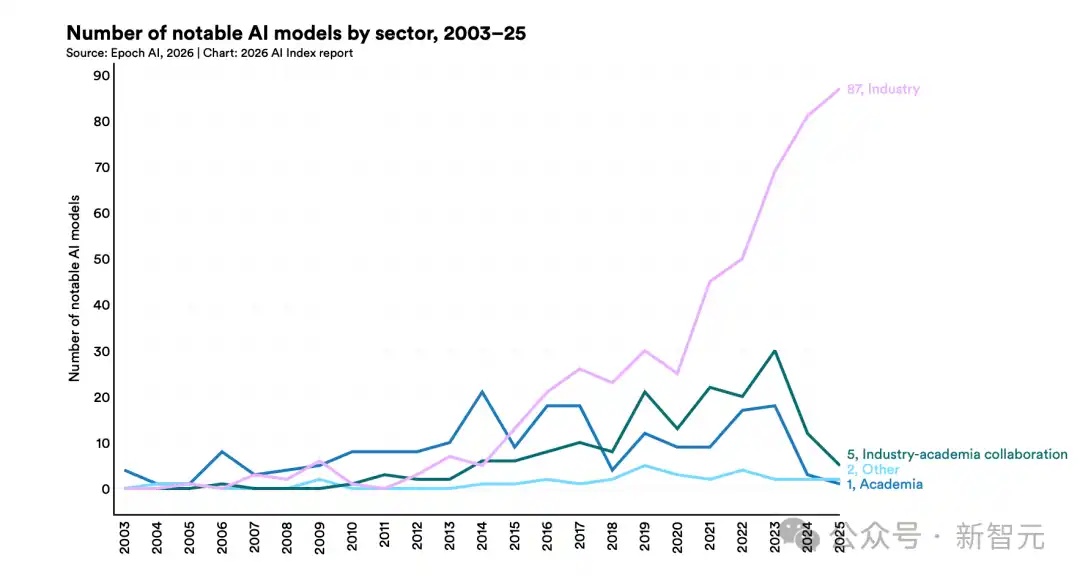
AOver 90% of the world's top AI models in the past year came from industry, not academia or government labs.
QWhat significant negative impact on employment is highlighted in the report, particularly for a specific age group?
AEmployment for software developers aged 22-25 has decreased by approximately 20% since 2024, as entry-level positions are being disproportionately affected.
QWhat is the term used in the report to describe the uneven and inconsistent development of AI capabilities?
AThe term used to describe the uneven development of AI capabilities is 'jagged frontier' (锯齿前沿).
Похожее
From Survival to Accelerated Growth: The Journey of Zcash's Three-Year Rise as Told by the Founder of ZODL
**From Survival to Accelerated Growth: Zcash Founder Details the 3-Year Rise**
Three years ago, Zcash (ZEC) was a struggling pioneer in privacy technology, with a price near $30, low shielded supply (11%), and a community mired in governance disputes. Today, ZEC trades around $600, with over 31% of its supply (~$3B) in user-controlled shielded pools. This transformation resulted from breaking key constraints.
First, **governance shackles were removed**. The old model guaranteed funding to two entities (ECC and ZF) regardless of performance, creating a monopoly. In 2024, ECC rejected further direct funding, forcing a change. The NU6 upgrade ended direct funding, allocating 8% to community grants and 12% to a protocol-controlled treasury for retroactive rewards, expiring in 2028 unless renewed by overwhelming consensus. The entities also relinquished their trademark-based veto power, freeing community governance.
Second, the **product focus shifted** from pure cryptography to user growth. Previously, engineering excelled at privacy tech but failed to attract users. In early 2024, the team (later ZODL) pivoted to building products users wanted, like the Zodl wallet (default privacy, hardware support, cross-asset swaps). This drove shielded supply to grow over 400% in ZEC terms, with 86.5% of recent transactions being shielded, representing real user adoption.
Third, the **narrative evolved** from the limiting "privacy coin" label to "unstoppable private money." This clarified Zcash's value proposition: a Bitcoin-like monetary policy with verifiable private payments via advanced cryptography. This structural narrative—protocol (Zcash), asset (ZEC), gateway (Zodl)—enabled broader exchange listings, institutional interest, and ETF filings.
Finally, **organizational constraints were broken**. In early 2026, the ECC team left its non-profit structure after disputes over control, forming Zcash Open Development Lab (ZODL). ZODL raised $25M from top VCs (Paradigm, a16z, etc.), gaining the capital and agility of a startup to scale consumer products.
Current metrics show strong momentum: social discussion volume for ZEC surged 15,245% in a year, with 81% positive sentiment. The focus is now on enhancing user experience (Zodl wallet), scalability (Tachyon project targeting Visa-level throughput with 25-second blocks), and post-quantum security (quantum-recoverable wallets coming soon). Zcash is positioned to become faster, more usable, scalable, and quantum-resistant.
marsbit11 мин. назад

marsbit11 мин. назад
Five Counterparty Risk Architectures: A Settlement-Layer Methodology for Classifying TradFi Models in Crypto Exchanges
**Summary:**
This companion piece reframes the five TradFi-on-crypto exchange architectures, previously classified by "architectural fingerprint," through the lens of counterparty risk. The core question is: whose balance sheet bears the loss first in a stress scenario, and has it historically done so? Each of the five models corresponds to a distinct risk holder with its own documented failure modes.
* **Model 1 (Stablecoin-Settled CEX Perpetuals):** Risk is held by the stablecoin issuer (e.g., reserve composition, bank connectivity) and the CEX's own book. History includes Tether's banking disconnections (2017) and reserve misrepresentations (CFTC 2021 Order).
* **Model 2 (CFD Brokers):** Risk resides on the broker's balance sheet (B-book model). Regulatory differences (e.g., ESMA's mandatory negative balance protection vs. Mauritius FSC's lack thereof) define loss allocation rules, as seen in the 2015 SNB event (Alpari UK insolvency).
* **Model 3 (Off-Chain Custody & Transfer Agent Chain):** Risk lies with the off-chain custodian/platform. User asset recovery depends on Terms of Use and corporate structure, exemplified by the Celsius bankruptcy ruling (2023) where Earn Account assets were deemed property of the estate.
* **Model 4 (DEX Perpetual Protocols):** No single balance sheet bears risk. Loss absorption relies on a protocol's insurance fund and Auto-Deleveraging (ADL) mechanism, as demonstrated in the GMX V1 (2022) and dYdX v3 YFI (2023) incidents.
* **Model 5 (Regulated CCP - DCM-DCO-FCM):** The most institutionalized model concentrates risk in the Central Counterparty (CCP). However, history shows CCPs can employ non-standard tools under extreme stress, such as mass trade cancellation (LME Nickel, 2022) or enabling negative price settlements (CME WTI, 2020).
The report argues that regulatory choices and counterparty risk structures are co-extensive, not in an upstream-downstream relationship. It concludes with five separate observation checklists (not predictions) for monitoring the structural vulnerabilities of each risk model.
marsbit28 мин. назад

marsbit28 мин. назад
Here Are The Major Bitcoin Levels To Watch After Breaking $80,000
Bitcoin has closed a week above $80,000 for the first time since late January, strengthening the bullish case after breaking through the $78,000 to $80,000 bearish order block. The key to future price action now depends on whether bulls can hold two critical levels. The first is the $78,000 floor, which must be defended to confirm the former resistance zone has turned into support. The second is the $82,000 lower-high area; a clean break above it could open the path toward the next major resistance at $90,000. However, a truly bullish trend shift would only be confirmed with a high-timeframe close above the $97,900 "Change of Character" level, which would break the pattern of lower highs formed since late 2025. While currently trading around $81,000, analysis suggests there remains a significant chance Bitcoin retests the $60,000 zone before any sustained upward move.
bitcoinist1 ч. назад
Zcash Is Up 1,500% And Its Biggest Backer Says This Is Why
Zcash (ZEC) has surged approximately 1,500%, a rally attributed by prominent backer Josh Swihart to fundamental resets in governance, product strategy, narrative, and organization. Three years ago, Zcash had strong cryptography but weak momentum. Today, shielded transaction adoption has risen dramatically, and over $3 billion in value is held in shielded wallets.
Key changes include a governance reset where direct funding to core institutions ended, breaking a perceived "stranglehold" and empowering the broader community. Product focus shifted to user adoption, exemplified by the Zodl wallet, which contributed to shielded supply rising from 11% to about 30%. The narrative moved from "privacy coin" to "unstoppable private money," improving institutional perception and leading to listings and investment.
Organizationally, key developers formed the Zcash Open Development Lab (ZODL), raising $25 million to scale adoption. Current priorities are improving user experience, scalability (targeting faster block times), and post-quantum security. Swihart concluded these compounded efforts explain Zcash's accelerated growth.
bitcoinist2 ч. назад

bitcoinist2 ч. назад
Популярные статьи
Добро пожаловать на HTX.com! Мы сделали приобретение Sonic (S) простым и удобным. Следуйте нашему пошаговому руководству и отправляйтесь в свое крипто-путешествие.Шаг 1: Создайте аккаунт на HTXИспользуйте свой адрес электронной почты или номер телефона, чтобы зарегистрироваться и бесплатно создать аккаунт на HTX. Пройдите удобную регистрацию и откройте для себя весь функционал.Создать аккаунтШаг 2: Перейдите в Купить криптовалюту и выберите свой способ оплатыКредитная/Дебетовая Карта: Используйте свою карту Visa или Mastercard для мгновенной покупки Sonic (S).Баланс: Используйте средства с баланса вашего аккаунта HTX для простой торговли.Третьи Лица: Мы добавили популярные способы оплаты, такие как Google Pay и Apple Pay, для повышения удобства.P2P: Торгуйте напрямую с другими пользователями на HTX.Внебиржевая Торговля (OTC): Мы предлагаем индивидуальные услуги и конкурентоспособные обменные курсы для трейдеров.Шаг 3: Хранение Sonic (S)После приобретения вами Sonic (S) храните их в своем аккаунте на HTX. В качестве альтернативы вы можете отправить их куда-либо с помощью перевода в блокчейне или использовать для торговли с другими криптовалютами.Шаг 4: Торговля Sonic (S)С легкостью торгуйте Sonic (S) на спотовом рынке HTX. Просто зайдите в свой аккаунт, выберите торговую пару, совершайте сделки и следите за ними в режиме реального времени. Мы предлагаем удобный интерфейс как для начинающих, так и для опытных трейдеров.
1.3k просмотров всегоОпубликовано 2025.01.15Обновлено 2025.03.21

Он решает проблемы масштабируемости, совместимости между блокчейнами и стимулов для разработчиков с помощью технологических инноваций.
2.2k просмотров всегоОпубликовано 2025.04.09Обновлено 2025.04.09
HTX Learn — ваш проводник в мир перспективных проектов, и мы запускаем специальное мероприятие "Учитесь и Зарабатывайте", посвящённое этим проектам. Наше новое направление .
1.8k просмотров всегоОпубликовано 2025.04.10Обновлено 2025.04.10