Solana’s 90% slowdown: Is quantum-safe security killing SOL’s speed?

ambcryptoОпубликовано 2026-04-05Обновлено 2026-04-05

Введение

Solana's recent quantum security testing with Project Eleven has exposed a critical trade-off: implementing quantum-resistant signatures could slow the network by 90%. This is a significant challenge for Solana, as its core advantage has been its high speed and scalability, processing 31x more transactions than Ethereum with 1,191 TPS. This speed has fueled its growth in DeFi and stablecoin adoption, notably for non-USD currencies. The potential 90% slowdown forces Solana to balance its defining speed with future-proof security, risking its competitive edge if it cannot maintain both performance and protection against quantum computing threats.

Can a blockchain achieve both scalability and speed, or is it forced to prioritize one over the other?

Solana’s latest move has put this question in the spotlight for traders and developers. For years, Solana’s high-speed powered growth in its stablecoin market and transaction volume.

Put simply, its fast throughput allowed the network to handle huge transaction loads while maintaining strong on-chain liquidity.

Look at Solana’s de-dollarization push: Dune data, as of press time, showed that Unique Senders of non-USD stablecoins on the network nearly tripled year-on-year, driven by EURC and BRZ adoption.

From a strategic standpoint, the network is clearly diversifying its stablecoin portfolio, laying the groundwork for broader DeFi expansion.
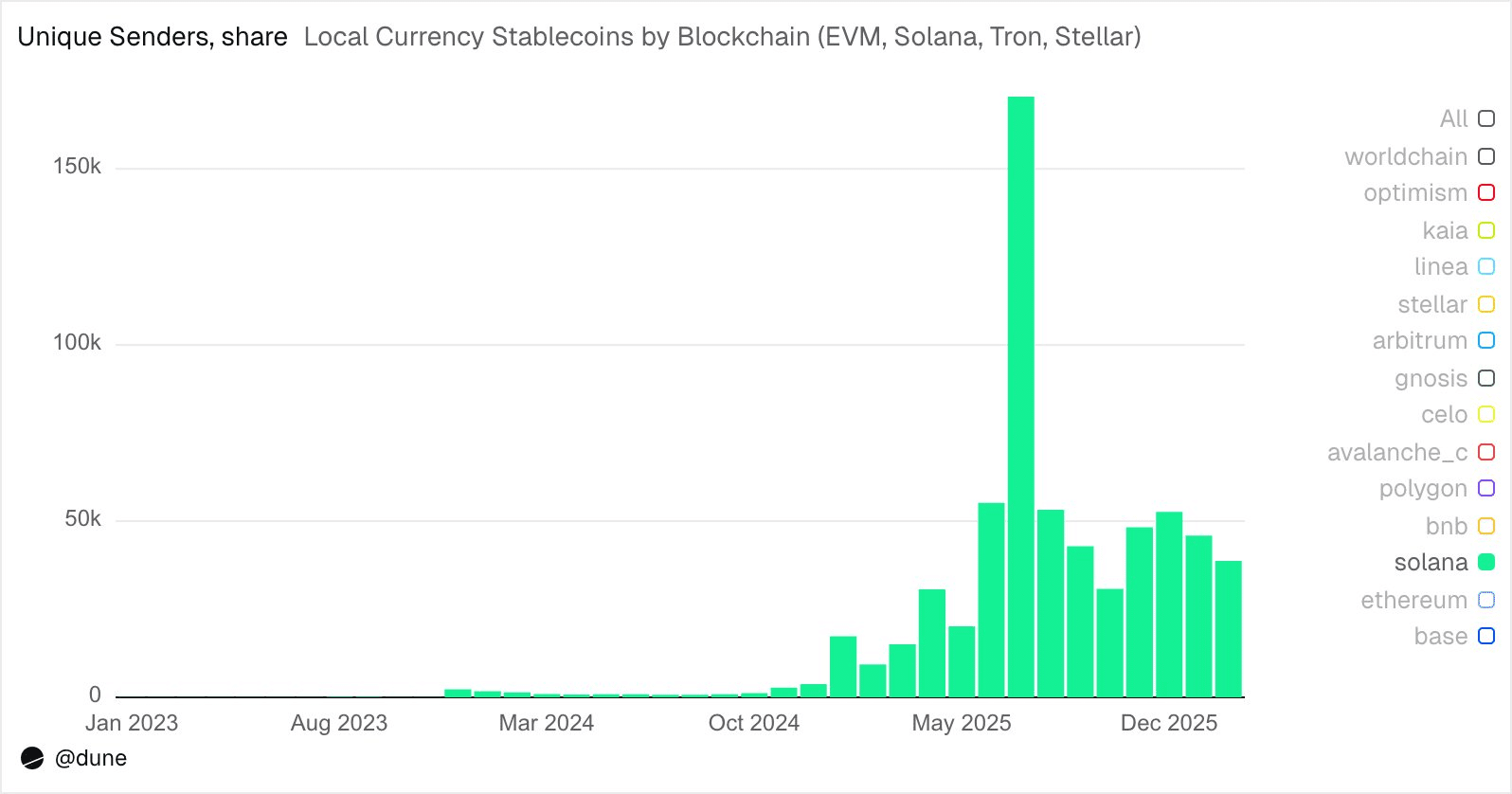
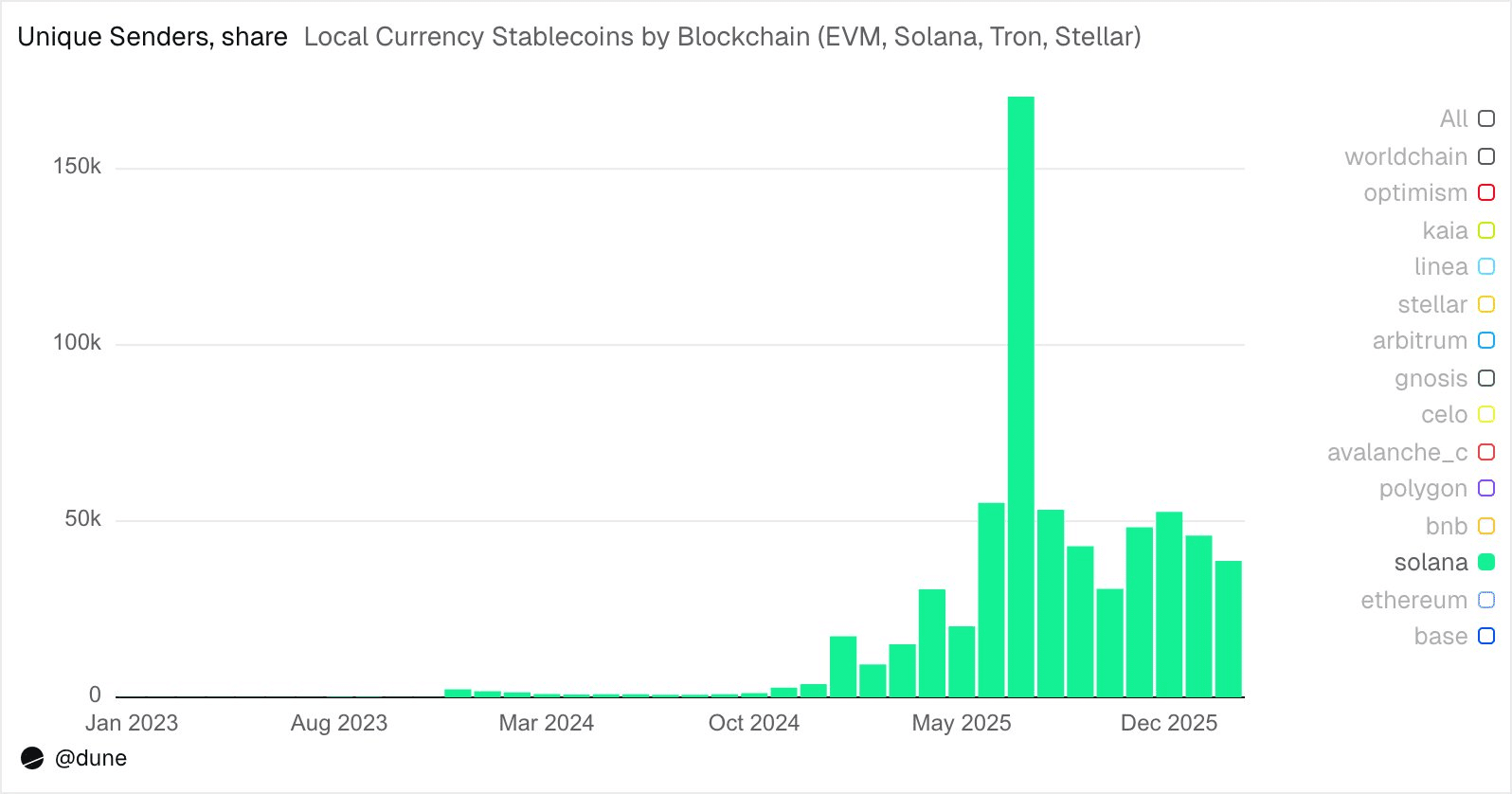
Source: Dune

From a technical perspective, however, this growth highlights Solana’s [SOL] strong underlying network fundamentals. Its high throughput, fast confirmation times, and robust on-chain liquidity have enabled it to support complex financial activity at scale, something that many competing blockchains still struggle with.

However, recent quantum testing revealed a trade-off, raising questions about whether Solana can keep its edge.

For context, Solana is working with Project Eleven to test quantum-safe signatures. Basically, it’s a way to protect the network from potential attacks by future quantum computers.

The catch?

Early tests show some big compromises.

Quantum-safe signatures are up to 40× larger, and the network ran roughly 90% slower. In simple terms, making Solana quantum-resistant could seriously slow down transactions, forcing the network to juggle speed, scalability, and security all at once.

That naturally brings up a tough question: Can Solana stay fast and secure while keeping its edge?

Speed vs security: Solana’s edge over Ethereum faces a critical test

The trade-off is clear: Either lock in security and slow down, or keep speed and take on more risk.

Recent quantum testing exposed this trade-off. To safeguard the network against future quantum attacks, Solana accepted a roughly 90% slowdown in speed.

As AMBCrypto noted, this is particularly challenging for Solana, since speed has long been its defining advantage over other layer-1s, especially Ethereum [ETH].

The impact of that advantage has been enormous.

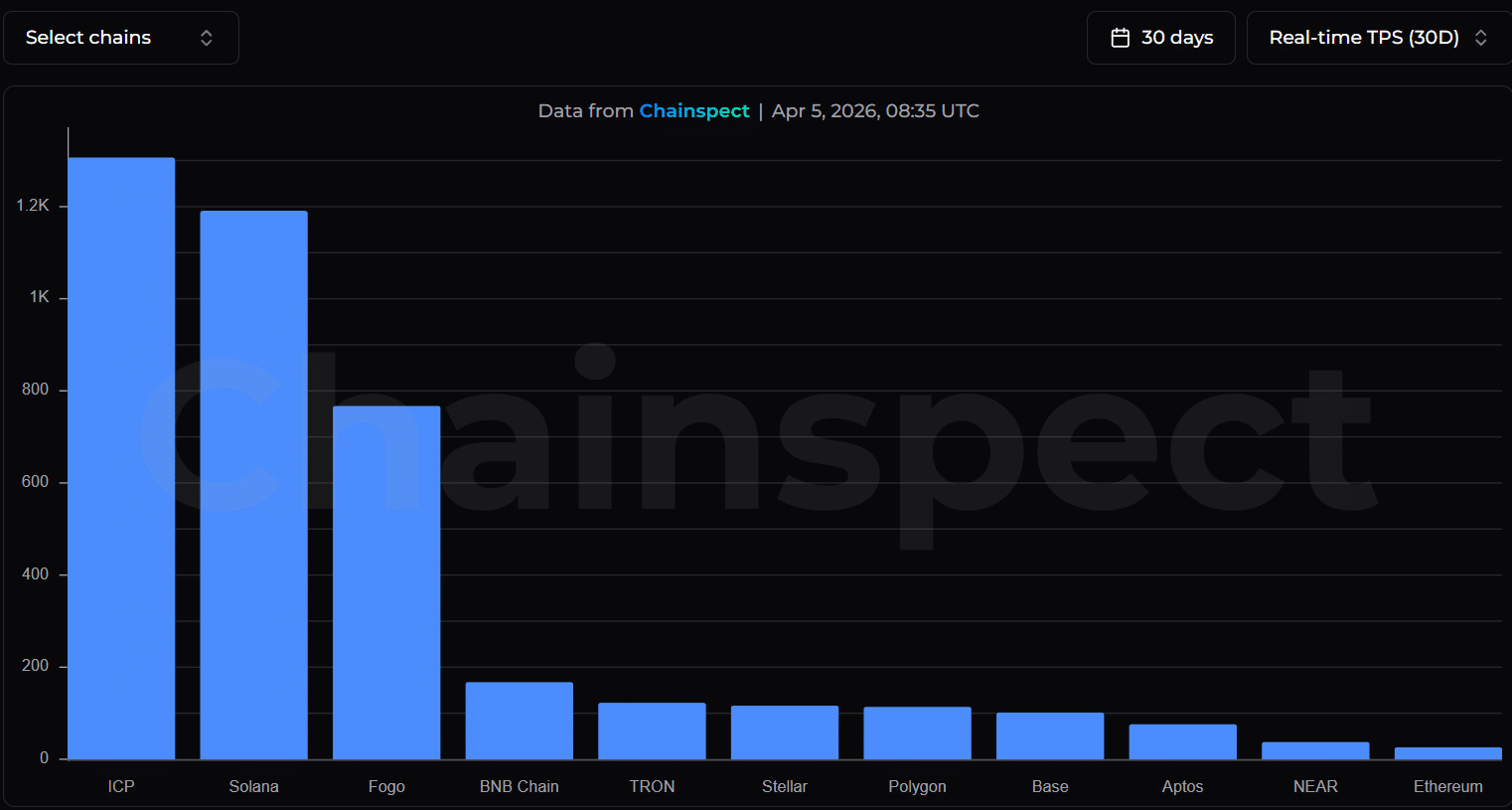
According to Chainspect data, Solana’s high throughput has given it a massive edge over Ethereum across multiple metrics. Look at transaction volume: Solana has processed 31× more transactions than Ethereum, reaching a staggering 106 billion transactions in total.
Source: Chainspect

Notably, this scalability comes straight from Solana’s high speed.

As the chart above shows, Solana ranks second among all blockchains with 1,191 real-time transactions per second (TPS), compared to Ethereum’s 25.99 TPS. This allows Solana to handle massive transaction loads efficiently, giving it a clear edge in DeFi, something slower L1s like Ethereum still struggle with.

According to AMBCrypto, that’s why the recent quantum testing is such a crucial moment.

A 90% slowdown in speed puts Solana’s signature advantage under pressure. Even more, it could slow DeFi growth just as competition from Ethereum is heating up.

This, in turn, forces the network to prove it can stay fast, secure, and ahead of the pack. Otherwise, it risks losing the edge that has long set it apart.


Final Summary

  • High throughput and fast TPS let Solana handle massive transactions, support DeFi growth, and outperform Ethereum across key metrics.
  • Moving toward quantum-safe security slows the network by 90%, forcing Solana to balance speed and security, or risk losing its lead.


Связанные с этим вопросы

QWhat is the main trade-off Solana faces according to the recent quantum testing?

AThe main trade-off is between security and speed. Implementing quantum-safe signatures would make the network roughly 90% slower, forcing Solana to choose between enhanced security against future quantum attacks and maintaining its signature high transaction speed.

QHow does Solana's transaction speed (TPS) compare to Ethereum's, and why is this significant?

ASolana's real-time TPS is 1,191, which is significantly higher than Ethereum's 25.99 TPS. This high speed and scalability have been Solana's defining advantage, allowing it to process 31 times more total transactions and efficiently support complex DeFi activity, which Ethereum struggles with.

QWhat evidence from the article shows Solana is diversifying its stablecoin ecosystem?

ADune data shows that the number of Unique Senders of non-USD stablecoins on Solana, such as EURC and BRZ, nearly tripled year-on-year. This indicates a strategic push to diversify its stablecoin portfolio as part of a broader DeFi expansion.

QWhat is the purpose of Solana's collaboration with Project Eleven?

ASolana is working with Project Eleven to test and implement quantum-safe signatures. The purpose is to protect the network from potential attacks by future quantum computers, thereby future-proofing its security.

QWhat is a key potential consequence for Solana if its network speed is significantly reduced?

AA key potential consequence is that Solana could lose its competitive edge, particularly in DeFi, just as competition from other layer-1s like Ethereum is increasing. A 90% slowdown could hinder its ability to handle massive transaction loads efficiently and support growth.

Похожее

Why Do You Always Lose Money on Polymarket? Because You're Betting on News, While the Pros Read the Rules

Why do you always lose money on Polymarket? Because you bet on news, while the pros study the rules. This article explains how top traders ("che tou") profit by meticulously analyzing market rules, not just predicting events. Polymarket, a prediction market platform, often sees disputes over event outcomes due to ambiguous rule wording. For instance, a market asking "Who will be the leader of Venezuela by the end of 2026?" was misinterpreted by many who bet on Delcy Rodríguez, assuming she held power. However, the rules specified "officially holds" as the formally appointed, sworn-in individual. Since Nicolás Maduro was still recognized as president officially, he won the market—even being in prison. To resolve such disputes, Polymarket uses a decentralized arbitration system via UMA protocol. The process involves: 1. Proposal: Anyone can propose a market outcome by staking 750 USDC, earning 5 USDC if unchallenged. 2. Dispute: A 2-hour window allows challenges with a 750 USDC stake; successful challengers earn 250 USDC. 3. Discussion: A 48-hour period on UMA Discord for evidence and debate. 4. Voting: UMA token holders vote in two 24-hour phases (blind then public). Outcomes require >65% consensus and 5M tokens voted; otherwise, four re-votes occur before Polymarket intervention. 5. Settlement: Results are final and automatic. Unlike traditional courts, Polymarket’s system lacks separation between arbitrators and stakeholders—voters often hold market positions, creating conflicts of interest. This leads to herd mentality in discussions and non-transparent outcomes without explanatory rulings, preventing precedent formation. Thus, success on Polymarket hinges on deep rule interpretation, not just event prediction, exploiting gaps between reality and contractual wording.

marsbit2 ч. назад

Why Do You Always Lose Money on Polymarket? Because You're Betting on News, While the Pros Read the Rules

marsbit2 ч. назад

DeepSeek Funding: Liang Wenfeng's 'Realist' Pivot

DeepSeek, a leading Chinese AI company, has initiated its first external funding round, aiming to raise at least $300 million at a valuation of no less than $10 billion. This move marks a significant shift from its founder Liang Wenfeng’s previous idealistic stance of rejecting external capital to maintain independence. Despite strong financial backing from its parent company, quantitative trading firm幻方量化 (Huanfang Quant), which provided an estimated $700 million in revenue in 2025 alone, DeepSeek faces mounting challenges. Key issues include a 15-month gap in major model updates, delays in its flagship V4 release, and the loss of several core researchers to competitors offering significantly higher compensation. The company is also undergoing a strategic pivot by migrating its infrastructure from NVIDIA’s CUDA to Huawei’s Ascend platform, a move aligned with China’s push for technological self-reliance amid U.S. export controls. However, DeepSeek lags behind rivals like智谱AI and MiniMax—both now publicly listed—in areas such as product ecosystem, multimodal capabilities, and commercialization. The funding round, though relatively small in scale, is seen as a way to establish a market-validated valuation anchor, making employee stock options more competitive and facilitating talent retention. It also signals DeepSeek’s transition from a pure research-oriented organization to a commercially-driven player in the global AI ecosystem.

marsbit3 ч. назад

DeepSeek Funding: Liang Wenfeng's 'Realist' Pivot

marsbit3 ч. назад

Торговля

Спот
Фьючерсы

Популярные статьи

Обсуждения

Добро пожаловать в Сообщество HTX. Здесь вы сможете быть в курсе последних новостей о развитии платформы и получить доступ к профессиональной аналитической информации о рынке. Мнения пользователей о цене на SOL (SOL) представлены ниже.

活动图片