Solana Recovery Narrative Strengthens as RWA Market Hits $1.15B and Regulation Turns Positive

bitcoinistОпубликовано 2026-02-05Обновлено 2026-02-05

Введение

Solana's (SOL) recent price decline below $100 has not diminished its broader recovery narrative. Despite a 25% drop from recent highs, key support near $95–$100 is holding, with technical indicators suggesting potential for a rebound toward $150 or higher. On-chain fundamentals are strengthening, with Total Value Locked reaching a record 73.4 million SOL ($7.5 billion) and daily transactions exceeding 100 million. The real-world asset (RWA) market on Solana has grown to $1.15 billion, supported by its low-cost, high-throughput infrastructure. Standard Chartered adjusted its 2026 SOL price target to $250 but raised its 2030 forecast to $2,000, citing Solana's advantages in micropayments, stablecoin transfers, and improving regulatory clarity.

Solana’s (SOL) recent price weakness has not erased the broader recovery narrative forming around the network. While SOL continues to trade below the psychologically important $100 level after a sharp pullback from January highs, on-chain data and institutional forecasts suggest the blockchain’s long-term positioning is improving.

Related Reading: Elon Musk Revives ‘Dogecoin To The Moon’ With Hint For 2027

Growing real-world asset (RWA) activity, record network usage, and a more constructive regulatory backdrop are increasingly shaping analysts’ views of Solana’s next phase.
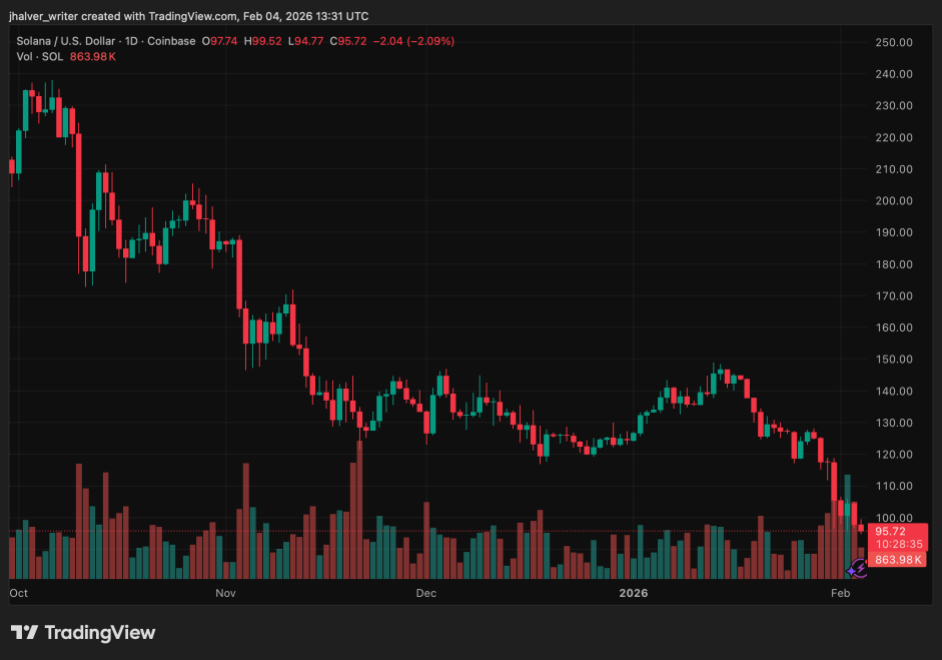
SOL's price trends to the downside on the daily chart. Source: SOLUSD on Tradingview

Price Pressure Persists, But Key Support Holds

SOL has fallen roughly 25% from recent highs near $127, slipping below $100 amid broader crypto market risk-off sentiment. Technical indicators still reflect caution, with bearish momentum dominating short-term charts and some analysts warning of a possible drop toward the $85 area if support near $95 fails.

That said, the $95–$100 zone has repeatedly acted as a major demand area in past market cycles. The daily relative strength index has dipped into oversold territory, a condition that has previously coincided with local bottoms for SOL.

Several technical analysts note that a sustained defense of this range could open the door to a recovery toward the $150 region, with more optimistic scenarios extending toward $215–$260 if resistance levels are reclaimed.

Network Activity And RWA Growth Support The Thesis

Despite price volatility, Solana’s on-chain fundamentals continue to strengthen. Total value locked recently reached an all-time high of 73.4 million SOL, equivalent to roughly $7.5 billion, marking an 18% weekly increase.

On the other hand, daily transactions have surged above 100 million, hitting multi-year highs, while decentralized exchange volumes are also at their strongest levels in months.

Beyond DeFi metrics, the real-world asset market on Solana has expanded rapidly, with tokenized RWAs on the network now estimated at around $1.15 billion. This growth aligns with Solana’s positioning as a low-cost, high-throughput settlement layer, particularly for stablecoins and tokenized financial products.

Faster, more stablecoin-friendly turnover and consistently low transaction fees have made the network increasingly attractive for high-volume use cases.

Standard Chartered Sees Long-Term Upside

Standard Chartered has reinforced this longer-term view, cutting its end-2026 SOL price target to $250 from $310 due to near-term volatility, while raising its 2030 forecast to $2,000.

The bank cited Solana’s dominance in micropayments, stablecoin transfers, and emerging real-world applications as key drivers behind its long-range projections.

According to the bank, Solana’s ability to process large transaction volumes at minimal cost gives it an advantage as regulation around digital assets becomes clearer and more supportive.

Related Reading: Ethereum Active Addresses Near All-Time High Despite Price Plunge

While short-term price action remains uncertain, the combination of rising network usage, expanding RWA activity, and improving regulatory clarity continues to underpin Solana’s recovery narrative.

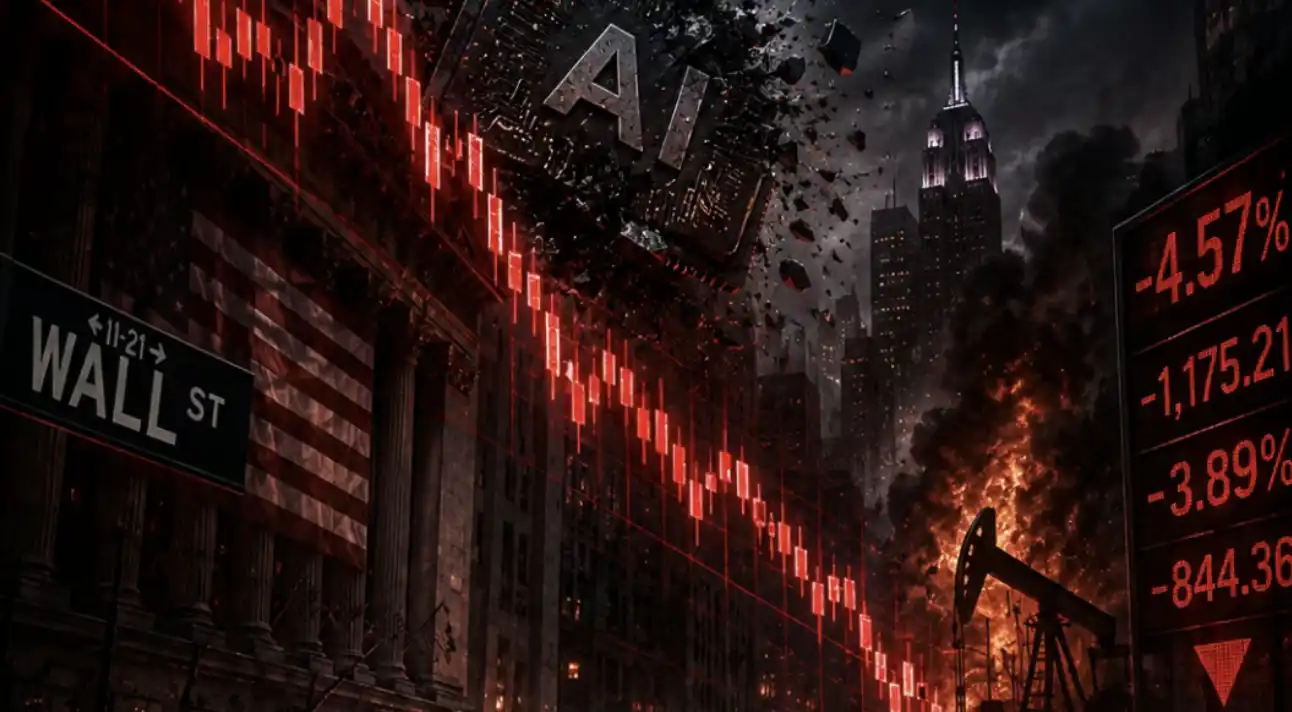
Cover image from ChatGPT, SOLUSD chart on Tradingview

Связанные с этим вопросы

QWhat are the key factors supporting Solana's recovery narrative despite recent price weakness?

AThe key factors supporting Solana's recovery narrative are growing real-world asset (RWA) activity (now at $1.15B), record network usage (daily transactions above 100M), and a more constructive regulatory backdrop.

QWhat is Standard Chartered's long-term price forecast for SOL by the year 2030?

AStandard Chartered has raised its long-term price target for SOL to $2,000 by the year 2030.

QWhat technical price level is identified as a major demand area and crucial support for SOL?

AThe $95–$100 zone is identified as a major demand area that has acted as crucial support in past market cycles.

QWhat recent milestone did Solana's Total Value Locked (TVL) achieve?

ASolana's Total Value Locked (TVL) recently reached an all-time high of 73.4 million SOL, equivalent to roughly $7.5 billion.

QAccording to the bank, what are the key drivers behind Solana's long-range growth projections?

AAccording to Standard Chartered, the key drivers are Solana's dominance in micropayments, stablecoin transfers, and emerging real-world applications, enabled by its ability to process large transaction volumes at minimal cost.

Похожее

Agents Take Over Traffic Distribution Power: What Are Tencent, ByteDance, and Alibaba Competing For?

In the race to dominate the AI era's entry point, China's tech giants—Tencent, ByteDance, and Alibaba—are aggressively deploying AI Agents to control the future of traffic distribution. Alibaba is pursuing a dual-track "closed loop + openness" strategy. Its Qianwen app is evolving into a super-Agent integrated across its ecosystem (Taobao, Alipay, etc.) to handle complex tasks like travel planning. Concurrently, it is opening its platform to external brands (Luckin Coffee, KFC) and has launched a B2B Agent platform, "Wukong," targeting enterprise automation. Its other flagship, Quark, aims to be an "AI super search box" for information and tasks. ByteDance is executing an omnipresent "sprawl strategy." Its Doubao app boasts over 300 million monthly active users and is evolving into a default AI entry point for daily life, with plans for paid versions and e-commerce integration. Its core weapon is the Kouzi platform, a visual "AI assembly factory" for developers to build custom Agents. ByteDance is also pushing hardware integration, collaborating on AI phones and developing smart glasses to embed Doubao everywhere. Tencent is playing its long-held "ultimate card" by quietly embedding an AI Agent directly into WeChat. This Agent, accessible via a swipe, can understand user commands and automatically execute tasks by calling upon WeChat's millions of mini-programs (e.g., finding and ordering coffee). This leverages WeChat's unparalleled 1.4-billion-user ecosystem to position the app as an AI-powered "service operating system," a move that could dramatically reshape the competitive landscape. The core battleground is shifting from competing for "user screen time" to competing to be the "default execution layer" for user intent. The business model is evolving from an "attention economy" to an "intent economy," where the Agent that can most efficiently fulfill a user's need gains control over service access and token flow. This represents a fundamental change in how users connect with digital services, making the fight for the Agent入口 (entry point) a pivotal moment for redefining industry leadership in the AI age.

marsbit8 мин. назад

Agents Take Over Traffic Distribution Power: What Are Tencent, ByteDance, and Alibaba Competing For?

marsbit8 мин. назад

From Banning Doubao to Embracing Honor: Why Did WeChat Suddenly 'Change Its Face'?

The article explores the sudden shift in WeChat's strategy towards AI assistants from mobile phone manufacturers, transitioning from strict opposition to active collaboration. For over a year, WeChat fiercely resisted attempts by phone AI assistants (like ByteDance's Doubao in late 2025) to control its features via GUI automation ("simulated clicking"), citing security and data control concerns. This stance created a significant barrier for system-level AI integration. Now, Tencent has initiated A2A (Agent-to-Agent) partnerships with major phone brands like Honor, Xiaomi, OPPO, and vivo. This model allows a phone's system AI (e.g., Honor's YOYO) to parse a user's voice command and send a structured request directly to WeChat's own internal AI agent via secure APIs. WeChat then executes the action (e.g., sending a message) and returns the result. The article attributes Tencent's "change of face" to strategic pressure. While leading in social app usage, Tencent trails rivals like ByteDance and Alibaba in standalone AI app popularity. WeChat, with its vast mini-program ecosystem, is Tencent's key asset for an AI comeback. The upcoming WeChat AI agent aims to handle tasks like booking and payments within the app. However, phone system assistants remain the primary AI entry point for most users. The A2A collaboration allows Tencent to extend WeChat's AI reach to this crucial system layer while maintaining control over its core functions and data. For phone manufacturers, embracing A2A is a pragmatic move. The GUI route proved unviable due to WeChat's blocks. A2A offers a compliant path to integrate a vital service, enhancing their AI assistants' usefulness. It allows them to focus on developing their own AI ecosystems for other services while cooperating on WeChat access. The collaboration is framed as a mutual, strategic necessity: Tencent gains a distribution channel, and manufacturers gain a key functionality. The partnership relies on a "dual authorization" mechanism for security, requiring both user and app consent for each action. While questions about long-term data privacy practices remain, experts note A2A is more secure and compliant than GUI automation. Ultimately, this cooperation is seen as a tentative, calculated truce. Tencent's long-term goal is to make WeChat an AI-powered "service OS." Phone manufacturers aim to make their system AI the central user interface. Their paths may converge or clash in the future, but for now, the A2A deal represents the opening chapter in the battle for the AI-era user入口, driven by necessity and strategic calculus on both sides.

marsbit1 ч. назад

From Banning Doubao to Embracing Honor: Why Did WeChat Suddenly 'Change Its Face'?

marsbit1 ч. назад

On-Chain Figures on the Eve of Kickoff: 1.6 Billion Traded Before the World Cup Even Begins

"On-Chain Numbers on the Eve of the World Cup: $1.6 Billion Traded Before Kick-off" Analysis of on-chain markets before the 2026 FIFA World Cup reveals significant crypto integration into football. The most striking figure is the approximately **$1.6 billion** in total trading volume on the single "World Cup Winner" contract on the Polymarket prediction market platform, accumulated before a single match was played. This represents explosive growth for a sector whose annual volume surged from ~$16B in 2024 to ~$64B in 2025. The ecosystem is maturing beyond speculation. Key developments include: 1) **Infrastructure upgrades** like Polymarket's migration to native, regulated USDC stablecoin for settlements; 2) **Reliable data oracles**, such as Chainlink, being used to resolve real-world match outcomes on-chain; and 3) **Official recognition**, with FIFA appointing its first-ever "Prediction Markets" partner. Over 100 contracts now cover everything from the outright winner to individual match results and even non-sporting risks like venue relocation. This evolution marks a fundamental shift. While crypto firms are absent from FIFA's top-tier sponsor list, the technology has deeply penetrated the tournament's financial and predictive infrastructure through regulated stablecoin settlements, decentralized oracles, and new official partnership categories. The regulatory landscape remains complex and varies by jurisdiction, but on-chain markets for the World Cup are already a multi-billion-dollar reality.

marsbit2 ч. назад

On-Chain Figures on the Eve of Kickoff: 1.6 Billion Traded Before the World Cup Even Begins

marsbit2 ч. назад

Торговля

Спот
Фьючерсы

Популярные статьи

Обсуждения

Добро пожаловать в Сообщество HTX. Здесь вы сможете быть в курсе последних новостей о развитии платформы и получить доступ к профессиональной аналитической информации о рынке. Мнения пользователей о цене на SOL (SOL) представлены ниже.

活动图片