SK Hynix Becomes the 'Capitalist Traitor', Samsung Employees Launch Major Strike

marsbitОпубликовано 2026-05-13Обновлено 2026-05-13

Введение

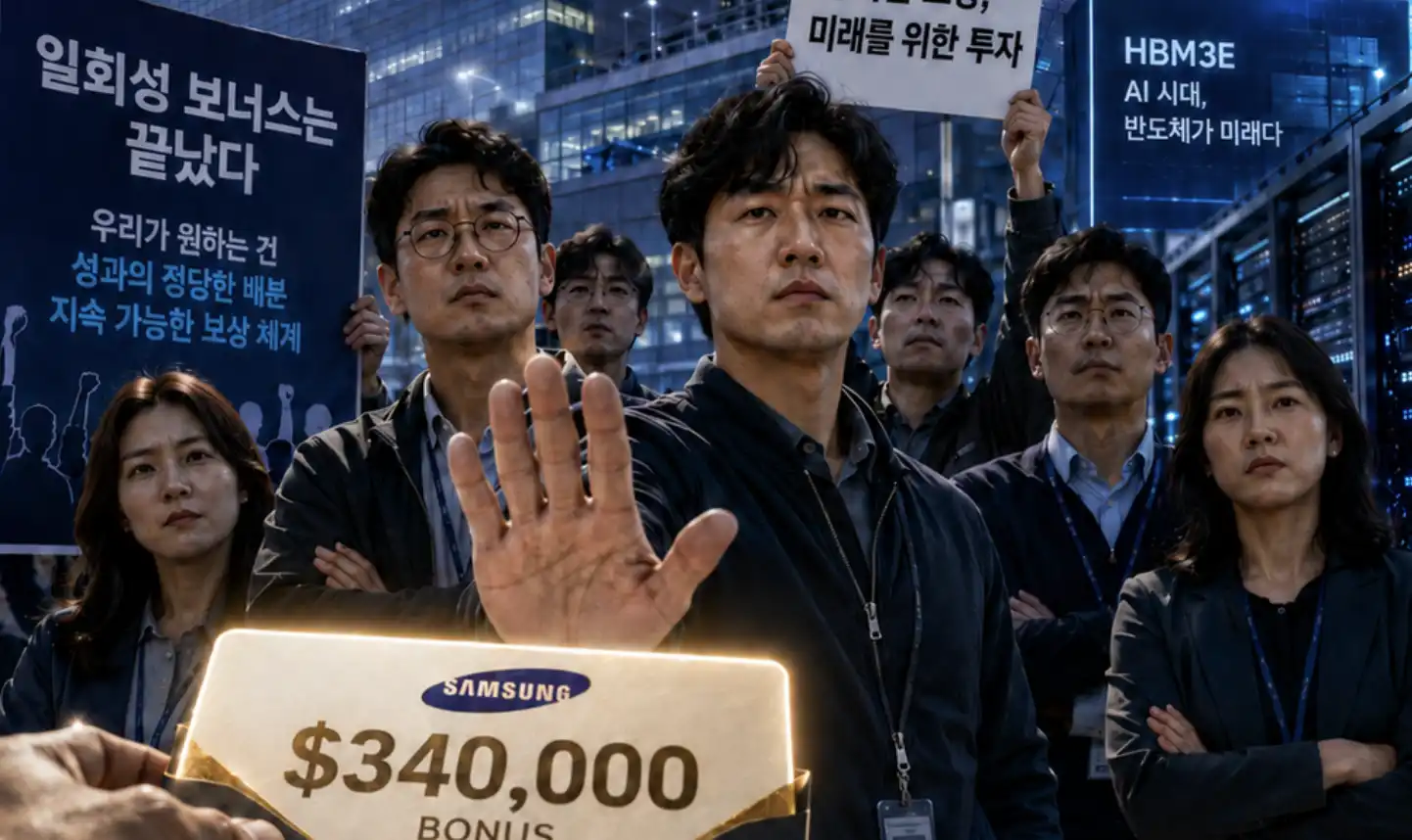
A major labor dispute is escalating at Samsung Electronics, with its union threatening an 18-day strike from May 21st after mediation failed. The core conflict is over profit-sharing, not the wage increase amount. The union, emboldened by a precedent set at rival SK Hynix, demands a permanent, formula-based annual bonus tied to 13% of the semiconductor division's operating profit. Management offered a large one-time payout instead, refusing to institutionalize an annual split, fearing it would set a costly precedent across Samsung's diverse business groups and the wider Korean conglomerate system. SK Hynix's deal, guaranteeing employees 10% of annual operating profit for a decade, has already delivered substantial bonuses due to its dominance in the lucrative HBM memory market for AI chips. This has triggered rare employee movement from Samsung to SK Hynix. The strike, potentially involving tens of thousands, risks impacting global DRAM and NAND production. Analysts see this as the start of a broader recalibration within the AI supply chain, where workers in critical, scarce roles are beginning to renegotiate their share of the massive profits generated, moving beyond traditional models like stock options towards more direct, transparent cash profit-sharing agreements.

Written by: Xiao Bing, Shenchao TechFlow

Samsung Electronics' labor negotiations have finally reached the brink of a strike.

Late on May 12th, mediation led by Korea's National Labor Relations Commission broke down. Samsung Electronics Union President Choi Seung-ho told reporters as he left the meeting room, "There's no point in waiting any longer." Barring any unforeseen circumstances, starting May 21st, the union will launch a major 18-day strike, lasting until June 7th.

The union currently has about 74,750 members, with approximately 80% from the semiconductor division (DS). According to Choi, about 41,000 members have expressed willingness to participate in the strike, with the final number potentially exceeding 50,000. Considering Samsung's participation rates in labor actions over the past two years, industry analysts estimate the actual participation this time will be between 30,000 and 40,000, making it the largest labor action in Samsung's history. A one-day partial strike previously caused a 58% reduction in night shift production on some lines. If the full 18-day strike proceeds, TrendForce estimates it could affect 3-4% of global DRAM capacity and 2-3% of NAND capacity. JPMorgan estimates that based on the current disagreements, Samsung Electronics' annual operating profit could be reduced by over 40 trillion KRW.

The real story isn't the strike itself, but the proposal the union rejected.

A 13% Offer, No Deal

According to the UK's Financial Times, the two sides had recently narrowed their initial gap considerably. The union's initial demands were a 15% bonus pool from the semiconductor division's operating profit, removal of the 50% bonus cap, plus a 7% wage increase. Management's initial response was 10% plus some other benefits. After back-and-forth negotiations, it was rumored both sides were close to the 13% figure.

But talks stalled.

The union wanted the 13% written into the agreement, to be paid annually according to this formula. Management was willing to pay a lump sum at this ratio, but only for this year, translating to an average one-time bonus of about $340,000 per person based on current profit levels.

It doesn't sound that different, but the union rejected it.

For employees, the difference isn't complicated:

The logic of a one-time bonus is: the company made a lot this year, so we're giving you a bonus. Whether the company makes a lot next year, whether we give a bonus, and according to what formula, will be renegotiated every year.

The logic of annualized profit-sharing is: according to the agreement, a certain percentage of operating profit inherently belongs to employees. Employees receive it for as long as the AI boom lasts; if the boom fades, employees accept that.

Both models are "bonuses," but they correspond to different statuses. The former is a temporary gift from the company; the latter is a share that is institutionally allocated by rule. With similar amounts, the two arrangements mean either employees wait for management's decision every year, or they have a predictable rule written in black and white.

This is the core point the union won't let go.

SK Hynix Has Already Made This Work

The union's confidence comes from its neighbor.

In the second half of last year, SK Hynix reached an agreement with its union, abolishing the previous bonus cap and establishing a 10% annual operating profit pool for employee sharing, valid for the next ten years. In February 2026, SK Hynix issued the first bonus under this new mechanism, amounting to 2,964% of base salary, averaging nearly $100,000 per person.

SK Hynix's Q1 2026 operating profit surged more than 5 times year-over-year, with an operating margin of 72%, an extremely rare figure in the hardware industry. The reason is clear: it holds over 50% of the global HBM (High Bandwidth Memory) market, being the main supplier of HBM for Nvidia's H100 and H200 chips. It earns as much as AI data centers are built.

As profit expectations have been raised throughout the year, some Korean and foreign media have calculated, under optimistic scenarios, that the average SK Hynix employee bonus this year could be around $470,000; if the high-end profit forecasts from institutions like Macquarie for 2027 materialize, it could theoretically approach $900,000. These figures require caution; they are projections based on optimistic profit assumptions, not money already in hand. But even based on the already disbursed amount and conservative expectations for the second half, the absolute numbers still far exceed Samsung's current offer.

Since December last year, about 200 Samsung employees have jumped ship to SK Hynix, according to the Samsung union's own statistics. This is a very rare migration direction among engineers, as SK Hynix has been playing catch-up to Samsung for the past decade. But this time, with the bonus structure changed, people are following.

Samsung Management Finds It Hard to Compromise

From the outside, Samsung just seems stingy, but from management's perspective, it's more complex than it appears.

Samsung Electronics is not a pure-play memory chip company. It has multiple business lines: mobile phones, home appliances, display panels, foundry, memory, and more. The semiconductor division making a lot this year doesn't mean other divisions can enjoy the same cycle. In Q1, the DX division's operating profit was already declining. If semiconductors alone get a 15% written profit share, people within the group would immediately ask: why do they get a share, and we don't?

According to external analyst calculations, if Samsung Semiconductor truly allocated 15% of operating profit to employees, the corresponding bonus pool would reach 40 to 45 trillion KRW, an amount higher than SK Hynix's total annual operating profit. This isn't just the company being "reluctant," but such a large-scale fixed expense, once institutionalized, would be very difficult to roll back in the future.

What management is most unwilling to do is write "formulaic profit-sharing" into a contract. Once this precedent is set, next year the DX union, the display panel union, will all use the same logic to negotiate. The entire internal compensation order within the Samsung Group would be reshuffled, and labor contracts across the entire Korean chaebol system would be used as new references.

That's why Samsung would rather endure strike losses, be called "stingy" by the union and media, and hold its ground on the wording of "annualization."

This Won't Stop at Korea

The specific day the union and management reach a compromise isn't the most important thing in the long run.

What's important is: Scarce positions on the AI industrial chain have begun renegotiating their value.

Over the past thirty years, Silicon Valley's script has been to tie employees' fates to the company's stock price with equity incentives. But this script has two implicit premises: the company must go public, and employees must be part of the early batch. Engineers joining later, after stock dilution, get far less than those who came before.

SK Hynix has carved a second path: no need to wait for an IPO, no need to watch the stock price; use cash profit-sharing to turn employees into cycle partners. Its benefits are a transparent formula, a timetable, and predictability. The cost is the company needs to acknowledge that employees aren't just a cost item, but also part of the profit item.

Once this path is proven at SK Hynix, and some version is negotiated at Samsung, the next entities facing the same question might not just be Korean companies.

What do TSMC engineers think about how much Nvidia earns for every GPU sold? What do ASML workers think about the $200 million price tag of an EUV lithography machine? Will veterans in those age-old industries supplying liquid cooling, power, and transformers for data centers suddenly realize they hold scarce resources?

Not all questions will have immediate answers, but the questions have been asked.

The capital market has already provided one round of answers to "Who gets the AI红利?" in the past two years: Nvidia shareholders were the first to reap the红利, followed by TSMC, SK Hynix, and Samsung through capacity and pricing power—this is distribution among companies.

Distribution within companies has just begun.

The 18 days starting May 21st might end with a union victory, or with some compromise, where management concedes a step on "annualization," writing it into a shorter-term agreement to leave an escape route. The specific outcome affects this contract's amount, but not the real direction.

SK Hynix employees have already received their first profit-sharing ticket. Samsung employees are using a strike to fight for theirs. Who gets the next ticket, when, and in what form, might be one of the most interesting underlying trends to follow in the AI industrial chain over the next three to five years.

Связанные с этим вопросы

QWhat are the main differences between the bonus structures proposed by Samsung management and the union?

AThe union demands a 13% annual profit-sharing scheme written into a long-term agreement, ensuring a predictable, rule-based bonus tied to profits each year. Management offers a one-time bonus of approximately $340,000 per employee based on current profits, but refuses to institutionalize an annual formula. The core dispute is over creating a permanent, predictable rule versus retaining management discretion for annual negotiations.

QHow has SK Hynix's new bonus system influenced the Samsung labor dispute?

ASK Hynix successfully implemented a ten-year agreement last year, abolishing bonus caps and allocating 10% of annual operating profit to employees. This resulted in substantial per-employee bonuses (e.g., nearly $100,000 in early 2026). This precedent has empowered Samsung's union, leading to employee defections (around 200) from Samsung to SK Hynix and strengthening the union's demand for a similar, formula-based, long-term profit-sharing scheme at Samsung.

QWhy is Samsung management resistant to the union's demand for a formula-based annual profit share?

ASamsung is a conglomerate with multiple divisions (e.g., smartphones, appliances, displays, foundry). A formula for its high-profit semiconductor division alone would create internal equity issues, prompting demands from other divisions' unions. Institutionalizing a large-scale, fixed profit share (estimated at 40-45 trillion won) is seen as a rigid, costly commitment that would be difficult to reverse and could redefine compensation norms across the entire Samsung Group and the wider Korean chaebol system.

QWhat potential global impact could the resolution of this dispute have beyond South Korea?

AThe dispute highlights a broader trend: workers in critical AI supply chain roles (e.g., semiconductor manufacturing, equipment, infrastructure) are beginning to renegotiate their share of the profits. If profit-sharing models like SK Hynix's become established, it could set a precedent, prompting similar demands at companies like TSMC, ASML, and key infrastructure suppliers, challenging traditional compensation models and shifting the internal distribution of AI industry profits from companies to their skilled workforce.

QWhat is the estimated operational and financial impact of the potential Samsung strike?

AA full 18-day strike by an estimated 30,000-40,000 workers (primarily in semiconductor production) could reduce global DRAM output by 3-4% and NAND output by 2-3%. Financially, JP Morgan estimates that the full-year impact of the labor dispute, based on the current disagreements, could reduce Samsung Electronics' annual operating profit by over 40 trillion won.

Похожее

How to Define "Real U.S. Stocks": Differences Between On-Chain Tokens, Price Contracts, and Direct Broker Connections

**Title:** Defining "Real US Stocks": Differences Among On-Chain Tokens, Price Contracts, and Broker-Direct Access **Summary:** In 2026, using stablecoins to purchase US stocks is mainstream, but products marketed as "buying US stocks with USDT" offer fundamentally different assets. This article analyzes three primary models. **1. Tokenized Stocks:** These are on-chain tokens representing economic exposure to underlying stocks, held by an issuer or custodian. They offer benefits like 24/7 trading and DeFi composability (e.g., use as loan collateral). However, users lack direct legal shareholder status; dividends may not be paid in cash, and voting rights are typically non-binding advisory expressions. Examples include platforms like Ondo Finance. **2. Stock Futures / Equity Perpetuals:** These are derivative contracts tracking a stock's price, allowing leveraged long/short positions 24/7, similar to crypto perpetuals. They offer high efficiency and flexibility but involve funding fees, which can be a significant long-term cost, especially during strong trends. Crucially, they confer no ownership rights (dividends, voting) to the holder. **3. Broker-Direct Model:** This model provides access to real securities via licensed broker-dealers. Stocks/ETFs are bought and held within the US clearing and custodial system (e.g., DTCC), making it the only path to genuine stock ownership. Users receive cash dividends and formal proxy voting rights (where applicable). It supports thousands of stocks and ETFs, far exceeding the coverage of the other two models. Key advantages include no funding fees, a clean cost structure for long-term holds, and the potential to transfer holdings to other brokers. Some platforms facilitate stablecoin (USDT/USDC) deposits, reducing reliance on traditional banking. A critical distinction exists *within* the broker-direct model: the underlying brokerage architecture (e.g., Fully Disclosed IB, Omnibus IB, Self-Clearing) determines how client assets are held, protected, and how safeguards like SIPC insurance are conveyed. Users should verify the specific clearing structure and regulatory compliance of any platform. In conclusion, "buying US stocks with USDT" can mean holding an on-chain economic proxy (Tokenized Stocks), trading a price derivative (Stock Futures), or owning the actual security (Broker-Direct). For users seeking full ownership rights and long-term investment, the broker-direct model is the definitive choice, though its implementation details require careful scrutiny.

marsbit39 мин. назад

How to Define "Real U.S. Stocks": Differences Between On-Chain Tokens, Price Contracts, and Direct Broker Connections

marsbit39 мин. назад

NVIDIA Launches DSX Platform, Expanding into AI Factory Infrastructure

NVIDIA has unveiled the DSX platform at its GTC Taipei event, marking a strategic expansion from GPU sales into comprehensive AI factory infrastructure solutions. The platform addresses challenges like power supply, cooling, and resource orchestration as AI models scale, shifting the industry focus from single-chip performance to overall infrastructure efficiency. DSX integrates NVIDIA's chips, systems, software, and partner technologies to cover the entire AI factory lifecycle—from design and simulation to deployment and operations. It aims to accelerate deployment, improve reliability and operational efficiency, and reduce the cost per generated token in AI inference. The software suite includes DSX MaxLPS, which uses 45°C liquid cooling and rack-level optimization to allow up to 40% more GPUs per megawatt, and DSX OS, an open-source platform for AI factory operations. The platform also encompasses reference designs, digital twin simulation (DSX Sim), dynamic workload adjustment based on grid conditions (DSX Flex), and data exchange between systems. Early adopters include cloud providers like CoreWeave and Lambda. Major hardware partners, including Dell, HPE, Lenovo, and Supermicro, are developing DSX-ready systems. Pilot projects for DSX Flex are underway with energy providers. Strategically, DSX represents NVIDIA's ongoing transition from an AI chip supplier to a full-stack AI infrastructure platform provider, aiming to set industry standards and solidify its market leadership.

marsbit44 мин. назад

NVIDIA Launches DSX Platform, Expanding into AI Factory Infrastructure

marsbit44 мин. назад

After Burning Tens of Billions of Dollars in Tokens, Silicon Valley Giants Start Limiting Employee Token Usage

After burning tens of billions of dollars on AI tokens, major Silicon Valley firms are now restricting employee usage. Companies like Microsoft, Uber, and Salesforce, which heavily promoted AI for "efficiency," are facing a cost crisis. The practice of "tokenmaxxing"—pushing employees to maximize AI tool usage—led to wasteful spending on trivial tasks like checking the weather or writing birthday messages, with studies showing significant hidden costs for bug fixes and code rewrites. The core issue is a misalignment between individual productivity gains and actual business value. While employees use AI to automate tasks they dislike, such as writing reports, this often doesn't translate to increased company revenue or improved core business outcomes. For instance, AI-generated code speeds up development but also sees an 800% increase in "code churn" (code being discarded or rewritten). As a result, only 14% of CFOs report seeing a clear, measurable return on AI investments. Firms are now shifting strategies. Microsoft has revoked most internal licenses for Claude Code, while others are implementing monitoring and cost controls. New tools from companies like Harness and CloudZero aim to track AI spending and tie costs to business results. Some AI vendors, like HubSpot, are moving from token-based pricing to charging based on outcomes, such as "resolved conversations" or "leads generated." This represents a necessary correction in the AI adoption cycle. The challenge now is for companies to move beyond using AI merely to speed up old tasks and instead rethink their workflows and business models fundamentally. The future of enterprise AI depends on proving its value, not just its usage.

marsbit1 ч. назад

After Burning Tens of Billions of Dollars in Tokens, Silicon Valley Giants Start Limiting Employee Token Usage

marsbit1 ч. назад

I've Been a VC in Web3 for Nine Years: Asian Funds Are Experiencing "Hell Mode"

After nine years as a Web3 VC, the author observes a severe downturn in Asia's crypto venture capital scene, with many funds disappearing or pivoting away. The market has cooled dramatically since the 2021-2024 frenzy, leading to fewer deals and active investors. IOSG Ventures, a firm that has endured three market cycles, has adapted its strategy: shifting from 80-90% early-stage investments to a 50% early-stage, 30% post-TGE, and 20% OTC portfolio to find better value and liquidity. The current bear market is described as "hell mode" for Asian funds due to scarce LP capital, forcing extreme precision in targeting only top projects. The author argues the core industry problem has been the disconnect between tokens and real value, where tokens served as fundraising tools without granting holders rights to protocol revenue. A positive shift is emerging where projects like Uniswap and Morpho are programmatically binding token value to protocol profits. Investment focus has moved towards fundamentals: real-yield financial infrastructure (stablecoins, lending) and crypto-native AI infrastructure, while avoiding narrative-driven projects. The conclusion is that true, durable companies are born in pessimistic times when focus shifts to real user needs and sustainable business models. The industry's future will be shaped by those who remain after the泡沫 dissipates.

marsbit1 ч. назад

I've Been a VC in Web3 for Nine Years: Asian Funds Are Experiencing "Hell Mode"

marsbit1 ч. назад

Торговля

Спот
Фьючерсы
活动图片