Silver Faces a 'Delivery Failure' Crisis? March May Be a 'Critical Moment' for Precious Metals

marsbitОпубликовано 2026-01-29Обновлено 2026-01-29

Введение

A potential delivery crisis is looming in the silver market, with veteran analyst Bill Holter warning that COMEX could face a physical silver default as early as March 2026. Such an event would destroy the credibility of the current pricing mechanism and trigger a chain reaction spreading to gold and credit markets, potentially causing a systemic financial collapse. Unusually high delivery demand has already emerged, with over 40 million ounces of silver requested for delivery in January—a traditionally non-delivery month—compared to the usual 1-2 million ounces. As the key March delivery month approaches, demand could reach 70-80 million ounces, potentially exhausting COMEX's registered inventory of 110-120 million ounces. This warning comes amid an unprecedented rally, with silver prices surging 154% year-to-date and 40% in January alone. If COMEX fails to deliver, contract values could collapse, undermining trust in paper contracts and triggering a liquidity crisis reminiscent of the 1980 Silver Thursday event. Despite prices exceeding $100/ounce, analysts believe the market remains in early stages, with predictions of $300/ounce or even extreme valuations based on monetary recalibration. Strong industrial demand from solar, EV, and electronics sectors, combined with investment demand as an inflation hedge, contrasts with constrained supply, setting the stage for continued volatility and potential long-term price appreciation.

Author:Bu Shuqing, Wall Street News

The precious metals market is facing a potential delivery crisis.

Veteran precious metals analyst Bill Holter recently warned that the New York Commodity Exchange (COMEX) could see a physical silver delivery default as early as March 2026. This would completely destroy the credibility of the existing pricing mechanism and trigger a chain reaction spreading to the gold and credit markets, potentially leading to the collapse of the entire financial system.

Abnormal delivery demand has already emerged. According to Holter, in January, traditionally a non-delivery month, COMEX has already seen over 40 million ounces of silver requested for delivery, whereas this figure is typically only 1 to 2 million ounces in previous years during the same period. As the main delivery month of March approaches, delivery demand could reach 70 to 80 million ounces, potentially depleting COMEX's current registered inventory of 110 to 120 million ounces.

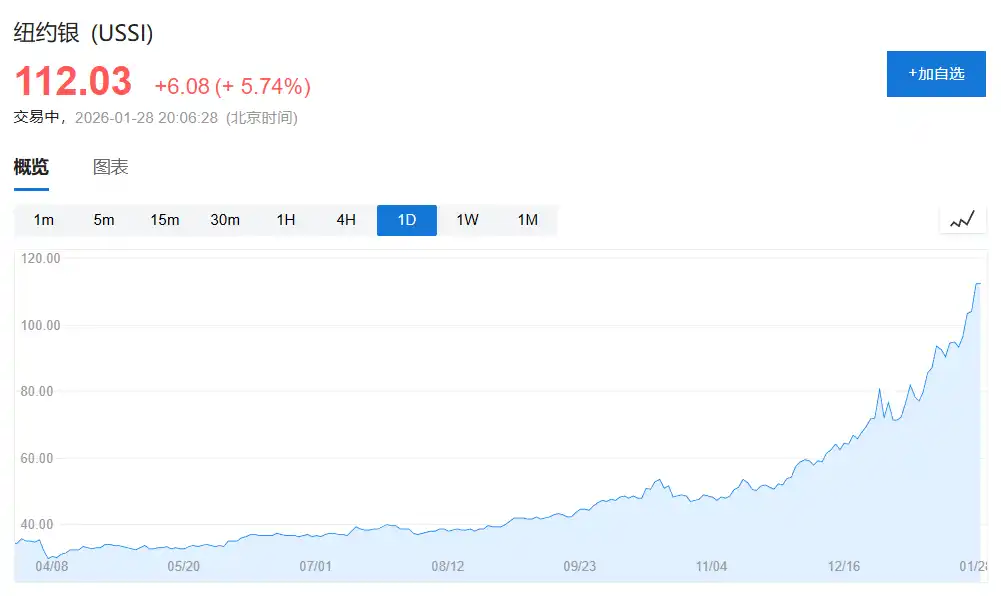
This warning comes as the silver market is experiencing an unprecedented rally. Silver prices have surged 154% year-to-date in 2025, rising about 40% in January alone, far outpacing the stock market's performance over the same period. UBS strategists have already alerted clients this week, stating that the gains in precious and industrial metals have been "out of control" recently.

If Delivery Fails, Is the Financial System at Risk of Collapse?

The COMEX silver market is facing unprecedented physical delivery pressure. Holter pointed out that the appearance of 40 million ounces of delivery requests in January, a non-delivery month, is an extremely abnormal phenomenon, signaling the potential for a larger-scale run in the main delivery month of March.

"If COMEX cannot fulfill its delivery obligations, the contract value will go to zero," Holter stated. He emphasized that a delivery default would completely negate COMEX's pricing authority, as contracts that cannot be honored hold no value.

More seriously, a silver delivery failure would immediately transmit to the gold market. Holter warned that since gold is essentially an "anti-dollar" or "anti-U.S. Treasury" asset, a default in the gold market would directly impact the credit market, thereby threatening the stability of the entire financial system.

Currently, COMEX's registered deliverable silver inventory is approximately 110 to 120 million ounces, but the market questions whether this inventory might be subject to re-hypothecation or other encumbrances. If March delivery demand exceeds available inventory, the market will face the most severe liquidity crisis since the Silver Thursday event of 1980.

Holter painted a grim picture of the consequences of a delivery default. He predicted that if a delivery failure occurs in March 2026, it would trigger currency devaluation and the collapse of the entire financial system.

"The real economy runs on credit. Everything you touch, everything you do, involves the participation of credit," Holter said. If credit becomes unavailable, the real economy would completely stall.

This warning is not alarmist. The pricing mechanism of the precious metals market has long relied on paper contracts, with physical delivery being extremely low. Once trust in paper contracts collapses, investors will flock to demand physical delivery, and exchange inventories are far from sufficient to meet the delivery demands of all contracts.

Considering the U.S.'s total debt and commitment scale of $200 trillion, the financial system's reliance on credit has reached a historical extreme. A crisis of confidence in any key market could trigger a chain reaction, and the precious metals market is precisely the final anchor of trust for the entire monetary system.

Price Predictions "Ridiculously Underestimated"

Although the silver price has broken through $100 per ounce, Holter believes the market is still in the early stages of the rally. He stated that all current price predictions—including the $600 per ounce target proposed years ago—will ultimately prove to be "ridiculously underestimated."

Well-known silver analyst Peter Krauth is also optimistic, expecting silver prices to potentially hit $300 per ounce in the upcoming "mania phase." Krauth believes that $50 per ounce has become the new price floor, and a sharp adjustment in the gold-to-silver ratio will be the core driver pushing silver prices higher.

Holter provided an even more extreme valuation framework from a monetary perspective. He pointed out that if calculated based on the U.S. federal government's $38 trillion debt, supported by 8,000 tons of gold reserves, the gold price should reach $200,000 per ounce. This logic also applies to the repricing of silver.

Some large traders and banks that are short precious metals have already fallen into financial difficulties. Holter indicated that the persistently rising metal prices—especially silver prices—are putting severe pressure on these institutions, which could exacerbate market instability.

Silver's strong performance is rooted in a deep fundamental imbalance. As a metal with both monetary and industrial properties, silver is being squeezed by multiple sources of demand.

Industrial demand remains strong, particularly in areas such as solar energy, electric vehicles, and electronics. At the same time, investment demand is also surging, with investors viewing silver as a hedge against inflation and currency devaluation.

The supply side faces structural constraints. Silver is primarily a by-product of base metal mining like copper, lead, and zinc, making its production difficult to quickly respond to price signals. This supply rigidity can easily trigger sharp price fluctuations when demand surges.

Krauth emphasized that all the elements needed to sustain the rally for "quite some time" are already in place. Although there is a risk of a short-term pullback, the medium to long-term trend is already established.

Связанные с этим вопросы

QWhat potential crisis is the COMEX silver market facing according to analyst Bill Holter?

ABill Holter warns that the COMEX may face a physical silver delivery default as early as March 2026, which could destroy the credibility of the existing pricing mechanism and trigger a chain reaction leading to the collapse of the entire financial system.

QWhat unusual demand pattern has been observed in the COMEX silver market recently?

AIn January, a traditionally non-delivery month, there were over 40 million ounces of silver requested for delivery, compared to the usual 1-2 million ounces in previous years.

QWhat is the estimated size of the COMEX's registered silver inventory, and why is it a concern?

AThe COMEX's registered deliverable silver inventory is approximately 110-120 million ounces. There is concern that this may be insufficient if delivery demands reach 70-80 million ounces in the key March delivery month, potentially leading to a liquidity crisis.

QWhat are some of the extreme price targets mentioned for silver by the analysts in the article?

AAnalyst Peter Krauth expects silver could reach $300 per ounce in an upcoming 'mania phase,' while Bill Holter suggests that even a target of $600 per ounce would be a 'laughable underestimate' from a monetary valuation perspective.

QBeyond investment demand, what other factors are contributing to the strong fundamentals for silver?

ASilver is experiencing strong industrial demand from sectors like solar energy, electric vehicles, and electronics. Additionally, its supply is structurally constrained as it is largely a byproduct of base metal mining (like copper, lead, zinc), making it difficult to quickly increase production in response to price signals.

Похожее

How Many Tokens Away Is Yang Zhilin from the 'Moon Chasing the Light'?

The article explores the intense competition between two leading Chinese AI companies, DeepSeek and Kimi (Moon Dark Side), and the mounting pressure on Yang Zhilin, the founder of Kimi. While DeepSeek re-emerged after 15 months of silence with its powerful V4 model—boasting 1.6 trillion parameters and low-cost, long-context capabilities—Kimi has been focusing on long-context processing and multi-agent systems with its K2.6 model. Yang faces a threefold challenge: technological rivalry, commercialization pressure, and investor expectations. Despite Kimi’s high valuation (reaching $18 billion), its revenue heavily relies on a single product with low paid conversion rates, while DeepSeek’s strategic silence and open-source influence have strengthened its market position and valuation prospects, now targeting over $20 billion. Both companies reflect broader trends in China’s AI ecosystem: Kimi aims for global influence through open-source contributions and agent-based advancements, while DeepSeek prioritizes foundational innovation and hardware independence, notably shifting to Huawei’s chips. Their competition is seen as vital for China’s AI progress, with the gap between top Chinese and U.S. models narrowing to just 2.7% on the Elo rating scale. Ultimately, the article argues that this rivalry, though anxiety-inducing for leaders like Zhilin, is essential for driving innovation and solidifying China’s role in the global AI landscape.

marsbit30 мин. назад

How Many Tokens Away Is Yang Zhilin from the 'Moon Chasing the Light'?

marsbit30 мин. назад

TechFlow Intelligence Bureau: ChatGPT Helps Amateur Mathematician Crack 60-Year-Old Problem, CFTC Sues New York Regulator Over Coinbase and Gemini

An amateur mathematician, with the assistance of ChatGPT, has solved a combinatorial mathematics puzzle originally proposed by Hungarian mathematician Paul Erdős in the 1960s. This marks another milestone in AI-aided mathematical research, demonstrating the evolving capabilities of large language models in formal reasoning. In other AI developments, OpenAI introduced a new privacy filter tool for enterprise API usage, automatically screening sensitive data. Meanwhile, the Qwen3.6-27B model achieved 100 tokens per second on a single RTX 5090 GPU using quantization, significantly lowering the cost barrier for local AI deployment. In crypto and Web3, the U.S. CFTC sued New York’s financial regulator, challenging its oversight of Coinbase and Gemini—a first-of-its-kind federal-state regulatory clash. Following a vulnerability, KelpDAO and major DeFi protocols established a recovery fund. Tether froze $344 million in assets linked to Iran’s central bank upon U.S. Treasury request, highlighting the centralized control risks in stablecoins. Separately, Litecoin underwent a 3-hour chain reorganization to undo a privacy-layer exploit. In the U.S., former President Trump invoked the Defense Production Act to address power grid bottlenecks affecting AI data centers and dismissed the entire National Science Board, raising concerns over research independence. A retail trader gained 250% on a $600k Intel options bet amid AI-related speculation. Xiaomi announced its first performance electric vehicle, targeting rivals like Tesla. Meanwhile, iPhone users reported devices automatically reinstalling a hidden app daily, suspected to be MDM-related. A Chinese securities report noted that A-share institutional crowding has reached its second-longest streak since 2007, signaling high valuations and potential style rotation. The day’s developments reflect a dual narrative: AI is enabling unprecedented individual breakthroughs, while centralized power structures—whether governmental or corporate—are becoming more assertive, underscoring that decentralization is as much a political-economic challenge as a technical one.

marsbit53 мин. назад

TechFlow Intelligence Bureau: ChatGPT Helps Amateur Mathematician Crack 60-Year-Old Problem, CFTC Sues New York Regulator Over Coinbase and Gemini

marsbit53 мин. назад

Торговля

Спот
Фьючерсы
活动图片