Seed Round Secures $500 Million, It Aims to Be the 'Apple' of Payment Blockchains

比推Опубликовано 2025-12-11Обновлено 2025-12-11

Введение

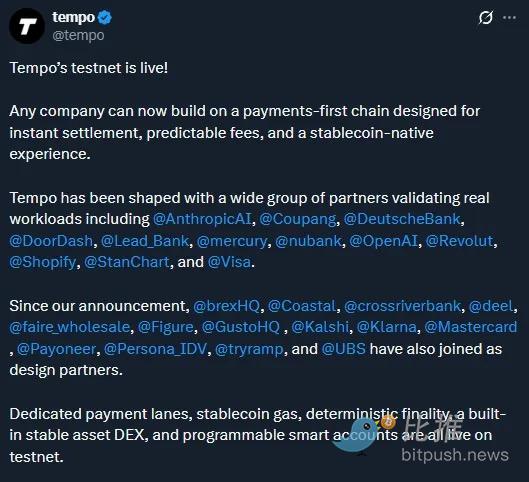
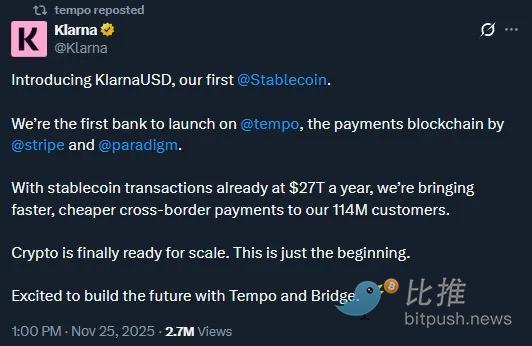
Stripe's Tempo blockchain, a fork of Ethereum optimized for fintech applications, is now live on testnet. Backed by a $500 million seed round from Stripe and Paradigm, it aims to become the "Apple" of payment blockchains through vertical integration and a closed-architecture approach. Key innovations include: TIP-20, a stablecoin standard with prioritized transaction lanes; low, predictable gas fees payable in any stablecoin (converted automatically via a built-in AMM); and native smart accounts enabling batch payments, gas sponsorship, scheduled transactions, and passkey authentication. Unlike Ethereum’s open, permissionless validator set, Tempo uses a private, permissioned consensus mechanism (Simplex BFT) and is fully EVM-compatible. Its design prioritizes user experience, security, and commercial adoption over decentralization, targeting the payments industry as its primary market. The code is open-sourced under Apache/MIT licenses.

Author: Lex Sokolin

Original Title: Analysis: Stripe's Tempo is building the Apple of payment blockchains

Compiled and Edited by: BitpushNews


So fast!

Stripe's controversial payment chain—forked from Ethereum and modified with key adaptations for fintech applications—is now live on the testnet.

It's worth noting that the project has completed a seed funding round of $500 million, co-supported by Stripe and Paradigm, targeting the payment industry as its initial market entry point.

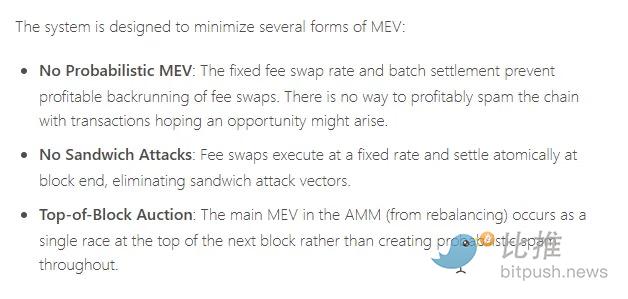
(Source Chart: Technical Architecture Comparison Diagram)

Interested parties can check out the code repository here.

The first thing we noticed is that the technology is released under the Apache or MIT open-source licenses. This is good news.

The Apache 2.0 license is a popular permissive open-source license from the Apache Software Foundation, allowing broad commercial use, modification, and distribution, requiring only the retention of copyright notices, provision of the license text, and notation of significant modifications, while also including an explicit patent grant from contributors to users.

Therefore, the open-source community is free to adopt any of Tempo's technological achievements. This means that although Ethereum may not gain the commercial landing advantages that Tempo brings to Stripe, it can still absorb its protocol-level technological innovations.

So what are the key differences? We quote the core design notes:

Payment Channels Reserved for TIP‐20 Transfers

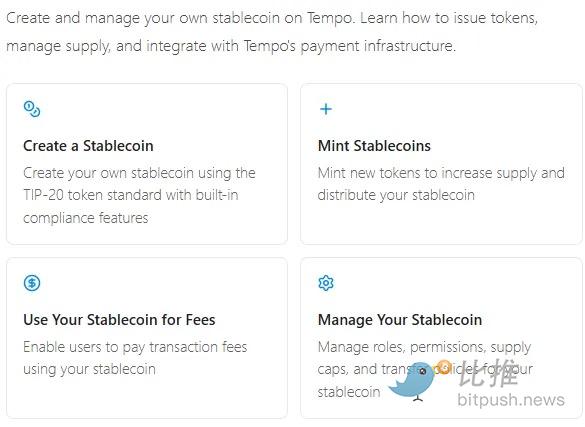
TIP‐20 is a stablecoin issuance standard created with specific functions. Its core effect is to bundle stablecoin issuance with prioritized transfers on-chain.

On Ethereum, different stablecoin issuers compete with each other, and these issuers are not fundamentally different from other token issuers.

On Tempo, the stablecoin issuance contract is solidified in the TIP20Factory, creating the potential for future on-chain revenue. Establishing a fast lane for such tokens gives them a permanent advantage. However, anyone can use this factory contract, meaning competition still exists at the distribution level, but manufacturing tends to be centralized.

Low, Predictable Fees Paid in Stablecoins

Users can pay Gas fees directly with USD stablecoins upon initiation. A fee automated market maker (AMM) will convert them into the validator's preferred stablecoin. The target cost for TIP‐20 transfers is less than one-thousandth of a dollar (<$0.001). Liquidity providers in the AMM can earn a 0.3% fee from each swap. This design also avoids Miner Extractable Value (MEV) and arbitrage attacks against transactions—which have cost users over $1 billion on Ethereum.

Generalizing the way users pay for transactions is a commendable design direction, and Tempo achieves multi-directional payment options.

Here, any asset can be converted into stablecoins to pay for Gas; on Ethereum, while any asset (including stablecoins) can also be converted to ETH to pay Gas, this process is not automated and requires support from smart accounts.

More importantly, Ethereum has execution competition between different AMMs, rather than solidifying a specific AMM within the chain mechanism. This competition is crucial when trying to spur innovation for new financial primitives; but for Tempo, which aims to industrialize financial primitives, its importance is relatively lower.

Native Smart Account Integration

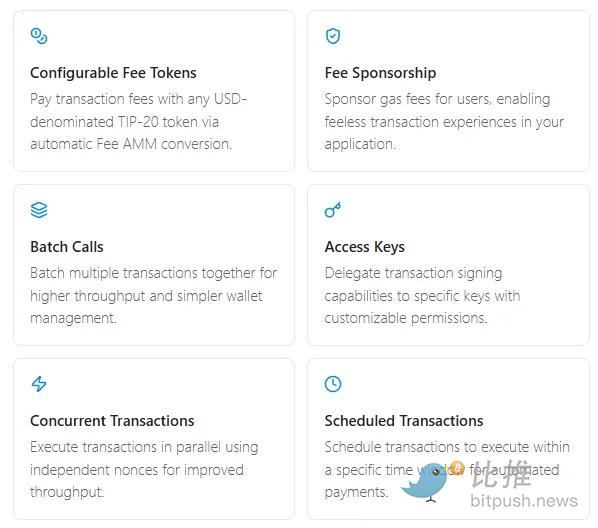
Tempo integrates the excellent concept of smart accounts into transactions: (1) supports batch processing of multiple operations (payroll, settlement, refunds); (2) a fee sponsorship mechanism, allowing applications to pay Gas on behalf of users; (3) scheduled payment functionality, supporting recurring and timed payments within protocol-level time windows; (4) modern authentication methods using passkeys (e.g., biometric login).

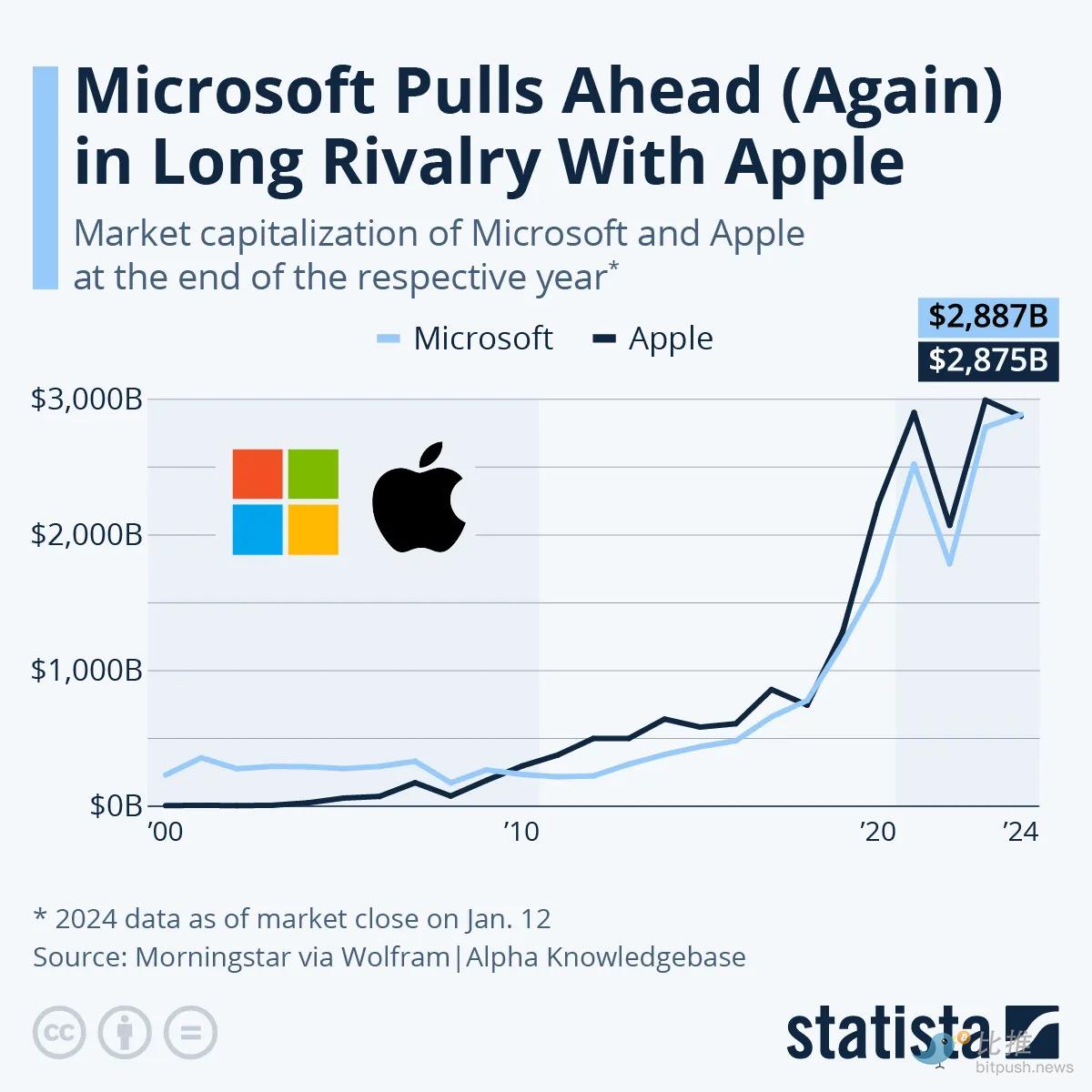
(Attached Figure: Statista chart of long-term competitive trends between Microsoft and Apple)

Just as Stripe itself integrates various fintech services into a single platform, Tempo is absorbing the most demanded payment features as native parts of the chain, rather than leaving them to third-party development and competing for user awareness. This is the Apple-style software development philosophy—all experiences are meticulously designed, proprietary, and vertically integrated—rather than the Windows-style model of gathering developers to create third-party applications (which may create functional breadth but often lack security and a unified user experience). More broadly, this reflects the fundamental difference between closed and open architecture systems.

Performance and Finality

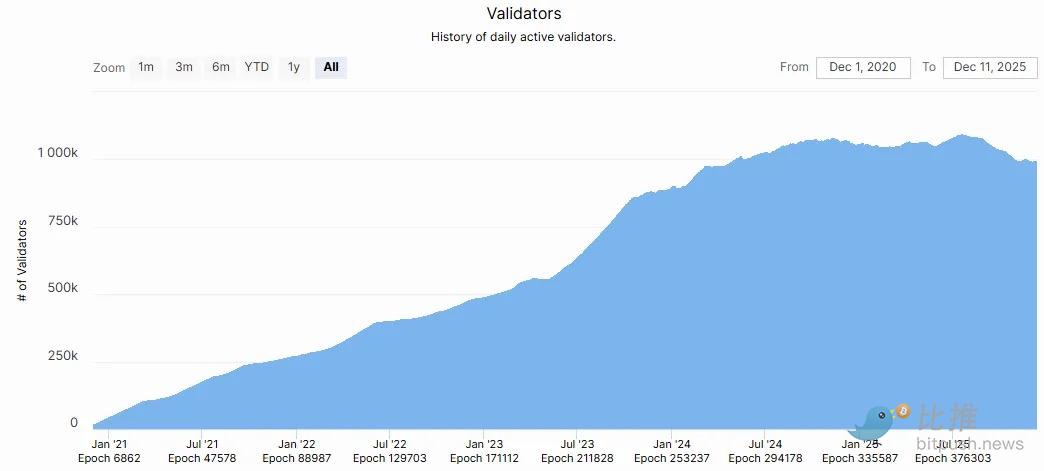
(Source: Ethereum Validator Distribution Chart)

Tempo is fully compatible with the Ethereum Virtual Machine (EVM). Developers can use the same tools, languages, and frameworks (e.g., Solidity, Foundry, Hardhat) as on Ethereum to deploy and interact with smart contracts. Its consensus algorithm uses Simplex BFT consensus (originating from Commonware, to which Tempo has invested $25 million). The validator set is currently private and permissioned, an expected design for the initial stage of a private company.

In contrast, Ethereum is antifragile and anti-censorship, meaning anyone can freely join or leave the validator set. There are currently about 1 million daily active validators on the chain.

Overall, the core impression of Stripe/Tempo is: it is advancing rapidly with a vertically integrated product approach, aiming to capture the fintech market. Its partnerships with AI companies, Web2 enterprises, and traditional banks fully demonstrate its strength in driving blockchain commercialization.

Original link:https://www.bitpush.news/articles/7595070

Связанные с этим вопросы

QWhat is the core innovation of Tempo's TIP-20 standard compared to Ethereum's stablecoin issuance?

AThe TIP-20 standard binds stablecoin issuance with prioritized on-chain transfers by creating a dedicated payment channel for TIP-20 transfers. Unlike Ethereum where stablecoin issuers compete freely, Tempo centralizes the issuance mechanism through the TIP20Factory contract, creating potential for on-chain revenue while allowing distribution-level competition.

QHow does Tempo handle gas fee payments differently from Ethereum?

ATempo allows users to pay gas fees directly in dollar stablecoins through an automated market maker (AMM) that converts them to the validator's preferred stablecoin, with costs targeted below $0.001 per TIP-20 transfer. This differs from Ethereum where assets must be converted to ETH for gas payments, a process that isn't automated and requires smart account support.

QWhat are the key features of Tempo's native smart account integration?

ATempo's smart account integration includes: (1) batch processing for multiple operations like payroll and settlements, (2) fee sponsorship allowing applications to pay gas for users, (3) scheduled payments with protocol-level timing capabilities, and (4) modern authentication using passkeys like biometric login.

QWhat is the fundamental architectural difference between Tempo's approach and Ethereum's approach as described in the article?

ATempo follows an Apple-like closed architecture with vertical integration where payment features are natively incorporated into the chain with proprietary, carefully designed experiences. Ethereum follows a Windows-like open architecture that relies on third-party developers to create applications, resulting in broader functionality but potentially less security and unified user experience.

QHow does Tempo's consensus mechanism and validator system differ from Ethereum's?

ATempo uses Simplex BFT consensus with a private, permissioned validator set, which is expected for a private company's initial phase. Ethereum features an anti-fragile and anti-censorship design where anyone can freely join or leave the validator set, with approximately 1 million active validators daily.

Похожее

Stuck Polymarket: The Real Test After Riding the Traffic Boom Has Arrived

Polymarket, a leading prediction market platform, is facing significant technical challenges as its growth outpaces its current infrastructure on Polygon. Users are experiencing laggy transactions, unresponsive orders, and delayed confirmations, severely impacting the trading experience. In response, DeFi Engineering VP Josh Stevens outlined a comprehensive engineering overhaul. The plan includes reducing on-chain data delays, fixing order cancellation issues, rebuilding the central limit order book (CLOB), improving website performance, and developing a unified SDK and API. A major revelation was the ongoing "chain migration," indicating a potential move away from Polygon. The core issue is that Polymarket has evolved from a simple prediction market into a high-frequency trading platform, making Polygon's limitations—such as block space, gas fees, and block time—a ceiling for further growth. The migration is not just a simple chain switch but a fundamental rebuild of its trading system to support more complex products like perpetual contracts (Perps). This announcement has sparked competition among chains like Solana, Sui, and Algorand, all vying to host Polymarket. For Polygon, losing this key application, which contributes significantly to its gas fee revenue, would be a major setback. The real test for Polymarket is no longer attracting users but proving it can provide a stable, reliable trading environment that retains them.

Odaily星球日报3 мин. назад

Stuck Polymarket: The Real Test After Riding the Traffic Boom Has Arrived

Odaily星球日报3 мин. назад

Lowering Expectations for BTC's Next Bull Market

The author, Alex Xu, explains his decision to significantly reduce his Bitcoin holdings (from full to ~30% of his portfolio) during the current bull cycle, citing a lowered long-term outlook for BTC's price appreciation in the next cycle. He outlines six key reasons for this reduced expectation: 1. **Diminished Growth Drivers:** The narrative of exponential user adoption has largely played out with institutional ETF adoption. The next major growth phase—adoption by sovereign national reserves or central banks—seems unlikely in the near future. 2. **Personal Opportunity Cost:** More attractive investment opportunities have emerged in other assets, such as undervalued companies. 3. **Industry-Wide Contraction:** The broader crypto industry is struggling, with most Web3 business models (SocialFi, GameFi, DePIN) failing. This overall萧条 (depression) reduces the fundamental demand and consensus for Bitcoin. 4. **Strain on Major Buyer:** MicroStrategy, a major corporate buyer of BTC, faces rising financing expenses for its debt, which could slow its purchasing rate and create significant marginal pressure on the market. 5. **Increased Competition from Gold:** The emergence of "tokenized gold" has closed the functional gap (portability, divisibility) between physical gold and Bitcoin, offering a strong competitor in the non-sovereign store-of-value space. 6. **Security Budget Concerns:** The block reward halving continues to exacerbate the long-standing issue of funding Bitcoin's network security, with new fee source explorations like Ordinals and L2s largely failing. The author's decision to hold a significant (though reduced) position reflects a cautious, not bearish, outlook. He remains open to increasing his exposure if the fundamental reasons for his skepticism change or if new positive catalysts emerge.

marsbit42 мин. назад

Lowering Expectations for BTC's Next Bull Market

marsbit42 мин. назад

Can Iran 'Control' the Strait of Hormuz?

Iran has announced a comprehensive plan to assert control over the strategic Strait of Hormuz, a critical global oil shipping chokepoint. The proposed measures include requiring all vessels to obtain Iranian permission for passage, imposing fees for security, environmental protection, and navigation management—preferably paid in Iranian rials—and absolutely banning Israeli ships. Vessels from countries deemed hostile by Iran’s top security bodies may also be barred. Analysts suggest Iran’s motives are multifaceted: increasing pressure on the U.S. and Israel by leveraging control over oil transit to influence global prices and inflation; creating a new revenue stream, potentially exceeding $7.7 billion annually, to counter Western sanctions and support postwar reconstruction; and using transit permissions as bargaining chips in future negotiations, notably with the U.S. However, the plan faces significant practical and diplomatic challenges. Enforcing comprehensive interception and fee collection in the busy waterway, patrolled by international military forces, would be difficult. The U.S. has already countering with a blockade of Iranian ports and threats to intercept any ship paying fees, potentially strangling Iran’s oil exports and fee revenue. Broad international opposition, led by European and Gulf states, and legal controversies further complicate implementation. The proposal may ultimately serve more as a negotiating tactic than a feasible policy, with its execution remaining highly uncertain.

marsbit1 ч. назад

Can Iran 'Control' the Strait of Hormuz?

marsbit1 ч. назад

Торговля

Спот
Фьючерсы
活动图片