Second Largest Whale Cuts Losses and Liquidates, Can AAVE Still Be Bought Amid Deepening Conflict?

Odaily星球日报Опубликовано 2025-12-22Обновлено 2025-12-22

Введение

The second-largest AAVE whale, excluding the project team, protocol contracts, and exchanges, has sold off 230,000 AAVE tokens (worth approximately $38 million) at a loss, causing a 12% price drop. The sale occurred amid growing tensions between the Aave team and its community over governance and financial control. The conflict began when the community discovered that Aave Labs, without prior communication, redirected front-end exchange fees—previously directed to the Aave DAO treasury—to its own address after switching the default trading path to Cow Swap. This change could divert an estimated $10 million annually from the community to the team. Aave Labs defended the move, arguing that front-end products are separate from the protocol and that the team has the right to monetize its own infrastructure. In response, a proposal was made to transfer control of Aave’s brand assets—including domains and social accounts—to AAVE token holders. Founder Stani Kulechov opposed the proposal, calling it oversimplified and poorly structured, further escalating community backlash. The situation highlights deeper structural tensions in DeFi between team-controlled products and community-governed protocols. The outcome of the ongoing snapshot vote on the proposal may significantly influence AAVE’s price and long-term community trust.

Original | Odaily Planet Daily (@OdailyChina)

Author | Azuma (@azuma_eth)

The leading lending protocol Aave is embroiled in a public opinion storm, with the conflict between the team and the community intensifying, which has objectively shaken the confidence of token holders in the AAVE token itself.

In the early hours of today, the second-largest AAVE holding whale, excluding the project team, protocol contracts, and CEXs, cut losses and liquidated 230,000 AAVE (worth approximately $38 million), causing AAVE to drop 12% short-term. It is reported that this "number two big brother" purchased the AAVE holdings from late last year to early this year at an average price of $223.4. The average selling price today was about $165, resulting in a final loss of $13.45 million.

  • Odaily Note: The whale address is https://debank.com/profile/0xa923b13270f8622b5d5960634200dc4302b7611e.

Origin of the Incident: Fee Flow Dispute

To understand the current community crisis at Aave, we need to start with a recent change to the Aave frontend.

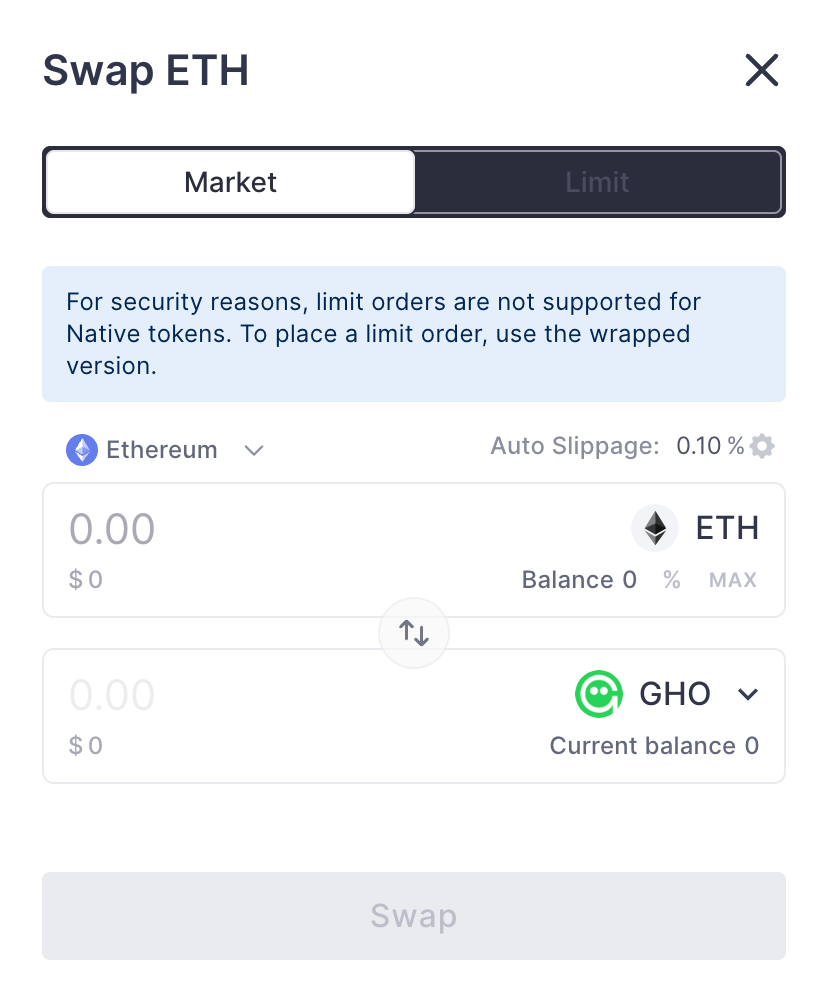
On December 4th, Aave announced a partnership with Cow Swap, adopting the latter as the default trading path for the swap function on the Aave frontend (Odaily Note: previously it was ParaSwap), utilizing its anti-MEV features for better quotes.

This seemed like a normal functional upgrade, but the community soon discovered that the additional fees generated by this function (including referral fees or positive slippage surplus fees), which previously flowed to the Aave DAO treasury address when using ParaSwap, were now being directed to the Aave Labs address after switching to Cow Swap.

Community representative EzR3aL was the first to notice this change, which Aave had not actively mentioned. They questioned the Aave team in the governance forum and estimated that, just tracking the income flow on Ethereum and Arbitrum, this fee change could generate around $200,000 in weekly revenue, corresponding to an annualized income of over $10 million — this meant Aave had redirected at least tens of millions of dollars in revenue from the community address to the team address, seemingly without anyone knowing.

Core Controversy: Who Really Owns the Aave Brand?

As EzR3aL's post gained traction, a large number of AAVE holders felt betrayed, especially considering that Aave made this change without communicating with the community or making any disclosure, somewhat hinting at an intention to conceal this alteration.

In response to community质疑 (queries/doubts), Aave Labs replied directly under EzR3aL's post, stating that there should be a clear distinction between the protocol layer and the product layer. The swap function interface on the Aave frontend is entirely operated by Aave Labs, which is responsible for capital investment, construction, and maintenance. This function is completely independent of the DAO-managed protocol. Therefore, Aave Labs has the right to independently decide how to operate and profit from it... The income previously flowing to the Aave DAO address was a donation from Aave Labs, but it was not an obligation.

In short, Aave Labs' stance is that the frontend interface and its ancillary functions essentially belong to the team's product, and the revenue generated should also be regarded as company property, not to be confused with the protocol and related income controlled by the DAO.

This statement quickly sparked heated discussion within the community regarding the ownership of the Aave protocol versus its products. A well-known DeFi analyst wrote an article titled "Who Really Owns 'Aave'?: Aave Labs vs Aave DAO". Odaily Planet Daily also published a Chinese translation, which can be read for further context.

On December 16th, the矛盾 (contradiction/conflict) was further intensified. Former Aave CTO Ernesto Boado initiated a proposal in the governance forum requesting the control of Aave brand assets (including domain names, social media accounts, naming rights, etc.) be transferred to AAVE token holders. The relevant assets would be managed through a DAO-controlled entity (the specific form to be determined later) with strict anti-encroachment protection mechanisms.

The proposal received nearly ten thousand views and hundreds of high-quality replies within the Aave governance forum. Various participants in the Aave ecosystem expressed their positions in the comments below the proposal. Although some voices believed the proposal's execution plan was insufficient and risked exacerbating the conflict, most replies expressed support.

Founder's Statement, But Community Unconvinced

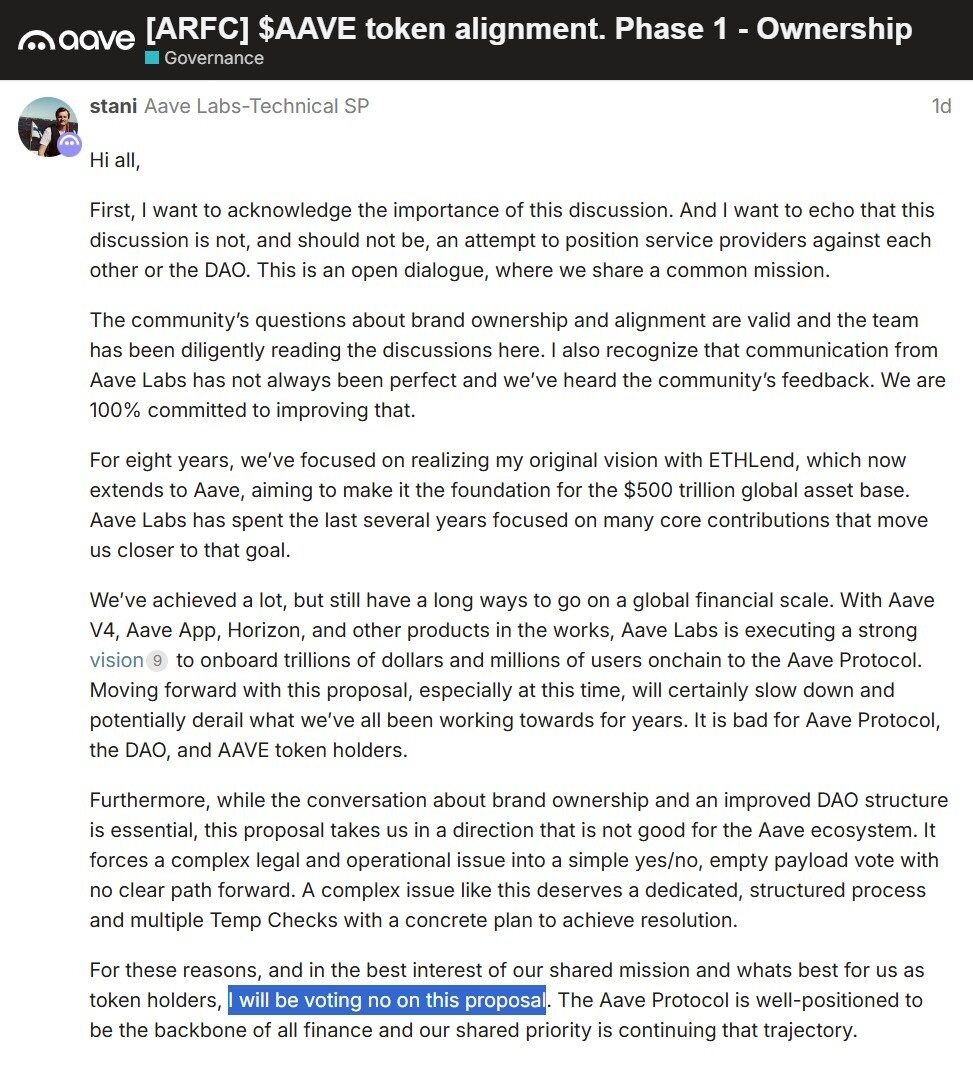
As community sentiment heated up, Aave founder Stani responded in the forum: "...This proposal leads us in a direction unfavorable to the Aave ecosystem. It attempts to force a complex legal and operational issue into a simple 'yes/no' vote without providing a clear execution path. Handling such a complex issue should involve a specially designed structured process, achieving consensus through multiple interim checks accompanied by specific solutions. For the reasons above, I will vote against this proposal..."

From a business operations perspective, Stani's claim that the proposal is too rash might not be wrong. However, in the current discussion atmosphere, this statement can easily be interpreted as 'the Aave founder disagrees with transferring brand assets to token holders,' which obviously further intensified the conflict between the community and the team.

After Stani's statement, even some attacking remarks against Stani appeared in the original post's comments. More users expressed their dissatisfaction via the forum or social media. An OG user mentioned it was the first time he considered liquidating his AAVE holdings. A loyal AAVE believer stated: "AAVE holders should realize this is just another DeFi shitcoin. It's neither better nor worse than the others."

The latest community development is the one mentioned at the beginning of this article: the number two big brother cutting losses and exiting with a loss exceeding ten million dollars.

Can AAVE Still Be Bought?

Just two weeks ago, Odaily Planet Daily wrote an article titled "What Did the Smart Money Aggressively Buying AAVE at Lows See?". At that time, AAVE was still a favorite of top institutions like Multicoin Capital. Its优质 (high-quality) brand reputation, substantial locked funds, clear expansion path, and strong revenue and buyback flow all proved that AAVE was a 'true value token' different from other altcoins.

But in just two weeks, a舆论危机 (public opinion crisis) spanning from fee ownership to brand control and then to team-community relations has rapidly plunged AAVE from a "representative of value tokens" into the center of controversy, even landing it on the short-term top decliners list due to emotional impact.

As of writing, Aave Labs has stated below Ernesto's proposal that they have initiated an ARFC snapshot vote on the proposal, allowing AAVE token holders to formally express their stance and clarify the future direction. The outcome of this vote and the subsequent handling attitude of the Aave Labs team will undoubtedly significantly impact Aave community faith and the short-term price performance of AAVE.

It is important to emphasize that this incident is not merely "negative news" or "performance change," but a集中拷问 (concentrated interrogation) of Aave's existing governance structure and boundaries of rights.

If you believe that Aave Labs will still maintain high alignment with Aave DAO's long-term interests, and the current friction is more of a communication and process失误 (mistake), then the price pullback led by emotions might be a good entry window; but if you think this controversy exposes not an occasional problem, but a structural contradiction of long-term unclear rights between the team and the protocol, lacking institutional constraints, then this storm might just be the beginning.

From a broader perspective, Aave's controversy is not an isolated case. As DeFi matures, protocol revenue becomes genuinely considerable, and brands and frontends begin to possess commercial value, some inherent structural contradictions between protocols and products, teams and communities will surface. Aave is pushed into the spotlight this time not because it erred more, but because it has gone further.

This debate over fees, brand, and control rights poses a question that needs answering not just by AAVE, but is an inevitable question the entire DeFi industry must eventually face.

Связанные с этим вопросы

QWhat was the main reason behind the community crisis and whale selling AAVE tokens?

AThe crisis stemmed from a dispute over fee redirection from Aave's front-end swap function. After switching to Cow Swap, fees that previously flowed to the Aave DAO treasury were redirected to Aave Labs, causing community backlash over undisclosed changes and raising questions about revenue ownership.

QHow did Aave Labs justify redirecting the swap fees to their own address instead of the DAO treasury?

AAave Labs argued that the front-end interface and its swap functionality are separate from the protocol managed by the DAO. They claimed ownership of the product layer, stating that the fees generated were company property, not DAO revenue, and previous donations to the DAO were voluntary, not obligatory.

QWhat proposal did former Aave CTO Ernesto Boado make to address the community's concerns?

AErnesto Boado proposed transferring control of Aave's brand assets—including domains, social media accounts, and naming rights—to AAVE token holders through a DAO-controlled entity, aiming to ensure community governance and anti-encroachment protections.

QHow did Aave founder Stani Kulechov respond to the proposal, and what was the community's reaction?

AStani opposed the proposal, calling it overly simplistic for a complex legal and operational issue and advocating for a structured process with multiple checks. The community perceived this as resistance to decentralizing control, intensifying opposition and leading to negative sentiment, including whale sell-offs.

QWhat broader DeFi industry issue does the Aave controversy highlight?

AThe controversy underscores structural tensions in DeFi between teams and communities over revenue sharing, brand ownership, and governance control. It reflects a industry-wide challenge as protocols mature and front-end products gain commercial value, forcing debates on equitable distribution of power and profits.

Похожее

Will the Fed Still Cut Interest Rates? Tonight's Data Is Crucial

The core debate surrounding the Federal Reserve's potential interest rate cuts is intensifying amid geopolitical conflict and rebounding inflation. The key question is whether high energy prices will cause persistent inflation or weaken consumer demand enough to force the Fed to cut rates. Citigroup presents a bullish case for cuts, arguing that oil supply disruptions from the Strait of Hormuz are temporary and will not lead to lasting inflationary pressure. They point to receding bond yields and oil prices as evidence the market is pricing in a short-lived shock. Citi's data also shows tightening financial conditions, a stabilizing labor market, and healthy tax returns, supporting their view that the path to lower rates remains open. Conversely, Deutsche Bank offers a starkly contrasting, more hawkish outlook. They argue the Fed's current policy is already neutral and expect rates to remain unchanged indefinitely. Their view is based on stalled disinflation progress and a shift toward more hawkish rhetoric from key Fed officials like Waller, who cited risks from prolonged Middle East conflict and tariffs. Other officials, including Williams and Hammack, signaled rates would likely stay on hold for a "considerable time." The market pricing has shifted dramatically, now forecasting zero cuts in 2026. The imminent release of the March retail sales "control group" data is highlighted as a critical test. This metric, which excludes gas station sales, will reveal if high gasoline prices are eroding consumer spending in other areas. A weak reading could support the case for imminent rate cuts, while a strong one would bolster the argument for the Fed to hold steady. This data is pivotal for determining the near-term policy path.

marsbit7 мин. назад

Will the Fed Still Cut Interest Rates? Tonight's Data Is Crucial

marsbit7 мин. назад

The Second Half of Macro Influencer Fu Peng's Career

Fu Peng, a prominent Chinese macroeconomist and former chief economist of Northeast Securities, has joined Hong Kong-based digital asset management firm Bitfire Group (formerly New Huo Group) as its chief economist. This move, announced in April 2026, triggered an 11% surge in Bitfire's stock price. Fu, known for his accessible macroeconomic commentary and large social media following, will focus on integrating digital assets into global asset allocation frameworks, particularly combining FICC (fixed income, currencies, and commodities) with cryptocurrencies for institutional clients. His career includes roles at Lehman Brothers and Solomon International, with significant influence gained through public communication. However, in late 2024, Fu faced temporary social media bans after a controversial private speech at HSBC on China's economic challenges, though he denied regulatory sanctions. He later left Northeast Securities citing health reasons. Bitfire, a licensed virtual asset manager serving high-net-worth clients, seeks to build trust and attract traditional capital through Fu’s expertise and credibility. The partnership represents a strategic shift for both: Fu enters the crypto sector after a traditional finance peak, while Bitfire aims to leverage his macro framework for institutional adoption. Outcomes remain uncertain regarding capital inflows and compatibility within corporate structure.

marsbit1 ч. назад

The Second Half of Macro Influencer Fu Peng's Career

marsbit1 ч. назад

Торговля

Спот
Фьючерсы

Популярные статьи

Как купить AAVE

Добро пожаловать на HTX.com! Мы сделали приобретение Aave Protocol (AAVE) простым и удобным. Следуйте нашему пошаговому руководству и отправляйтесь в свое крипто-путешествие.Шаг 1: Создайте аккаунт на HTXИспользуйте свой адрес электронной почты или номер телефона, чтобы зарегистрироваться и бесплатно создать аккаунт на HTX. Пройдите удобную регистрацию и откройте для себя весь функционал.Создать аккаунтШаг 2: Перейдите в Купить криптовалюту и выберите свой способ оплатыКредитная/Дебетовая Карта: Используйте свою карту Visa или Mastercard для мгновенной покупки Aave Protocol (AAVE).Баланс: Используйте средства с баланса вашего аккаунта HTX для простой торговли.Третьи Лица: Мы добавили популярные способы оплаты, такие как Google Pay и Apple Pay, для повышения удобства.P2P: Торгуйте напрямую с другими пользователями на HTX.Внебиржевая Торговля (OTC): Мы предлагаем индивидуальные услуги и конкурентоспособные обменные курсы для трейдеров.Шаг 3: Хранение Aave Protocol (AAVE)После приобретения вами Aave Protocol (AAVE) храните их в своем аккаунте на HTX. В качестве альтернативы вы можете отправить их куда-либо с помощью перевода в блокчейне или использовать для торговли с другими криптовалютами.Шаг 4: Торговля Aave Protocol (AAVE)С легкостью торгуйте Aave Protocol (AAVE) на спотовом рынке HTX. Просто зайдите в свой аккаунт, выберите торговую пару, совершайте сделки и следите за ними в режиме реального времени. Мы предлагаем удобный интерфейс как для начинающих, так и для опытных трейдеров.

836 просмотров всегоОпубликовано 2024.04.12Обновлено 2025.05.13

Как купить AAVE

Обсуждения

Добро пожаловать в Сообщество HTX. Здесь вы сможете быть в курсе последних новостей о развитии платформы и получить доступ к профессиональной аналитической информации о рынке. Мнения пользователей о цене на AAVE (AAVE) представлены ниже.

活动图片