Russia, Iran-Linked Groups Turn To Crypto For Crowdfunded Drone Purchases – Report

bitcoinistОпубликовано 2026-03-31Обновлено 2026-03-31

Введение

A recent Chainalysis report reveals that pro-Russia and Iran-affiliated groups are increasingly using cryptocurrency to fund purchases of commercially available drones and components, which have become central to modern conflict. These groups utilize crypto for both direct purchases from manufacturers and indirect acquisitions via third-party e-commerce platforms like Alibaba. Iran-linked entities, including the IRGC, have used crypto to buy drone parts, while pro-Russia militias have raised over $8.3 million in crypto donations since 2022 to purchase drones, often from Chinese manufacturers. The blockchain provides transparency into these transactions, highlighting how crypto is transforming conflict economics by enabling groups to crowdfund military equipment despite limited access to traditional finance.

A recent report has shared that Pro-Russia and Iran groups are turning to crypto to fund purchases of commercially available drones and related components, as the products become central to modern conflict.

Crypto-Funded Drone Purchases Linked To Russia, Iran

On Monday, blockchain analytics firm Chainalysis revealed that groups affiliated with Russia and Iran are utilizing crypto to fund the acquisition of low-cost military drones and their components.

The firm traced crypto flows from individual wallets linked to various paramilitary groups to the purchase of affordable drones and related components from vendors on e-commerce platforms.

According to the report, low-cost, commercially available drones have become central to modern conflict, enabling both state and non-state actors, including pro-Russia militias and Iran-backed terrorist organizations.

Most purchases use traditional financial channels, but Chainalysis noted that drone procurement networks are ⁠increasingly intersecting with the blockchain. As the firm explained, crypto can enter the drone procurement picture directly or indirectly. In the first scenario, a drone manufacturer openly accepts digital assets as payment on its website.

In the second scenario, electronics and dual-use component vendors that sell through third-party e-commerce platforms like Alibaba accept digital assets to sell drones and their parts to buyers whose identities and intended use are unclear.

The report found that Iran-linked groups have been using crypto to acquire drone components and sell military equipment, highlighting a wallet associated with Iran’s Islamic Revolutionary Guard Corps (IRGC) that purchased drone parts from a Hong Kong-based supplier.

As reported by Bitcoinist in January, Iran’s Ministry of Defence Export Center (Mindex), the state arms export arm, openly offered to accept crypto as payment for military hardware, including drones, air defense systems, warships, and ballistic missiles.

Paramilitary Groups ‘Crowdfund The Frontline’

Chainalysis also emphasized that the “most publicly visible crypto-drone nexus operates at the militia level, through open crowdfunding campaigns on social media platforms.”

The blockchain analytics firm has identified dozens of pro-Russia volunteer and paramilitary organizations asking for crypto donations for military equipment since Russia invaded Ukraine in ​2022.

Over the past four years, the pro-Russia groups have raised more than $8.3 million in these donations across various blockchains to purchase drones and associated components from global e-commerce platforms.

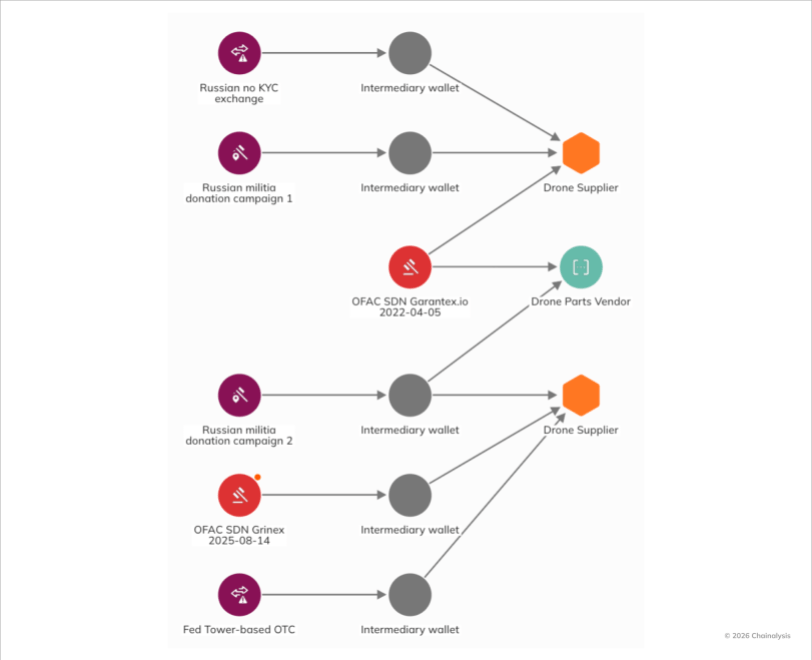
On-chain evidence shows Russian militia fundraising groups purchasing from a Hong Kong-based drone manufacturer and drone purchasers acquiring liquidity from Russian-language no-Know Your Client (KYC) exchanges, the sanctioned Russian exchanges Garantex and Grinex, and a Federation Tower-based OTC service.

To the firm, this strongly suggests that Russia-linked actors may have acquired drones from Chinese manufacturers for deployment in Ukraine. Chainalysis also matched crypto transactions between $2,200-$3,500 to the exact prices of drones and their components on ​e-commerce platforms.

Russian militia donation campaign wallets purchase drones via intermediaries. Source: Chainalysis

“The striking point is not the dollar figure, but the logic. At the militia level, low-cost commercial drones are among the most tactically significant items crowdfunded crypto can buy,” the report affirmed.

“At $2,200–$3,500 per unit, a single successful fundraising campaign translates directly into battlefield capability for groups that cannot access conventional finance,” it continued.

The firm underscored that the blockchain offers new opportunities to trace these flows and obtain a better understanding of how emerging technologies are “transforming the economics of conflict.”

“On the blockchain, there’s this incredible opportunity, once you have ‌identified the ⁠vendor to see the counterparty activity and make assessments that help clarify that utilization and the intent behind the purchase,” Andrew Fierman, Chainalysis’s head of national security intelligence, told Reuters

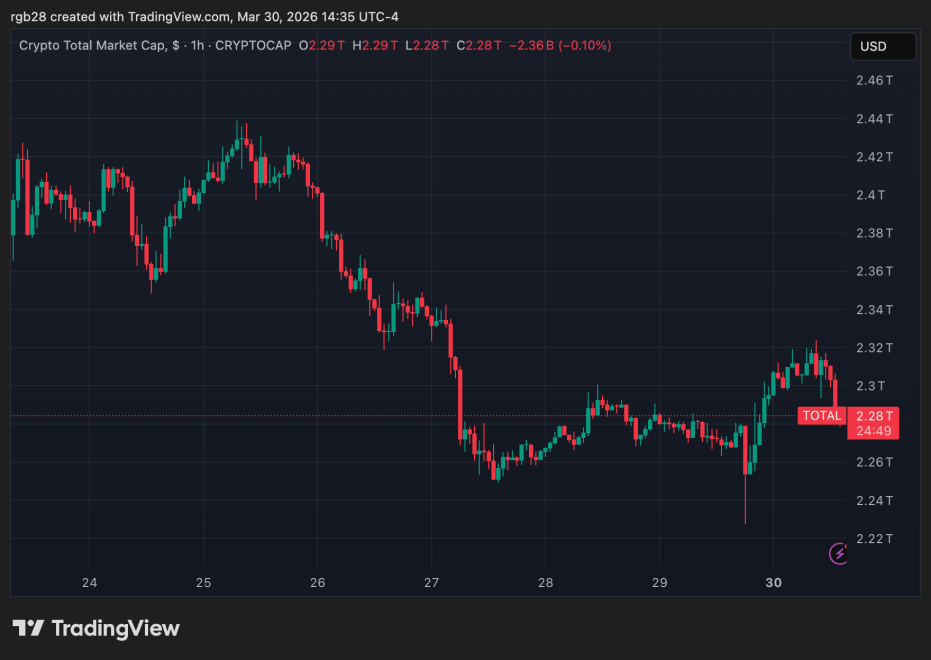
Total crypto market capitalization is at $2.28 trillion on the one-week chart. Source: TOTAL on TradingView

Связанные с этим вопросы

QAccording to the report, how are pro-Russia and Iran-linked groups using cryptocurrency in relation to drone procurement?

AThey are using cryptocurrency to fund the acquisition of low-cost military drones and related components, often through crowdfunding campaigns on social media and purchases from vendors on e-commerce platforms.

QWhat are the two main scenarios described in which cryptocurrency enters the drone procurement process?

AThe first scenario is when a drone manufacturer openly accepts digital assets as payment on its website. The second is when electronics and dual-use component vendors on third-party e-commerce platforms accept crypto from buyers whose identities and intended use are unclear.

QWhich specific Iran-linked group was identified as using a crypto wallet to purchase drone parts, and from where?

AA wallet associated with Iran’s Islamic Revolutionary Guard Corps (IRGC) was used to purchase drone parts from a Hong Kong-based supplier.

QHow much money have pro-Russia groups raised through crypto donations for military equipment since the invasion of Ukraine, and what is its primary use?

APro-Russia groups have raised more than $8.3 million in crypto donations, which is primarily used to purchase drones and associated components from global e-commerce platforms.

QWhat does the report identify as the 'most striking point' about these crypto-funded drone purchases, and why?

AThe most striking point is not the dollar figure, but the logic. For militia-level groups that cannot access conventional finance, a single successful campaign raising $2,200–$3,500 can directly translate into significant battlefield capability by funding a low-cost commercial drone.

Похожее

The Value Distribution of Stablecoins

**Summary: The Value Distribution of Stablecoins** The article argues that stablecoins are evolving from mere trading tools into broader channels for dollar access. It divides the stablecoin ecosystem into four layers to analyze how value is distributed: 1. **Issuance Layer:** Mints stablecoins, holds reserve assets, and captures the spread between reserve yield and user costs (e.g., Tether, Circle). This layer currently earns the largest profit margin. 2. **Infrastructure Layer:** Connects stablecoins to the traditional financial system, handling fiat on/off-ramps, banking integration, compliance (KYC/AML), and asset management (e.g., Bridge, BVNK). This is the "unglamorous" but critical work, building the essential bridges between crypto and real-world finance. 3. **Acquiring/Distribution Layer:** Integrates stablecoins into merchant systems, manages payment flows, and provides enterprise financial software (e.g., Stripe, Coinbase). They act as the access point for businesses. 4. **Application Layer:** The end-users and businesses that ultimately use stablecoins for payments, settlements, or as a store of value. They benefit from convenience but have little pricing power. The core thesis is that while the issuance layer currently dominates profits, the often-overlooked **infrastructure layer holds significant long-term potential**. The real challenge and barrier to mass adoption is not the on-chain transfer of stablecoins (which is simple), but the complex "last mile" integration into existing business workflows, banking systems, and regulatory frameworks across different countries. Companies in this layer are currently in a "land grab" phase, investing heavily to build networks, secure bank partnerships, and establish compliance pathways. While their position is currently pressured by the profitable issuers above and distribution platforms below, the article suggests that if stablecoins become a default financial rail for businesses, the infrastructure providers who have done the hard work of integration will ultimately gain strong pricing power and become entrenched, essential players.

marsbit3 ч. назад

The Value Distribution of Stablecoins

marsbit3 ч. назад

The Value Distribution of Stablecoins

The Value Distribution of Stablecoins The article argues that stablecoins are evolving from a mere trading tool into a broad "dollar channel." It analyzes the industry's value chain through four layers: 1. **Issuance Layer (e.g., Tether, Circle):** The top layer that mints stablecoins, holds reserve assets, and captures the thickest interest rate spread. 2. **Infrastructure Layer (e.g., Bridge, BVNK):** Connects stablecoins to the traditional financial system, handling critical but complex "dirty work" like fiat on/off-ramps, banking integration, compliance (KYC/AML), and cross-border settlement. 3. **Acquiring/Distribution Layer (e.g., Stripe, Coinbase):** Embeds stablecoins into merchant systems, manages payment flows, and integrates with enterprise software. 4. **Application Layer:** End-users and businesses that ultimately use stablecoins for payments, settlement, or storing value. The author posits that while the issuance layer currently captures the most profit, the most overlooked and potentially critical layer is infrastructure. The core challenge for stablecoin adoption isn't the on-chain transfer (which is simple), but bridging the gap between blockchain and the real-world financial system. This involves solving practical problems for businesses: fiat conversion, reconciliation, tax handling, and user onboarding. Infrastructure companies are currently in a difficult "land-grab" phase—building networks, securing banking relationships, and achieving compliance country-by-country. They face pressure from both the profitable issuance layer above and distribution platforms below. However, the author suggests this layer is building a crucial moat. Once stablecoins become a default business rail, the infrastructure players who have done the hard work of integration may gain significant, durable value and pricing power.

链捕手4 ч. назад

The Value Distribution of Stablecoins

链捕手4 ч. назад

How to Do Research Well: Deliberately Practice the Real Skills That Matter

No one truly teaches you how to do research. You're often given a desk, a pre-selected problem, and vague instructions to "create something new." Consequently, many people reverse-engineer the job based on visible outputs—papers, posts, announcements—learning only how to *appear* like a researcher rather than how to *become* one. True research capability is built from stacking small, trainable skills, nearly all of which can be developed through deliberate practice. **Pick Your Own Problem:** Most researchers absorb problems from advisors or trends, lacking the underlying reasoning. Choosing a problem you genuinely care about, as John Schulman advises, leads to original work. Develop "taste" like a muscle: predict experiment outcomes, guess paper results from methods, and track which findings remain important over time. **Upgrade Your Inputs:** Relying on shared reading lists (arXiv hot lists, filtered group chats) leads to unoriginal conclusions. Undervalued old literature often holds crucial insights (e.g., MoE, LSTM, backpropagation). Richard Sutton's "The Bitter Lesson" or Claude Shannon's 1952 talk on creative thinking are more predictive than lengthy modern surveys. Breadth matters as much as depth: draw from neuroscience, mechanism design, hardware knowledge, and honest statistics. Read papers directly, especially appendices and limitations sections. **Write Everything Down:** As Paul Graham noted, writing exposes flaws in seemingly mature ideas. Writing is the cheapest defense against self-deception. Following Feynman's principle, Darwin programmatically wrote down facts contradicting his theory to combat memory bias. Maintain a detailed log of hypotheses, setups, predictions, results, and updated understandings. Reviewing past logs fosters essential humility.

marsbit6 ч. назад

How to Do Research Well: Deliberately Practice the Real Skills That Matter

marsbit6 ч. назад

Торговля

Спот
Фьючерсы
活动图片