Russia, Iran-Linked Groups Turn To Crypto For Crowdfunded Drone Purchases – Report

bitcoinistОпубликовано 2026-03-31Обновлено 2026-03-31

Введение

A recent Chainalysis report reveals that pro-Russia and Iran-affiliated groups are increasingly using cryptocurrency to fund purchases of commercially available drones and components, which have become central to modern conflict. These groups utilize crypto for both direct purchases from manufacturers and indirect acquisitions via third-party e-commerce platforms like Alibaba. Iran-linked entities, including the IRGC, have used crypto to buy drone parts, while pro-Russia militias have raised over $8.3 million in crypto donations since 2022 to purchase drones, often from Chinese manufacturers. The blockchain provides transparency into these transactions, highlighting how crypto is transforming conflict economics by enabling groups to crowdfund military equipment despite limited access to traditional finance.

A recent report has shared that Pro-Russia and Iran groups are turning to crypto to fund purchases of commercially available drones and related components, as the products become central to modern conflict.

Crypto-Funded Drone Purchases Linked To Russia, Iran

On Monday, blockchain analytics firm Chainalysis revealed that groups affiliated with Russia and Iran are utilizing crypto to fund the acquisition of low-cost military drones and their components.

The firm traced crypto flows from individual wallets linked to various paramilitary groups to the purchase of affordable drones and related components from vendors on e-commerce platforms.

According to the report, low-cost, commercially available drones have become central to modern conflict, enabling both state and non-state actors, including pro-Russia militias and Iran-backed terrorist organizations.

Most purchases use traditional financial channels, but Chainalysis noted that drone procurement networks are ⁠increasingly intersecting with the blockchain. As the firm explained, crypto can enter the drone procurement picture directly or indirectly. In the first scenario, a drone manufacturer openly accepts digital assets as payment on its website.

In the second scenario, electronics and dual-use component vendors that sell through third-party e-commerce platforms like Alibaba accept digital assets to sell drones and their parts to buyers whose identities and intended use are unclear.

The report found that Iran-linked groups have been using crypto to acquire drone components and sell military equipment, highlighting a wallet associated with Iran’s Islamic Revolutionary Guard Corps (IRGC) that purchased drone parts from a Hong Kong-based supplier.

As reported by Bitcoinist in January, Iran’s Ministry of Defence Export Center (Mindex), the state arms export arm, openly offered to accept crypto as payment for military hardware, including drones, air defense systems, warships, and ballistic missiles.

Paramilitary Groups ‘Crowdfund The Frontline’

Chainalysis also emphasized that the “most publicly visible crypto-drone nexus operates at the militia level, through open crowdfunding campaigns on social media platforms.”

The blockchain analytics firm has identified dozens of pro-Russia volunteer and paramilitary organizations asking for crypto donations for military equipment since Russia invaded Ukraine in ​2022.

Over the past four years, the pro-Russia groups have raised more than $8.3 million in these donations across various blockchains to purchase drones and associated components from global e-commerce platforms.

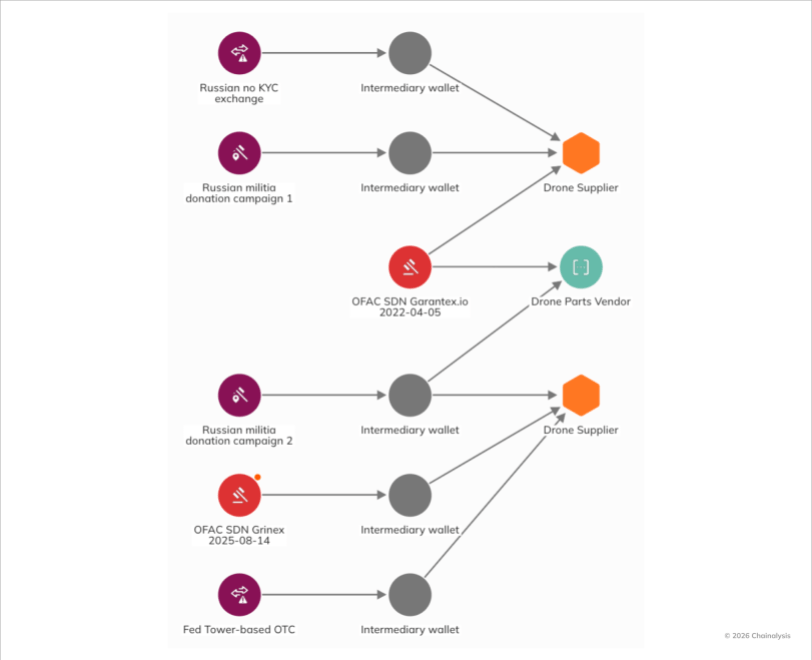
On-chain evidence shows Russian militia fundraising groups purchasing from a Hong Kong-based drone manufacturer and drone purchasers acquiring liquidity from Russian-language no-Know Your Client (KYC) exchanges, the sanctioned Russian exchanges Garantex and Grinex, and a Federation Tower-based OTC service.

To the firm, this strongly suggests that Russia-linked actors may have acquired drones from Chinese manufacturers for deployment in Ukraine. Chainalysis also matched crypto transactions between $2,200-$3,500 to the exact prices of drones and their components on ​e-commerce platforms.

Russian militia donation campaign wallets purchase drones via intermediaries. Source: Chainalysis

“The striking point is not the dollar figure, but the logic. At the militia level, low-cost commercial drones are among the most tactically significant items crowdfunded crypto can buy,” the report affirmed.

“At $2,200–$3,500 per unit, a single successful fundraising campaign translates directly into battlefield capability for groups that cannot access conventional finance,” it continued.

The firm underscored that the blockchain offers new opportunities to trace these flows and obtain a better understanding of how emerging technologies are “transforming the economics of conflict.”

“On the blockchain, there’s this incredible opportunity, once you have ‌identified the ⁠vendor to see the counterparty activity and make assessments that help clarify that utilization and the intent behind the purchase,” Andrew Fierman, Chainalysis’s head of national security intelligence, told Reuters
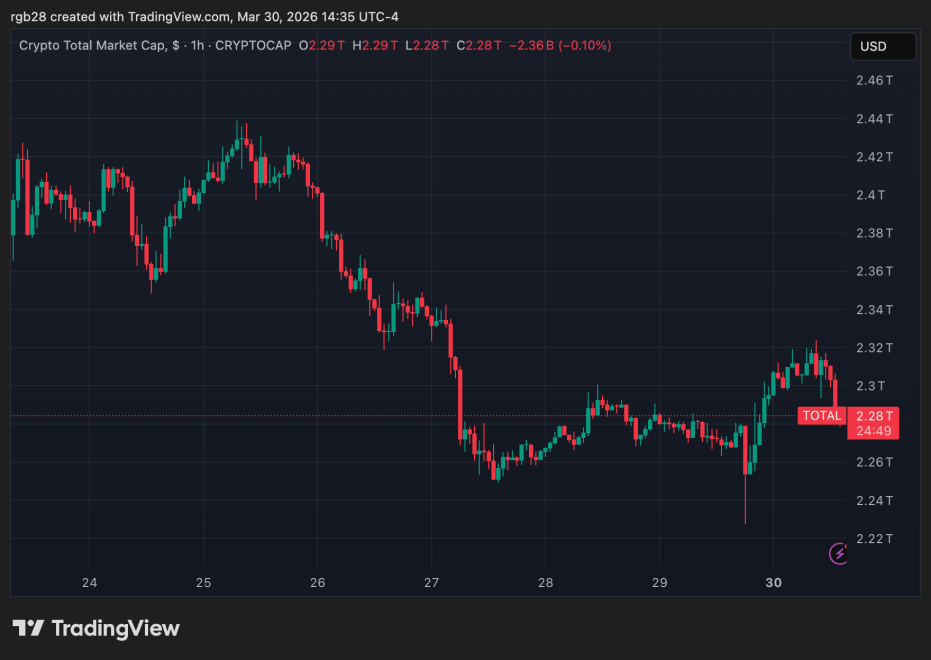
Total crypto market capitalization is at $2.28 trillion on the one-week chart. Source: TOTAL on TradingView


Связанные с этим вопросы

QAccording to the report, how are pro-Russia and Iran-linked groups using cryptocurrency in relation to drone procurement?

AThey are using cryptocurrency to fund the acquisition of low-cost military drones and related components, often through crowdfunding campaigns on social media and purchases from vendors on e-commerce platforms.

QWhat are the two main scenarios described in which cryptocurrency enters the drone procurement process?

AThe first scenario is when a drone manufacturer openly accepts digital assets as payment on its website. The second is when electronics and dual-use component vendors on third-party e-commerce platforms accept crypto from buyers whose identities and intended use are unclear.

QWhich specific Iran-linked group was identified as using a crypto wallet to purchase drone parts, and from where?

AA wallet associated with Iran’s Islamic Revolutionary Guard Corps (IRGC) was used to purchase drone parts from a Hong Kong-based supplier.

QHow much money have pro-Russia groups raised through crypto donations for military equipment since the invasion of Ukraine, and what is its primary use?

APro-Russia groups have raised more than $8.3 million in crypto donations, which is primarily used to purchase drones and associated components from global e-commerce platforms.

QWhat does the report identify as the 'most striking point' about these crypto-funded drone purchases, and why?

AThe most striking point is not the dollar figure, but the logic. For militia-level groups that cannot access conventional finance, a single successful campaign raising $2,200–$3,500 can directly translate into significant battlefield capability by funding a low-cost commercial drone.

Похожее

Polymarket's "2028 Presidential Election" Volume King Is... LeBron James???

An article from Odaily Planet Daily, authored by Azuma, discusses a peculiar phenomenon observed on the prediction market platform Polymarket regarding the "2028 US Presidential Election" event. Despite having a real-time probability of less than 1%, unlikely candidates such as NBA star LeBron James (with $48.41 million in trading volume), celebrity Kim Kardashian ($33.84 million), and even ineligible figures like Elon Musk ($23.14 million) and New York City Mayor Zohran Mamdani ($18.39 million) account for approximately 70% of the total trading volume. In contrast, high-probability candidates like Vice President JD Vance ($10.58 million), California Governor Gavin Newsom ($15.71 million), and Secretary of State Marco Rubio ($9.32 million) have significantly lower trading activity. The article explains that this counterintuitive trend is not driven by irrational speculation but by rational strategies. Polymarket offers a 4% annualized holding reward for certain markets, including the 2028 election, to maintain long-term pricing accuracy. This yield exceeds the current 5-year US Treasury rate (3.98%), attracting large investors ("whales") to hold "NO" shares on low-probability candidates for risk-free returns. Additionally, some users utilize a platform feature that allows converting a set of "NO" shares into corresponding "YES" shares for better liquidity or pricing efficiency, rather than directly buying "YES" shares for their preferred candidates. Thus, the seemingly absurd trading activity is strategically motivated.

marsbit47 мин. назад

Polymarket's "2028 Presidential Election" Volume King Is... LeBron James???

marsbit47 мин. назад

Dialogue with ViaBTC CEO Yang Haipo: Is the Essence of Blockchain a Libertarian Experiment?

"ViaBTC CEO Yang Haipo: Blockchain as a Hardcore Libertarian Experiment" In a deep-dive interview, ViaBTC CEO Yang Haipo reframes the essence of blockchain, arguing it is not merely a new technology or infrastructure but a hardcore libertarian experiment. This experiment, born from the 2008 financial crisis and decades of cypherpunk ideology, tests a fundamental question: to what extent can freedom and self-organization exist without centralized trust? The discussion highlights the experiment's verified outcomes. On one hand, it has proven its core value of censorship resistance, providing critical financial lifelines for entities like WikiLeaks and individuals in hyperinflationary or sanctioned countries via tools like stablecoins. However, Yang points out a key paradox: the most successful product, USDT, is itself a centralized compromise, showing users prioritize a less-controlled pipeline over pure decentralization. On the other hand, the experiment has exposed the severe costs of this freedom—a "dark forest" without safeguards. Events like the collapses of LUNA, Celsius, and FTX, resulting in massive wealth destruction and prison sentences for founders, underscore the system's fragility and the inherent risks of an unregulated environment. Yang observes that despite decentralized protocols, human nature inevitably recreates centralized power structures, speculative frenzies, and narrative-driven cycles (from ICOs to Meme coins), where emotion and belonging often trump technological substance. Looking forward, he believes blockchain's future is significant but niche. Its real value lies in serving specific, real-world needs for financial sovereignty and bypassing traditional controls, not as a universal infrastructure replacing all centralized systems. For the average participant, Yang's crucial advice is to cultivate independent judgment. True freedom is not holding a crypto wallet, but possessing a mind resilient to groupthink and narrative hype in a high-risk, often irrational market.

marsbit1 ч. назад

Dialogue with ViaBTC CEO Yang Haipo: Is the Essence of Blockchain a Libertarian Experiment?

marsbit1 ч. назад

Торговля

Спот
Фьючерсы
活动图片