Ripple Updates XRP ‘Fast Facts’ As ETF And Institutional Momentum Grows

bitcoinistОпубликовано 2026-01-08Обновлено 2026-01-08

Введение

RippleX has updated its "FAST FACTS" about XRP, positioning it as infrastructure for real-world utility rather than a speculative asset. The update highlights XRP's role in settlement, liquidity, and moving value across financial systems, with a fixed supply of 100 billion. XRPL is emphasized as a decentralized blockchain with over 116 validators and 6.4 million wallets, settling over $1 trillion in value. The thread also notes XRP's growing role in real-world assets (RWA) and stablecoins, listing key issuers and partnerships. Additionally, it mentions the emergence of institutional treasuries, like Evernorth's $1B commitment, and multiple spot ETFs, signaling regulated, mainstream adoption. XRP traded at $2.20 at the time of writing.

RippleX, the developer-focused arm of Ripple,used a Jan. 6 X thread to refresh a set of “FAST FACTS” about XRP, framing the asset less as a speculative ticker and more as market infrastructure, arriving as spot ETF momentum and early institutional treasury narratives begin to form around the token.

“XRP is a digital asset of choice for real-world utility – from stablecoin settlement to real-world assets, to institutional payments,” RippleX wrote. “With new momentum around XRP ETFs and institutional treasuries forming, here are some updated FAST FACTS about XRP.”

What Is XRP?

The thread’s opening points stick to the positioning Ripple has leaned on for years: XRP as a liquidity and settlement rail between financial systems rather than an app-layer bet.

RippleX described it as “a functional digital asset designed for settlement and liquidity, focusing on moving value between financial systems,” adding that, “acting as a neutral bridge, it helps move value between payments, stablecoins, tokenized financial assets, and collateral across the global economy.”

RippleX also reiterated supply constraints and control narratives that frequently resurface in institutional due diligence. “XRP was created at the launch of XRPL in 2012 and its supply is permanently capped at 100B – no additional XRP can ever be minted and no single entity (including Ripple) controls or can change the total supply,” the post said.

Other “fast facts” were more about market posture than mechanics, including the claim that XRP is “one of the few digital assets with clear regulatory standing in the US” and that it remains a top-three asset by market capitalization.

RippleX devoted several entries to XRPL’s decentralization metrics and operational history, emphasizing that the ledger runs independently of Ripple the company.

“XRPL is a public, decentralized blockchain with 116+ independent validators and 910+ public nodes – it operates independent of Ripple as an entity,” RippleX wrote. “XRP plays a core role on the network as its native settlement and liquidity asset.”

On consensus and execution, RippleX said XRPL uses “Proof-of-Association (PoA),” describing a model with “no mining, no staking, no block rewards,” and “transaction finality in 3–5 seconds.” It also pointed to network-scale usage stats since inception: “4B+ transactions,” “100M+ ledgers,” “6.4M+ wallets,” and “$1T+ in value” settled.

Real-World Assets And Stablecoins

A notable portion of the thread focused on RWAs and stablecoins,two categories where issuers and liquidity relationships matter more than raw TPS.

RippleX said XRPL is “now one of the top 10 blockchains for RWA activity,” listing issuers and initiatives “such as Ondo Finance, OpenEden, Archax/abrdn, Guggenheim Treasury Services, Mercado Bitcoin, VERT, and the Dubai Land Department” as building or launching assets on XRPL.

On stablecoins, RippleX cited a “growing stablecoin ecosystem” including “RLUSD, USDC, XSGD, AUDD, BBRL/USBD, and EURCV,” adding that “XRP often serves as a liquidity pair,” facilitating exchange between stablecoins and other assets on the network.

RippleX’s final “fast facts” aimed directly at regulated access and institutional balance sheets. It claimed XRP “now has its first institutional treasury” via Evernorth, which “has secured more than $1B in commitments,” describing this as a shift “from a traded asset to a regulated, balance-sheet asset for institutions.”

It also said XRP is “now supported by multiple spot ETFs,” naming Bitwise (XRP), Canary Capital (XRPC), Franklin Templeton (XRPZ), and Grayscale (GXRP) as issuers—positioning ETFs as a bridge into “regulated, mainstream investment products.”

Finally, RippleX pointed to wrapped XRP as an interoperability lever, saying it extends XRP’s utility to the “XRPL EVM Sidechain” and to ecosystems including “Ethereum, Solana, Optimism, and HyperEVM.”

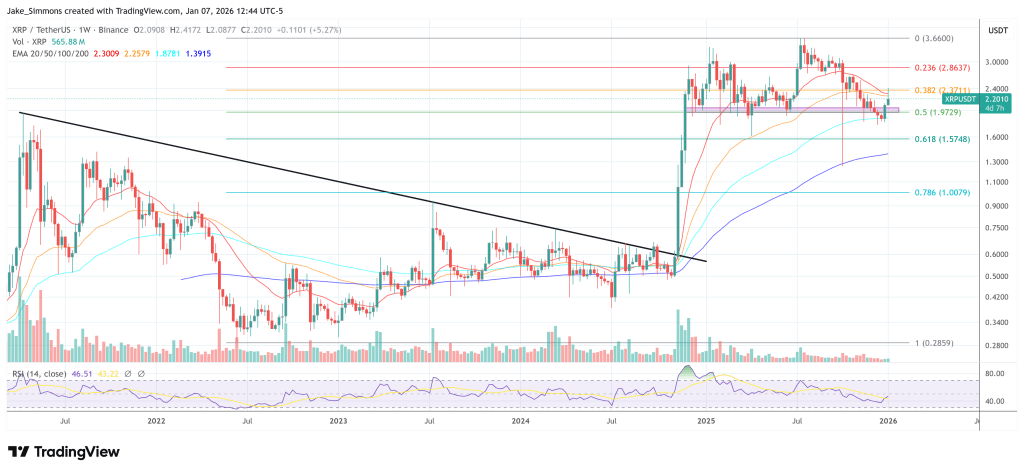
At press time, XRP traded at $2.20.

XRP faces the 0.382 Fib, 1-week chart | Source: XRPUSDT on TradingView.com

Связанные с этим вопросы

QWhat is the main purpose of RippleX's updated 'FAST FACTS' about XRP?

ATo frame XRP less as a speculative asset and more as market infrastructure, highlighting its real-world utility and institutional adoption as ETF and treasury momentum grows.

QHow does RippleX describe the role of XRP in the financial ecosystem?

ARippleX describes XRP as a functional digital asset designed for settlement and liquidity, acting as a neutral bridge to move value between payments, stablecoins, tokenized financial assets, and collateral across the global economy.

QWhat are some key technical features of the XRP Ledger (XRPL) mentioned in the article?

AXRPL is a public, decentralized blockchain with over 116 independent validators and 910+ public nodes, using Proof-of-Association consensus with no mining or staking, and achieving transaction finality in 3-5 seconds.

QWhich real-world asset (RWA) and stablecoin initiatives are building on XRPL according to the article?

ARWA initiatives include Ondo Finance, OpenEden, Archax/abrdn, Guggenheim Treasury Services, Mercado Bitcoin, VERT, and the Dubai Land Department. Stablecoins include RLUSD, USDC, XSGD, AUDD, BBRL/USBD, and EURCV.

QHow is XRP gaining institutional adoption through regulated products?

AXRP now has its first institutional treasury via Evernorth with over $1B in commitments, and is supported by multiple spot ETFs from issuers like Bitwise, Canary Capital, Franklin Templeton, and Grayscale, positioning it as a regulated, balance-sheet asset.

Похожее

When AI Begins to Audit the World: From Claude Discovering the ZEC Vulnerability, Watching the Encryption Industry Enter the 'Recursive Security Era'

**When AI Audits the World: From Claude's Discovery of a ZEC Vulnerability, Viewing the Crypto Industry Entering a "Recursive Security Era"** This article examines a pivotal shift in the blockchain security landscape, triggered by the convergence of two events: Anthropic's research on AI's "Recursive Self-Improvement" and Claude Opus 4.8's discovery of a critical vulnerability in Zcash's code. Traditionally, crypto security has relied on human experts and automated tools for periodic audits. However, the article argues AI is transitioning from a mere tool to an active participant in understanding and analyzing complex systems. Claude's ability to identify a subtle flaw in Zcash's zero-knowledge proof system demonstrates AI's potential to dramatically lower the cost and time required for risk discovery. This goes beyond finding a single bug; it signals a change in the very mechanism of how vulnerabilities are found. The core thesis introduces the concept of "Recursive Security," drawing a parallel to Anthropic's "Recursive Self-Improvement." Just as AI can accelerate its own development through feedback loops, security systems are evolving towards a continuous cycle of analysis, risk identification, remediation, and re-analysis. Security is becoming a persistent, evolving capability integrated into a system's lifecycle, rather than a one-time pre-launch audit. This shift is particularly urgent for the crypto industry, where system complexity from Layer-2 networks, modular architectures, and ZK-proofs is growing faster than human analysis capacity. AI excels at the pattern recognition and contextual understanding needed to navigate this complexity. Importantly, the article cautions that AI augments both defenders and potential attackers, accelerating the entire threat landscape. The future competitive advantage may not lie in having zero vulnerabilities, but in having the fastest risk discovery, validation, and response capabilities. The Claude-Zcash incident is thus an early signal of an era where AI-driven, recursive security systems become essential for managing risk in an increasingly complex digital world.

marsbit28 мин. назад

When AI Begins to Audit the World: From Claude Discovering the ZEC Vulnerability, Watching the Encryption Industry Enter the 'Recursive Security Era'

marsbit28 мин. назад

From MSTR to STRC+: Where Is the Limit of the Strategy Universe?

From MSTR to STRC+: The Evolution and Limits of the Strategy Universe This article examines the transformation of Strategy (formerly MicroStrategy) from a simple "Bitcoin treasury" company into a complex financial engineering firm building a BTC-backed credit system. **Core Thesis:** Strategy's true significance lies not just in its massive BTC holdings (~844k BTC), but in its attempt to transform this static reserve into a multi-layered credit curve within traditional capital markets and, subsequently, into on-chain yield infrastructure. **The MSTR Flywheel:** The initial model was a reflexive loop: BTC price rises → MSTR stock rises → company raises capital (debt/equity) at a premium → buys more BTC → increases per-share BTC exposure → MSTR premium grows. This "amplified Bitcoin" equity (MSTR) thrives on bullish momentum but is vulnerable to tightening premiums and rising funding costs. **Building the Credit Curve:** Strategy's innovation is slicing its single BTC balance sheet into different risk/return profiles via specialized securities: * **MSTR:** High-volatility equity layer absorbing full BTC upside/downside. * **STRC:** Key product. A perpetual preferred stock designed as "short duration high yield credit," offering ~11.5% floating monthly dividends. It attracts fixed-income investors seeking yield without direct BTC exposure, funding Strategy's operations. * **STRD/STRK/STRF:** Other preferred/share classes with varying durations, conversion rights, and fixed dividends. **Risks of the STRC Model:** STRC's high yield is not risk-free. Its stability depends on: 1) Sufficient BTC asset coverage, 2) Strategy's continued ability to pay dividends, and 3) Market faith in the MSTR/STRC funding flywheel. Stress points include deep BTC price declines eroding the asset buffer, rising dividend costs if STRC trades below par, and a broken flywheel if MSTR's premium (mNAV) falls persistently. **On-Chain Expansion: STRC+:** Projects like **Saturn** and **Apyx** aim to package STRC's (and other DAT preferred stock) cash flows into on-chain stablecoin yield (e.g., sUSDat, apyUSD). They offer DeFi a new yield source distinct from trading fees or incentives—cash dividends from traditional securities. However, this introduces compounded risks: off-chain custody, issuer credit risk, BTC volatility, and protocol execution risk. **Conclusion: The Ultimate Boundary** Strategy's endgame is not infinite BTC accumulation. It is the market's long-term acceptance of a new credit system where BTC serves as collateral for tradable securities whose cash flows can power on-chain financial applications. Its "universe" expands if this BTC-native credit curve gains legitimacy, but contracts if these instruments are repriced purely as high-risk, yield-bearing credit assets without stablecoin mythology.

marsbit47 мин. назад

From MSTR to STRC+: Where Is the Limit of the Strategy Universe?

marsbit47 мин. назад

Торговля

Спот
Фьючерсы
活动图片