Real Finance secures $29M to build institutional rails for tokenized assets

cointelegraphОпубликовано 2025-12-09Обновлено 2025-12-09

Введение

Real-world asset tokenization network Real Finance has raised $29 million in private funding, led by a $25 million commitment from Nimbus Capital, to build institutional infrastructure for tokenized assets. The funds will support the expansion of its compliance and operational systems as it develops a full-stack RWA platform. The company aims to tokenize $500 million in RWAs, targeting 2% of the current tokenized asset market. The market is currently dominated by US Treasury products, private credit, and alternative funds, with tokenized money market funds growing rapidly. Industry experts, including Plume CEO Chris Yin, project major expansion in 2025, with potential for significant user growth and diversification into assets like private credit, mineral rights, and energy.

Real-world asset (RWA) tokenization network Real Finance has secured $29 million in private funding to build an infrastructure layer for RWAs, aiming to make it easier for institutions to adopt tokenized assets.

The funding round included a $25 million capital commitment from Nimbus Capital, a digital asset investment firm, with additional participation from Magnus Capital and Frekaz Group, the company informed Cointelegraph.

Real Finance stated that the funding will be utilized to expand its compliance and operational infrastructure as it develops a full-stack RWA platform.

In the near term, the company aims to tokenize $500 million worth of RWAs — a target it says would represent about 2% of today’s tokenized asset market.

To date, the tokenization market has been dominated by US Treasury products, private credit and institutional alternative funds, although tokenized public equities and other asset types are also beginning to gain traction, according to industry data.
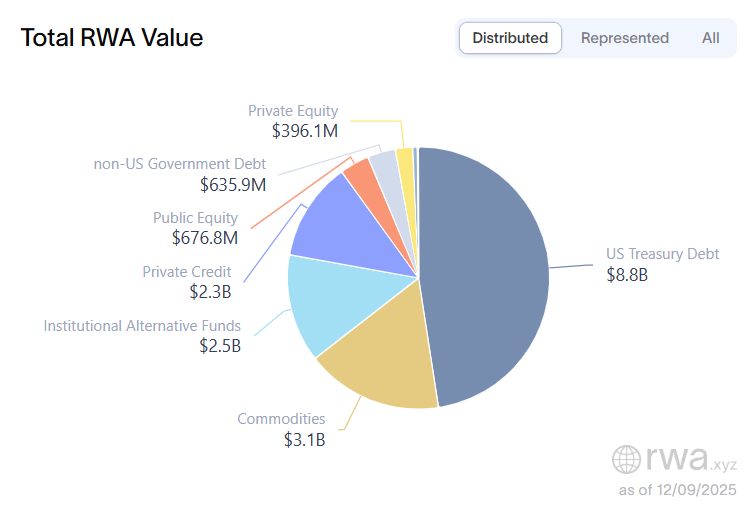
The existing RWA market by asset type. Source: RWA.xyz

Money market funds, which are low-risk investment vehicles that invest in short-term, highly liquid assets, often hold some of the same instruments, such as Treasury bills. Tokenized money market funds have also been expanding quickly, with their market size growing roughly tenfold since 2023, according to data from the Bank for International Settlements.

Goldman Sachs and BNY Mellon are among the largest institutions to enter the tokenized money market fund space, adding further momentum to one of the fastest-growing segments of the RWA sector.

Related: Tokenized money market funds emerge as Wall Street’s answer to stablecoins

Tokenized RWA market poised for major expansion, industry insiders say

With 2025 already a landmark year for tokenized real-world assets due to rising institutional participation, next year could see even stronger growth, according to Chris Yin, co-founder and CEO of Plume, an RWA-focused layer-2 blockchain.

“Currently, we are tracking to over 10x the RWA holders number since the start of the year,” Yin told Cointelegraph, adding that “we think it’s not crazy to imagine another banner year with 25x+ in user growth numbers.”

Beyond US government debt, Yin said the market is seeing rising interest in private credit, mineral rights, energy assets, GPUs and other nontraditional categories.
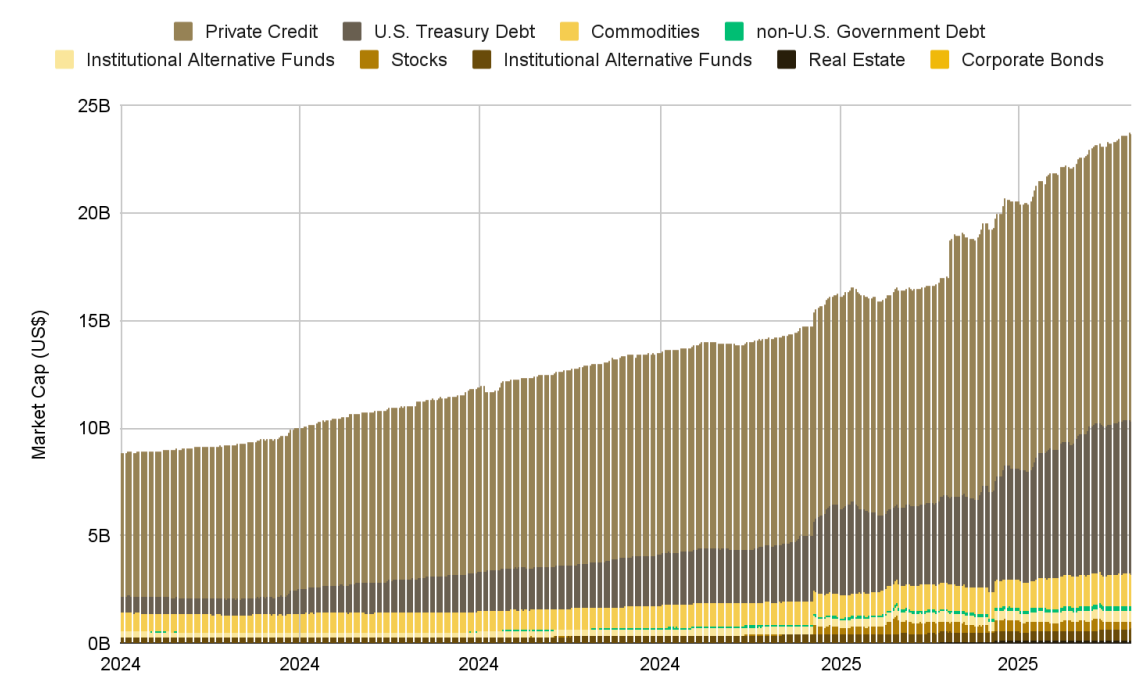
The tokenized RWA market has experienced significant growth since 2024. Source: Binance Research

His outlook aligns with a June report from Binance Research, which noted that clearer regulatory expectations in the United States could draw even more major institutions into tokenization.

Related: SEC ends Biden-era probe into tokenized equity platform Ondo Finance

Похожее

New Huo Tech Livio: Ethereum Fusaka Upgrade Value Underestimated

New Huo Tech's Livio argues that the Ethereum Fusaka upgrade, completed on December 3, is significantly undervalued by the market. Occurring during a period of extreme pessimism and a major crypto market correction, the upgrade went largely unnoticed but represents a critical strategic improvement to Ethereum’s economic model and ecosystem performance. Fusaka systematically tackles two core bottlenecks: high costs and poor user experience. It achieves a "cost revolution" by dramatically reducing Layer-2 (L2) transaction fees—potentially as low as $0.001 per transaction—without overburdening the Layer-1 (L1) mainnet. This enables economically viable high-frequency applications like on-chain gaming, social dApps, AI agent settlements, and RWA (Real World Asset) trading. The upgrade also delivers a user experience leap by natively supporting Passkey authentication, allowing users to sign transactions using biometrics like fingerprints or FaceID instead of managing complex seed phrases. This shift makes using crypto wallets as seamless as conventional apps, lowering the barrier to entry for mainstream adoption. Most importantly, Fusaka fundamentally overhauls Ethereum’s tokenomics. It establishes a structured "taxation" system where L2s must pay fees to the L1 for security and data capacity. These fees are burned, creating a stable, endogenous "buyback" mechanism for ETH. As L2 activity grows, this is projected to result in an additional 3,000–10,000 ETH burned annually, shifting Ethereum from an inflationary to a deflationary or slightly inflationary model. This ties ETH's value directly to network usage, strengthening its role as the risk hub and settlement layer for the entire L2 economy. With Fusaka, Ethereum’s scaling roadmap is affirmed, with potential L2 TPS reaching 10,000 and eventually 100,000+. The upgrade is a pivotal step towards mass Web3 commercialization, and its strategic long-term value is currently underestimated by the market.

marsbit5 мин. назад

New Huo Tech Livio: Ethereum Fusaka Upgrade Value Underestimated

marsbit5 мин. назад

Торговля

Спот
Фьючерсы
活动图片