Qubic Sets April 1 Start Date For Dogecoin Attack

bitcoinistОпубликовано 2026-03-23Обновлено 2026-03-23

Введение

Qubic has announced it will launch its Dogecoin mining initiative on April 1, 2026, as part of a broader strategy to integrate external proof-of-work into its decentralized compute network. The project aims to use Dogecoin ASIC mining to strengthen QUBIC tokenomics by selling mined DOGE to buy and burn QUBIC, making it deflationary. The effort also serves as a real-world stress test for Qubic’s Oracle Machines, which validate mining shares through a Byzantine fault-tolerant system. This follows Qubic’s earlier controversial campaign against Monero, which was later reassessed as a 34% attack rather than a 51% takeover. Unlike the Monero operation, Dogecoin mining will run concurrently with Qubic’s AI training workloads, without displacing them.

Qubic says it will begin its Dogecoin push on April 1, marking the next phase of a mining strategy that first drew attention through its campaign against Monero. The big question is whether Qubic can turn Dogecoin mining into a live demonstration of its broader thesis: that external proof-of-work can be absorbed into a decentralized compute network and used to strengthen Qubic’s own token economics.

In a series of posts over the weekend, Qubic framed the rollout as both a product launch and a stress test. “Every Dogecoin share mined through the Qubic network gets validated by Oracle Machines: independent computors spread across the network who each verify the share separately. Up to 13 oracle commits per transaction. If the result passes the quorum’s Byzantine fault tolerance threshold (agreement from 451 of 676 computors), it’s validated on-chain.”

Qubic To Launch Dogecoin Mining Offensive On April 1

The team added that Oracle Machines went live on mainnet on February 11 and described Dogecoin mining as “the first real-world external use case built on top of this system.” Those claims line up with Qubic’s March technical updates, which said Dogecoin mining is on track for an April 1 mainnet launch and positioned it as a real-world stress test for the network’s outsourced-computing stack.

Dogecoin ASICs will be able to mine Qubic and receive higher rewards, while mined DOGE will be sold to buy QUBIC on the open market. Part of that purchased supply, it said, would be recycled into mining incentives, while “the rest will be burned,” with the explicit goal of making QUBIC deflationary. Qubic’s official Dogecoin mining explainer similarly says the community is still finalizing how mining revenue will be split between ASIC miners, computors, and broader network incentives.

That makes the April 1 launch more than a simple mining integration. Qubic has been arguing for months that Dogecoin changes its operating model because ASIC-based Scrypt mining can run in parallel with the network’s CPU- and GPU-based AI training, rather than alternating between workloads as it previously did with Monero.

“ASIC miners handle Dogecoin. CPUs and GPUs continue training Aigarth. Both contribute to the network. Neither displaces the other,” Qubic wrote in its March 3 explainer. “The same validation framework can serve price feeds, cross-chain data, and any external information that smart contracts need to act on.”

The backdrop is Qubic’s much more controversial Monero campaign. In August 2025, the project published a post titled “Qubic Performs 51% Monero Network Takeover Demonstration,” claiming it had reached majority hashrate and reorganized the chain. But that version did not hold up cleanly under later scrutiny.

Later independent analyses placed Qubic’s effective share closer to 28% to 35%. Even Sergey Ivancheglo ultimately conceded the operation “should be rebranded into ‘34% attack,’” a nod to the fact that the maneuver looked more like selfish mining than outright majority control.

Dogecoin was not a sudden pivot. By mid-August 2025, after the Monero episode, Qubic’s community had already chosen Dogecoin as its next target for “the following mining season,” with Ivancheglo indicating the transition would take months of development. Qubic’s January and March 2026 updates show that timeline now converging on launch: planning began in January, testing advanced through March, and the dispatcher is already live for test tasks.

At press time, DOGE traded at $0.09.
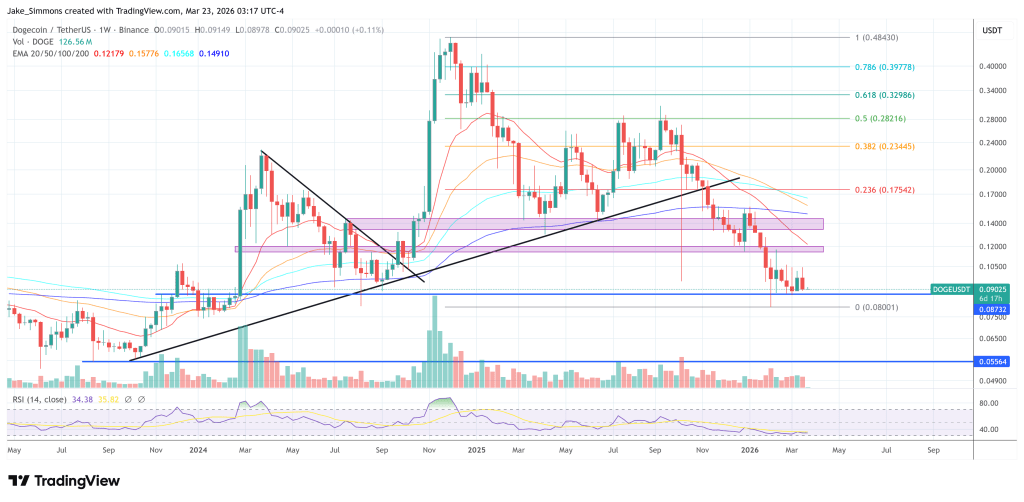
DOGE hovers above key support area, 1-week chart | Source: DOGEUSDT on TradingView.com

Связанные с этим вопросы

QWhat is the start date for Qubic's Dogecoin mining initiative and what is the broader goal of this strategy?

AQubic will begin its Dogecoin push on April 1. The broader goal is to demonstrate that external proof-of-work can be absorbed into a decentralized compute network to strengthen Qubic's own token economics.

QHow does the Qubic network validate Dogecoin shares, and what is the threshold for validation?

ADogecoin shares are validated by Oracle Machines, which are independent computors spread across the network. Validation requires agreement from 451 out of 676 computors to meet the Byzantine fault tolerance threshold.

QWhat will happen to the Dogecoin (DOGE) mined through the Qubic network, and how does this relate to QUBIC tokens?

AMined DOGE will be sold to buy QUBIC on the open market. Part of the purchased QUBIC will be recycled into mining incentives, and the rest will be burned to make QUBIC deflationary.

QHow does Qubic's approach to Dogecoin mining differ from its previous campaign against Monero?

AUnlike the Monero campaign, which alternated workloads, Dogecoin mining with ASICs can run in parallel with Qubic's CPU- and GPU-based AI training, allowing both to contribute without displacing each other.

QWhat was the outcome of Qubic's Monero campaign, and how did independent analyses view it?

AQubic initially claimed a 51% network takeover, but independent analyses later placed its effective hashrate share at 28% to 35%, leading to it being rebranded as a '34% attack' rather than a majority control.

Похожее

AI Giants Enter the Dark Forest

In the AI industry's "dark forest," major players like Anthropic, OpenAI, and DeepSeek are strategically withholding their most advanced models to avoid becoming targets in a high-stakes competitive landscape. Anthropic released Claude Opus 4.7 but admitted it underperforms compared to their unreleased model Mythos, citing safety concerns. They delayed addressing user complaints about performance regression until OpenAI’s GPT-5.5 launch, highlighting a tactic of controlled disclosure aligned with competitors’ moves. OpenAI’s GPT-5.5, though a full retrain since GPT-4.5, was seen as incremental rather than revolutionary. Leaks revealed internal models like Glacier and Heisenberg, indicating significant unreleased capabilities. OpenAI acknowledges a "capability overhang," where real model power exceeds what users experience, often due to infrastructure-driven throttling. DeepSeek launched V4 Preview, a cost-efficient model, but its full potential (V4 Pro Max) awaits Huawei’s Ascend 950 super-nodes量产 in late 2026. Their strategy focuses on affordability and scalability, aiming to democratize AI access globally, a move noted even by NVIDIA’s CEO as a disruptive threat. Together, these actions reflect a broader trend: leading AI labs are deliberately pacing releases, hiding strengths, and aligning disclosures with competitive dynamics—each avoiding the risk of exposure in a forest where first movers become targets.

marsbit40 мин. назад

AI Giants Enter the Dark Forest

marsbit40 мин. назад

Naval Steps Into the Arena: A Historic Collision Between Ordinary People and Venture Capital

Naval Ravikant, co-founder of AngelList and a prominent Silicon Valley thinker, has taken a hands-on role as the chairman of the investment committee at USVC—a new SEC-registered fund allowing non-accredited investors to access high-growth private tech companies with a minimum investment of $500. The fund’s initial portfolio includes leading AI firms like OpenAI, Anthropic, xAI, and others. This move represents a significant shift in democratizing access to venture capital, a space traditionally dominated by institutional investors and high-net-worth individuals. USVC aims to let ordinary investors participate in the high-alpha, pre-IPO growth phase of tech companies—a stage where much of the value creation now occurs before public listings. However, the fund is not without complexities. It offers limited liquidity, with potential quarterly redemptions capped at 5%, and charges an all-in fee of 2.5% in its first year. While this is higher than traditional ETFs, it is positioned as a more accessible alternative to conventional VC fee structures. Ultimately, USVC symbolizes a broader movement toward financial inclusion in high-stakes tech investing—not through crypto or Web3 mechanisms, but via regulated, retail-friendly investment vehicles. It offers a ticket to early-stage innovation, though risks typical of venture capital remain.

marsbit41 мин. назад

Naval Steps Into the Arena: A Historic Collision Between Ordinary People and Venture Capital

marsbit41 мин. назад

Торговля

Спот
Фьючерсы
活动图片