Compiled & Translated by: Deep Chao TechFlow
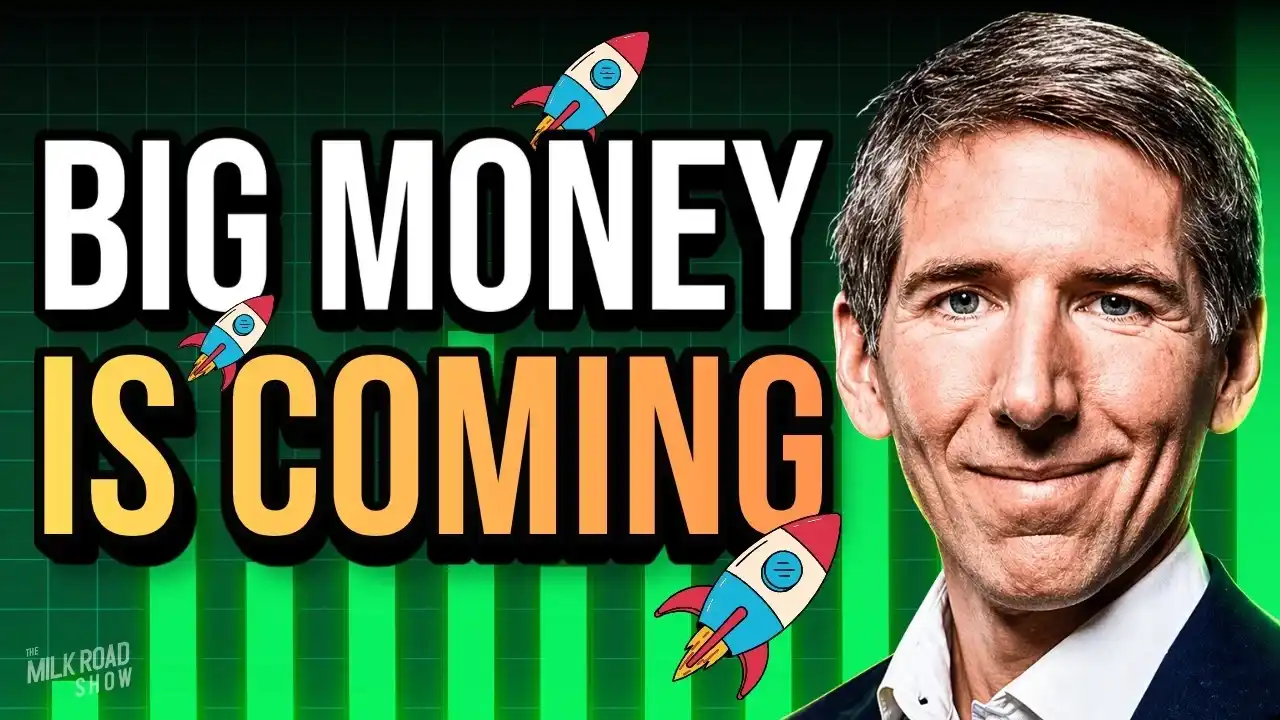
Guest: Matt Hougan, Chief Investment Officer (CIO) of Bitwise Asset Management
Host: John Gillen, The Milk Road Show
Podcast Source: Milk Road
Original Title: Matt Hougan: Crypto Is Down 50%... Wall Street Is ALL-IN
Release Date: Recorded on August 12, 2026, uploaded on August 13
Disclaimer: Matt Hougan is the Chief Investment Officer of Bitwise Asset Management. Bitwise manages over $15 billion in crypto assets, with products covering BTC/ETH/SOL spot ETFs, on-chain vaults, active strategies, etc. The specific assets discussed in the program, such as the 5% crypto allocation recommendation, ETH $8000 target price, Hyperliquid, Ondo, Chainlink, Solana, Aave, Uniswap, are all covered by Bitwise's product lines or research. Hougan explicitly stated in the program, "For Bitwise's business, 100% YOLO is better for me," yet recommends a 5% allocation. Readers should judge his views with this stance in mind.
Key Takeaways
Matt Hougan is the Chief Investment Officer of Bitwise, former CEO of ETF.com, having sold that company in three parts to FactSet, Informa, and BATS Global Markets; he is a co-author of two authoritative books on ETFs and crypto assets for the CFA Institute and has been selected three times for the Barron's ETF Roundtable. In other words, he is one of the people who built the entire ETF industry from scratch, and now he's on the side of crypto, not a KOL.
The biggest contrast of this episode is in the title: crypto is down 50% from its highs, but Hougan says Wall Street is ALL-IN instead. This isn't a slogan. He provides concrete evidence: the week the Senate postponed the CLARITY Act vote, BlackRock announced the launch of two tokenized funds on Ethereum and other chains. People from major wealth management platforms like Wells Fargo, UBS, and Stifel told him they don't care about short-term prices, viewing crypto as an asset class that will mature over the next 10 years. Morgan Stanley approved the Solana ETF when the market was falling, not due to FOMO, but precisely the opposite.
Hougan's two most important judgments: First, BTC no longer cares about bad news. The AI bubble liquidation, Saylor selling BTC, the CLARITY Act probability dropping from 40% to 14%, and BTC rebounded. "Everyone who wanted to sell has sold. Those left believe it will reach $1 million." Second, a 0% crypto allocation is not neutral; it's extremely bearish. Global stocks are $110 trillion, crypto is $2.5 trillion, so a neutral weight should be about 2%. If you have zero allocation, you are essentially making an active bearish judgment.
Summary of Key Insights
On the CLARITY Act and Regulation
"This bill will never die, and it might never pass. It will live forever in a kind of 'undead' state." "Crypto won't wait for it. BlackRock announced tokenized funds the very week the Senate postponed the vote." "Anti-crypto people are a dying breed. When BlackRock, Nasdaq, NYSE, JPMorgan, Standard Chartered are all pushing from behind, no one can stuff this back into the bottle."
On BTC Price Action
"Bear markets die in apathy. You know a bear market is truly dead when the market stops reacting to bad news." "Everyone who wanted to sell has sold. Those left believe this coin will reach $1 million. They don't care if the AI bubble bursts." "BTC sideways movement is a good thing. Volatility is being suppressed, and when it releases upwards, it will be fast."
On DCA vs. Lump Sum Buying
"Both Jan VanEck and Matthew Siegel are right. DCA is behavioral insurance, preventing you from panic selling and then chasing highs. But from an absolute return perspective, Jan is right; BTC might break out upwards very quickly." "If you truly believe this coin will reach $1 million, why gamble over $5,000? Buying at $5,000 in 2018, $3,500 in 2019, or $63,000 now, you'll end up doing well."
On the Consensus for a Late October Bottom
"I hear three or four people a day say the bottom is in October; this makes me nervous. Once a consensus forms, it often doesn't play out that way." "The calendar is indeed a reliable indicator for BTC returns. It might drop to the $50K range. But by year-end, I'm bullish for higher. The upside is much larger than the downside."
On Institutional Dynamics
"The ships of platforms like Wells Fargo, UBS, Stifel have already begun a slow turn. They don't care about short-term prices; they treat crypto as an asset class that will form over the next 10 years." "Morgan Stanley approved the Solana ETF not because of FOMO. On the contrary, they approved it when the market was falling."
On the 5% Allocation
"5% is a magic number. Below 5%, you get an almost free lunch: returns improve significantly, while portfolio volatility hardly changes." "Above 5%, returns continue to rise, but volatility also starts to increase substantially." "0% is not neutral; it's extremely bearish. Global stocks are $110 trillion, crypto is $2.5 trillion, neutral should be about 2%. By having zero allocation, you are making an active bearish judgment."
Main Text
I. The CLARITY Act Didn't Pass, But Crypto Won't Wait
Host John Gillen: In your recent CIO memo, you wrote that even if the CLARITY Act doesn't pass, it won't truly die, and crypto will keep moving. Can you elaborate?
Matt Hougan said when he wrote that memo, everyone expected a final result around August 5th or 7th because Congress was about to recess, and people had circled that date for months. But the closer he got, the more he realized that's not how Washington works. Sure enough, as the recess neared, Senators started hinting "maybe in September," "maybe in the lame-duck session." His prepared judgment for clients was: what was thought to be a decisive moment turned out to be a dud. That's indeed what happened—no vote before the August recess. At the last minute, a Senator applied for a potential September vote, so this continues to drag on.
Hougan's core judgment: This bill will never die, and it might never pass. It will live forever in a kind of 'undead' state. He also admitted he might be wrong; if political pressure mounts, it could pass before the election, but his base case is that the CLARITY Act remains in this 'undead' state through year-end.
Another judgment is also materializing: Crypto won't wait for it. Wall Street will keep pushing tokenization, and people will keep pushing stablecoins. Hougan emphasizes that crypto will keep building on its own.
The host added: He previously interviewed Rebecca Rettig, Chief Legal Officer of Certa Labs, who said, "A bill in Washington dies nine times before it finally passes." Rettig used to work on Capitol Hill. Hougan said he hasn't completely given up hope.
II. 24/7 Stock Trading & Tokenization: BlackRock Won't Wait for Regulation
Host: You tweeted an hour ago saying '24/7 stock trading will happen bigger and faster than most people expect.' Was that referring to the SEC's proposed innovation exemption allowing tokenized stock trading? Why are you so bullish?
Hougan's logic is simple: Financial institutions love making money. Trading stocks 24/7/365 makes more money than 9:30 to 4:00, five days a week. Having 8 billion global people able to buy makes more money than a few hundred million in the US. So they'll do it. That's why you see all these tokenization projects, all these companies talking about it on earnings calls. The limiting factor has always been regulation. If the SEC actually issues rules moving tokenized trading from 'here' to 'there,' Wall Street will rush through that door.
Hougan mentioned a point of contrast: The tokenization market is ridiculously small right now. On-chain assets are $300 billion, tokenized stocks are only a few billion. The global stock market is $110 trillion. That's a difference of hundreds of times. Hougan later said that $110 trillion figure is outdated; after the bull market, it might be $125 trillion. Global total assets are $670 trillion.
The host provided evidence: The very week the Senate postponed the CLARITY Act vote by a full month, BlackRock announced the launch of two tokenized funds on Ethereum and other chains. Hougan's judgment: This is the Uber, Airbnb playbook. Consumers and companies move ahead of regulation because the demand is obvious, and they feel they can do it compliantly. Regulation eventually catches up. BlackRock is doing this because they think they can be compliant, they know the demand is there, they know the world is moving towards tokenizing all assets, and they want to remain the world's largest asset manager in that world, just as they are in the current paper-based world.
III. The Anti-Crypto Army is a Dying Breed
Host: The CLARITY Act battle reminds us the anti-crypto army isn't dead yet. Some publicly celebrated the Act not passing. Is this regulatory risk still present?
Hougan: It's always a risk. You never know if extreme political factions might regain power. But when what's pushing this isn't just crypto, but also BlackRock, Nasdaq, NYSE, JPMorgan, Standard Chartered, then stuffing it back into the bottle becomes very difficult.
He acknowledged uncertainty in some corners: developer liability. But the big direction of "moving assets on-chain," even the anti-crypto army can't reverse. He called them a dying breed.
The host added a Standard Chartered report from this week: Predicting $4 trillion in on-chain tokenized assets by 2030, while also giving Chainlink a $200 target price. Hougan said if regulation materializes, Standard Chartered's numbers might be conservative. These things can snowball very quickly once they start. The world is huge. $670 trillion in global assets, 4% is over $24 trillion, and currently, on-chain is less than 1%.
Hougan's most counterintuitive judgment: Tokenized RWAs are so small precisely because reluctant regulators have suppressed it for years. Once released, it's pent-up demand bouncing back.
IV. BTC Sideways is Good: Bear Markets Die in Apathy
Host: What's your take on BTC's sideways movement these past weeks?
Hougan's answer was unexpected: "Bear markets die in apathy. You know a bear market is truly dead when the market stops reacting to bad news."
He listed recent bad news: AI stock volatility (most notably the momentum compression trade triggered by Situational Awareness's liquidation), Saylor selling a large amount of BTC, the CLARITY Act probability dropping from 40% to 14%. BTC went up instead.
Hougan's explanation: Everyone who wanted to sell has sold. Those left believe this coin will reach $1 million. They don't care if the AI bubble bursts. This is ultimately good for BTC. Hougan is reassured, not worried, by BTC's sideways movement.
V. DCA vs. Buy Now, Late October Bottom Consensus
Host: I've interviewed Jan VanEck and Matthew Siegel from VanEck. Jan says 'Don't get fancy, build your position now.' Matthew says 'DCA in from now to Q4.' What do you think? How does Bitwise approach this?
Hougan: They're both right. Matthew is right on a behavioral level. One of crypto's biggest risks is behavioral risk: buying, dropping 15%, panic selling, then chasing at new highs. DCA is behavioral insurance: buy 10% this month, if it drops next month, you're happy to buy the next 10%. If you believe it will rise, DCA gives you a mechanism to fight panic.
But from an absolute return perspective, Jan is right. Hougan believes BTC volatility is being suppressed and will release upwards quickly. If you're after absolute returns, you should be fully invested now.
The host mentioned the late October bottom consensus: he hears many people say BTC bottoms in October, which makes him nervous because once a consensus forms, it often doesn't happen that way. Hougan admitted the consensus is strong; hearing three or four people a day say it makes him nervous too. But the calendar has historically been a reliable indicator for BTC returns, and he can't argue with it. The consensus is it might drop to the $50K range. But if you believe it will reach $1 million, why gamble over $5,000? Buying at $5,000 in 2018, $3,500 in 2019, or $63,000 now, you'll end up doing well.
Hougan's judgment: Bullish for higher by year-end. The path in between depends on many factors, but the upside is much larger than the downside.
VI. Institutional Dynamics: Wells Fargo, UBS, Morgan Stanley Are All Turning
Host: What are you talking about with clients recently? Are they worried about the CLARITY Act, quantum risk, Jim Cramer selling bags?
Hougan said he's been talking a lot with people from the world's largest wealth management platforms over the past month. Wells Fargo, UBS, Stifel, etc. The biggest surprise is: Their ships have already begun a slow turn. They don't care about short-term prices. They treat crypto as an asset class that will mature over the next 10 years. They know bear markets happen; these are smart people, but they understand it's part of the asset class.
Hougan gave a specific example: Morgan Stanley approved the Solana ETF when the market was falling. Not because of FOMO. On the contrary.
VII. On-Chain Asset Management & ETH $8000
Host: What's your view on on-chain vaults and asset management? Which assets benefit most?
Hougan said Bitwise's own vault business has grown significantly this year despite crypto market uncertainty. He believes on-chain asset management will be massive; vaults are one primitive, but not the only one. Other forms of on-chain asset management will appear within 3 to 6 months. Capital will flow in two directions: First, yield-generating strategies (like funding rate arbitrage, etc.), where on-chain assets offer unique yield opportunities not available off-chain; Second, tokenized stock portfolios, which are more flexible on-chain than traditional wrappers. And unique to on-chain: perps, pre-IPO stocks, etc.
The host asked about institutional interest in altcoins. Hougan said there are two areas: First, the stablecoin and tokenization theme. Institutions are looking for exposure to this theme. Circle, Securitize, Robinhood are traditional answers, but the on-chain answers are Ethereum, Solana, Chainlink, Ondo. Hougan said: These institutional investors haven't heard of Ondo, but they're asking what it is. Second, real yield. Hyperliquid is the most obvious example. But there are real yield projects across the entire crypto stack.
The host mentioned ETH. Hougan's ETH bull thesis: Total on-chain assets will grow 10x to 100x. ETH leads in market share for tokenization and stablecoins. Two questions for ETH: Can it continue to absorb on-chain assets? Hougan thinks yes (Lindy effect: trust, brand, time). How to translate market share into value? The community focuses on "ETH as a monetary asset value," which Hougan finds interesting but not fully convinced yet. His ETH price target is $8000 (Bitwise's official forecast).
VIII. 5% is a Free Lunch, 0% is Active Bearishness
Host: Bitwise recommends a 5% crypto allocation. How did you arrive at that number?
Hougan: 5% is a magic number. Below 5%, adding crypto to a portfolio significantly improves returns, but overall portfolio volatility hardly changes. Stocks still drive portfolio volatility; you get what financial literature calls a "free lunch": diversification benefits and upside, with almost no added risk. Above 5%, returns continue to rise, but volatility also starts to increase substantially.
The host added: Other asset managers have recommended higher allocations. Hougan joked: "100% YOLO is better for my business, but we're trying to be responsible."
Hougan's most counterintuitive judgment: 0% is extremely bearish. Global stocks are $110 trillion, crypto is $2.5 trillion. If you aim for a neutral weight, it should be about 2%. 5% is mildly bullish, 0% is extremely bearish. By having zero allocation, you are essentially making an active bearish judgment. You're off the market.
The host concluded: At this point in time, having zero crypto allocation is a huge risk.