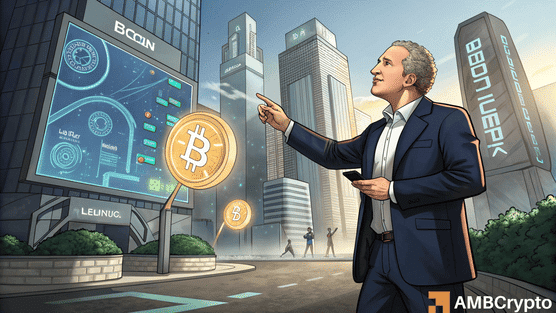
Peter Schiff sparks tokenized Gold vs. Bitcoin debate: ‘We accept BTC’

ambcryptoОпубликовано 2026-03-16Обновлено 2026-03-16

Введение

Peter Schiff, a prominent gold advocate and Bitcoin critic, has reignited the debate between the two assets by announcing his company, SchiffGold, will accept Bitcoin payments. This move is a strategic effort to promote his new tokenized gold product, which he claims offers a more stable and reliable store of value. Schiff's argument centers on gold's historical role as money and his belief that Bitcoin is a highly speculative asset. The announcement is seen as a direct challenge to Bitcoin proponents, framing the acceptance of BTC as a means to demonstrate the superiority of his gold-backed token.

Связанные с этим вопросы

QWhat is the main topic of the debate sparked by Peter Schiff?

AThe debate centers on the comparison between tokenized gold and Bitcoin, specifically regarding which asset people are more willing to accept.

QAccording to the title, which asset does 'we' refer to in the statement 'We accept BTC'?

AThe title does not explicitly specify who 'we' refers to, but it is part of Peter Schiff's argument in the debate, suggesting a group or his perspective is now accepting Bitcoin, which is notable given his historical criticism of it.

QWhat is Peter Schiff's known historical stance on Bitcoin, making this debate significant?

APeter Schiff is a well-known gold advocate and a prominent cryptocurrency skeptic who has frequently criticized Bitcoin, so his statement about accepting BTC is a significant and surprising development that sparks debate.

QWhat does the term 'tokenized Gold' refer to in this context?

A'Tokenized gold' refers to digital tokens that are backed by and represent ownership of physical gold, allowing it to be traded on blockchain platforms.

QWhat visual element accompanies the article based on the provided HTML code?

AThe article is accompanied by an image with the source URL 'https://d1x7dwosqaosdj.cloudfront.net/images/2026-03/f15d98a84ae441cb9199b2a002082ebe.png', which is displayed as a post thumbnail.


Похожее

Michael Saylor's Latest Article: Bitcoin Must Find Balance Between Uniqueness and Universal Value

Michael Saylor outlines four key Bitcoin ideologies shaping its future: * **Bitcoin Maximalists** see Bitcoin as the dominant digital monetary network and a breakthrough in economic empowerment, emphasizing its superior property rights and role as a sound money solution. * **Bitcoin Capitalists** focus on integration, believing Bitcoin must embed into the global economy—through institutions, capital markets, and financial products—to reach its full potential as digital capital. * **Bitcoin Technologists** advocate for continuous protocol improvements in scalability, privacy, and security to adapt to evolving needs and threats, while acknowledging the high bar for change. * **Bitcoin Fundamentalists** guard Bitcoin's core principles of self-custody, decentralization, and censorship resistance, warning against dilution from institutions or risky modifications. Saylor argues that a healthy Bitcoin ecosystem requires a balance of these perspectives. Bitcoin's path forward involves disciplined expansion: preserving its immutable core (Fundamentalist insight), recognizing its dominant status (Maximalist view), integrating with the global economy (Capitalist drive), and enabling careful innovation, primarily in higher layers (Technologist role). The challenge is to maintain Bitcoin's unique properties while making it useful for the world, ensuring it remains Bitcoin as it grows.

Foresight News18 мин. назад

Michael Saylor's Latest Article: Bitcoin Must Find Balance Between Uniqueness and Universal Value

Foresight News18 мин. назад

Reddit Weekly Hot Stock Watch: RKLB/LUNR/ASTS Plunge Collectively, Is the Space Sector Still Worth Considering?

Reddit's stock communities witnessed a concentrated surge in discussion around space stocks last week, with SPCE, RKLB, LUNR, and ASTS leading the chatter. This often signals an underlying catalyst for investor attention. However, despite being grouped as "space plays," these companies have vastly different fundamentals and recent performances. While SPCE (Virgin Galactic) saw a 22% single-day surge—potentially fueled by short covering and fallout from Blue Origin's rocket test anomaly—the other three stocks declined sharply. RKLB dropped 15%, LUNR fell 13%, and ASTS was down 7%. This divergence highlights they are not a monolithic sector. The downturn for RKLB, LUNR, and ASTS stemmed from multiple headwinds converging: Blue Origin's New Glenn rocket explosion (directly impacting ASTS's launch plans), anticipation of SpaceX's massive IPO drawing funds away from these "alternative" public space stocks, and insider selling at RKLB after significant rallies. A closer look reveals key differences: RKLB stands out with substantial, growing revenue ($113.9M in Q1) and a $2.2B backlog, though its high valuation (~80x Forward P/S) prices in success for its upcoming Neutron rocket. LUNR's reported revenue growth is largely acquisition-driven, with its core moon landing business facing a crucial test with the upcoming IM-3 mission. ASTS has a large potential market in space-based cellular connectivity but faces significant execution risk, especially after the Blue Origin launch setback. SPCE, despite high discussion volume, has minimal revenue and its recent spike appears driven more by sentiment than fundamentals. The analysis suggests it's premature to call a "buying opportunity" for the sector broadly. RKLB is considered the most fundamentally sound but may be more attractive at a lower price point ($96-$102). For the others, investors are advised to wait for specific catalysts: LUNR's IM-3 mission outcome, clarity on ASTS's revised launch timeline, and for SPCE, to avoid the speculative frenzy. The long-term space thesis remains, but short-term valuations have run ahead of fundamentals for most names.

marsbit33 мин. назад

Reddit Weekly Hot Stock Watch: RKLB/LUNR/ASTS Plunge Collectively, Is the Space Sector Still Worth Considering?

marsbit33 мин. назад

Why Does Crypto Always Build 'Casinos', But Rarely Creates 'Indispensable Products'?

The article explores why cryptocurrency has primarily fostered speculation rather than essential, "sticky" consumer products. It introduces the concept of "sofalarity"—the point where a platform's convenience becomes so ingrained that leaving feels unthinkable. While Big Tech creates this lock-in through ecosystem control and data harvesting, crypto lacks equivalent everyday utility. Its appeal hinges on the variable rewards of price volatility, akin to gambling, which drives engagement but not dependency. The author argues crypto's core promise—fixing opaque backend systems like correspondent banking—solves problems most people never see or feel, failing to deliver a tangible "aha moment" of improved daily life. This need for explanation hinders mass adoption. Meanwhile, platforms like Google and Meta monetize vast behavioral data, a treasure trove crypto's transparent ledgers (recording only financial transactions) cannot match for predictive insight. The piece further questions whether crypto's potential lies in consumer super-apps or, more plausibly, in becoming enterprise-grade infrastructure—modern settlement rails. It concludes with a critical look at Real-World Asset (RWA) tokenization, suggesting it may merely digitize and accelerate corporate extraction (e.g., in housing or healthcare) rather than democratize access, as the technology itself is a neutral tool. True disruption, the author implies, requires building sovereign systems outside exploitative platforms.

marsbit34 мин. назад

Why Does Crypto Always Build 'Casinos', But Rarely Creates 'Indispensable Products'?

marsbit34 мин. назад

Торговля

Спот
Фьючерсы
活动图片