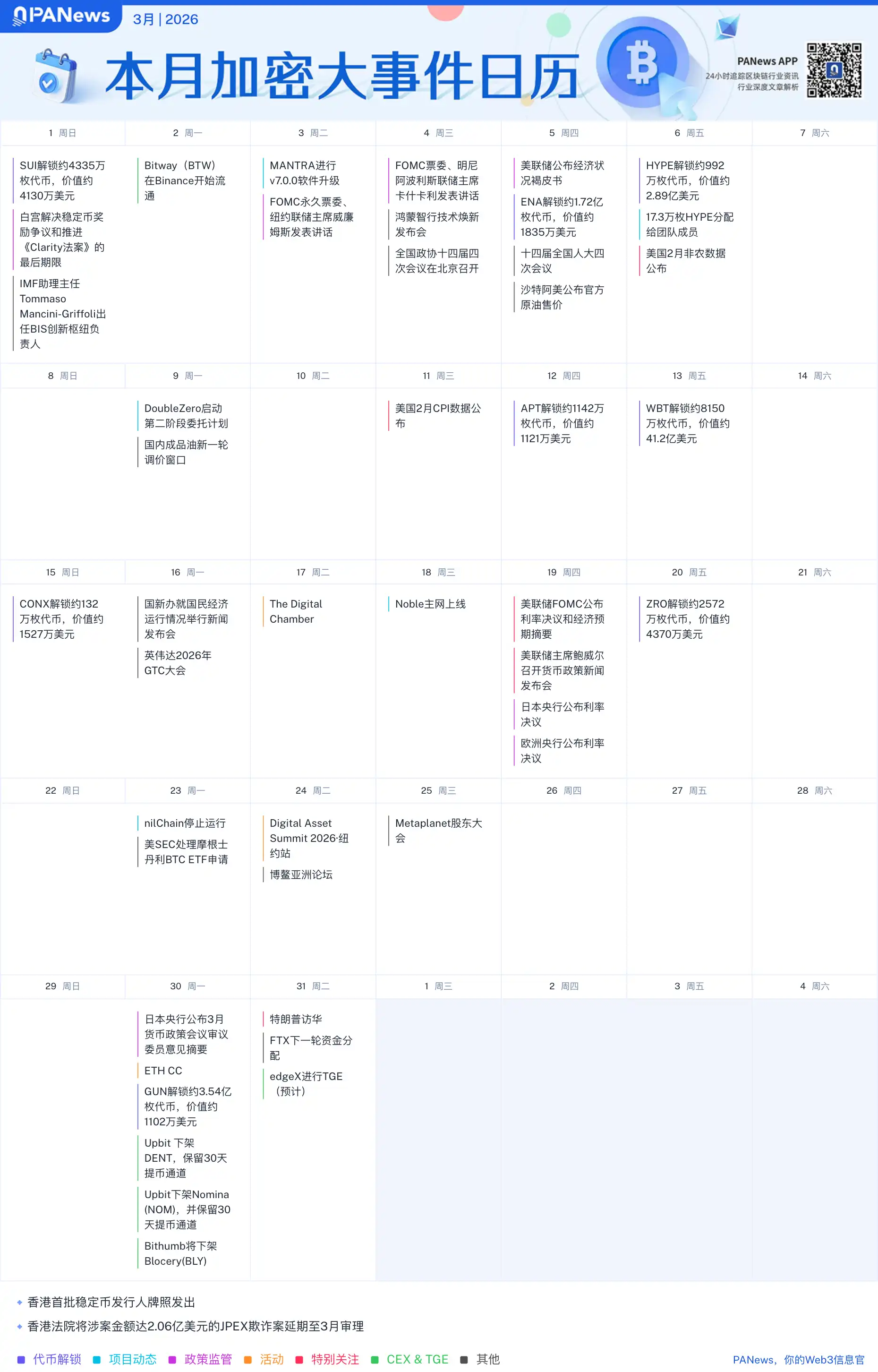
PA Infographic | A Glance at Major Web3 Events in March 2026

marsbitОпубликовано 2026-03-01Обновлено 2026-03-01

Введение

PA Graphic | Key Web3 Events to Watch in March 2026 March 2026 is set to be a critical month for the crypto market, shaped by policy, macroeconomic trends, and liquidity dynamics. Major events include: - The FOMC interest rate decision and subsequent press conference by Jerome Powell, a key moment for global risk assets. - The upcoming vote on the Clarity Act, which could define US regulatory frameworks for stablecoins and digital assets. - The release of US February non-farm payroll and CPI data, influencing ongoing macro liquidity expectations. - Hong Kong issuing its first batch of stablecoin licenses. - Major token unlocks, including SUI and HYPE, totaling billions of dollars, potentially increasing selling pressure. - Metaplanet’s shareholder meeting, focusing on its Bitcoin strategy and capital market moves. - FTX’s new round of fund distributions, which may impact market sentiment and liquidity. With policy updates, economic data, token unlocks, and industry events unfolding simultaneously, market volatility is expected to intensify in March. For a concise overview of the core Web3 developments in March 2026, this graphic has you covered.

More comprehensive coverage, flexible filtering, and convenient export. Welcome to experience PANews' new crypto calendar 👇

Click to view PA Calendar

In March, the crypto market enters a phase intertwined with policy, macroeconomics, and liquidity. Key highlights:

  • FOMC interest rate decision and Powell's press conference, a critical window for global risk assets
  • Imminent vote on the Clarity Act, a crucial moment for US stablecoin and digital asset regulatory framework
  • US releases February non-farm payroll and CPI data, ongoing博弈 in macro liquidity expectations
  • Hong Kong issues first batch of stablecoin licenses
  • SUI, HYPE tokens, and others face large unlocks, totaling over billions of dollars in a single month, watch for potential selling pressure
  • Metaplanet holds general meeting, focus on its Bitcoin strategy and capital market movements
  • FTX's new round of fund distribution, potential impact on market sentiment and liquidity

With policy, data, unlocks, and industry conferences advancing in parallel, volatility may further amplify in March.

Global focal events converge. Lock in the core narrative of Web3 for March 2026 with just this one graphic!

Связанные с этим вопросы

QWhat are the key highlights of the Web3 market in March 2026 according to the article?

AThe key highlights include the FOMC interest rate decision and Powell's press conference, the vote on the Clarity Act, the release of US non-farm payrolls and CPI data, the issuance of the first stablecoin licenses in Hong Kong, large token unlocks for SUI and HYPE, the Metaplanet shareholders meeting, and FTX's new round of fund distribution.

QWhich US regulatory framework for stablecoins and digital assets is entering a critical moment in March 2026?

AThe Clarity Act is entering a critical moment, with its vote imminent, which will shape the US regulatory framework for stablecoins and digital assets.

QWhat potential market impact is mentioned regarding SUI and HYPE tokens in March 2026?

ASUI and HYPE tokens are experiencing large-scale unlocks, with a total value exceeding billions of US dollars, potentially leading to significant selling pressure on the market.

QWhat major event is happening with Metaplanet in March 2026 and why is it noteworthy?

AMetaplanet is holding its shareholders meeting, which is noteworthy due to the focus on its Bitcoin strategy and capital market movements.

QHow does the article characterize the overall market conditions for March 2026?

AThe article states that with policy, data, token unlocks, and industry conferences all happening concurrently, market volatility in March is expected to further increase.

Похожее

Uncovering the Truth About Agent Commerce, Payments, and Infrastructure

Decoding Agent Commerce, Payments, and Infrastructure: The Reality Over the past year, I've been building infrastructure for the Agent economy, engaging with major players like Stripe, Visa, Coinbase, Google, and dozens of startups. A clear conclusion emerges: true, large-scale demand does not yet exist. Startups face structural challenges. Data points illustrate this gap. Stripe's Agent commerce platform has over 1,000 merchants but only single-digit transacting agents. Visa's Agent payment token requires 9-month KYC and a $250M revenue threshold, accessible only to giants like Amazon. On-chain analysis reveals actual daily Agent transaction volume is around $17k, half of which are test transactions. The article analyzes four potential markets: **1. Agent-to-Merchant (A2M):** Current AI shopping UX is often inferior to traditional e-commerce for visual, comparison-heavy purchases (clothing, electronics). Chat interfaces are a step back. Real merchant interest is defensive "Agent Engine Optimization," fearing future obsolescence, not current demand. Potential exists in high-frequency, low-decision purchases (e.g., food delivery) or simplifying terrible UX (complex checkouts, non-native shoppers), but these require massive consumer distribution channels dominated by giants like DoorDash and Amazon. **2. Agent-to-API (A2A):** Developers already have subscriptions and billing for core APIs (compute, data). The argument for micro-payments via crypto for sub-dollar API calls is addressed by pre-paid balances today. The deeper issue is supplier resistance; major SaaS firms rely on enterprise contracts, not fractional cent pricing. Opportunity lies in the long tail of niche services, but this is a smaller market catering to developers, a historically low-paying group. **3. Agent-to-Agent (A2A):** This remains a theoretical long-term vision with near-zero current transaction volume. It involves unique challenges: discovery, trust, negotiation, dispute resolution. When it materializes, it will require a fundamentally new settlement infrastructure for high-speed, variable-value, multi-party transactions. It's a real long-term bet, but not the current market. **4. Agent-to-Finance (A2F):** This is the only category with existing, paying demand. Integrating AI into financial workflows (trading, portfolio management) is a natural evolution and enables new capabilities like autonomous rebalancing. However, competition favors incumbents with regulatory licenses, compliance infrastructure, and existing client relationships. **The Real Issue:** Why is infrastructure still being built? Incumbents can afford long-term bets, and payment companies see every problem as a nail for their payment hammer. However, payment is just one piece. The core challenge is *coordination*—orchestrating work between Agents and humans, verifying outcomes, and settling results. Payment is part of settlement, which is part of coordination. Companies that solve the coordination problem will subsume payments, not the other way around. Startups lack the infinite runway of giants and must find today's real market, which, after a year of exploration, lies outside these four categories—in an area with real, growing, and underserved activity.

marsbit56 мин. назад

Uncovering the Truth About Agent Commerce, Payments, and Infrastructure

marsbit56 мин. назад

Kalshi, MTS, and a16z's Ambition

The article "Kalshi, MTS, and a16z's Ambition" explores prediction markets as a focal point of excitement in 2025 for investors, crypto enthusiasts, and media. It traces their intellectual lineage from Friedrich Hayek's ideas on dispersed knowledge and market coordination to Robin Hanson's Logarithmic Market Scoring Rule (LMSR), which incentivizes truthful information sharing. The piece argues that a16z's significant investment in prediction market platform Kalshi (valued at $220B) transcends mere financial speculation. a16z frames prediction markets as a new form of "media" that provides "presence"—a way for individuals to actively engage with and influence world events through financial stakes, countering postmodern detachment. By wagering on outcomes, users become "super observers," and the market's aggregated probabilities gain authoritative power to define event truth and importance. The article uses media company MTS ("Monitoring The Situation") as a case study of a16z's "new media" strategy: rapidly producing high-intensity, multi-format content to "take over the timeline." However, prediction markets like Kalshi are presented as the ultimate piece in this media empire. Their real-money, crowd-sourced probabilities possess a unique "reality distortion field" and perceived objectivity, potentially swaying public opinion and granting a private company unprecedented interpretive power over reality. Ultimately, Kalshi's immense valuation is attributed not just to its exchange model, but to its role as a foundational component in a16z's envisioned new media landscape, where prediction markets define narrative and truth.

链捕手56 мин. назад

Kalshi, MTS, and a16z's Ambition

链捕手56 мин. назад

Торговля

Спот
Фьючерсы
活动图片