Optimism Proposes Using 50% of Superchain Revenue for OP Token Buybacks

TheNewsCryptoОпубликовано 2026-01-09Обновлено 2026-01-09

Введение

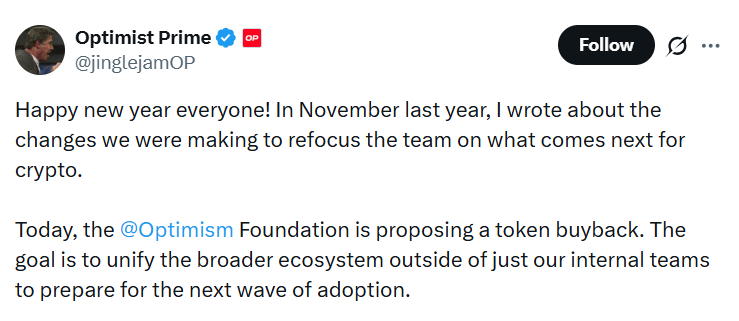
Optimism has proposed a major shift in its tokenomics by allocating 50% of Superchain revenue to monthly OP token buybacks, pending community approval. If passed, the program will begin in February 2026, using sequencer fees to purchase OP tokens via an OTC provider. The purchased tokens will be returned to the treasury, not immediately burned or sold, with future governance deciding their use. This initiative aims to tie OP’s value directly to ecosystem usage and economic activity, reflecting Optimism’s significant role in the L2 space, where it holds 61.4% of the fee market share. The proposal has sparked debate over combining buybacks and expanded treasury discretion in a single vote. A governance call is scheduled for January 12, with a formal vote on January 22.

Optimism has proposed a major change to how its ecosystem uses its revenue. The plan is to buy back the OP tokens every month by using 50% of its Superchain revenue. If the Community approves this plan, Optimism is planned to start in February 2026. This makes a major shift in OP’s Role from being just a governance token to a token that is directly tied to the usage and revenue of the Ecosystem.

How Optimism Plans to Turn Superchain Fees Into OP Token Demand

The Buyback will happen from the revenue earned by the Superchain from the Sequencer fees. Over the past years, these chains have generated over 5,800 ETH in revenue. So under the proposal, 50% of the revenue will be used to buy OP tokens. Purchases will be made monthly through the OTC Provider. The bought OP tokens will be sent back to the treasury. This will be paused if monthly revenue drops below $200,000. These treasury tokens would not be burned or sold immediately. The Governance would later decide whether to burn or use them for staking and ecosystem incentives.

The reason for this new plan is to make the OP’s value reflect its real economic activity instead of revenue sitting unused in the treasury. Optimism and Superchain agave become dominant players in layer-2. 61.4% of the L2 fee market share and 13% of all on-chain transactions are where the most L2 economic activity is happening.

The Foundation will have the limited discretion to manage remaining ETH. They can use it to generate yield and support ecosystem development. This reduces slow governance overhead while keeping spending within set rules. The Staking partnerships have already generated yield and aim to strengthen OP mainnet’s institutional appeal.

There has been some debate going on for the community members because the proposal combines OP buybacks and expanded treasury discretion in one vote. The Critics argue that these should be voted on separately to avoid bias from the price expectations. The community discussion is going on, a governance call is scheduled for Jan 12, and a formal vote happens on Jan 22. Once it is approved, the buyback will begin in February and the program will run for 12 months.

Highlighted Crypto News:

A Bearish Wall Looms Over BONK: Fade Lower or Fight Back for Gains?

TagsOptimismsuperchain

Связанные с этим вопросы

QWhat is the main change proposed by Optimism regarding its Superchain revenue?

AOptimism has proposed using 50% of its Superchain revenue to buy back OP tokens every month.

QWhen is the proposed buyback program planned to begin if approved by the community?

AThe buyback program is planned to start in February 2026 if the community approves the proposal.

QWhat is the source of the revenue that will be used for the OP token buybacks?

AThe buybacks will be funded from the revenue earned by the Superchain from sequencer fees.

QWhat will happen to the purchased OP tokens after they are bought back?

AThe purchased OP tokens will be sent back to the treasury, and governance will later decide whether to burn them or use them for staking and ecosystem incentives.

QWhat is the minimum revenue threshold that would pause the monthly buyback program?

AThe monthly buyback program will be paused if the monthly revenue drops below $200,000.

Похожее

Why Hasn't the U.S. Seen the Rise of 'Huabei' or 'Jiebei'?

The article explores why the U.S. lacks large-scale consumer credit products like China's "Huabei" and "Jiebei," despite having a developed financial sector. Key reasons include: 1. **Structural Barriers**: A fragmented federal and state regulatory system, reinforced by post-2008 reforms like the Dodd-Frank Act, raises compliance costs and protects traditional banks, stifling fintech innovation. 2. **Credit Card Dominance**: Credit cards, used by 70-80% of adults, form a $1.28 trillion debt market with high APRs (avg. 22.3%). This system cross-subsidizes users who pay in full with those carrying balances, creating a predatory yet entrenched ecosystem. 3. **Data Privacy Laws**: Strict regulations (e.g., FCRA, CCPA) prevent tech giants from leveraging behavioral data for credit scoring, unlike in China where such data fuels fintech models. 4. **Capital Market Disincentives**: Wall Street penalizes tech firms entering finance due to lower valuations associated with heavy regulation and risk, as seen in Apple’s failure with Apple Card. 5. **Banking Oligopoly**: Major banks control consumer lending, leveraging lobbying power and consumer habits to maintain high-cost credit, while alternatives like payday loans (400% APR) or "unbanked" services remain niche or exploitative. Ultimately, regulatory, structural, and corporate interests collectively block the emergence of accessible, low-cost digital lending in the U.S.

Odaily星球日报7 мин. назад

Why Hasn't the U.S. Seen the Rise of 'Huabei' or 'Jiebei'?

Odaily星球日报7 мин. назад

More and More 'Model Supermarkets' Are Opening: ByteDance, Alibaba, and Tencent Compete to Integrate

Chinese tech giants like ByteDance, Alibaba, and Tencent are accelerating the rollout of integrated AI model subscription services—dubbed “model supermarkets”—to provide developers with bundled access to multiple leading domestic large language models (LLMs). ByteDance’s Volcengine recently upgraded its "Coding Plan" by adding newer models like GLM-5.1, Minimax M2.7, and Kimi k2.6, allowing subscribers to use various top models under a single monthly fee starting at ¥40. However, user feedback reveals significant issues, including rapid consumption of usage limits (e.g., hitting caps within hours), frequent server errors (like HTTP 429), and slow response times during peak hours. Complaints about misleading deduction rates—where calls to advanced models consume more quota—are also common. The trend is industry-wide: Alibaba, Tencent, and Baidu have all launched similar multi-model coding plans. While these platforms reduce trial costs for developers, they also expose challenges in balancing affordability with service quality and computational stability. Amid this shift, independent AI companies like Zhipu, MiniMax, and Moonlight Face (Kimi) are developing strategies to avoid becoming mere “pipes” in this ecosystem—focusing on vertical applications, autonomous agents, and long-context models to retain competitiveness. Analysts suggest that, while platform aggregation may pressure model firms in the short term, specialized and vertical AI capabilities will remain differentiated in the long run.

marsbit10 мин. назад

More and More 'Model Supermarkets' Are Opening: ByteDance, Alibaba, and Tencent Compete to Integrate

marsbit10 мин. назад

Торговля

Спот
Фьючерсы
活动图片