OpenAI's Largest Internal Wealth Creation: 600 Individuals Cash Out $6.6 Billion Combined, 75 Take the Full $30 Million Cap

marsbitОпубликовано 2026-05-11Обновлено 2026-05-11

Введение

OpenAI conducted its largest-ever internal stock sale in October, allowing over 600 current and former employees to collectively cash out approximately $6.6 billion. About 75 individuals sold the maximum allowed amount of $30 million per person, a limit tripled from $10 million due to high investor demand. The tender offer was based on a $500 billion company valuation. President Greg Brockman confirmed in court that his OpenAI stake is worth around $30 billion. Employees collectively own about 26% of the company, with average paper wealth per employee around $1 billion, far exceeding pre-IPO norms at other major tech firms. Following a recent funding round at an $852 billion valuation and with monthly revenue reaching $2 billion, OpenAI is reportedly preparing for a potential trillion-dollar IPO in late 2026.

Author: Claude, Shenchao TechFlow

Synopsis: The Wall Street Journal revealed the scale of wealth creation within OpenAI. In a staff stock sale last October, the company raised the personal cash-out limit from $10 million to $30 million. Over 600 current and former employees participated, cashing out a combined $6.6 billion, with approximately 75 individuals taking the full maximum amount. President Brockman confirmed in court this week that his stake is worth about $30 billion. Silicon Valley has never seen such a concentration of millionaires created by a private company before its IPO.

Image source: Wall Street Journal

In the past Silicon Valley, the typical path for ordinary employees to strike it rich was one: wait for the company to go public. OpenAI is rewriting that rule.

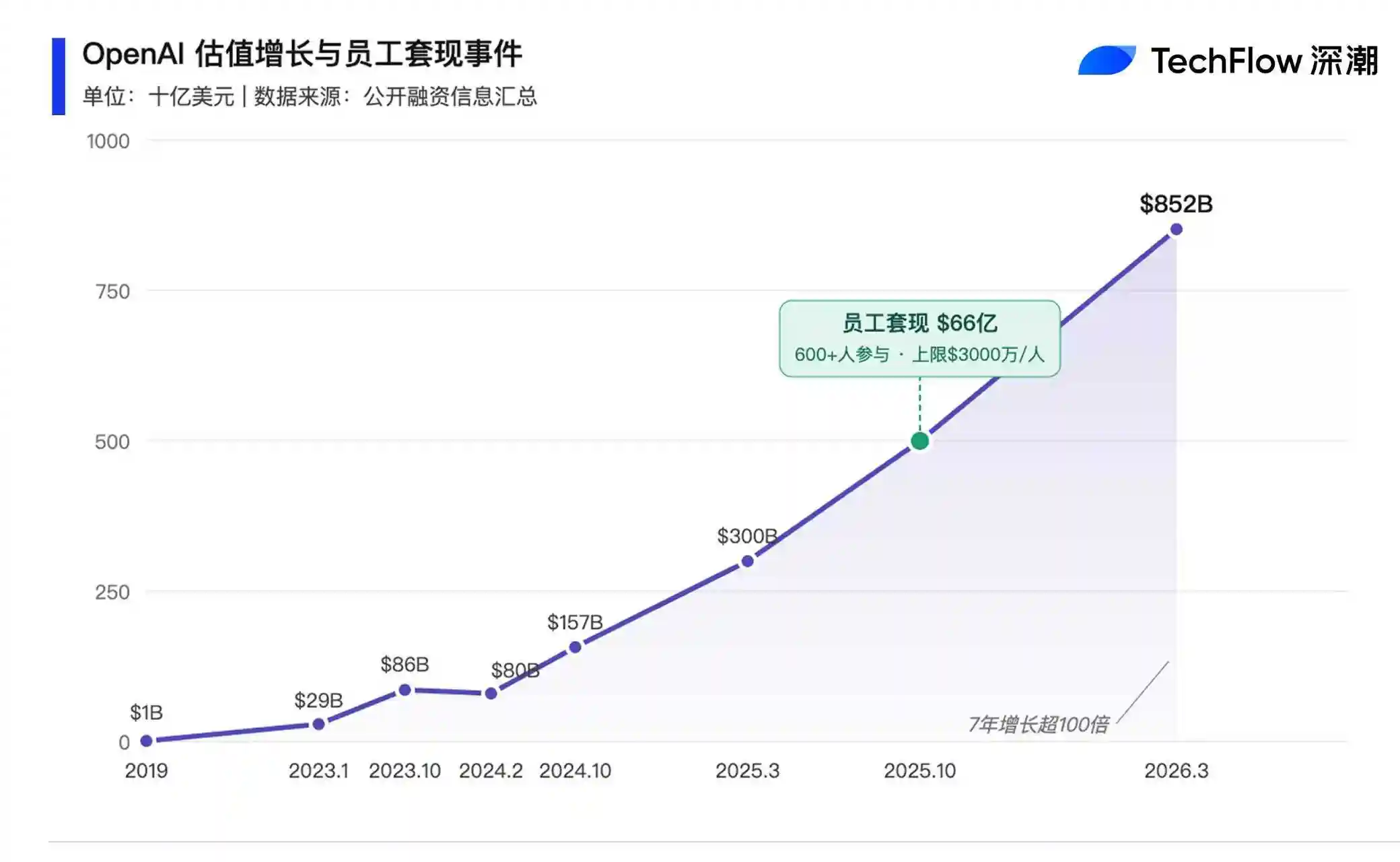
According to The Wall Street Journal, in an internal stock transaction completed last October, OpenAI allowed employees to sell up to $30 million in shares each. Over 600 current and former employees participated, cashing out approximately $6.6 billion in total. Informed sources revealed that about 75 of them took the full $30 million cap. This is the largest single employee stock sale event in the tech industry to date.

Cash-Out Cap Tripled, Driven by External Investor Demand

OpenAI originally set a single cash-out limit of $10 million for employees. However, due to external investor demand far exceeding expectations, the company tripled the cap to $30 million last fall.

The transaction was completed at a $500 billion valuation, with investors including Thrive Capital, SoftBank, Dragoneer Investment Group, Abu Dhabi's MGX, and T. Rowe Price. As previously reported by CNBC, OpenAI initially planned a sale of about $6 billion, later expanded to $10.3 billion, but the actual transaction ended up being around $6.6 billion. Internally, the lower participation rate was interpreted as a vote of confidence in the long-term prospects by employees.

According to OpenAI's rules, employees can sell shares after two years of service. This means many employees who joined after ChatGPT's launch at the end of 2022 had their first opportunity to cash in options in this transaction. The value of OpenAI's stock has increased over 100-fold in the past seven years.

Brockman Confirms $30 Billion Stake in Court, Musk's Lawyer Presses Relentlessly

The scale of wealth held by executives is even more staggering. According to NBC, OpenAI President and Co-founder Greg Brockman confirmed during testimony on May 4th that his current OpenAI equity is worth approximately $30 billion.

This figure was disclosed on the fourth day of the trial in Elon Musk's lawsuit against OpenAI. Musk's lawyer, Steven Molo, repeatedly referenced this number during over two hours of questioning, pressing Brockman on why he hadn't fulfilled a promised $100,000 donation while amassing a $30 billion fortune. According to CNBC, Brockman admitted, "It is true I ultimately did not make the donation."

As reported by Fortune, Musk's legal team also revealed multi-layered financial ties between Brockman and CEO Sam Altman: Altman provided Brockman with about $10 million in equity from his family office as early as 2017; Brockman also holds stakes in AI chip startup Cerebras and nuclear fusion company Helion Energy. OpenAI had previously discussed acquiring Cerebras, and Altman has invested hundreds of millions in Helion. Musk's side argues these cross-holdings compromised Brockman's independence as a fiduciary.

Employees Hold 26% Stake, Average Paper Wealth Exceeds Returns of Most VC Funds

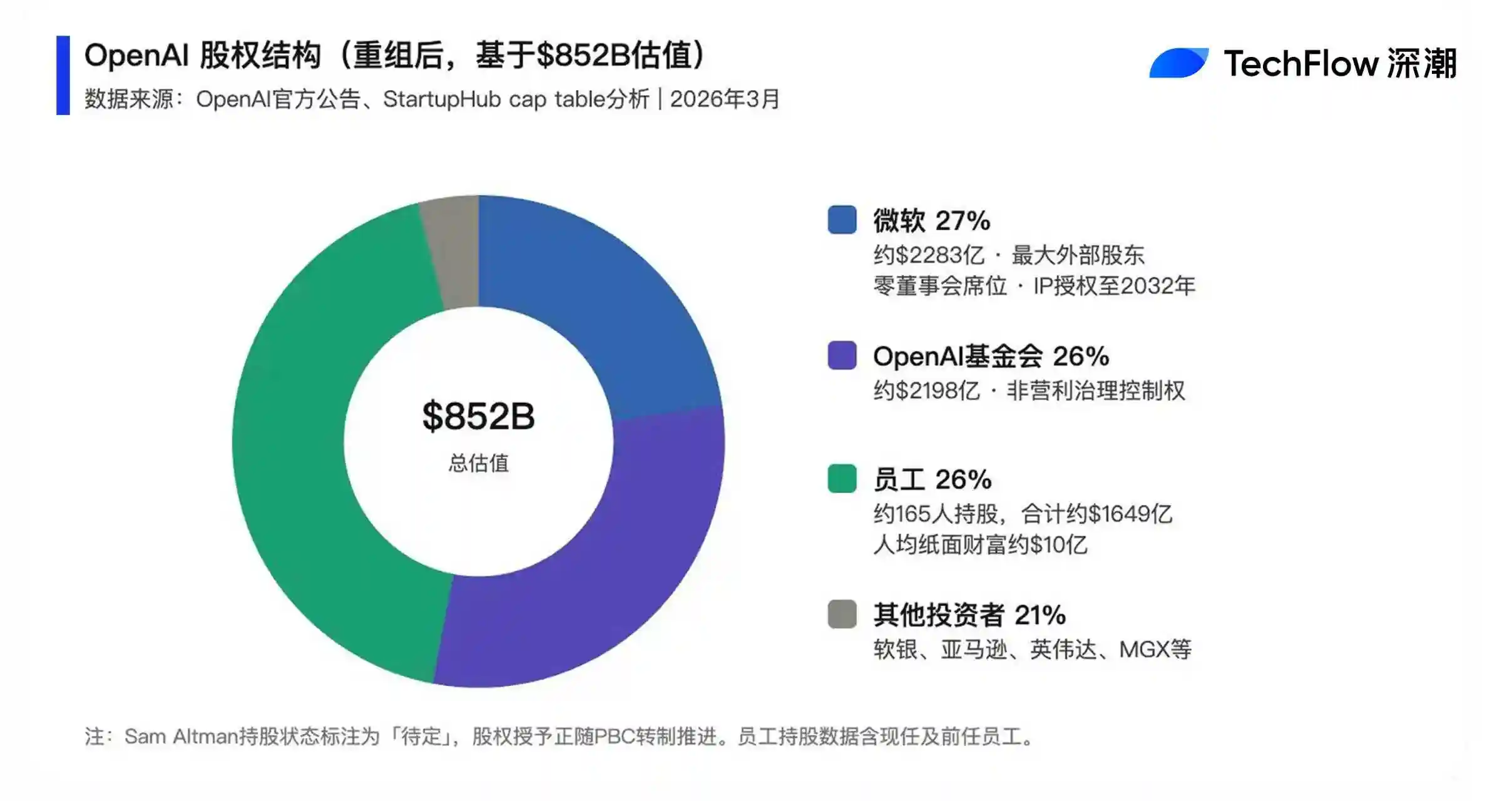
Following the company restructuring completed last October, OpenAI employees collectively hold about 26% of the company's equity.

According to an analysis by StartupHub, approximately 165 current and former employees collectively hold equity worth about $164.9 billion, averaging nearly $1 billion in paper wealth per person. This exceeds the total lifetime returns of most venture capital funds.

According to an analysis by The Wall Street Journal and data firm Equilar, OpenAI's per capita stock-based compensation in 2025 is about $1.5 million. This is over 7 times the figure for Google before its 2004 IPO, and 34 times the average for 18 large tech companies in the year before their IPOs over the past 25 years.

The company's equity-based compensation expense constitutes nearly half of its projected revenue, far surpassing peers like Palantir, Meta, and Salesforce.

$852 Billion Valuation, Trillion-Dollar IPO on Horizon, Wealth Creation Far From Over

OpenAI completed a $122 billion financing round on March 31st this year at an $852 billion valuation, setting a new record for the largest single private funding round in Silicon Valley history. Amazon led the investment with $50 billion, while Nvidia and SoftBank each invested $30 billion. The company's current monthly revenue is $2 billion, with over 900 million weekly active ChatGPT users and more than 50 million paid subscribers.

According to multiple media reports, OpenAI is preparing for an IPO in the fourth quarter of 2026, with a target valuation potentially reaching $1 trillion. If successful, this would become one of the largest tech IPOs in history. CFO Sarah Friar previously stated at Davos that the company plans to allocate a portion of the IPO shares to retail investors.

Связанные с этим вопросы

QAccording to the article, how many OpenAI employees participated in the internal stock sale and what was the total amount cashed out?

AOver 600 current and former employees participated, cashing out a total of approximately $6.6 billion.

QWhat was the new individual cash-out limit set for the October stock sale, and how did it compare to the previous limit?

AThe new individual cash-out limit was set at $30 million. It was a threefold increase from the previous limit of $10 million.

QWhat did OpenAI president Greg Brockman reportedly confirm about his stake in the company during the Musk vs. OpenAI trial?

AHe confirmed that his current OpenAI equity is worth approximately $30 billion.

QWhat percentage of OpenAI is owned by employees, and what is the approximate average paper wealth per employee as cited by StartupHub?

AEmployees collectively own about 26% of OpenAI. According to StartupHub, around 165 employees hold a total of approximately $164.9 billion in equity, averaging about $1 billion in paper wealth per person.

QWhat is OpenAI's reported monthly revenue, and when is its IPO potentially scheduled to launch according to the article?

AOpenAI's monthly revenue is reported to be $2 billion. Its IPO is potentially scheduled to launch in the fourth quarter of 2026.

Похожее

SharpLink CEO: How to Understand Ethereum Developers Just Exceeded 1 Million?

SharpLink CEO reflects on the milestone of Ethereum surpassing 1 million historical developers, emphasizing that this figure represents the largest pool of technical talent ever assembled around an open, permissionless blockchain network. While approximately 232,000 developers remain active, the key question for the crypto industry is not which chain is fastest, but where the best builders choose to build long-term. Ethereum's advantage lies in a decade-long accumulation of infrastructure, standards, tools, liquidity, and a cohesive culture, making it the default operating system for programmable finance. This developer base is tackling complex challenges: the Glamsterdam upgrade aims to enhance scalability while preserving core principles; synchronous composability seeks to unify Rollup ecosystems; and significant efforts are underway for post-quantum security. Ethereum's deeper network effects stem from composability and shared standards (like the EVM and Solidity), creating a flywheel of more developers, tools, and liquidity. Three reinforcing strengths cement Ethereum's lead: credible neutrality (secured by ~900k validators), a modular architecture with interconnected Rollups, and a culture that attracts top researchers. The ecosystem is consolidating as the trusted coordination layer for internet-native finance, favored by large institutions valuing security and liquidity. The future of Ethereum is being built by this global community of founders and architects.

链捕手8 мин. назад

SharpLink CEO: How to Understand Ethereum Developers Just Exceeded 1 Million?

链捕手8 мин. назад

A Clod of Chinese Soil Chokes Two Japanese Giants

"Chinese Soil Chokes Japanese Giants" The production of a key electronic specialty gas, tungsten hexafluoride (WF6), vital for manufacturing AI chips, was halted by two leading Japanese producers—Kanto Denka and Central Glass. Their shutdown was not due to a technological failure but a sudden, critical shortage of a raw material they had long taken for granted: ultra-high-purity (6N-grade) tungsten powder, which is almost entirely sourced from China. Following a quiet Chinese export announcement in January 2026, tungsten powder shipments to Japan dropped to zero for months. Despite frantic efforts, Japanese companies found no viable alternative; imported powder was three times more expensive and lacked the required purity. Their existing stockpiles were exhausted by mid-2026. WF6 is essential for depositing tungsten into the microscopic contact holes of High Bandwidth Memory (HBM) chips, which are crucial for advanced processors like those from Nvidia. While Japanese firms had mastered producing ultra-pure WF6 gas, their entire supply chain relied on China's 6N tungsten powder—a dependency now revealed as a fatal vulnerability. China's dominance in this "soil" results from decades of painstaking R&D by companies like Xiamen Tungsten and China Tungsten & Hightech. They overcame immense technical hurdles, such as separating chemically similar molybdenum from tungsten, to achieve mass production of the world's purest tungsten powder. With their primary suppliers gone, Kanto Denka and Central Glass announced a permanent halt to WF6 production starting July 1, 2026. This immediately created a supply crisis for major semiconductor manufacturers like Samsung and SK Hynix, forcing them to urgently seek and certify new Chinese suppliers for WF6 itself. The reversal marks a dramatic shift: China has moved from exporting low-value raw materials to controlling the high-purity foundation of a critical global tech supply chain, upending a long-established industrial hierarchy.

marsbit39 мин. назад

A Clod of Chinese Soil Chokes Two Japanese Giants

marsbit39 мин. назад

Without Tencent, What's Left for Suiyuan?

The article centers on the crucial question posed in the title: what is Seyond Technology really worth if its dominant customer, Tencent, were to stop purchasing its AI chips? As the last of China's "Four AI Chip Dragons" to secure approval for a public listing, Seyond's IPO filing reveals a profound and controversial dependency. In 2025, 74.9% to over 80% of its revenue came from Tencent. The piece argues that this extreme customer concentration is not merely a vulnerability but a strategic outcome of China's AI industry evolution. It contrasts Seyond's path with its peers (Moore Thread, Biren Technology, and MetaX), noting that while others raced to market with ambitious stories, Seyond focused first on securing and delivering for a major client. Its explosive revenue growth—with Q1 2026 up 1474.85% year-on-year—is driven by concentrated orders from Tencent, which itself faces massive, escalating AI compute demands for products like its Yuanbao and Hunyuan models. The relationship is framed as a deliberate, symbiotic cultivation of a supply chain. As both a major shareholder (20.26%) and primary client, Tencent is actively fostering Seyond to build a controllable, stable alternative to NVIDIA, similar to how global tech giants historically nurtured key suppliers. The high switching costs—involving software stacks and deployed systems—create a deep "ecological moat" for Seyond within Tencent's ecosystem. The analysis positions the AI chip landscape in three tiers: NVIDIA as the global leader, Huawei's Ascend as the state-backed player, and commercial firms like Seyond competing for market orders. Seyond is increasingly seen as "Tencent's compute foundation," with its product roadmap closely aligned with the tech giant's needs. The conclusion is that the industry's metric for success is shifting from fundraising and technical specs to real orders, delivery capability, and ecosystem binding. Seyond's value, therefore, lies not just in its chips but in holding a massive, multi-year procurement order from China's largest internet company—a tangible asset arguably more telling than any technical whitepaper in the current climate. The core insight is that for domestic chips, the ultimate challenge isn't just catching up technologically with NVIDIA, but earning the trust, scenarios, and recurring orders from a major anchor client.

marsbit1 ч. назад

Without Tencent, What's Left for Suiyuan?

marsbit1 ч. назад

Торговля

Спот
Фьючерсы
活动图片