OpenAI Completely Overhauls Codex, Grows Its Own Mouse, Schedules Itself to Outwork Humans

marsbitОпубликовано 2026-04-17Обновлено 2026-04-17

Введение

OpenAI has fundamentally transformed Codex from a coding assistant into a versatile AI agent capable of autonomous computer control. The updated Codex can now operate in the background with its own independent cursor, allowing it to run applications like Xcode, test software, and fix bugs without interrupting the user’s workflow. It features a built-in browser for real-time visual editing of web pages, enabling developers to make changes through direct UI interactions. The release also introduces over 90 plugins for tools like JIRA, CircleCI, and SharePoint, integrating end-to-end development and productivity workflows. A new "heartbeat" feature allows Codex to self-schedule tasks, maintain context across sessions, and work autonomously over extended periods. Additional enhancements include memory capabilities, support for handling GitHub code reviews, multi-tab terminals, and built-in file generation for Excel, PDF, and PowerPoint. Currently, advanced computer control is available on macOS (excluding EU/UK users), with Windows support limited to data retrieval. This expansion positions Codex as a foundational step toward OpenAI’s planned "super-app," combining coding, automation, and multi-tool integration into a single platform.

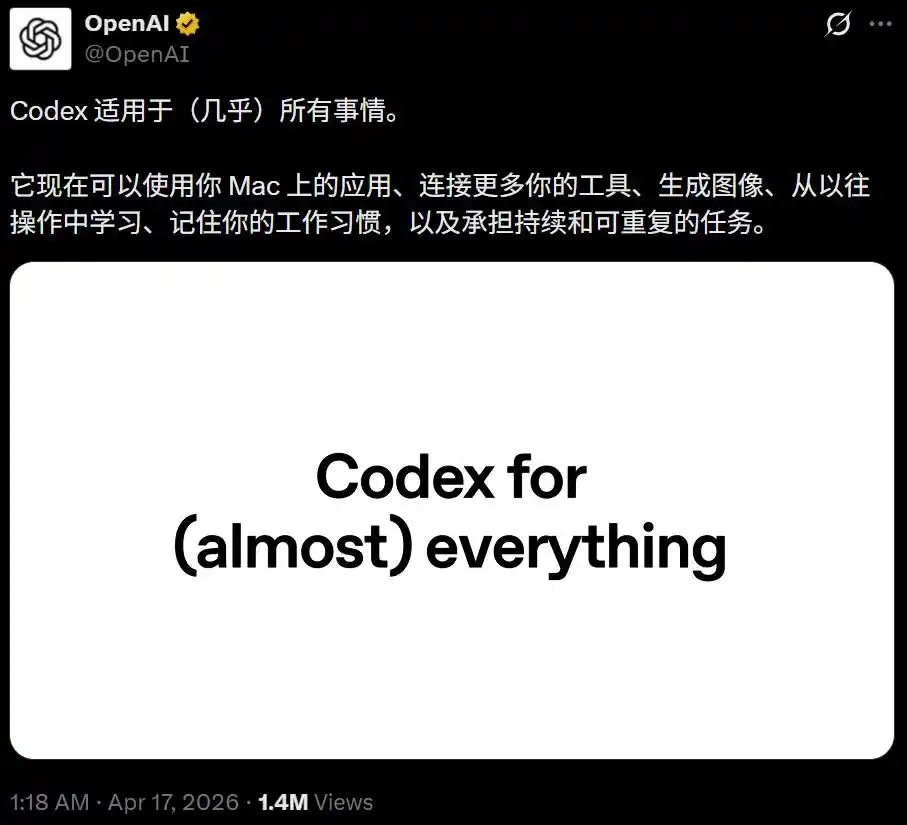
Just now, OpenAI has turned Codex upside down!

Yesterday you were still using Codex to write code.

Today it can already view your screen, click your mouse, remember your preferences from last week, and schedule its own tasks.

Multiple AI Agents work for you in the background simultaneously, without affecting your mouse and keyboard at all.

Codex's "Secret Sauce": It can use apps directly in the background without taking over your entire computer.

From today, this tool used weekly by 3 million developers is no longer just a programming Agent.

You Do Your Work, It Runs Xcode in the Background

Now, Codex has its own cursor, which does not interfere with your mouse.

You write documents while it runs Xcode to test an App next to you, both happening at the same time.

This feature has significant origins; its lead, Ari Weinstein, is the co-creator of Apple Shortcuts, whose team was acquired by OpenAI last fall.

To understand what it can do, just watch a demo.

First, the user gives the command: "Run this Tic-Tac-Toe App in Xcode, play a game to test it yourself, and fix any bugs you find."

Then, Codex opens Xcode by itself, starts the iOS simulator, and begins playing with its own cursor.

During testing, it discovers a logic bug—after a human move, the computer draws two O's simultaneously.

After some thought, Codex decisively switches back to the code interface and locates the position of the bug.

After modifying the Swift code, it immediately recompiles and performs a second round of complete testing for verification.

In less than a minute. Run → Test → Find bug → Fix → Regression verification, the entire Debug closed loop, all in one go.

Currently, Computer Use only supports macOS; users in the EU and UK cannot use it for now.

The Windows version can pull information from other apps into Codex but does not yet support background cursor-level control.

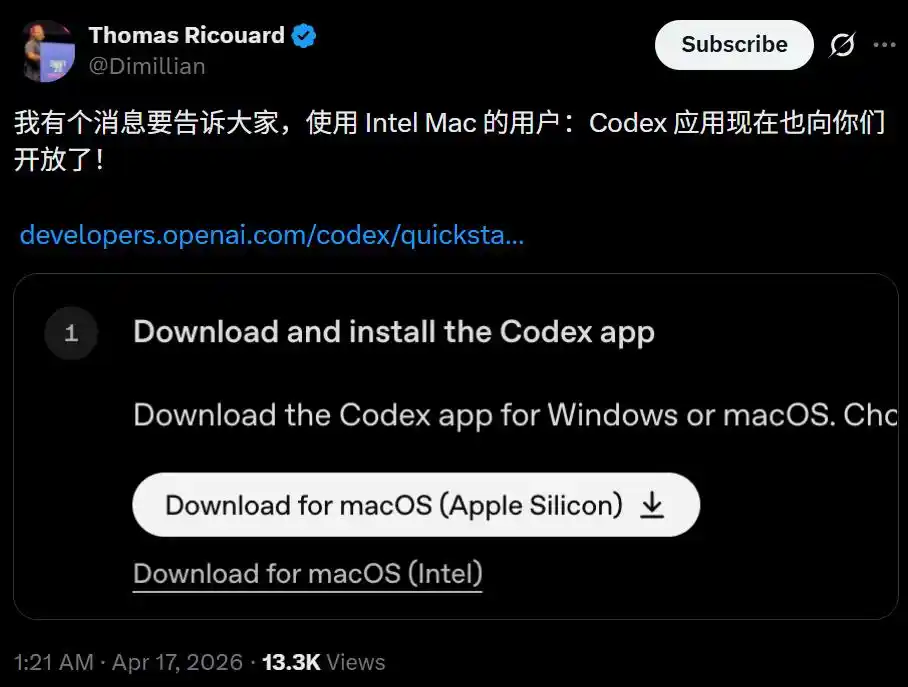
In this update, Codex gains support for Intel Macs for the first time.

Click to Modify, No More Code Hunting for Front-End Debugging

The Codex client now has a built-in browser,底层 powered by OpenAI's own Atlas engine.

In practical terms,以前 front-end developers adjusting UI had to jump back and forth between code and the browser. Now you can operate on the rendered webpage.

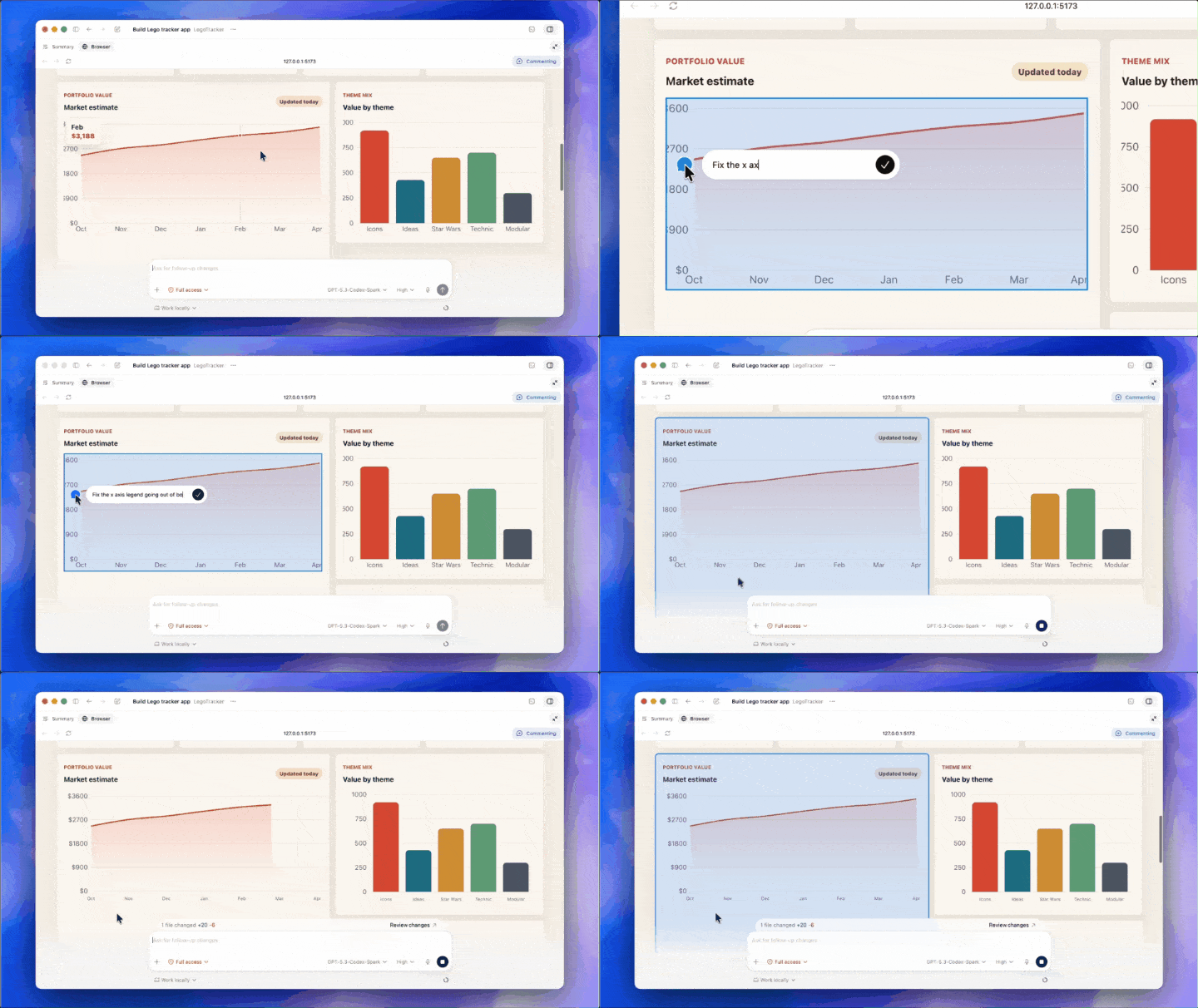
Click the main title, leave a comment "Reduce font size and shorten the slogan"; click the top left corner, "Add a logo";发现 the chart's X-axis legend is out of bounds, click the error spot, write "Fix the out-of-bounds issue".

Codex understands visual and spatial context,修改 code in the background instantly, and the page refreshes in real-time.

OpenAI used a web application called Brickfolio, a Lego set tracker, for the demo.

Codex wrote the code from scratch, configured the environment, started the local server, and opened the rendered page in the built-in browser. The whole process took just seconds.

Then came the WYSIWYG (What You See Is What You Get) modification experience. It feels like reviewing a design mockup; you just annotate the problems, and all underlying iterations are handled by the AI.

In other words, the user只需 clicks and marks here and there on the page, and Codex changes the code in the background, producing results in real-time on the front end.

The built-in browser is currently limited to localhost preview. OpenAI stated that future expansions will include full browser control capabilities.

Over 90 Plugins Launched, The Entire Toolchain Welded into Codex

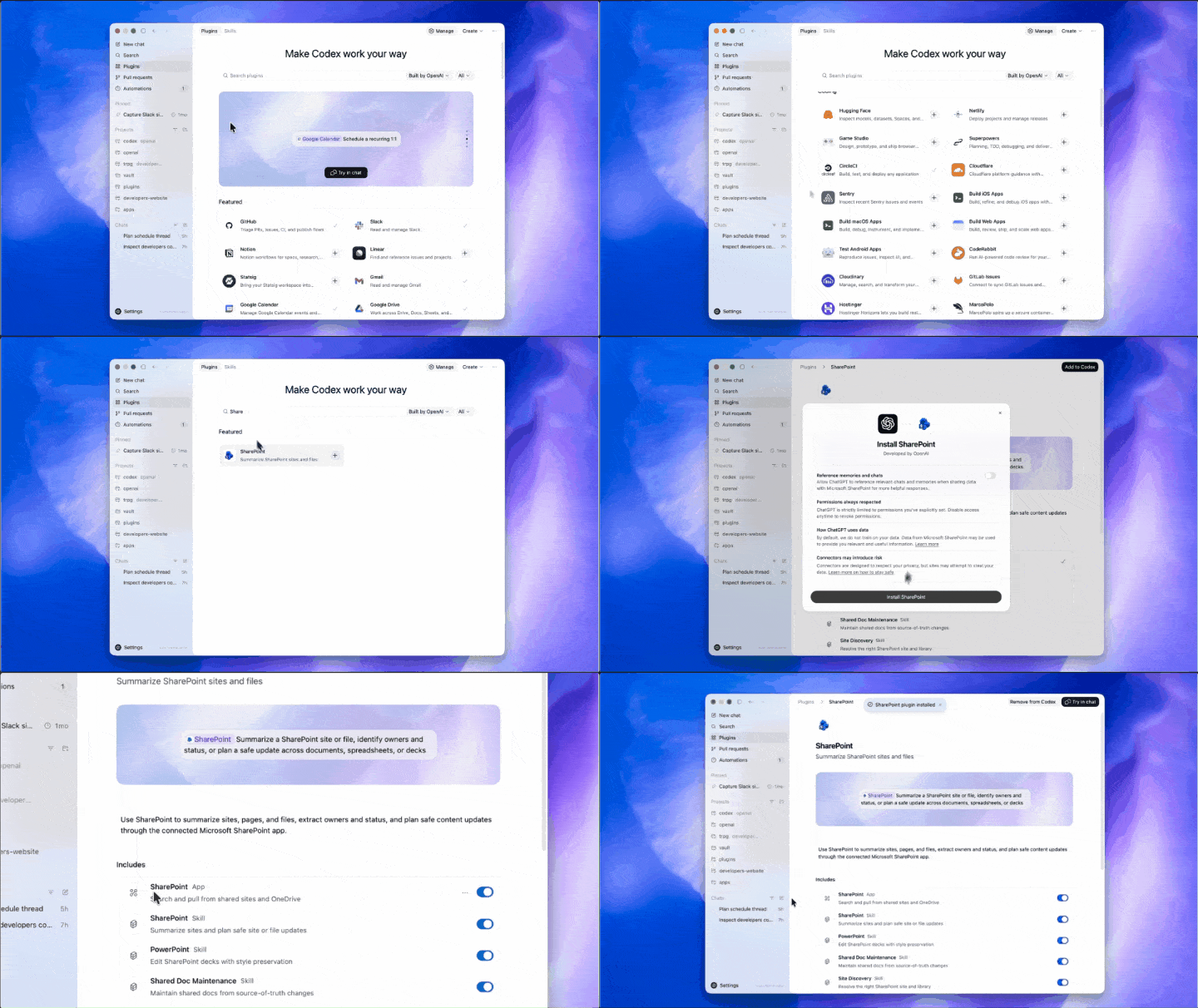
On the plugin front, OpenAI launched over 90 in one go.

Atlassian Rovo manages JIRA, CircleCI handles CI/CD, GitLab Issues tracks requirements, Microsoft Suite processes documents, Neon by Databricks operates databases—covering almost all tools a development team uses daily.

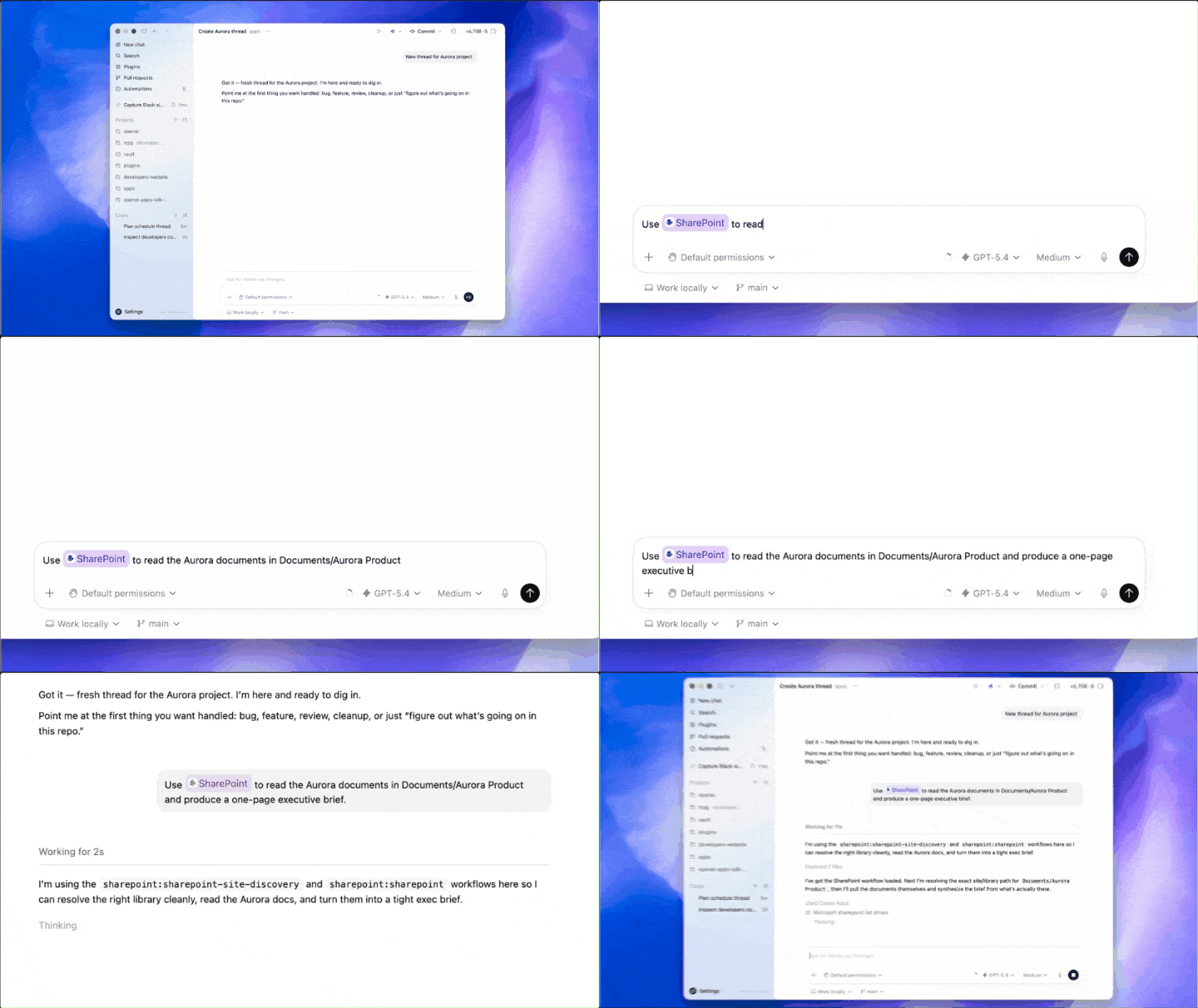
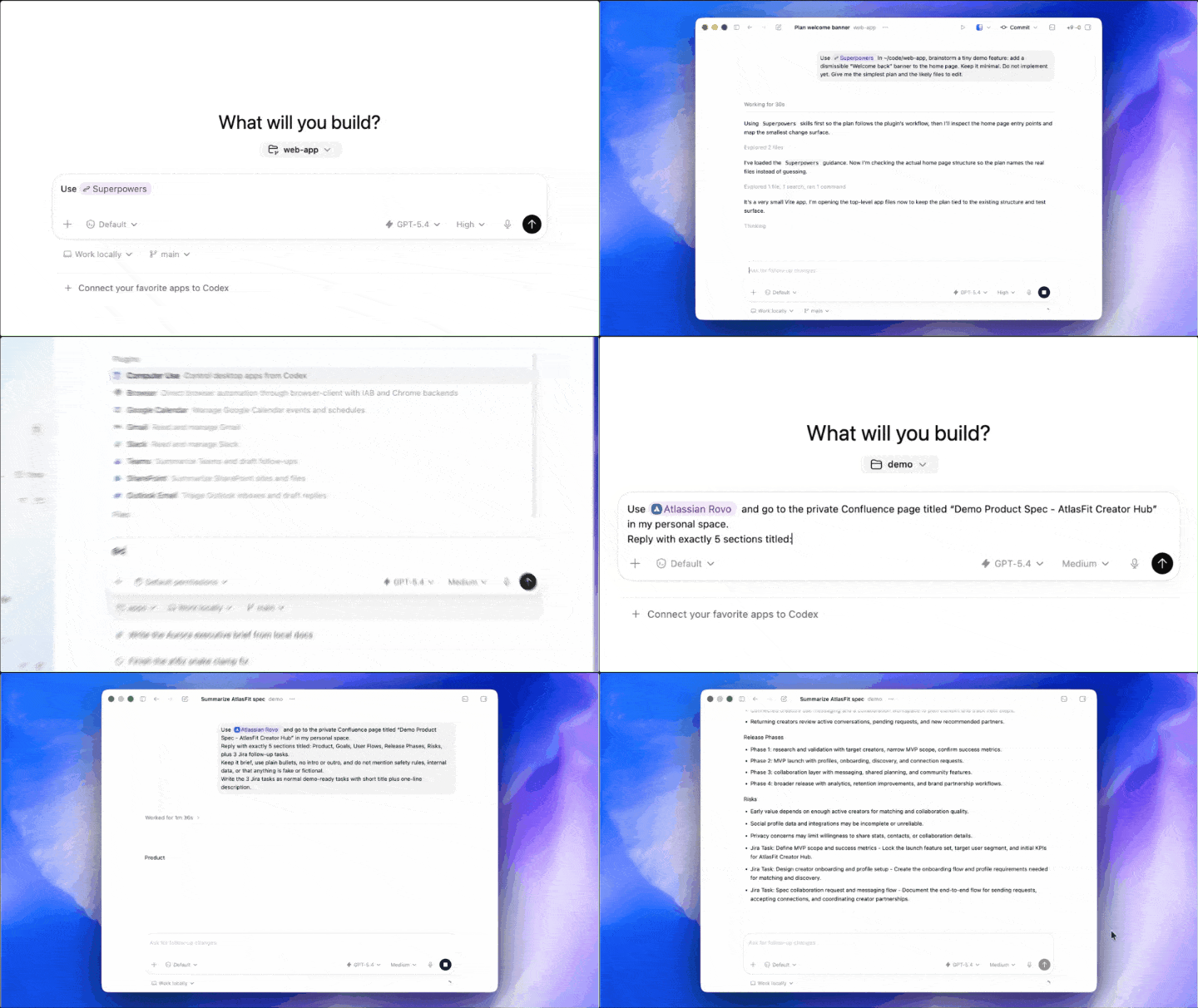
Usage is simple: just @ the plugin name in the input box.

For example, @SharePoint, ask Codex to read documents in the product catalog and generate an executive brief. It automatically searches the file tree, parses documents, and extracts core information, saving you from searching through various cloud drives.

Another example: @Superpowers, ask Codex to conceptualize a feature plan within the local code directory. It will traverse your file structure, read code and CSS, and provide a set of implementation suggestions that fit the current project architecture.

@CircleCI can help diagnose branch build failures; @Atlassian Rovo can read product specifications on Confluence, output summaries in format, and even convert feature points into standard JIRA tasks.

From upstream requirements to local coding, to CI/CD and task management, plugins串起来了 the entire chain.

AI Starts Scheduling Itself

Even more noteworthy is the new "Heartbeat" mechanism.

Now Codex can schedule future work for itself, automatically waking up at the set time to continue working, even across days or weeks. Moreover, it can reuse previous conversation threads, so the context accumulated last time is not lost.

For example, a user can ask Codex to check Slack, Gmail, Google Calendar, and Notion. It pulls relevant information from these four channels and throws out a prioritized to-do list.

The user adds, "Can you keep an eye on this for me?"

Codex immediately sets itself an hourly automatic patrol schedule, proactively reports on key points requiring decisions, and even asks, "Do you need me to draft a reply for you?"

This is no longer just a tool; it's a junior employee who doesn't sleep.

Coupled with the natively built-in image generation capability of gpt-image-1.5, product concept maps, front-end designs, and visual prototypes can all be completed in one go within the same workflow.

Daily Needs Filled in One Go

Besides these major features, there are also a batch of experience-level upgrades.

First, the memory function is available in preview; Codex can remember your preferences and corrected points, so you don't have to explain from scratch the next time you start a chat.

Second, GitHub code review comments can now also be processed in Codex.

Support for opening multiple terminal tabs simultaneously is here, and the ability to connect to remote development machines via SSH is also in internal testing. There's also a new summary panel to help you keep an eye on the Agent's work plans, information sources, and output files at any time.

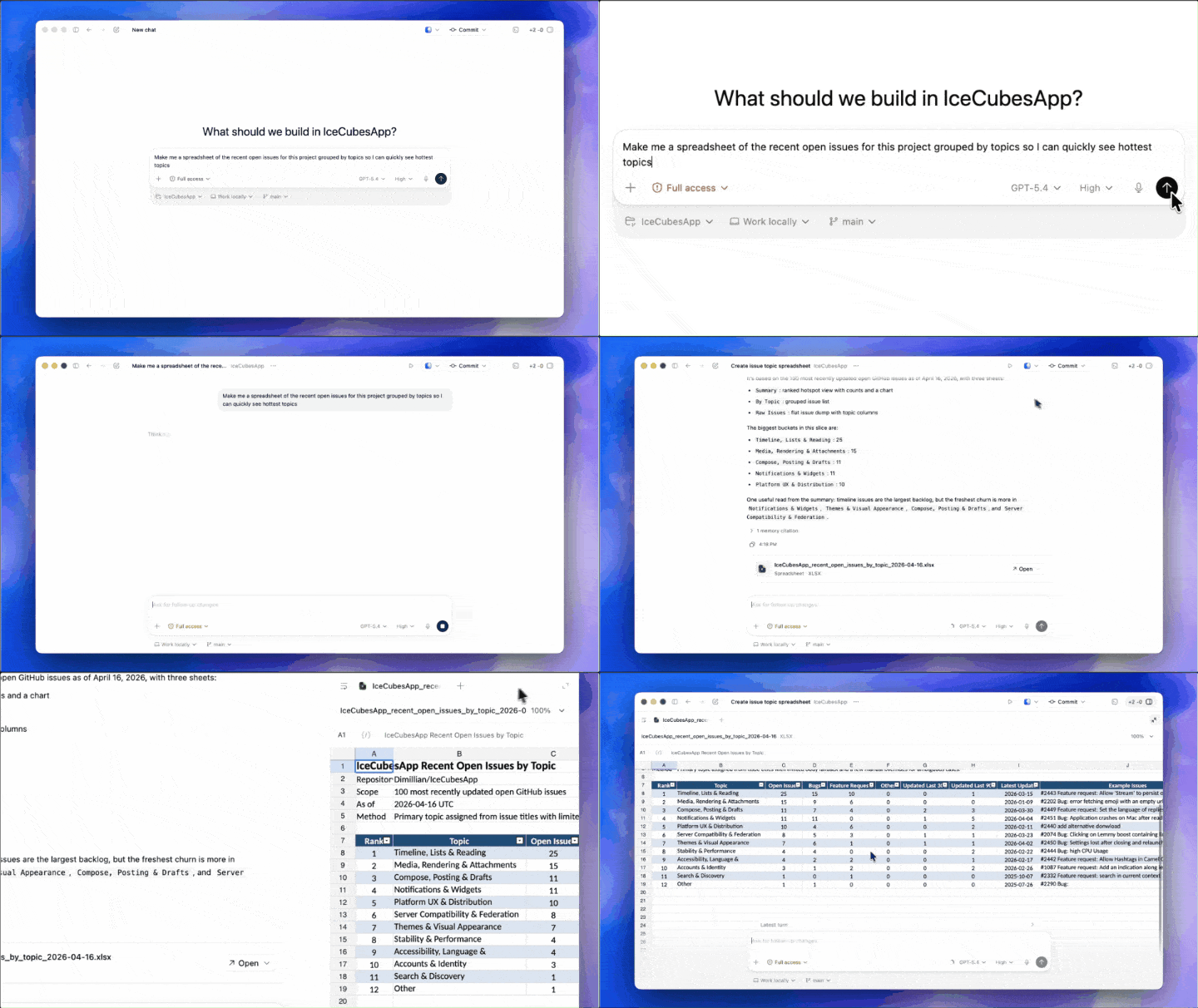
In the demo, the user asked Codex to organize the recent open issues of the current project and generate a table grouped by theme.

Codex then pulled the code repository context in the background and, after a few minutes, threw out a core summary listing the project's current biggest pain points.

Click to generate an Excel file—no need to switch to external software; a complete spreadsheet preview can be opened right in the sidebar.

The same goes for PDFs and PPTs, all handled within the Codex window.

The First Piece of the Super App Puzzle

Looking back at the timeline, you can feel OpenAI's pace.

March 19: Foreign media reported that OpenAI plans to merge ChatGPT, Codex, and the Atlas browser into a desktop "Super App".

March 31: OpenAI secured $122 billion in funding, with a valuation of $852 billion, led by Amazon, NVIDIA, and SoftBank. The funding documents clearly stated that the capital would be used for the development and deployment of the Super App.

April 16: This wave of Codex updates landed.

Another telling data point: over 80% of OpenAI's internal employees are already using Codex, and not just engineers.

Writing weekly reports, organizing feedback, drafting product requirement documents, reviewing contracts, sending security training reminders—they use it for everything.

50% of Codex users are already using it for non-coding tasks.

This isn't a programming tool adding features. This is a Super App using the shell of a programming tool for a cold start.

If You Can't Beat Them, Infiltrate: Made an Official Plugin for Anthropic

Even more interestingly, OpenAI also made an official plugin for Claude Code, actively embedding Codex into the competitor's ecosystem.

It somewhat has the vibe of, rather than waiting for developers to switch camps, better to infiltrate their workflow first.

Currently, Codex emphasizes background execution, multi-Agent parallelism, and unattended operation; Claude Code's advantages lie in long-context reasoning and deep code understanding. More and more teams are choosing to use both.

However, what OpenAI wants is clearly not just a share of the pie.

$122 billion is bet on something far greater than a programming tool.

Reference: https://openai.com/index/codex-for-almost-everything/

This article is from the WeChat public account "新智元" (New Wisdom Yuan), edited: Hao Kun (Very Sleepy)

Связанные с этим вопросы

QWhat is the key new feature of OpenAI's Codex that allows it to operate in the background without taking over the user's entire computer?

AThe key new feature is called 'Computer Use', which gives Codex its own independent cursor, allowing it to operate applications in the background (like running Xcode) while the user continues their work uninterrupted with their own mouse and keyboard.

QWhich operating system currently has the most comprehensive support for Codex's new background control capabilities, and which regions are temporarily excluded?

AmacOS currently has the most comprehensive support for the new background cursor-level control. Users in the European Union and the United Kingdom are temporarily unable to use this feature.

QHow does the new 'heartbeat' mechanism in Codex function?

AThe 'heartbeat' mechanism allows Codex to schedule future work for itself. It can wake up automatically at a set time (even across days or weeks) to continue tasks and can reuse previous conversation threads, maintaining all accumulated context from earlier interactions.

QWhat was the significant business move mentioned in the article that suggests OpenAI is building a 'super app'?

AThe significant business move was OpenAI securing $122 billion in funding at an $852 billion valuation, with investors including Amazon, Nvidia, and SoftBank. The funding documents explicitly stated the capital would be used for the development and deployment of a desktop 'super app' that merges ChatGPT, Codex, and the Atlas browser.

QWhat surprising strategic move did OpenAI make regarding its competitor Anthropic's Claude Code?

AOpenAI created and released an official plugin for Anthropic's Claude Code, effectively embedding its own Codex tool into the ecosystem of its direct competitor. This is a strategic move to integrate into developers' workflows rather than waiting for them to switch platforms entirely.

Похожее

Breaking the DeFi Cascading Liquidation Curse: Vitalik Proposes a New Solution

Vitalik Buterin has proposed a new DeFi design to eliminate the automatic liquidation mechanism that causes market instability during sharp downturns. The current system, used by protocols like Aave, triggers forced sales when collateral value falls below a threshold, often exacerbating price drops and creating systemic selling pressure. Buterin's alternative model is based on splitting an asset like ETH into two synthetic option-like tokens, P and N, pegged to a price index. Their combined value always equals one ETH. Instead of sudden liquidation, a position's value gradually drifts from its target peg if the market moves. Users must proactively rebalance their holdings to maintain their desired exposure, transferring the management burden from the protocol to the user or automated tools. A key advantage is the reduced reliance on real-time oracles. Pricing decisions are deferred until contract expiry, allowing for more robust, fault-tolerant oracle designs. This removes a clear liquidation threshold that speculators can target for manipulation or MEV extraction. However, significant challenges remain. Frequent rebalancing could incur high slippage and transaction costs, necessitating new liquidity provider models. The design is better suited for hedging instruments than for stablecoins requiring a rigid 1:1 peg. While not an immediate replacement for existing systems, the proposal challenges the foundational assumption that instantaneous forced liquidation is an unavoidable necessity in DeFi, opening the door for fundamentally different risk management architectures.

marsbit2 мин. назад

Breaking the DeFi Cascading Liquidation Curse: Vitalik Proposes a New Solution

marsbit2 мин. назад

The End of Single-Factor Cryptography

The article "The End of Single-Factor Crypto" posits a fundamental shift in the cryptocurrency ecosystem. It argues the era where crypto asset valuations were predominantly driven by, and correlated with, Bitcoin's price is ending. The space is bifurcating into two distinct economies: endogenous and exogenous. The endogenous economy represents traditional crypto, where token and project values are directly tied to crypto market prices. The emerging exogenous economy comprises projects and businesses that may utilize blockchain technology or tokens but derive their fundamental value from external, non-crypto factors like consumer demand, subscription revenue, or real-world utility. Examples include AI inference platforms like Venice, fintech lenders using blockchain for efficiency, and stablecoin/payment infrastructure companies acquired by giants like Mastercard and Stripe. This shift means investment analysis must change. For exogenous assets, evaluating traditional business fundamentals—such as revenue streams, unit economics, and competitive moats—becomes more critical than tracking Bitcoin charts. While endogenous assets like Bitcoin remain relevant, the growth of the exogenous category is driven by measurable demand independent of crypto price cycles, paving the way for a new, more diversified market phase. Consequently, crypto is evolving from a single-factor, reflexive asset class into a multifaceted ecosystem with varied drivers and investment theses.

marsbit3 мин. назад

The End of Single-Factor Cryptography

marsbit3 мин. назад

Morning Post | Bitmine Plans to Raise $300 Million Through Preferred Stock Issuance; Polymarket Accuses Kalshi of Commercial Espionage

ChainCatcher's Daily Crypto Brief: Key developments from the past 24 hours include significant funding moves, regulatory actions, and market predictions. Bitmine announced a $300 million preferred stock fundraising. Polymarket accused rival prediction platform Kalshi of corporate espionage, citing numerous suspicious coincidences in product launches, a claim Kalshi strongly denied. The U.S. Department of Justice, in a joint "Disruption Week" anti-fraud operation with companies like Coinbase and Meta, froze over $3.8 million in cryptocurrency linked to scams. In infrastructure news, Macau completed its integration with the multi-central bank digital currency bridge, mBridge, aiming to build efficient cross-border payment channels. Cosmos Labs acquired the block explorer Mintscan. Market-wise, Geoffrey Kendrick, Standard Chartered's Head of Digital Assets Research, stated Bitcoin is nearing a bottom around $63,000, maintaining a year-end target of $100,000. He noted stability in U.S. spot Bitcoin ETF holdings. Ahead of SpaceX's anticipated IPO, internal insiders at Rocket Lab (RKLB) sold over $18.41 million in stock. In tokenization, Goldman Sachs partnered with Apex and Archax to launch a tokenized real estate fund. The meme token tracker GMGN reported the top trending tokens: on Ethereum, HEX, SHIB, LINK, PEPE, mUSD; on Solana, TROLL, swarms, WORLDCUP, neet, Buttcoin; and on Base, PEPE, toby, ODDS, ELSA, SKI.

链捕手17 мин. назад

Morning Post | Bitmine Plans to Raise $300 Million Through Preferred Stock Issuance; Polymarket Accuses Kalshi of Commercial Espionage

链捕手17 мин. назад

55TB to 28TB? The Rumor and Panic Behind Rubin's Memory Being Halved

Title: 55TB to 28TB? The Rumor and Panic Behind the Potential Halving of Rubin's Memory. On June 4th, a report from SemiAnalysis suggested NVIDIA's next-gen Vera Rubin NVL72 AI rack may ship with roughly 28TB of SOCAMM DRAM per rack instead of the anticipated 55TB, primarily using 96GB modules. This sparked a market panic, causing Micron's stock to drop over 10% on fears of halved memory demand. However, the article argues this panic is misguided for several key reasons. First, SOCAMM modules are socketed and upgradeable, not soldered. Lower initial configuration doesn't mean permanent demand loss. Second, the primary driver is a severe 2026 LPDDR5X supply shortage, not diminished need. NVIDIA is likely prioritizing rack shipments with available components. Third, with fixed total LPDDR5X supply, using less per rack could allow NVIDIA to ship *more* racks, not necessarily reducing overall memory orders. Micron's sharp drop was also attributed to a broader semiconductor sell-off triggered by Broadcom's earnings, with the SemiAnalysis report providing a convenient narrative for profit-taking after Micron's massive rally. In summary: the report on lower default configurations is likely accurate, but interpreting it as a demand collapse is wrong. The real risk for Micron lies in its reportedly minimal HBM4 share for Rubin, not in potentially flexible SOCAMM demand. The sell-off appears more like a correction amplified by coinciding negative catalysts.

marsbit34 мин. назад

55TB to 28TB? The Rumor and Panic Behind Rubin's Memory Being Halved

marsbit34 мин. назад

Exclusive from Yingke | Tang Wenbin's 'Yuanli Lingji' Merges with Logistics Robotics Company, and Secures Investment from Zhipu, SenseTime, Jieyue, and Others

Exclusive report: Embodied AI company "Yuanli Lingji" recently completed a new round of financing from major AI model firms including Zhipu AI, Stepfun, and SenseTime, alongside continued investments from industrial backers like Huaqin and SAIC Hengxu. Founded in March 2025 by Tang Wenbin, former co-founder and CTO of Megvii, Yuanli Lingji is a general-purpose embodied AI model company. In a notable move, the company has merged with logistics robotics firm "Atomix" (formerly known as Yuanli Juhe) through a share acquisition. Atomix, which originated from Megvii's logistics robotics business led by Tang in 2016 and was spun off in July 2024, has grown to become the world's second-largest supplier of pallet shuttle robots, with annual revenue nearing 1 billion RMB and over 500 projects globally for clients like Uniqlo and CATL. This merger aims to break the industry's "data deadlock" by combining Atomix's extensive real-world operational data from more than 20 countries with Yuanli Lingji's model training capabilities. The company's embodied AI model "DM0" utilizes a cross-domain training approach, integrating internet semantics, autonomous driving rules, and robotics data to achieve hardware-agnostic, precise manipulation even with a compact 2.4B parameter size. The collective investment from key AI players and the strategic merger signal a shift in the competitive landscape, as major model companies pivot from language tokens to physical actions ("from Token to Action"). The industry is entering a consolidation phase where hardware, AI models, data, and application scenarios converge to scale embodied intelligence, a trend mirrored by recent moves from giants like ByteDance and Skild AI.

marsbit42 мин. назад

Exclusive from Yingke | Tang Wenbin's 'Yuanli Lingji' Merges with Logistics Robotics Company, and Secures Investment from Zhipu, SenseTime, Jieyue, and Others

marsbit42 мин. назад

Торговля

Спот
Фьючерсы
活动图片