Only Work 2 Hours a Day? This Google Engineer Uses Claude to Automate 80% of His Work

marsbitОпубликовано 2026-04-15Обновлено 2026-04-15

Введение

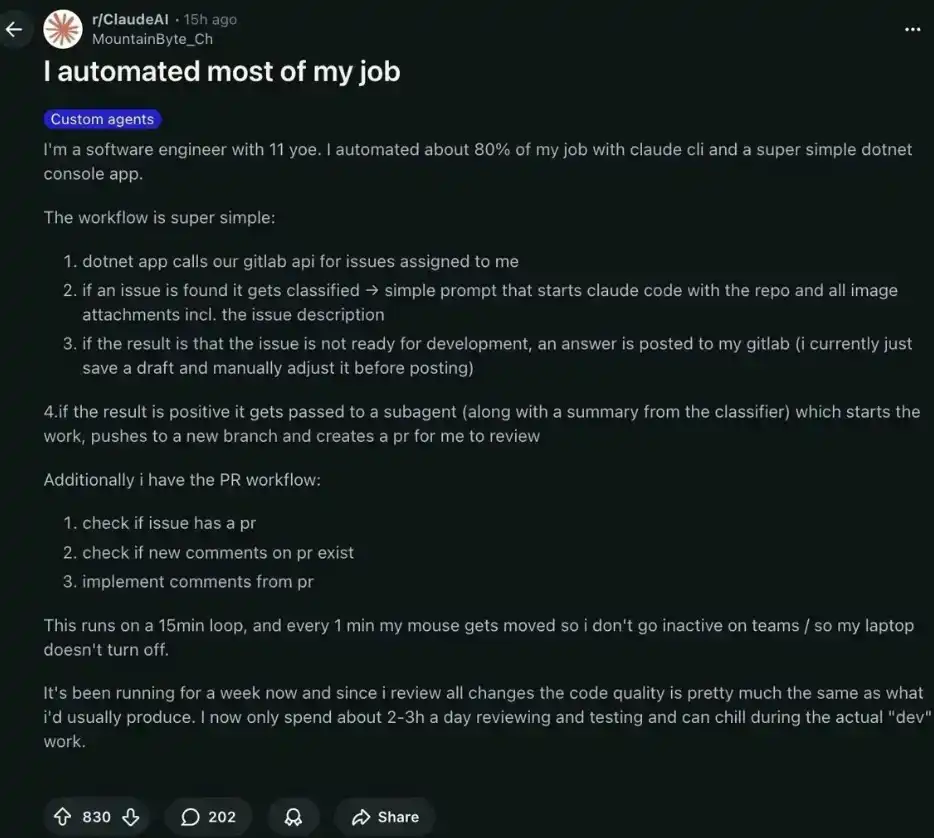
A Google engineer with 11 years of experience automated 80% of his work using Claude Code and a simple .NET application, reducing his daily work from 8 hours to just 2–3 hours while generating $28,000 in monthly passive income. The key to this transformation lies in three core elements: First, using a structured CLAUDE.md file based on Andrej Karpathy’s principles—Think Before Coding, Simplicity First, Surgical Changes, and Goal-Driven Execution—reduces Claude’s rule violations from 40% to just 3%. Second, the "Everything Claude Code" system acts as a full AI engineering team, with 27 pre-built agents for planning, reviewing, and executing tasks across multiple AI platforms. Third, a hidden token consumption issue in Claude Code v2.1.100 was identified, where 20,000 extra tokens were silently added, diluting instructions and reducing output quality. A quick fix using npx downgrades the version to avoid this. The automated system enables code generation, testing, and review to run autonomously in 15-minute cycles. The engineer now only reviews output, saving 5–6 hours daily. The setup takes less than 20 minutes, and the return on time investment is significant—potentially saving $10,000–$12,000 monthly for those valuing their time at $100/hour. The article emphasizes that managing AI systems, not just using them, is the new critical skill, enabling a shift from doing work to overseeing automated processes.

Editor's Note: As "AI writing code" gradually becomes an industry consensus, what truly changes productivity is not the model itself, but how you set rules for the model, organize workflows, and embed it into a sustainable operating system.

Starting from a simple CLAUDE.md file, to multi-agent collaboration, and then to an automated development loop, this method transforms the development process from a "dialogue between humans and AI" into "managing an AI engineering team." In this process, errors are constrained upfront, workflows are structured, and code generation, testing, and review are gradually taken over by the system instead of being manually executed.

More notably, the article also reveals a neglected detail: in long contexts and complex systems, model behavior is not entirely controllable. Whether it's hidden token consumption or diluted instructions, they can invisibly affect output quality. This makes "how to manage AI," rather than just "how to use AI," the new core competency.

At this point, developers no longer focus on coding but instead work around rule design, workflow scheduling, and result validation. Those who have completed this step first have already started shifting from "doing things personally" to "letting the system do things for them."

Below is the original text:

A Google engineer with 11 years of experience automated 80% of his work using Claude Code and a simple .NET application.

Now, he only works 2-3 hours a day instead of the original 8 hours. The rest of the time, he is basically in a "relaxed" state, with the system running on its own, generating $28,000 in passive income for him each month.

What he has mastered is precisely that set of methods you haven't yet learned.

Part 1—Writing CLAUDE.md According to Karpathy's Principles

Andrej Karpathy—one of the world's most influential AI researchers—once systematically summarized the most common mistakes large language models make when writing code: over-engineering, ignoring existing patterns, and introducing unnecessary additional dependencies that no one asked for.

Someone compiled these observations into a unified CLAUDE.md file.

The result: this project gained 15,000 stars on GitHub in a week. In a sense, it can be said that 15,000 people changed their way of working because of it.

The core idea is actually very simple: if errors are predictable, they can be prevented in advance with clear instructions. Just by placing a markdown file in the code repository, you can provide Claude Code with a complete set of structured behavioral rules, thereby unifying decision-making and execution across the entire project.

Inside this file, there are mainly four core principles:

· Think Before Coding → Avoid wrong assumptions and overlooked trade-offs
· Simplicity First → Avoid over-engineering and bloated abstractions
· Surgical Changes → Avoid modifying code that no one asked to change
· Goal-Driven Execution → Test first, then validate against clear success criteria

It doesn't rely on any framework, nor does it require complex tools—just one file can change Claude's behavior at the project level.

The real difference is:

· Without CLAUDE.md: Claude violates specifications about 40% of the time
· Using Karpathy's CLAUDE.md: Violation rate drops to about 3%
· Setup time: Only 5 minutes

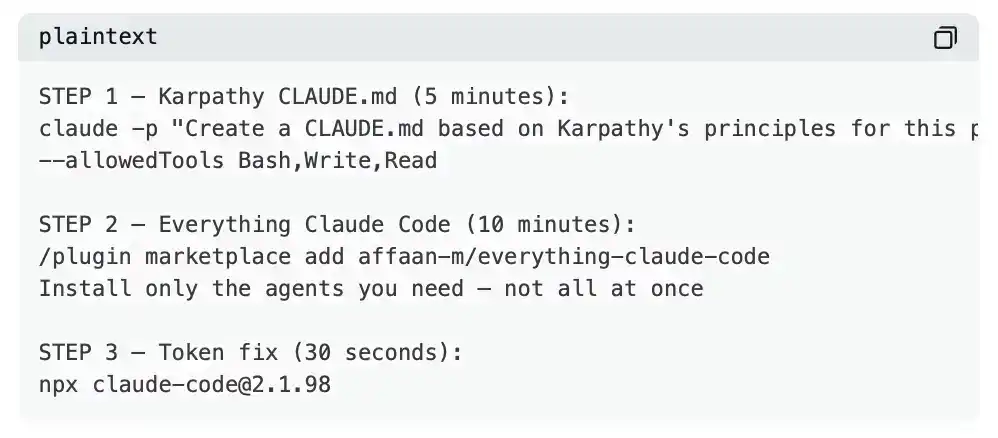
Command to automatically generate your own CLAUDE.md file:

claude -p "Read the entire project and create a CLAUDE.md based on:
Think Before Coding, Simplicity First, Surgical Changes, Goal-Driven Execution.
Adapt to the real architecture you see." --allowedTools Bash,Write,Read

It replaces this kind of Claude: over-engineering simple tasks, introducing unrequested dependencies, and even arbitrarily modifying files that shouldn't be touched.

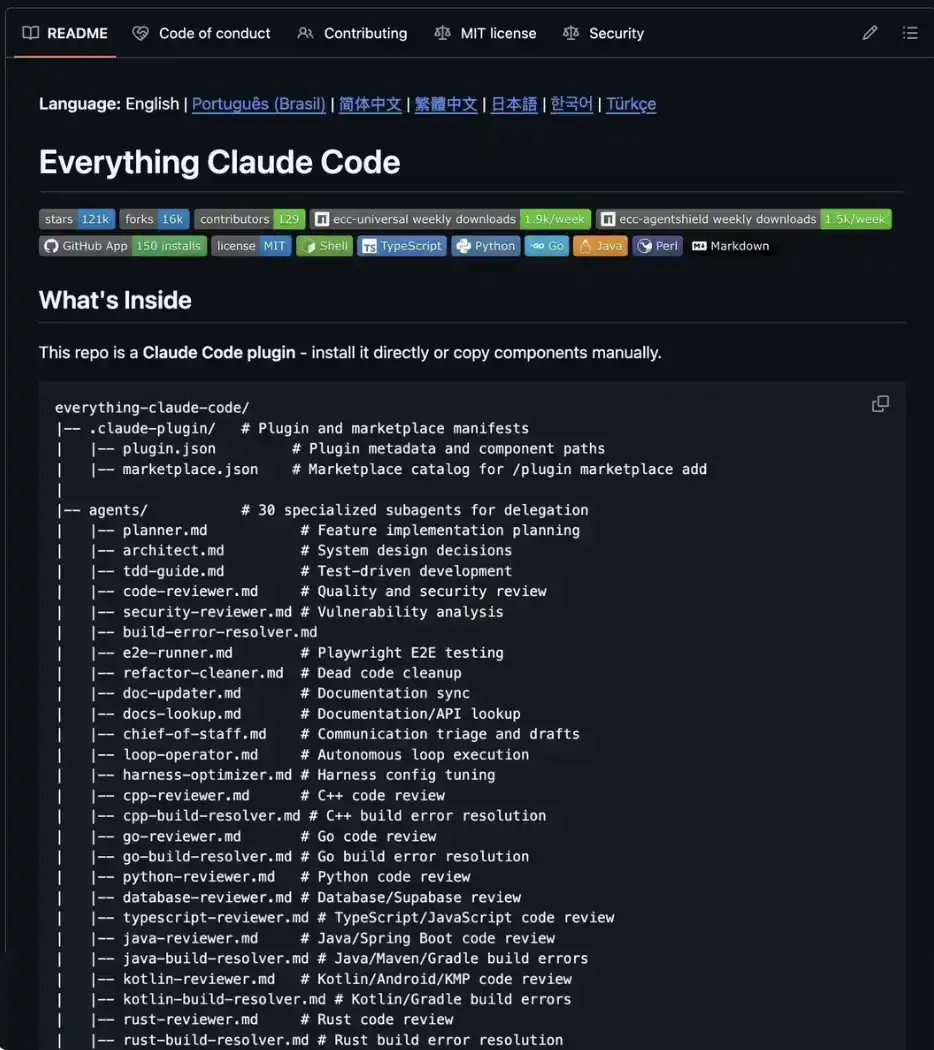
Part2 Everything Claude Code: A Complete Engineering Team in a Repository

Everything Claude Code (Over 153,000 stars on GitHub)

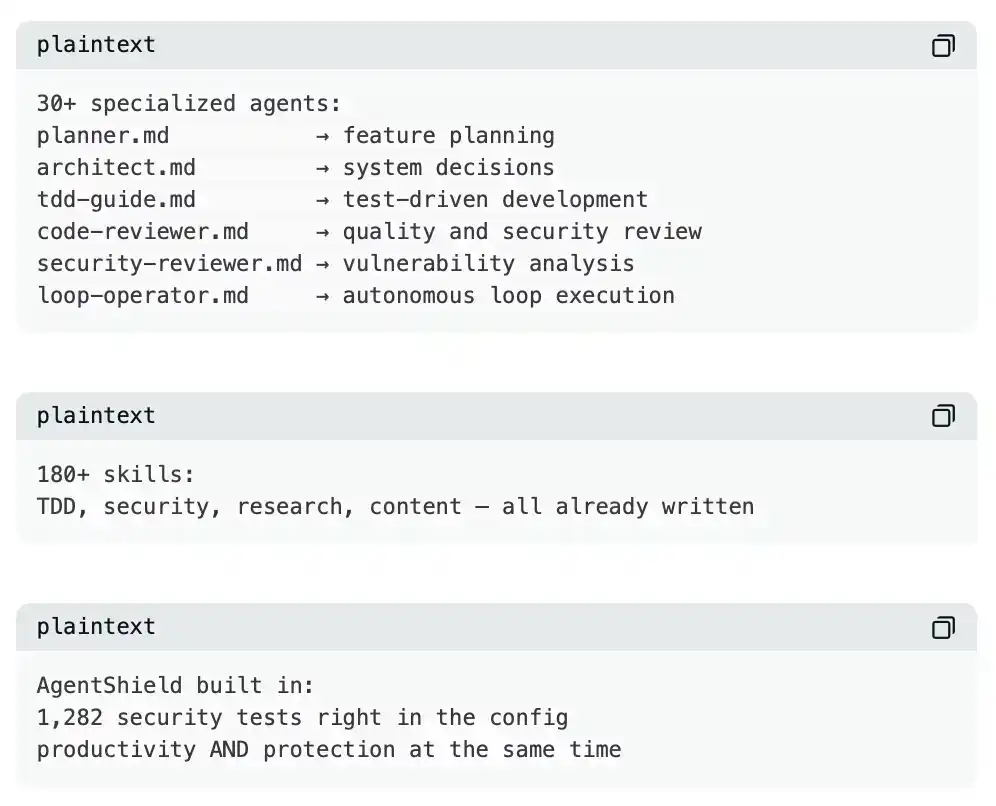
This is not just a collection of prompts; it's more like a complete AI operating system for building products.

Supports running on Claude, Codex, Cursor, OpenCode, Gemini, and more—one system, usable everywhere.

Installation:

/plugin marketplace add affaan-m/everything-claude-code

Or install manually—just copy the components you need into the project's .claude/ directory. Don't load everything at once—loading 27 agents and 64 skills simultaneously will likely exhaust your context allowance before you even input your first prompt. Only keep what you truly need.

The real difference is:

· Before: You were conversing with an AI
· After: You are managing an automatically running AI engineering team

It replaces: The weeks you would have spent building your own agent system, separately setting up different tools for planning/review/security, and the $200–500 monthly cost for various AI services.

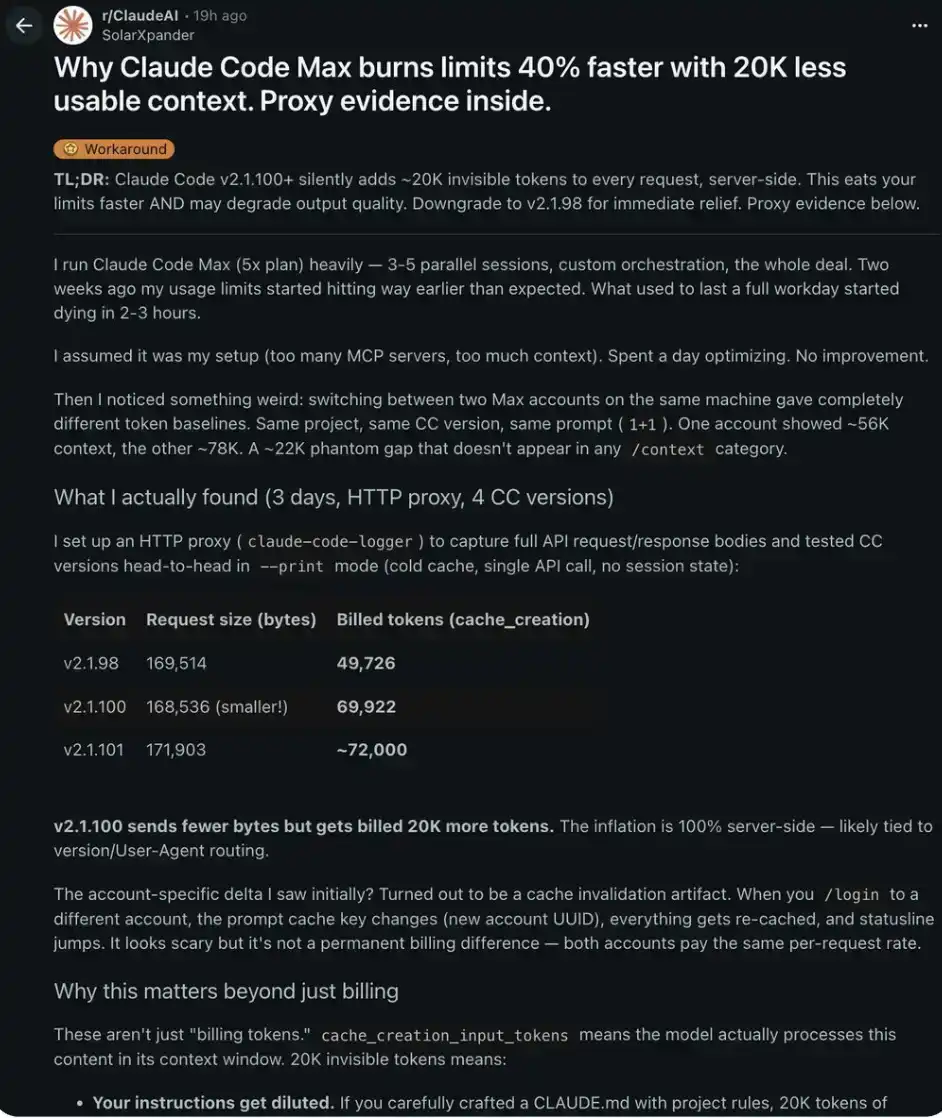
Part3 A Hidden "Scandal": Claude Code v2.1.100 Is Quietly Consuming Your Tokens

Someone set up an HTTP proxy and intercepted and analyzed the complete API requests of 4 different versions of Claude Code.

They found:

v2.1.98: 169,514 bytes request → 49,726 tokens charged
v2.1.100: 168,536 bytes request → 69,922 tokens charged
difference: -978 bytes but +20,196 tokens

v2.1.100 sent fewer data bytes but charged an extra 20,000 tokens. This "inflation" happens entirely on the server side—you can't see it, nor can you verify it through the /context interface.

Why this matters beyond billing: these extra 20,000 tokens are stuffed into Claude's actual context window.

This means:

→ Your CLAUDE.md instructions get diluted by these 20,000 "hidden contents"

→ Output quality degrades faster in long conversations

→ When Claude ignores your rules, it's hard to find the cause

→ Claude Max usage allowance is consumed about 40% faster than normal

Fix takes only 30 seconds: npx [email protected]

This is a temporary solution before Anthropic officially fixes the issue, but in practice, you can almost immediately feel the change in session effectiveness.

It replaces: You no longer need to guess why Claude suddenly stops following your instructions.

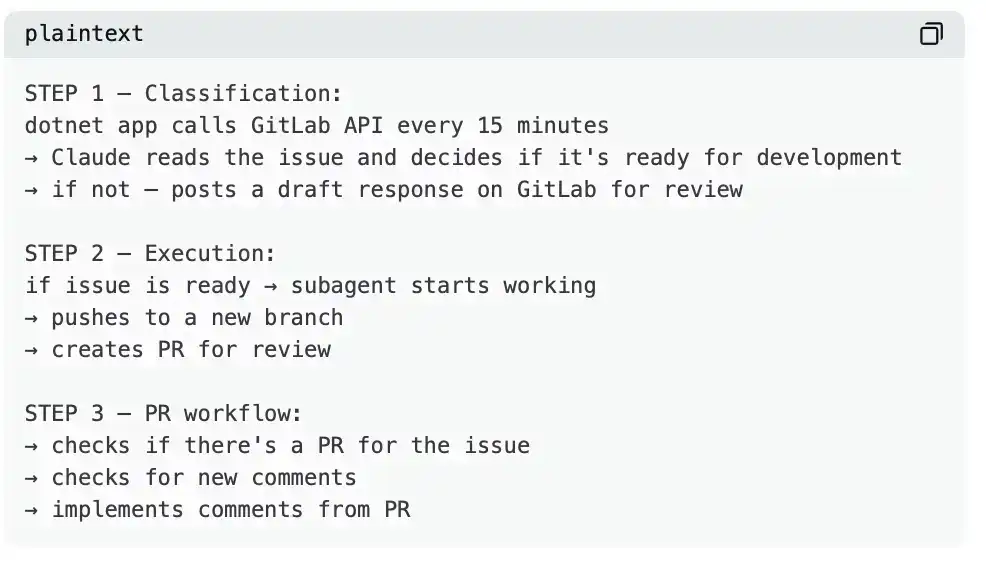
Case Study: What a Complete Automated System Looks Like

An engineer with 11 years of experience built a system consisting of three parts:

Results after one week:

· Before: 8 hours a day writing code
· After: Only 2–3 hours a day doing code review and testing

· Code quality: Basically unchanged—because he reviews each one
· Teams status: Always online—mouse moves automatically every minute
· Remaining time: Free to use all day

This isn't some "magic"; it's the result of CLAUDE.md + the right agents + a loop mechanism running every 15 minutes.

Complete checklist:

What you gain after reading this:

· Before: Claude violated existing specifications 40% of the time
· After: Using Karpathy's CLAUDE.md, violation rate dropped to 3%

· Before: You needed weeks to build agents
· After: 27 agents ready to use out-of-the-box

· Before: Claude Max exhausted its allowance in 2–3 hours
· After: Downgrading to v2.1.98 recovers about 40% of the usage limit

· Before: Needed 8 hours a day to write code
· After: Only 2–3 hours for review, the rest runs automatically

· Setup time: 15–20 minutes
· Daily savings: 5–6 hours
· Monthly savings: 100–120 hours

If your time is worth $30 per hour—you are "invisibly losing" $3000–3600 every month.

If it's $100 per hour—that's $10,000–12,000 flowing away monthly, just because you're still manually writing code that Claude could have done itself.

Most developers will never reach this level—not because they can't, but because they think it's complicated. In reality, between you and "full automation," there are only three commands and one file.

The engineer I mentioned at the beginning isn't some genius, nor is he a senior engineer from Google. He just spent one evening setting up the system—since then, the system does the work, and he lives his life.

You can do the same thing tonight. While others are still arguing whether AI will replace developers, those who have already set up the system are just collecting money and relaxing.

The choice is clear. You are building your own life—so choose the right path.

Связанные с этим вопросы

QWhat is the core concept behind the CLAUDE.md file mentioned in the article?

AThe core concept of the CLAUDE.md file is to provide a structured set of behavioral rules for Claude Code, based on principles like 'Think Before Coding', 'Simplicity First', 'Surgical Changes', and 'Goal-Driven Execution'. This file helps prevent common AI coding errors by setting clear, project-wide instructions, reducing violation rates from around 40% to just 3%.

QHow does the 'Everything Claude Code' system transform the developer's role?

AThe 'Everything Claude Code' system transforms the developer's role from directly coding and interacting with AI to managing an automated AI engineering team. It includes multiple agents and skills that handle tasks like planning, reviewing, and security, allowing the developer to focus on oversight and results rather than manual execution.

QWhat hidden issue was discovered with Claude Code v2.1.100, and what was its impact?

AClaude Code v2.1.100 was found to silently consume approximately 20,000 extra tokens per request compared to v2.1.98, despite sending fewer bytes. This 'hidden inflation' dilutes instructions from files like CLAUDE.md, reduces output quality in long conversations, and depletes usage limits about 40% faster, without any visible indication to the user.

QWhat were the key components of the automated system built by the Google engineer?

AThe automated system built by the Google engineer consisted of three main parts: a CLAUDE.md file for rule-based AI behavior, a set of tailored AI agents from the 'Everything Claude Code' repository, and an automated loop that ran every 15 minutes to handle coding, testing, and review processes with minimal human intervention.

QWhat time and financial benefits did the engineer achieve by automating 80% of his work?

AThe engineer reduced his daily work from 8 hours to just 2-3 hours, saving 5-6 hours per day and 100-120 hours per month. This automation generated $28,000 in monthly passive income. If valued at $30 per hour, this saves $3,000-$3,600 monthly; at $100 per hour, it saves $10,000-$12,000 monthly.

Похожее

55TB to 28TB? The Rumor and Panic Behind Rubin's Memory Being Halved

Title: 55TB to 28TB? The Rumor and Panic Behind the Potential Halving of Rubin's Memory. On June 4th, a report from SemiAnalysis suggested NVIDIA's next-gen Vera Rubin NVL72 AI rack may ship with roughly 28TB of SOCAMM DRAM per rack instead of the anticipated 55TB, primarily using 96GB modules. This sparked a market panic, causing Micron's stock to drop over 10% on fears of halved memory demand. However, the article argues this panic is misguided for several key reasons. First, SOCAMM modules are socketed and upgradeable, not soldered. Lower initial configuration doesn't mean permanent demand loss. Second, the primary driver is a severe 2026 LPDDR5X supply shortage, not diminished need. NVIDIA is likely prioritizing rack shipments with available components. Third, with fixed total LPDDR5X supply, using less per rack could allow NVIDIA to ship *more* racks, not necessarily reducing overall memory orders. Micron's sharp drop was also attributed to a broader semiconductor sell-off triggered by Broadcom's earnings, with the SemiAnalysis report providing a convenient narrative for profit-taking after Micron's massive rally. In summary: the report on lower default configurations is likely accurate, but interpreting it as a demand collapse is wrong. The real risk for Micron lies in its reportedly minimal HBM4 share for Rubin, not in potentially flexible SOCAMM demand. The sell-off appears more like a correction amplified by coinciding negative catalysts.

marsbit18 мин. назад

55TB to 28TB? The Rumor and Panic Behind Rubin's Memory Being Halved

marsbit18 мин. назад

Exclusive from Yingke | Tang Wenbin's 'Yuanli Lingji' Merges with Logistics Robotics Company, and Secures Investment from Zhipu, SenseTime, Jieyue, and Others

Exclusive report: Embodied AI company "Yuanli Lingji" recently completed a new round of financing from major AI model firms including Zhipu AI, Stepfun, and SenseTime, alongside continued investments from industrial backers like Huaqin and SAIC Hengxu. Founded in March 2025 by Tang Wenbin, former co-founder and CTO of Megvii, Yuanli Lingji is a general-purpose embodied AI model company. In a notable move, the company has merged with logistics robotics firm "Atomix" (formerly known as Yuanli Juhe) through a share acquisition. Atomix, which originated from Megvii's logistics robotics business led by Tang in 2016 and was spun off in July 2024, has grown to become the world's second-largest supplier of pallet shuttle robots, with annual revenue nearing 1 billion RMB and over 500 projects globally for clients like Uniqlo and CATL. This merger aims to break the industry's "data deadlock" by combining Atomix's extensive real-world operational data from more than 20 countries with Yuanli Lingji's model training capabilities. The company's embodied AI model "DM0" utilizes a cross-domain training approach, integrating internet semantics, autonomous driving rules, and robotics data to achieve hardware-agnostic, precise manipulation even with a compact 2.4B parameter size. The collective investment from key AI players and the strategic merger signal a shift in the competitive landscape, as major model companies pivot from language tokens to physical actions ("from Token to Action"). The industry is entering a consolidation phase where hardware, AI models, data, and application scenarios converge to scale embodied intelligence, a trend mirrored by recent moves from giants like ByteDance and Skild AI.

marsbit26 мин. назад

Exclusive from Yingke | Tang Wenbin's 'Yuanli Lingji' Merges with Logistics Robotics Company, and Secures Investment from Zhipu, SenseTime, Jieyue, and Others

marsbit26 мин. назад

U.S. Stock Market Trends: Dow Hits New High, Nasdaq Falls, Whom Did Broadcom's Slap Wake Up?

U.S. Stocks Split: Dow Hits Record High as Nasdaq Slips; Broadcom's Plunge Sparks Rotation On June 4, the U.S. stock market saw a sharp divergence. The Dow Jones surged 875 points (+1.73%) to a record high of 51,561.93, while the Nasdaq Composite edged down 0.09%. The S&P 500 rose 0.41%. The primary catalyst was a sharp sell-off in AI-related chip stocks, led by Broadcom (AVGO). Despite reporting a 143% year-over-year jump in AI semiconductor revenue to $10.8 billion, the company's shares plunged about 14%. This was triggered by its maintained long-term AI revenue target, which failed to meet heightened expectations for a stock that had gained 55% this quarter and traded at a high P/E ratio. The slide dragged down the broader semiconductor sector and the technology板块. Conversely, money rotated into sectors like Healthcare (+3.14%), Financials (+2.67%), and Real Estate (+1.87%). UnitedHealth and Goldman Sachs were major contributors to the Dow's gains. The rotation was attributed to a search for value outside overheated tech names and a slight dip in Treasury yields. In other major news, SpaceX confirmed its IPO for June 12, targeting a record $75 billion raise at a ~$1.75 trillion valuation. Additionally, initial jobless claims rose to a four-month high, adding nuance to the labor market narrative ahead of the key May non-farm payrolls report. The day's action signaled that while the AI growth story remains intact, excessive valuations are prompting a market reassessment. Funds are moving, at least temporarily, from high-flying tech to more defensive and value-oriented sectors. The sustainability of this rotation hinges on upcoming economic data, particularly the jobs report, and the market's absorption of the massive SpaceX IPO.

marsbit29 мин. назад

U.S. Stock Market Trends: Dow Hits New High, Nasdaq Falls, Whom Did Broadcom's Slap Wake Up?

marsbit29 мин. назад

From 'Old Dogs' to 'New Darlings': How AI is Revaluing Old Infrastructure, from Dell to Nokia

"Old Dogs" Become AI's New Darlings: Revaluing Legacy Infrastructure The AI investment narrative is shifting. Beyond the spotlight on core chipmakers like Nvidia, a new wave of interest is rising for legacy tech companies—Dell, HPE, Nokia, Cisco, Corning, Western Digital—once labeled as slow-growth, outdated stories. This resurgence stems from AI's evolution from model development to real-world deployment, creating massive demand for physical infrastructure. As AI moves into data center construction and enterprise adoption, the focus turns to who can actually build and deliver complex systems. These established players hold decades of experience in supply chains, integration, networking, and enterprise delivery—assets now critical for scaling AI. The revaluation can be grouped into three key infrastructure areas: 1. **Servers & Integration (e.g., Dell, HPE):** They are becoming essential system integrators, transforming GPUs into full-scale AI servers with networking, power, and cooling, then delivering them to clients. Strong recent earnings and AI-specific revenue/order growth for Dell and HPE underscore this shift. 2. **Networking & Connectivity (e.g., Corning, Nokia, Cisco):** As AI clusters grow, high-speed data transfer becomes paramount. Corning benefits from fiber demand for data center links, Nokia is exploring AI-integrated wireless networks (AI-RAN), and Cisco sees surging orders for data center switches—all critical for efficient AI operations. 3. **Storage (e.g., Western Digital, Seagate):** The AI data explosion requires vast capacity. Beyond high-speed memory (HBM), there's growing need for high-capacity HDDs to store training data, logs, video, and cold/archival data cost-effectively. This revaluation, however, is not a blanket endorsement. True reassessment requires concrete proof: AI-driven orders and revenue growth, upward revisions to company guidance, and sustainable improvements in profit quality, not just top-line sales. In essence, AI is not turning all old tech firms into high-growth stocks; it is selectively re-pricing the "old assets" of companies that are mission-critical for building the new AI infrastructure, transforming their legacy capabilities into renewed growth engines.

marsbit38 мин. назад

From 'Old Dogs' to 'New Darlings': How AI is Revaluing Old Infrastructure, from Dell to Nokia

marsbit38 мин. назад

Торговля

Спот
Фьючерсы
活动图片