NYSE parent in talks to invest in crypto company MoonPay: Report

cointelegraphОпубликовано 2025-12-18Обновлено 2025-12-18

Введение

Intercontinental Exchange (ICE), parent company of the New York Stock Exchange, is reportedly in talks to invest in cryptocurrency payments firm MoonPay, which is seeking a $5 billion valuation in its latest funding round. This follows ICE’s recent $2 billion investment in prediction platform Polymarket. MoonPay provides infrastructure for buying and selling crypto using traditional payment methods. The move reflects growing convergence between Wall Street and crypto, as seen in ICE's earlier partnership with Circle to explore stablecoin integration and the DTCC’s approval to offer tokenized bonds and stocks. These developments highlight the increasing institutional adoption of blockchain and tokenization technologies.

Intercontinental Exchange (ICE), the parent company of the New York Stock Exchange (NYSE), is in talks to invest in crypto payments company MoonPay as part of the company’s latest funding round.

MoonPay is seeking to raise funds at a $5 billion valuation, according to Bloomberg, which cited sources familiar with the deal and did not disclose the dollar amount of the potential investment.

In October, ICE invested $2 billion in prediction platform Polymarket, in a funding round that brought the company’s valuation to $9 billion.

MoonPay is a financial technology company that provides infrastructure for buying, selling and using cryptocurrencies through fiat on-ramps and off-ramps. Founded in 2019, it enables users to purchase crypto using traditional payment methods such as debit and credit cards, while offering services to wallets, exchanges and enterprises seeking to integrate crypto payments.

Polymarket founder Shayne Coplan (left) and Intercontinental Exchange CEO Jeffrey Sprecher (right) in front of the New York Stock Exchange after the $2 billion deal. Source: Shayne Coplan

Cointelegraph reached out to ICE and MoonPay but had not received a response at time of publication.

The investment deals reflect the growing ties between crypto and Wall Street, as traditional financial institutions adopt blockchain technology and form partnerships with crypto companies.

Related: Acting CFTC chair to join MoonPay after leaving agency

Wall Street and Crypto continue to converge, blurring the lines between both worlds

Stablecoin company Circle and ICE began exploring a stablecoin integration with ICE’s various clearing and data services in March.

The products being tested for possible integrations include Circle’s USDC (USDC) dollar-pegged stablecoin and its tokenized money market fund, US Yield Coin (USYC), an onchain yield-bearing product backed by short-term US Treasurys.

In December, the US Securities and Exchange Commission (SEC) gave the green light to the Depository Trust and Clearing Corporation (DTCC), a financial settlement and clearing infrastructure company, to begin offering tokenized bonds and stocks.

Real-world asset (RWA) tokenization is a way of representing physical or traditional assets on a blockchain, which allows for faster settlement times, cross-border transactions and the ability to use assets as collateral in decentralized finance (DeFi) applications.

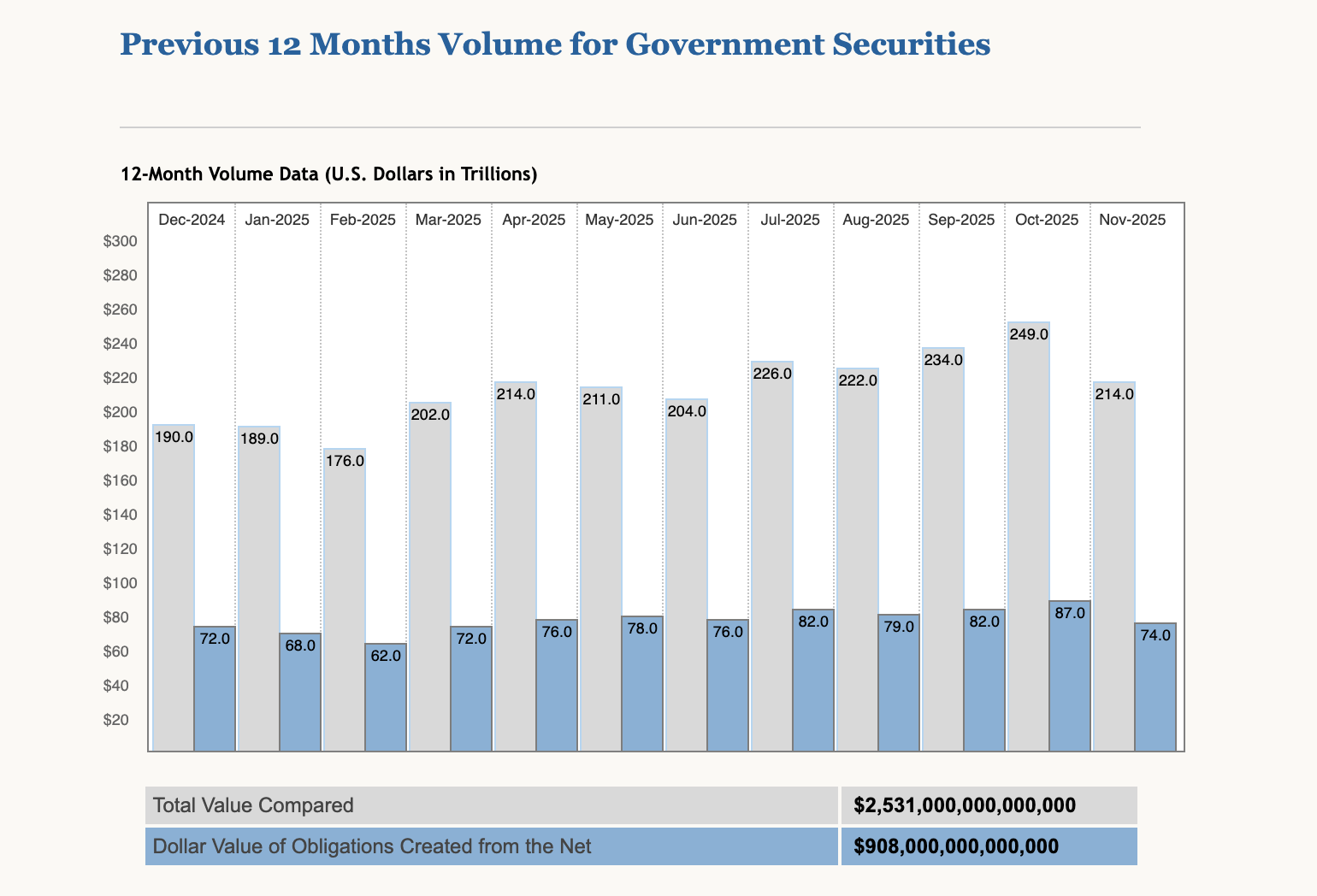
Volume of 12-month government securities settled using the DTCC’s infrastructure. Source: DTCC

DTCC handled about $3.7 quadrillion in settlement volume in 2024 and is considered the backbone of the traditional financial system, clearing transactions across the equity, bond, fixed income and financial derivatives markets.

The DTCC is expected to launch its tokenized trading services in the second half of 2026 and will mint some US Treasurys onchain using the Canton Network, a permissioned network of blockchain infrastructure geared toward financial institutions.

Magazine: Unstablecoins: Depegging, bank runs and other risks loom

Связанные с этим вопросы

QWhat is the parent company of the New York Stock Exchange (NYSE) and which cryptocurrency firm is it reportedly in talks to invest in?

AIntercontinental Exchange (ICE), the parent company of the NYSE, is in talks to invest in the cryptocurrency payments company MoonPay.

QAt what valuation is MoonPay seeking to raise funds in its latest funding round, as reported by Bloomberg?

AMoonPay is seeking to raise funds at a valuation of $5 billion.

QWhat was the size of ICE's previous investment in Polymarket and what was the resulting valuation of that company?

AICE invested $2 billion in Polymarket, which brought the company's valuation to $9 billion.

QWhat specific services does MoonPay provide in the cryptocurrency space?

AMoonPay provides infrastructure for buying, selling, and using cryptocurrencies through fiat on-ramps and off-ramps. It enables users to purchase crypto using traditional payment methods like debit and credit cards, and offers services to wallets, exchanges, and enterprises.

QWhat major traditional financial infrastructure company received SEC approval to begin offering tokenized bonds and stocks, and what network will it use to mint some US Treasurys onchain?

AThe Depository Trust and Clearing Corporation (DTCC) received SEC approval to offer tokenized bonds and stocks. It will mint some US Treasurys onchain using the Canton Network.

Похожее

From Survival to Accelerated Growth: The Journey of Zcash's Three-Year Rise as Told by the Founder of ZODL

**From Survival to Accelerated Growth: Zcash Founder Details the 3-Year Rise** Three years ago, Zcash (ZEC) was a struggling pioneer in privacy technology, with a price near $30, low shielded supply (11%), and a community mired in governance disputes. Today, ZEC trades around $600, with over 31% of its supply (~$3B) in user-controlled shielded pools. This transformation resulted from breaking key constraints. First, **governance shackles were removed**. The old model guaranteed funding to two entities (ECC and ZF) regardless of performance, creating a monopoly. In 2024, ECC rejected further direct funding, forcing a change. The NU6 upgrade ended direct funding, allocating 8% to community grants and 12% to a protocol-controlled treasury for retroactive rewards, expiring in 2028 unless renewed by overwhelming consensus. The entities also relinquished their trademark-based veto power, freeing community governance. Second, the **product focus shifted** from pure cryptography to user growth. Previously, engineering excelled at privacy tech but failed to attract users. In early 2024, the team (later ZODL) pivoted to building products users wanted, like the Zodl wallet (default privacy, hardware support, cross-asset swaps). This drove shielded supply to grow over 400% in ZEC terms, with 86.5% of recent transactions being shielded, representing real user adoption. Third, the **narrative evolved** from the limiting "privacy coin" label to "unstoppable private money." This clarified Zcash's value proposition: a Bitcoin-like monetary policy with verifiable private payments via advanced cryptography. This structural narrative—protocol (Zcash), asset (ZEC), gateway (Zodl)—enabled broader exchange listings, institutional interest, and ETF filings. Finally, **organizational constraints were broken**. In early 2026, the ECC team left its non-profit structure after disputes over control, forming Zcash Open Development Lab (ZODL). ZODL raised $25M from top VCs (Paradigm, a16z, etc.), gaining the capital and agility of a startup to scale consumer products. Current metrics show strong momentum: social discussion volume for ZEC surged 15,245% in a year, with 81% positive sentiment. The focus is now on enhancing user experience (Zodl wallet), scalability (Tachyon project targeting Visa-level throughput with 25-second blocks), and post-quantum security (quantum-recoverable wallets coming soon). Zcash is positioned to become faster, more usable, scalable, and quantum-resistant.

marsbit7 мин. назад

From Survival to Accelerated Growth: The Journey of Zcash's Three-Year Rise as Told by the Founder of ZODL

marsbit7 мин. назад

Five Counterparty Risk Architectures: A Settlement-Layer Methodology for Classifying TradFi Models in Crypto Exchanges

**Summary:** This companion piece reframes the five TradFi-on-crypto exchange architectures, previously classified by "architectural fingerprint," through the lens of counterparty risk. The core question is: whose balance sheet bears the loss first in a stress scenario, and has it historically done so? Each of the five models corresponds to a distinct risk holder with its own documented failure modes. * **Model 1 (Stablecoin-Settled CEX Perpetuals):** Risk is held by the stablecoin issuer (e.g., reserve composition, bank connectivity) and the CEX's own book. History includes Tether's banking disconnections (2017) and reserve misrepresentations (CFTC 2021 Order). * **Model 2 (CFD Brokers):** Risk resides on the broker's balance sheet (B-book model). Regulatory differences (e.g., ESMA's mandatory negative balance protection vs. Mauritius FSC's lack thereof) define loss allocation rules, as seen in the 2015 SNB event (Alpari UK insolvency). * **Model 3 (Off-Chain Custody & Transfer Agent Chain):** Risk lies with the off-chain custodian/platform. User asset recovery depends on Terms of Use and corporate structure, exemplified by the Celsius bankruptcy ruling (2023) where Earn Account assets were deemed property of the estate. * **Model 4 (DEX Perpetual Protocols):** No single balance sheet bears risk. Loss absorption relies on a protocol's insurance fund and Auto-Deleveraging (ADL) mechanism, as demonstrated in the GMX V1 (2022) and dYdX v3 YFI (2023) incidents. * **Model 5 (Regulated CCP - DCM-DCO-FCM):** The most institutionalized model concentrates risk in the Central Counterparty (CCP). However, history shows CCPs can employ non-standard tools under extreme stress, such as mass trade cancellation (LME Nickel, 2022) or enabling negative price settlements (CME WTI, 2020). The report argues that regulatory choices and counterparty risk structures are co-extensive, not in an upstream-downstream relationship. It concludes with five separate observation checklists (not predictions) for monitoring the structural vulnerabilities of each risk model.

marsbit25 мин. назад

Five Counterparty Risk Architectures: A Settlement-Layer Methodology for Classifying TradFi Models in Crypto Exchanges

marsbit25 мин. назад

Торговля

Спот
Фьючерсы
活动图片