NYSE Can't Sit Still, Plans to Launch 24/7 Tokenized Trading

比推Опубликовано 2026-01-19Обновлено 2026-01-19

Введение

The New York Stock Exchange (NYSE) is reportedly planning to launch a tokenized securities trading and on-chain settlement platform that would enable 7x24 hour trading of stocks and ETFs. This move, seen as a response to competitor Nasdaq's own application for tokenized stock trading submitted last year, represents a significant step by traditional finance into the digital asset space. The proposed "on-chain stock tokenization solution" includes features such as fractional share trading, stablecoin-based fund settlement, instant settlement, and plans to grant tokenized stocks equal dividend and governance rights as traditional securities. NYSE's parent company, ICE, is also collaborating with major banks to explore supporting infrastructure. Market reactions are mixed. Proponents view it as an inevitable fusion of traditional and crypto finance, bringing enhanced liquidity and modernized infrastructure like atomic settlement. Critics, however, express concerns that it primarily benefits exchanges and could negatively impact younger investors by creating a relentless trading environment. The approval process by the SEC is expected to take time, potentially not until late 2026, leaving a window of opportunity for existing crypto platforms that offer features like non-KYC trading and high leverage, which the NYSE platform is unlikely to provide. The core driver for traditional exchanges remains trading volume and fees, and their success is not guaranteed in this new competitiv...

Source: Odaily Planet Daily

Author: Wenser

Original Title: NYSE Plans to Launch 24/7 Tokenized Stock Trading, Leaving "Competitors" Stunned


As "Flash Crash Monday" continues, the crypto market has just been hit with another bombshell—according to multiple media sources, the New York Stock Exchange plans to launch a tokenized securities trading and on-chain settlement platform supporting 24/7 trading. After investing $2 billion in Polymarket last year, the ICE Group is once again leveraging its stock exchange to join the century-defining wave of cryptocurrency transformation.

It is worth noting that as early as last September, the "competitor" Nasdaq had already submitted an application to the SEC for tokenized stock trading. NYSE's move is also interpreted by the outside world as a response to competition among stock exchanges.

This article will briefly summarize market views related to this event and explore its potential impact.

NYSE Can't Sit Still: A More Aggressive "On-Chain Tokenization Solution for Stocks" Compared to Nasdaq

After Trump took office, the U.S. cryptocurrency regulatory environment underwent a significant shift. As a result, crypto IPOs, stablecoins, PayFi, and DeFi have developed rapidly, sweeping away the policy gloom of the Biden era. According to statistics, stablecoin trading volume reached $33 trillion last year, a sharp increase of 72% year-on-year. Behind this lies the substantial profits earned by stablecoin issuers Tether and Circle, as well as the massive liquidity that can be directed to the stock securities market.

Moreover, unlike Nasdaq's application to the SEC for tokenized stock trading last September, nearly half a year later, NYSE's moves related to "tokenized stock trading" are not just an application to regulators but a comprehensive "on-chain solution."

Specifically, NYSE's "on-chain tokenization solution for stocks" includes the following three aspects:

  • This is a tokenized securities trading and on-chain settlement platform, planning to support 24/7 trading of U.S. stocks and ETF funds, fractional share trading, stablecoin-based fund settlement, and instant delivery, while integrating NYSE's existing matching engine with a blockchain settlement system.

  • According to NYSE's plan, tokenized stocks will have the same dividends and governance rights as traditional securities.

  • NYSE's parent company, ICE, is also collaborating with banking giants such as BNY Mellon and Citigroup to explore tokenized deposits and clearing infrastructure to support cross-time zone, round-the-clock fund and margin management.
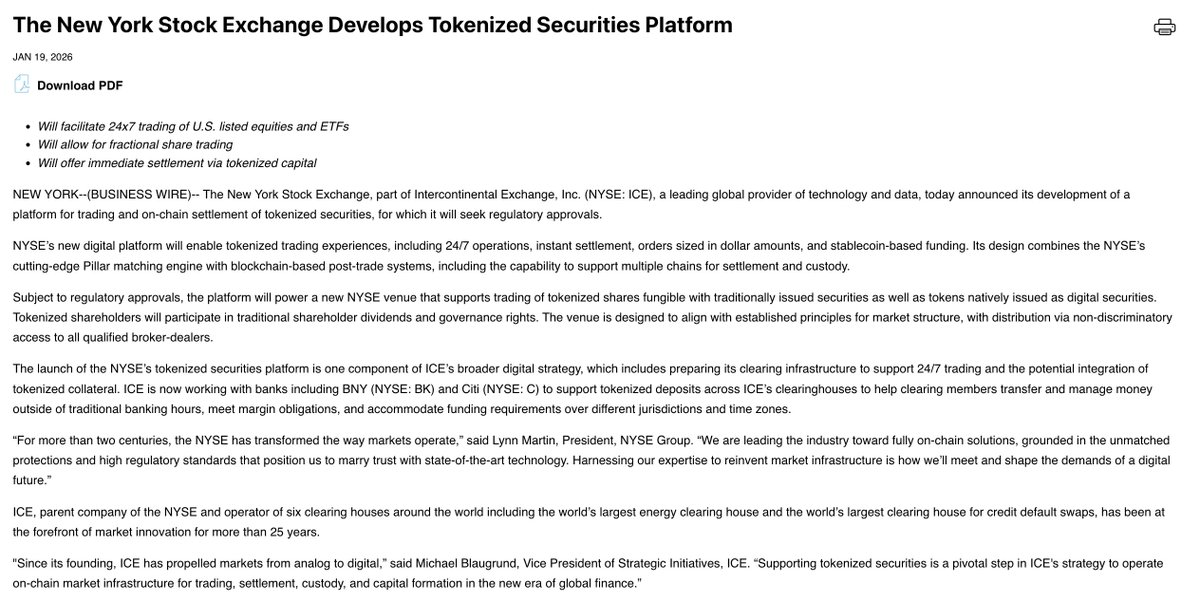
In comparison, if Nasdaq's tokenized stock application seems like a "new bottle for old wine" move in response to policy, NYSE's plan appears to be a "new retail trading platform" that integrates all aspects of "production-packaging-distribution-recycling."

Most importantly, NYSE's "tokenized stock" trading platform supports 24/7 trading, which was originally one of the advantages of various cryptocurrencies over securities and stocks. Now, this advantage becomes a joke in the face of the massive asset targets and liquidity of the world's largest stock exchange, NYSE.

As a result, there are some pessimistic views in the crypto market: "The RWA sector of the crypto market and its increasingly tight liquidity will face the strictest 'father.' Compared to NYSE's annual trading volume of over a hundred trillion dollars, crypto RWA projects can almost be said to not exist."

What Crypto Practitioners Think: Mixed Impacts, the Past Is the Past, the Present Is the Present

In 1792, 24 securities brokers signed the Buttonwood Agreement under a buttonwood tree outside 68 Wall Street in New York, marking the birth of the predecessor of the New York Stock Exchange. At that time, due to limited investment targets and market activity, stock trading hours were relatively flexible, with no strict continuous trading sessions. Brokers primarily conducted transactions through auctions or informal methods.

On March 8, 1817, the organization drafted a charter and officially changed its name to the New York Stock and Exchange Board.

In May 1887, NYSE standardized stock trading hours to "Monday to Friday: 10:00 AM to 3:00 PM; Saturday: 10:00 AM to 12:00 PM."

In 1952, Saturday trading was officially canceled.

In 1985, stock trading opening time was moved forward to 9:30 AM, and closing time extended to 4:00 PM, forming the current 9:30–16:00 session, which has lasted for about 41 years.

If NYSE's application for 24/7 tokenized stock trading is approved, it would mean that this decades- or even centuries-old "limited-time trading model" will become history. From this perspective, the crypto market has gained high recognition from mainstream finance.

Pro Views: The Era's Momentum Is Unstoppable

BTC OG and BankToTheFuture founder Simon Dixon posted, "Nothing can stop this (era's) train. Tokens are IOUs for actual assets held by custodians, supplementing DTCC claims. All-day trading is achievable without tokens. This is an upgraded version of the surveillance state. You will own nothing and be happy." The accompanying image showed BlackRock CEO Larry Fink and Coinbase CEO Brain Armstrong embracing.

Indian crypto KOL Open4profit posted, "(This will) allow the market to react immediately to global news; AI and algorithms will play a greater role in pricing and risk management; this is a significant change for the stock market—keep a close eye on liquidity changes."

Redstone DeFi co-founder Marcin saw a "startup opportunity," saying, "This is a good start and aligns with what we are going to do next."

Wintermute OTC head Jake O also highly affirmed the move: "Traditional infrastructure can extend trading hours but cannot solve T+1/2 friction or eliminate rent-seeking behaviors that increase costs and delays. Ironically, crypto solved this years ago: 24/7 trading, instant settlement, global access, no gatekeepers or (traditional banks') 'data fees.' Convergence is inevitable: equity trading on-chain, atomic settlement, the line between 'crypto' assets and 'traditional' assets will completely disappear. Welcome to the 21st century..."

Of course, some see it as an opportunity, while others see it as a threat.

Con Views: Exchanges Reap the Benefits, the Younger Generation Suffers

Unlike those in the industry who believe NYSE's move will stimulate the crypto market and promote cryptocurrency adoption, some insiders also see potential problems.

L1D partner LouisT posted: "The entire global financial system is moving on-chain, but somehow, they don’t seem to be bidding for our 'bear-drug-like' tokens." In other words, traditional financial market does not buy into the so-called RWA assets of cryptocurrencies.

MoonRock Capital founder expressed concern about the living conditions of the younger generation: "This is not good news for the baby boomers; your lives have become more difficult." He likely meant that compared to previous generations with more increments, baby boomers face a more complex investment environment and a round-the-clock "liquidity gaming stage."

BingX advisor Nebraskangooner also raised doubts: "Why make the stock market trade 24 hours? No one wants this except the exchanges. The only benefit is that without after-hours trading interference, stop-loss and take-profit points can truly function. Not sure what impact this will have on stock price movements after earnings reports?" This view focuses more on information impact and exchange profits.

Summary: A Gap Still Exists Between Traditional Finance and Crypto Natives, Opportunities for Users and Entrepreneurs Remain

Finally, I would like to share some personal views based on the above information:

First, based on current information, NYSE's related application may be approved as early as the end of 2026, with the main approval authority still being the U.S. SEC. For crypto platforms, this is an important time gap.

Second, NYSE's tokenized stock trading and on-chain settlement platform will likely primarily serve conventional investment institutions and compliant investors. For crypto-native groups and global investors, what they need is not just functional satisfaction but also the ability to achieve "KYC-free registered trading, global asset liquidity allocation, and riskier high-leverage" through tokenized stocks and RWA platforms. This may be the advantage of crypto RWA projects.

Finally, the core purpose of NYSE, Nasdaq, and others in promoting stock tokenization remains trading volume and fees. Like CEXs continuously listing new token projects, in the short term, they may still need to learn from CEXs, DEXs, and even on-chain Perp DEXs. This is also the basis for existing mature platforms to potentially counterattack. By then, it is not impossible for U.S. stock exchanges like NYSE and Nasdaq to fall from grace. The focus is still on where the liquidity is, where the attention is, and where the user base is.


Twitter:https://twitter.com/BitpushNewsCN

Bitpush TG Discussion Group:https://t.me/BitPushCommunity

Bitpush TG Subscription: https://t.me/bitpush

Original link:https://www.bitpush.news/articles/7603876

Связанные с этим вопросы

QWhat is the New York Stock Exchange (NYSE) planning to launch according to the article?

AThe NYSE is planning to launch a tokenized securities trading and on-chain settlement platform that supports 7x24 hour trading, fractional share trading, stablecoin-based fund settlement, and instant settlement for U.S. stocks and ETF funds.

QHow does the NYSE's tokenized stock trading plan differ from Nasdaq's application submitted last year?

AUnlike Nasdaq's application, which was seen as a superficial response to policy changes, the NYSE's plan is a comprehensive 'on-chain solution' that integrates trading, settlement, and banking infrastructure, offering full-chain functionality rather than just a tokenized representation of existing stocks.

QWhat are some potential positive impacts of the NYSE's 7x24 hour tokenized trading platform as viewed by crypto industry insiders?

APositive impacts include immediate market reaction to global news, greater role of AI and algorithms in pricing and risk management, elimination of traditional settlement delays and friction, and the blurring of boundaries between crypto and traditional assets, marking a significant step into modern financial infrastructure.

QWhat concerns do critics have about the NYSE's proposed 24/7 trading platform?

ACritics worry that it primarily benefits exchanges by increasing trading fees, complicates risk management for retail investors (especially younger generations), and may negatively impact post-earnings price movements due to constant trading availability, with little actual demand for such extended hours from most market participants.

QWhat advantages might crypto-native RWA projects still hold over traditional exchanges like the NYSE entering tokenized trading?

ACrypto RWA projects can offer advantages like non-KYC registration, global liquidity allocation, higher leverage options, and riskier trading environments, which may appeal to crypto-native users and global investors seeking more flexible and permissionless access compared to the NYSE's likely focus on institutional and compliant investors.

Похожее

Треугольник невозможного — это вообще псевдопроблема

Автор Билли Гао утверждает, что основное ограничение для массового внедрения блокчейн-технологий не в классической «трилемме» (масштабируемость, децентрализация, безопасность), а в двух фундаментальных недостатках: отсутствии легитимности и конфиденциальности. Несмотря на создание мощнейшей криптографической системы, все транзакции и балансы по умолчанию прозрачны для всех, что аналогично постоянному налогу из-за MEV (максимально извлекаемой стоимости) и препятствует входу институционального капитала. Блокчейн — это медленный, дорогой, но беспристрастный компьютер общего пользования, идеально подходящий для учета активов, которыми и является сам этот учет (например, деньги). Однако его реальное использование ограничивается узкой прослойкой пользователей, тогда как крупные фонды и обычные люди не могут его применять из-за юридических рисков и полной публичности финансовой деятельности. Первый недостаток — легитимность — начинает решаться через регулирование (например, закон GENIUS). Второй и главный — «прозрачность как налог» — требует внедрения конфиденциальности по умолчанию с помощью современных криптографических инструментов, таких как доказательства с нулевым разглашением. Это позволит доказывать соответствие правилам (например, платежеспособность или KYC), не раскрывая самих данных. Таким образом, добавление проверяемой конфиденциальности к децентрализованному консенсусу — это чистое улучшение, которое откроет блокчейн для триллионов долларов институциональных и частных капиталов, для которых он изначально и был предназначен.

marsbit7 ч. назад

Треугольник невозможного — это вообще псевдопроблема

marsbit7 ч. назад

Трилемма невозможности — это искусственная проблема

**Резюме: "Невозможный треугольник" — это псевдопроблема** Криптоиндустрия построила мощнейшую криптографическую систему, но она не обеспечивает приватности финансовых операций по умолчанию. Все транзакции и балансы публичны. Основная причина, по которой триллионы долларов не переходят на блокчейн — не в масштабируемости (старая "трилемма" решена), а в двух других, более фундаментальных недостатках: **легитимности и конфиденциальности**. **Легитимность**: Безграничный доступ (permissionless) создаёт правовую неопределённость для крупного капитала. Однако с появлением регуляторных рамок (например, закона GENIUS) этот барьер начинает снижаться. **Конфиденциальность (Приватность)**: Прозрачность блокчейна — это не преимущество, а **налог**. Публичность каждой позиции и транзакции приводит к потерям от MEV, фронтраннинга и слежки, что неприемлемо для институциональных инвесторов, фондов и обычных пользователей. Парадокс в том, что система, построенная на криптографии, не шифрует основную деятельность пользователей — их финансы. Однако современные криптографические примитивы (например, доказательства с нулевым разглашением — zk-SNARKs) позволяют решить эту проблему, не жертвуя проверяемостью (аудитом) или соблюдением норм (compliance). Можно доказать платёжеспособность, пройденный KYC или соответствие лимитам, не раскрывая самих данных. **Вывод**: Добавление **доказуемой приватности с возможностью контролируемого раскрытия информации** — это чистое улучшение текущей модели. Оно закрывает главные барьеры для институционального капитала, превращая блокчейн из "публичной таблицы" в конфиденциальный и легитимный расчётный слой, для которого он, по сути, и был предназначен. Только тогда наступит переход к массовому использованию.

链捕手7 ч. назад

Трилемма невозможности — это искусственная проблема

链捕手7 ч. назад

Оптические чипы: коллективное расширение производства

Рост спроса на оптические чипы для ИИ-инфраструктуры стимулирует глобальную волну расширения производственных мощностей. В США Coherent получает государственное финансирование для расширения завода по производству 6-дюймовых InP-пластин, а также заключает стратегические сделки с NVIDIA. Nokia наращивает мощности по тестированию и упаковке фотонных чипов. В Японии JX Advanced Metals инвестирует в увеличение производства InP-подложек в 7–10 раз. Европейские компании, такие как Tower Semiconductor и ST, активно расширяют производство кремниевой фотоники, заключая долгосрочные соглашения. Китай демонстрирует агрессивный рост: Soarse расширяет производство чипов и модулей, Sanan Photonics наращивает выпуск InP-чипов, а Yunnan Germanium увеличивает мощности по производству пластин. Основной движущей силой является растущая потребность ИИ-центров обработки данных в пропускной способности, что требует большего количества оптических компонентов независимо от того, будут ли использоваться традиционные съемные модули или перспективные технологии, такие как CPO, NPO или гибридные архитектуры. Гонка за лидерство в эпоху фотоники набирает обороты, поскольку США, Япония, Европа и Китай стремятся укрепить свои позиции в цепочке поставок.

marsbit9 ч. назад

Оптические чипы: коллективное расширение производства

marsbit9 ч. назад

1996 или 1999? Первым испытанием Уолша стало «Как смотреть на ИИ»

Назначенный председателем ФРС Вош столкнулся с ключевой дилеммой: как оценить текущий бум искусственного интеллекта? Экономисты разделились на два лагеря. Одни считают, что рост производительности благодаря ИИ скоро подавит инфляцию, позволяя ФРС бездействовать. Другие предупреждают, что спрос опережает предложение, и промедление с повышением ставок приведёт к необходимости более резких мер в будущем. Вош, судя по заявлениям, склоняется к подходу 1996 года, когда Алан Гринспен не стал повышать ставки во время бума производительности, что оказалось верным решением. Однако нынешняя ситуация отличается: растущие тарифы, большой дефицит бюджета и снижение выгод глобализации создают дополнительное инфляционное давление. Критики, такие как глава Чикагского ФРС Гулсби, утверждают, что ожидаемый всеми рост производительности от ИИ уже сейчас вызывает перегрев экономики, так как люди и компании увеличивают расходы в ожидании будущих выгод. Это требует более жёсткой денежно-кредитной политики. Оппоненты отмечают, что многие домохозяйства не могут брать кредиты под будущий рост доходов, что ослабляет этот эффект. Вош также сталкивается с парадоксом: он хочет отказаться от практики «прогнозирующего руководства» (forward guidance), установленной как раз в 1999 году для предупреждения рынков о ужесточении политики. Если экономика пойдёт по сценарию 1999 года, ему придётся либо использовать эту практику, либо рисковать вызвать рыночные потрясения молчанием. Таким образом, первый серьёзный вызов для Воша — определить, повторяет ли экономика оптимистичный сценарий 1996 года или ведёт к необходимости жёстких мер по образцу 1999 года. От этого выбора зависит не только ближайшая политика ФРС, но и его историческая репутация.

marsbit12 ч. назад

1996 или 1999? Первым испытанием Уолша стало «Как смотреть на ИИ»

marsbit12 ч. назад

Отчет по Ethereum за первый квартал 2026 года: снижение комиссий, рекордное количество пользователей и транзакций

В первом квартале 2026 года сеть Ethereum продемонстрировала парадоксальную динамику: количество активных пользователей, транзакций и пропускная способность достигли исторических максимумов, в то время как комиссии за транзакции, общая заблокированная стоимость (TVL), объем торгов и рыночная капитализация ETH снизились. Этот феномен объясняется стратегическим переходом к этапу «низких комиссий для роста масштаба» после обновления Fusaka, которое удешевило блок-пространство. Парадокс Джевонса проявляется в том, что снижение стоимости использования высвобождает новый спрос. Ключевой тренд — смещение нарратива от DeFi-платформы к глобальному расчетному слою для институциональных финансов. Ethereum сохраняет доминирующую позицию в сегментах стейблкоинов (61,8% среди топ-5 сетей), токенизированных фондов (73%) и товаров (84%), привлекающих таких гигантов, как BlackRock и JPMorgan. Инвестиции в масштабирование и снижение комиссий нацелены на укрепление сетевых эффектов и долгосрочную ценность ETH как базового актива для расчетов в цифровой экономике.

marsbit14 ч. назад

Отчет по Ethereum за первый квартал 2026 года: снижение комиссий, рекордное количество пользователей и транзакций

marsbit14 ч. назад

Торговля

Спот
Фьючерсы
活动图片