NYSE and Nasdaq Enter the Fray, U.S. Stock Tokenization Begins Close Combat

marsbitОпубликовано 2026-03-25Обновлено 2026-03-25

Введение

On March 24, the New York Stock Exchange (NYSE) announced a partnership with tokenization platform Securitize to develop a digital trading platform for tokenized securities. Just six days earlier, the SEC approved Nasdaq’s rule amendments to enable tokenized versions of Russell 1000 stocks and major index ETFs. The two largest U.S. stock exchanges unveiled their tokenization strategies in the same month, marking a significant acceleration in institutional adoption. Throughout March, multiple major players advanced tokenization initiatives. Nasdaq partnered with Kraken’s parent company Payward to offer tokenized stock distribution for non-U.S. users. S&P Dow Jones licensed its flagship S&P 500 to on-chain protocol Trade.xyz for perpetual contracts on Hyperliquid. Invesco, managing $2.2 trillion in assets, took over Superstate’s $967 million on-chain treasury fund. The House Financial Services Committee also held a hearing titled "Tokenization and the Future of Securities." Notably, Nasdaq and NYSE are pursuing different technical approaches. Nasdaq’s model integrates with the existing Depository Trust Company (DTC) system, using blockchain as an optional layer while maintaining unified liquidity and settlement. In contrast, NYSE is building a separate, blockchain-native infrastructure with Securitize as its digital transfer agent, aiming for 24/7 trading and near-instant settlement. Regulatory progress is also advancing, including the CLARITY Act moving toward markup and an...

On March 24, the New York Stock Exchange announced the signing of a memorandum of understanding with tokenization platform Securitize to jointly develop a digital trading platform for tokenized securities. Just six days earlier, the SEC had approved Nasdaq's rule amendments to trade Russell 1000 component stocks and major index ETFs in tokenized form. The two largest stock exchanges in the United States each unveiled their own tokenization plans within the same month.

This is not an isolated move by one or two institutions. Spreading out the calendar for March reveals a rare density of activity.

On March 9, Nasdaq partnered with Payward, the parent company of crypto exchange Kraken, planning to provide a distribution channel for tokenized stocks to non-U.S. users. On March 18, the SEC approved Nasdaq's rule amendments; on the same day, S&P Dow Jones Indices licensed its flagship S&P 500 index to the on-chain protocol Trade.xyz to issue perpetual contracts on the decentralized derivatives platform Hyperliquid.

On March 24, the NYSE signed with Securitize; on the same day, Invesco, which manages $2.2 trillion in assets, announced it would take over the USTB fund from on-chain treasury management company Superstate, with a size of $967 million. On March 25, the U.S. House Financial Services Committee held a special hearing, "Tokenization and the Future of Securities: Modernizing Our Capital Markets." According to FinTech Weekly, attendees included Kenneth Bentsen Jr., CEO of the Securities Industry and Financial Markets Association (SIFMA), and Summer Mersinger, CEO of the Blockchain Association.
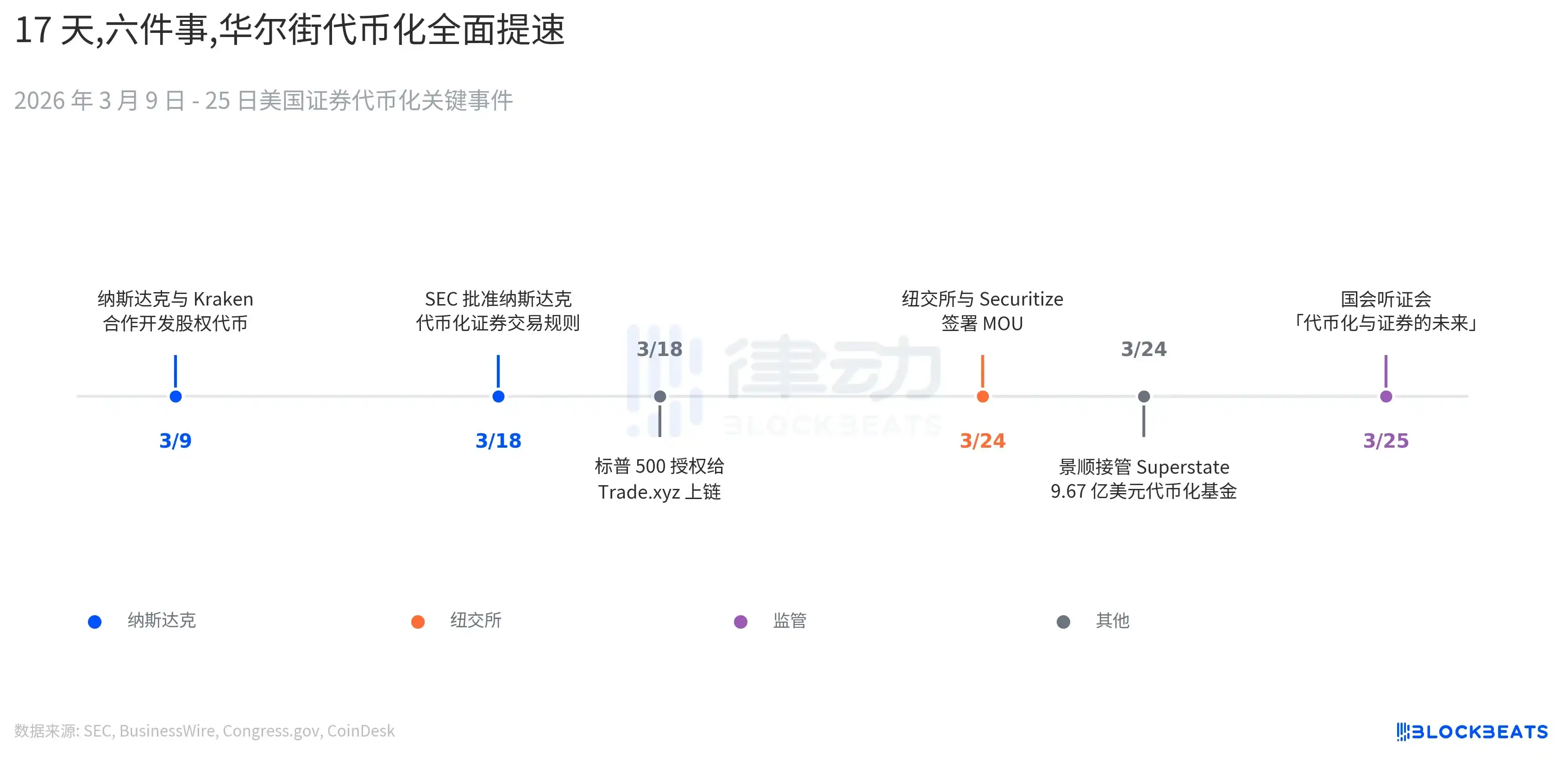
Six events in 17 days. Two major exchanges, three traditional asset management firms, one SEC approval, one congressional hearing. Among these events, the plans of Nasdaq and the NYSE are the most worthy of closer examination. The two are following different technical paths, and the divergence is greater than most realize.

Nasdaq is taking a compatibility route. According to the approval document (34-105047) released by the SEC on March 18, Nasdaq's tokenized securities trading will still be settled through the existing clearing system of the Depository Trust Company (DTC). Traders select a tokenized asset when placing an order, specify the blockchain and wallet address, and the DTC handles verification and settlement on the backend. Tokenized shares share the same CUSIP number as traditional shares, are matched on the same order book, and have identical execution priority. If the DTC determines that a participant is ineligible or the specified blockchain is incompatible, the transaction is automatically reverted to traditional settlement methods. In this setup, the blockchain is an optional wrapper; the underlying clearing pipeline remains unchanged. According to an analysis by the legal website Free Writings & Perspectives, eligible assets include Russell 1000 index components and ETFs tracking the S&P 500 and Nasdaq 100. The first tokenized trades are expected to launch in the third quarter of 2026.

The NYSE is taking a different path. According to a BusinessWire press release, the NYSE has designated Securitize as its first "Digital Transfer Agent," responsible for minting blockchain-native securities on-chain, maintaining ownership records, and handling corporate actions like dividends. According to CoinDesk, the NYSE is collaborating with Bank of New York Mellon and Citigroup to integrate tokenized deposits and stablecoin payments, aiming to enable 24/7 trading and near-instant settlement. This path is not about adding a layer on top of the existing clearing pipeline but about building an independent on-chain settlement infrastructure. The wording of Lynn Martin, President of NYSE Group, in the press release skipped "exploring" and "piloting," directly stating that the development of the new infrastructure must "preserve the trust, transparency, and protection that investors expect."
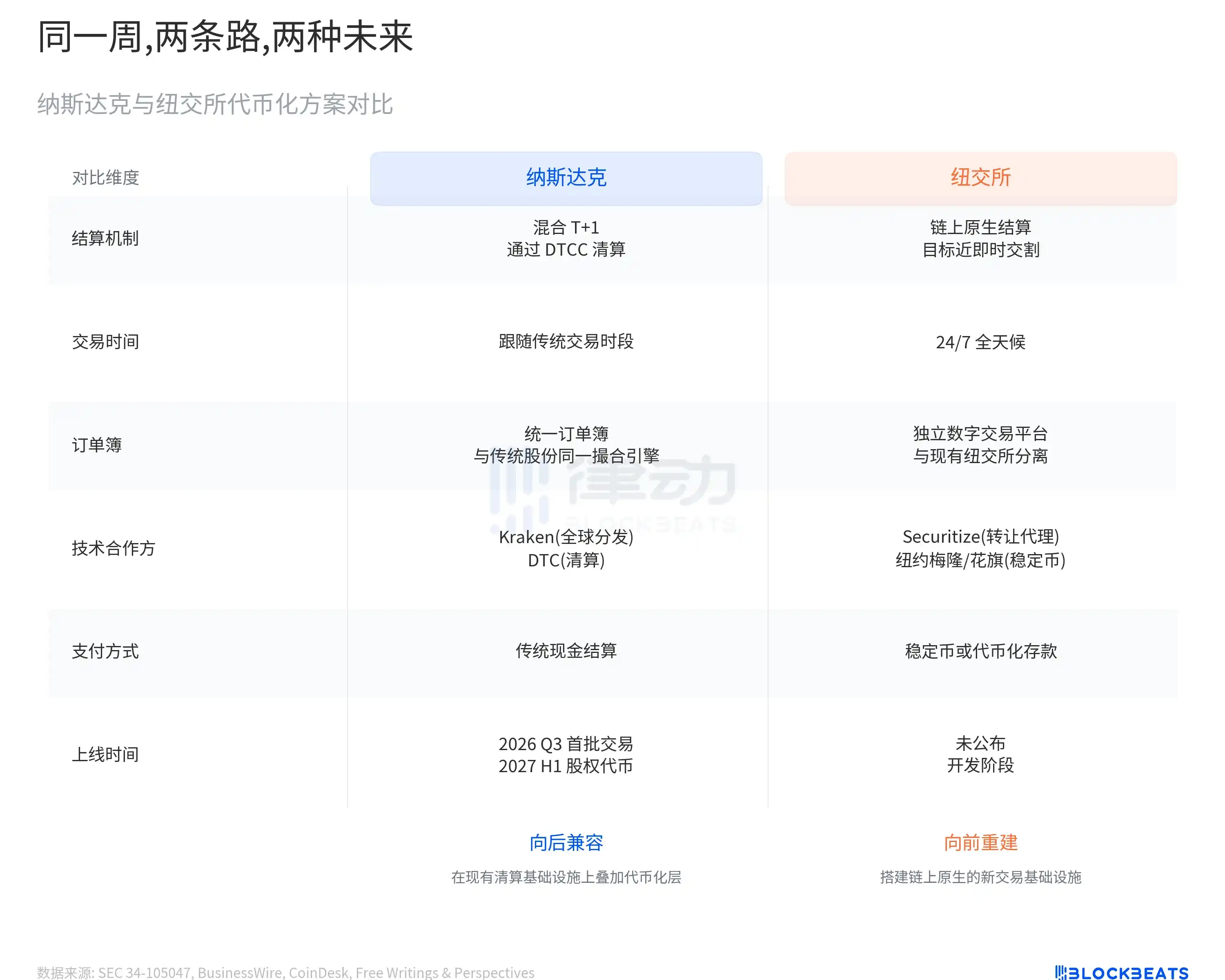
The core of the divergence is this: Nasdaq is adding functionality to its existing order book, maintaining unified liquidity, and can launch once the DTC updates its systems. The NYSE is building a separate digital trading platform that will run in parallel with the existing exchange, prioritizing 24/7 trading and instant settlement, though a specific launch date has not been announced according to CoinDesk. Securitize is the core technical support for the NYSE's plan. According to PRNewswire data, it currently manages approximately $4.6 billion, representing about 25% of the tokenized RWA market share.

It is also the technology provider for BlackRock's BUIDL fund. According to public data, BUIDL reached a size of $2.38 billion within 15 months of launch, making it the world's largest tokenized treasury fund. According to CoinDesk, Securitize's revenue for the first three quarters of 2025 grew 841% year-over-year to $55.6 million, and according to PRNewswire, it is going public via a SPAC with a valuation of $1.25 billion. By choosing Securitize as its first Digital Transfer Agent, the NYSE is entrusting the minting authority for tokenized securities to an infrastructure company on the verge of an IPO.

The regulatory side is also advancing. According to CoinDesk, the CLARITY Act, previously stalled for months due to stablecoin yield provisions, recently reached an "agreement in principle," and according to FinTech Weekly, the Senate Banking Committee has set a markup target for late April. In December 2025, the SEC issued a No-Action Letter to the DTC; according to a DTCC official announcement, this letter authorizes the DTC to provide tokenization services under a regulated framework, which is the prerequisite for Nasdaq's plan to proceed.

All of this happened within one month. What does this pace mean globally?
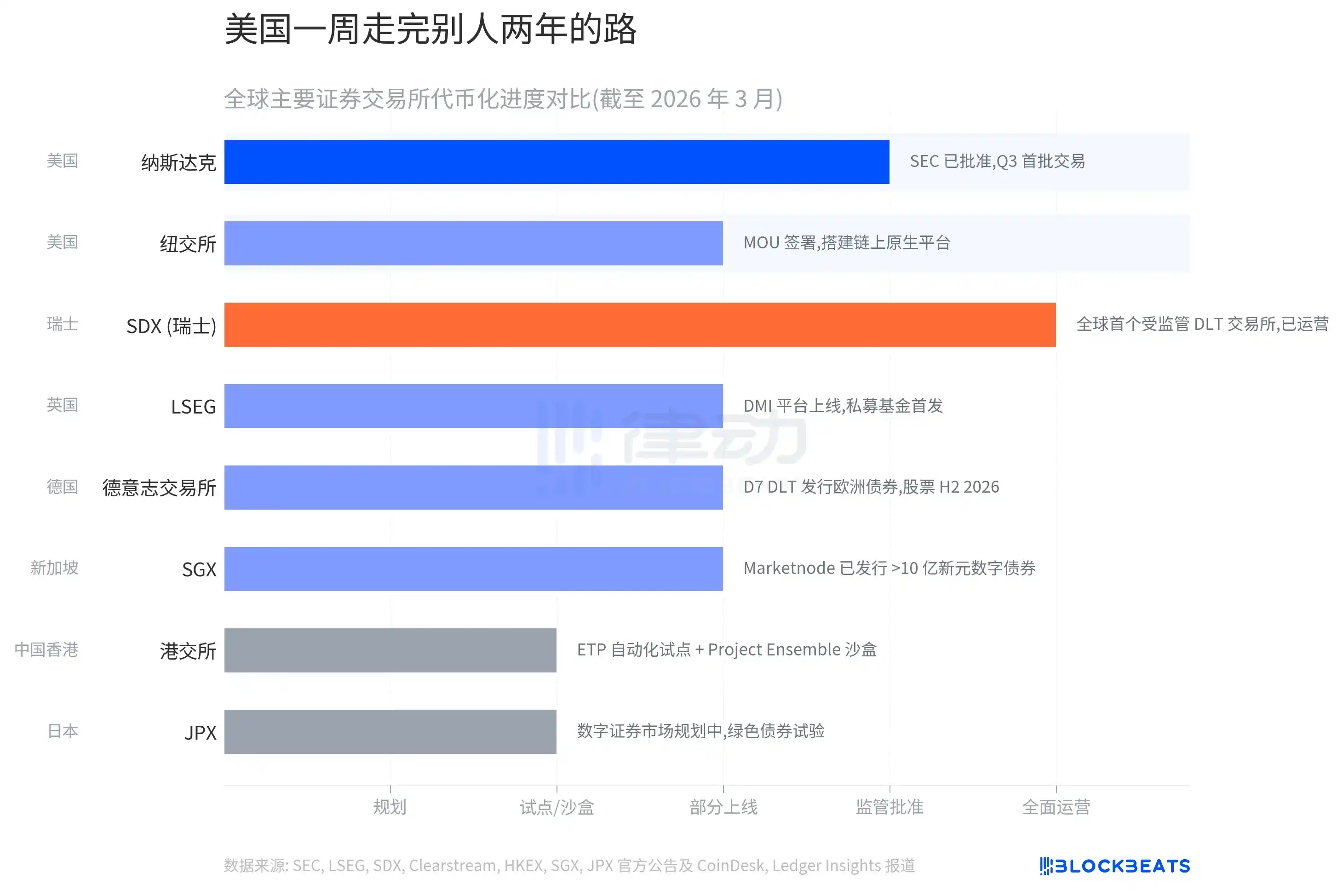
Switzerland's SIX Digital Exchange (SDX) was the world's first fully licensed DLT exchange, launching in 2021. According to Ledger Insights, it has issued over CHF 400 million in tokenized bonds, but its daily trading volume is only CHF 2-5 million, with influence largely confined to Switzerland. The London Stock Exchange Group (LSEG) launched its Digital Markets Infrastructure (DMI) platform in September 2025; according to an LSEG official announcement, the first transaction involved private fund tokenization, and it is currently applying for a Digital Securities Depository (DSD) license.

Deutsche Börse's Clearstream began issuing tokenized European bonds on its D7 platform in Q4 2025; according to the Clearstream website, tokenized equities are expected to launch in the second half of 2026. The Singapore Exchange (SGX), through its joint venture with Temasek, Marketnode, has issued over SGD 1 billion in digital bonds according to SGX website data. The Hong Kong Exchange (HKEX) and Japan Exchange Group (JPX) are still in the pilot and planning stages.

Most of these exchanges took two to three years to move from pilot to partial launch. Nasdaq went from SEC approval to its first expected trades in just over a quarter. The NYSE moved from signing an MOU directly to targeting on-chain native settlement. What took SDX five years to achieve, the two major U.S. exchanges have reached their respective starting lines for in a month. Nasdaq added a layer on the existing foundation; the NYSE is pouring a new foundation right next to it.


Связанные с этим вопросы

QWhat are the two different technical approaches taken by NASDAQ and NYSE in their recent tokenization initiatives?

ANASDAQ is taking a compatibility approach, integrating tokenized securities into the existing DTC clearing system, where tokenized shares share the same CUSIP and order book as traditional shares. The NYSE is building an independent, blockchain-native digital trading platform with Securitize as its digital transfer agent, aiming for 24/7 trading and near-instant settlement.

QWhat key regulatory approval did NASDAQ receive from the SEC on March 18th, and what does it allow?

AOn March 18th, the SEC approved NASDAQ's rule filing (34-105047) to allow the trading of tokenized versions of Russell 1000 index constituents and major index ETFs, with the first tokenized trades expected to launch in Q3 2026.

QWhich company did the NYSE partner with as its first 'Digital Transfer Agent' and what is this company's significance in the market?

AThe NYSE partnered with Securitize as its first Digital Transfer Agent. Securitize is a significant player, managing approximately $4.6 billion in assets, representing about 25% of the tokenized RWA market, and is the technology provider for BlackRock's $2.38 billion BUIDL fund.

QHow does the speed of the US exchanges' tokenization progress compare to other global exchanges like SDX and LSEG?

AThe US exchanges are moving much faster. While Swiss SDX took years to launch and has limited volume, and LSEG is still applying for licenses, NASDAQ went from SEC approval to an expected launch in one quarter, and the NYSE is directly targeting native on-chain settlement, compressing a multi-year process into a single month.

QWhat role did the DTC's No-Action Letter from the SEC in December 2025 play in enabling these tokenization efforts?

AThe No-Action Letter authorized the DTC to provide tokenization services under a regulated framework. This was a critical prerequisite that enabled NASDAQ's compatibility-based approach to move forward, as it relies on the existing DTC clearing infrastructure.

Похожее

Trump Media продаёт ещё 2628 BTC, запасы снижаются до 4261 BTC

Компания Trump Media & Technology Group (TMTG), стоящая за социальной сетью Truth Social, продолжает сокращать свои вложения в Bitcoin. По данным аналитической платформы Lookonchain, компания продала ещё 2628 BTC на сумму около 165 миллионов долларов через платформу Crypto.com. Это продолжение серии продаж, начавшихся семь месяцев назад. Всего за этот период TMTG продала 7281 BTC на общую сумму примерно 545 миллионов долларов по средней цене 74 855 долларов за монету. Первоначально компания приобрела 11542 BTC по средней цене 118 522 доллара. После последних транзакций её резервы сократились до 4261 BTC (около 269,8 миллиона долларов), что на 63% меньше изначальных холдингов. Эти продажи происходят на фоне усиленного внимания законодателей к криптовалютным интересам, связанным с Дональдом Трампом. В Конгрессе идут дебаты по закону CLARITY Act, который касается этических норм, владения цифровыми активами и потенциальных конфликтов интересов государственных лиц. Критики указывают на такие проекты, как мемкойны TRUMP и MELANIA, а также на токены World Liberty Financial, связывая политическое влияние с частными криптоинтересами.

cointelegraph4 мин. назад

Trump Media продаёт ещё 2628 BTC, запасы снижаются до 4261 BTC

cointelegraph4 мин. назад

Фуцзянь, Цзиньцзян: супер-единорог в сфере памяти тихо делает своё дело

В провинции Фуцзянь в городе Цзиньцзян, известном производством спортивной обуви, находится перспективная компания в области производства чипов памяти — Fujian Jinhua Integrated Circuit Co. (Jinhua). Основанная в 2016 году как часть национального плана по развитию полупроводниковой промышленности, компания столкнулась с серьёзными вызовами. В 2018 году она была внесена в санкционный список Министерства торговли США по обвинению в промышленном шпионаже в пользу американской компании Micron, что привело к остановке производственной линии. После пяти лет судебных разбирательств в феврале 2024 года федеральный суд в Сан-Франциско полностью оправдал Jinhua, сняв все обвинения. Несмотря на правовую победу, компания всё ещё остаётся в санкционном списке, а годы задержек серьёзно замедлили её развитие. Под руководством своего ключевого инженера Чэнь Чжэнкуня, известного как «мастер эффективности», компания сумела адаптировать производство, увеличив долю отечественного оборудования. В отличие от ChangXin Memory Technologies (CXMT) и Yangtze Memory Technologies (YMTC), которые продвинулись дальше в производстве DRAM и NAND-памяти соответственно, Jinhua сосредоточена на специализированной (нишевой) DRAM-памяти для потребительской электроники. Её текущая производственная мощность составляет около 40 000 пластин в месяц. Хотя её доход в 2023 году оценивался примерно в 2 млрд юаней, что значительно меньше, чем у конкурентов, компания остаётся важным игроком. История Jinhua тесно связана с амбициозной промышленной трансформацией города Цзиньцзян. Местные власти оказали компании полную поддержку, включая финансовые гарантии и создание кластера, что демонстрирует стратегическую важность проекта для региона. Несмотря на то, что Jinhua упустила первые годы бума на рынке памяти, её устойчивость в условиях санкций показывает потенциал для восстановления в новом цикле роста, движимом развитием искусственного интеллекта.

marsbit47 мин. назад

Фуцзянь, Цзиньцзян: супер-единорог в сфере памяти тихо делает своё дело

marsbit47 мин. назад

Почему биткойн-фермы внезапно стали новым входом для вычислительных мощностей ИИ на фоне дефицита электроэнергии в 38 ГВт?

Заголовок: Почему майнинговые фермы для биткоина внезапно стали новым входом для вычислительных мощностей ИИ на фоне дефицита электроэнергии в 38 ГВт? Краткое содержание: Когда конкуренция между центрами обработки данных ИИ сместилась с вопроса «кто купит больше GPU» к «кто раньше получит электроэнергию», некоторые майнинговые фермы для биткоина, ранее считавшиеся волатильными активами, начали трансформироваться в центры обработки данных для облачных провайдеров, используя свои готовые возможности подключения к сети, землю и трансформаторные подстанции. По расчетам Morgan Stanley, в период 2026-2028 годов в США может возникнуть дефицит электроэнергии для ЦОДов около 38 ГВт, и модернизация старых майнинговых ферм может обеспечить от 10 до 19 ГВт. Такие компании, как TeraWulf и Hut 8, переориентируются с добычи криптовалют на предоставление инфраструктуры («Powered Shell Provider»), предлагая клиентам из сферы ИИ критически важный ресурс — возможность быстрее конкурентов развернуть значительные вычислительные мощности. Ключевой ценностью становится не вычислительная мощность для майнинга, а дефицитный доступ к электросетям, получение которого «с нуля» в некоторых регионах США теперь может занять 5-7 лет.

华尔街日报48 мин. назад

Почему биткойн-фермы внезапно стали новым входом для вычислительных мощностей ИИ на фоне дефицита электроэнергии в 38 ГВт?

华尔街日报48 мин. назад

Майкл Сэйлор: «Мы никогда не говорили, что никогда не будем продавать биткоины»

Председатель стратегической комиссии Майкл Сэйлор прокомментировал сообщения о новом разрешении компании Strategy на продажу биткоинов. Он заявил, что данное разрешение не является новым — оно было объявлено ещё 29 июня в рамках системы управления капиталом компании. Соглашение позволяет продавать BTC на сумму до 5 миллиардов долларов для определённых целей, но не обязывает компанию к продаже. Сэйлор подчеркнул, что Strategy никогда официально не брала на себя обязательство никогда не продавать свои биткоины, хотя и рассчитывает оставаться чистым покупателем BTC в долгосрочной перспективе. Он назвал текущие новости «старыми», переподанными как новые, и подтвердил, что программа монетизации биткоинов компании не предполагает обязательной продажи её активов.

cryptonews.ru1 ч. назад

Майкл Сэйлор: «Мы никогда не говорили, что никогда не будем продавать биткоины»

cryptonews.ru1 ч. назад

«Летняя пила» продолжается: пробой $67 000 станет началом роста биткоина

Цена биткоина продолжает консолидироваться в диапазоне $58 000–$67 000 с начала июня. 1 августа актив снизился до $62 217. Аналитики расходятся в краткосрочных прогнозах: некоторые, как Crypto Candy, ожидают тестирования уровня $60 000 или ниже, пока цена находится под $66 000. Другие, как Jelle, видят в боковом движении «летнюю пилу» и придерживаются стратегии усреднения. Ключевым для определения дальнейшего направления считается уровень $67 000. По мнению Daan Crypto Trades, его пробой необходим для выхода из затянувшейся паузы. Roman полагает, что уверенный пробой с объемом может быстро запустить рост к $70 000–$80 000 и выше. С долгосрочной точки зрения, макроаналитик Герт ван Лаген рассматривает текущую фазу как накопление в рамках масштабной формации «чаша с ручкой». Он отмечает, что долгосрочные держатели не спешат продавать актив, о чем говорит показатель NUPL. Таким образом, рынок находится в решающей фазе, где пробой либо поддержки $60 000, либо сопротивления $67 000 задаст тренд на ближайшее будущее.

cryptonews.ru2 ч. назад

«Летняя пила» продолжается: пробой $67 000 станет началом роста биткоина

cryptonews.ru2 ч. назад

Торговля

Спот
活动图片




