In the final months of 2025, the atmosphere of a bear market began to spread.
Bitcoin slid from its high of $120,000, ETF inflows stalled at one point, various cryptocurrencies diverged in their trends, and the once sentiment-igniting Meme coins also began to lose interest. Compared to the end of 2021, this time there was no sudden regulatory crackdown, and aside from the 1011 crash, there didn't seem to be a severe liquidity crisis, yet it still felt like something was off.
If the crypto world of 2025 was a recalibration of true and false value, then will crypto be better in 2026?
This article attempts to find the answer. Perhaps we need to accept the fact that the crypto industry may be entering an era no longer driven by one-sided surges or "casino narratives."
I. Macro Winds Warm, Bitcoin Still Stands in the Spotlight
Over the past year, Bitcoin's price performance and market positioning have undergone significant changes.
After hitting a new all-time high of $120,000, the market began to pull back, volatility increased, and market sentiment gradually cooled. Unlike past rallies driven by retail investors, the main force behind this round of increases was the institutional money behind ETFs. Looking at holding costs, CryptoQuant analyst Axel Adler Jr. pointed out last month that the average holding cost for US ETFs was $79,000, which many also see as one of the price support levels. Therefore, Bitcoin's current trend is increasingly resembling a high-volatility institutional asset. On one hand, it has an anti-inflation positioning similar to gold; on the other hand, like tech stocks, it is influenced by macro sentiment and risk appetite, exhibiting beta properties.
From a broader macro background, 2025 was a year of回暖 (warming) sentiment for global risk assets. AI was the main theme, US stocks continuously hit new highs, the Fed announced three rate cuts in December, and the market re-entered a stage of warming liquidity expectations. The FOMC's year-end economic projections showed that the US GDP growth expectation for 2026 was also revised up from 1.8% to 2.2%–2.5%. The general expectation is that easing will continue next year, which might be a positive for assets like Bitcoin.
But the market is not without risks. If the economy suddenly weakens in 2026, or inflation rebounds unexpectedly, risk assets could still face significant adjustments.
II. Regulatory Turning Point: Policy Moves in the US and Hong Kong
Another important change in 2025 was the formal framing of regulation.
In the US, two key bills were passed. The first is the stablecoin bill (GENIUS Act), which clarifies the definition of stablecoins, reserve requirements, and issuance qualification thresholds, providing a compliance path for mainstream stablecoin issuers. This bill was signed into law by the President in July 2025 and will take effect 18 months after signing or 120 days after regulators issue final rules. The second is the Crypto-Asset Market Structure Act (CLARITY Act), which systematically divides the boundary between "security tokens" (regulated by the SEC) and "commodity tokens" (regulated by the CFTC) and proposes tiered regulation. This bill will be submitted to the Senate for deliberation in January, after which it may still require the President's signature, with an effective date to be determined. Meanwhile, the SEC has also accelerated the approval of more crypto ETFs, opening channels for institutional products.
In Hong Kong, China, regulatory步伐 (pace) also accelerated. In 2025, the Hong Kong Monetary Authority (HKMA) introduced a regulatory regime for stablecoin issuers, clearly requiring all Hong Kong-based stablecoin issuances to be licensed. This means that future issuances of stablecoins like USD or RMB in Hong Kong will need to meet certain capital and compliance requirements. Furthermore, HashKey has been listed on the Hong Kong Stock Exchange, becoming the first compliant platform with crypto trading as its core business to IPO in Hong Kong, a milestone event.
Overall, the regulatory trends in the US and Hong Kong, China, are both about suppressing illegal speculation while opening channels for legal business, pushing the industry towards institutionalization and compliance.
III. Three Main Themes: Stablecoins, Prediction Markets, On-Chain Stocks
Over the past few years, the most stable growth curve in the crypto industry has actually been stablecoins.
By 2025, the global stablecoin issuance volume had exceeded $300 billion, with the two major coins, USDT and USDC, accounting for over 80% combined. Stablecoins are becoming part of the global payment network. Whether it's USDT or USDC, the usage scenarios of these stablecoins have penetrated into daily merchants and cross-border settlements.
In 2026, stablecoins are likely to be closer to the real world than ever before. Traditional giants like Visa, Stripe, and PayPal are already using stablecoins for settlements. For example, Stripe already supports merchants subscribing with stablecoins, with real, landed services already available.
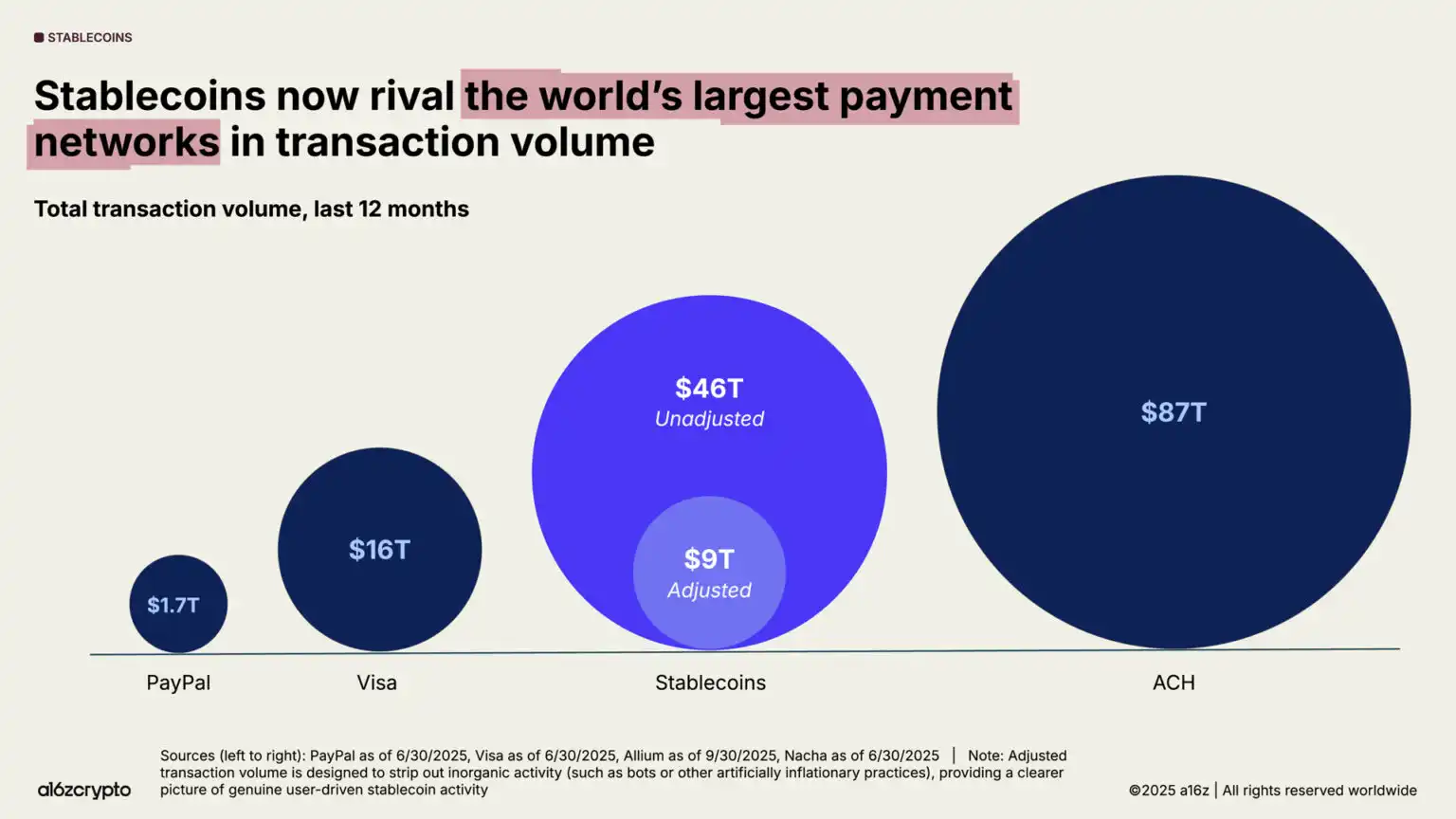
Image Source: a16z
Furthermore, with regulatory clarity, treasury-backed stablecoins (backed by high-quality assets) and regional stablecoins are expected to emerge, such as digital currency bridge projects promoted by Japan and the EU.
Another area worth watching is prediction markets.
Originally, most people thought prediction market products were too niche or non-compliant. But now, under themes like US elections, sports events, and economic data, they are gradually becoming a combination of "on-chain betting + pricing tools."
For example, Kalshi obtained a formal futures license from the US CFTC, allowing it to legally launch prediction trading related to macroeconomic data. Its valuation has now climbed to $11 billion. Polymarket, relying on topics like US elections and entertainment events, has also become a place for a large number of users to bet and gauge sentiment.
In 2026, prediction markets may move out of the purely speculative circle. For instance, users are not just betting on wins or losses but are using money to vote, expressing their judgment on the probability of a certain outcome. This collective intelligence pricing method could potentially be used by media, research institutions, and even trading strategies for reference. Additionally, AI will open up new possibilities for prediction markets, making them no longer rely solely on human betting but capable of automatically analyzing data, placing orders themselves, and even generating new markets. This will make prediction markets react faster and smarter, gradually becoming a tool for judging risks and trends, not just a place for gambling.
The last one that cannot be ignored is the development of on-chain stocks.
Simply put, the crypto industry is now not only trading crypto assets but also starting to move real-world assets onto the chain. For example, Securitize plans to launch the first fully compliant on-chain stock trading platform in 2026. Tokens purchased on-chain by users correspond to real company shares, entitling them to voting rights and dividends.
IV. Edge Narratives Emerge: New Directions That Might Take Off in 2026
https://a16zcrypto.com/posts/article/big-ideas-things-excited-about-crypto-2026/
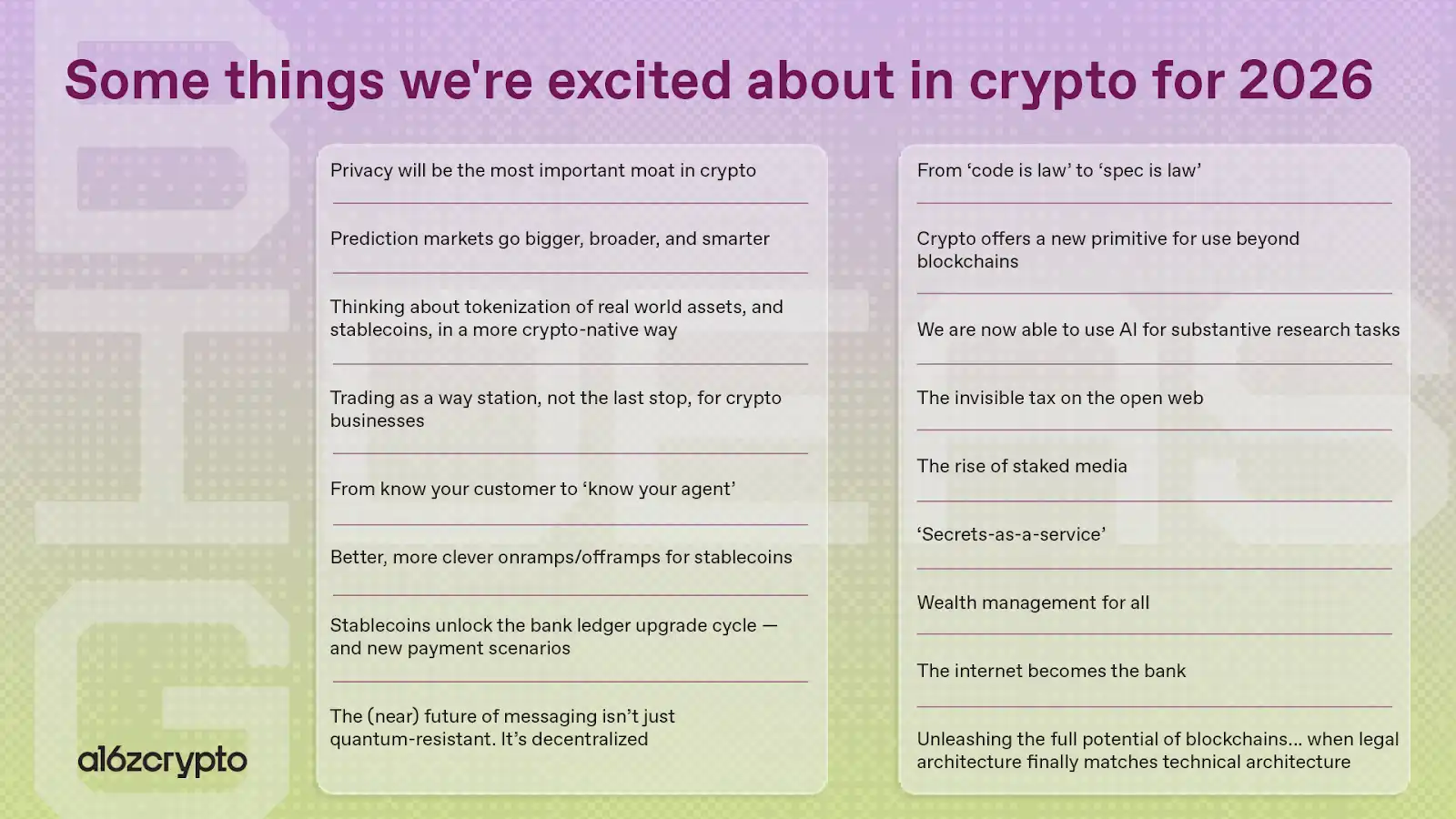
Image Source: a16z
1. The Identity Problem of AI Agents
As AI agents begin to participate in trading, browsing, placing orders, and even interacting with smart contracts, a key question is brought to the table: how do these non-human identities prove "who they are"?
The "Know Your Agent" (KYA) concept proposed by a16z aims to solve this very problem. On-chain, any agent initiating a transaction must have clear permissions and attribution, requiring cryptographic signature credentials for transactions. In 2026, this may become a prerequisite for the large-scale deployment of on-chain AI.
2. x402-like Protocols and Micropayments
a16z predicts that in the process of AI Agents widely trading data, calling computing power, and reading interfaces, we will enter an era of "automatic settlement + programmable payments."
No longer needing manual payments, AI Agents can identify needs among themselves and automatically execute payments. This is the real-world problem that protocols like x402 are solving. In 2026, their presence will become increasingly strong.
3. Privacy Chains Will Receive More Attention
a16z points out a key trend: compared to performance competition converging, privacy will become the core moat of future public chains. In the past, people worried that privacy chains were not conducive to regulation and lacked transparency. But now the problem is reversed: business data is too sensitive, and without privacy protection, compliant institutions simply dare not go on-chain. Precisely because of this, chains that come with privacy protection by default are becoming attractive. Once users use these chains, their data won't be easily leaked, migration costs are higher, naturally forming new user stickiness, which is essentially a network effect.
4. Staked Media
In the era of AI generating vast amounts of content, judging whether a statement is reliable cannot just depend on who said it, but also on whether there is a cost for saying it. Therefore, a16z proposes a new media model where content creators not only speak out but also "stake" their positions through methods like locking stakes, prediction markets, and NFT credentials.
For example, if you express a bullish view on ETH, you simultaneously lock up your own held ETH as collateral; if you make an election prediction, you also place a bet on-chain yourself. These公开 (public) interest bindings will make content more than just empty talk. If this play can work, it might become the new normal for on-chain media in the future.
Of course, the a16z report proposes far more than these few directions. This article focuses on selecting 4 trends we believe are more representative for elaboration. Other directions are also worth关注 (attention), such as: stablecoin on/off-ramp upgrades, RWA crypto-native transformation, stablecoins driving bank ledger system upgrades, diversification of wealth management, the rise of AI research assistants, real-time content profit-sharing mechanisms for AI agents, decentralized anti-quantum communication, "privacy as a service" becoming infrastructure, DeFi security paradigm shifts, intelligent prediction markets, verifiable cloud computing, focusing on product-market fit (PMF), and crypto bills unleashing more potential of blockchain.
Interested readers can refer to the original a16z report for further in-depth understanding.
V. The Crypto Industry is Moving Out of Its Internal Cycle
The early growth of the crypto industry was mostly built on a self-congratulatory system. Issuing coins, rebates, and airdrops all tried to attract more insiders to stay, but this closed loop is gradually being broken by reality.
From Polymarket to USDT, to the cross-border application of USDC, we see more and more people who are not Web3 users utilizing blockchain tools. Street vendors in Lagos may not understand wallet structures, but they know using USDT is much faster than bank transfers. In high-inflation countries, savers flock to USDC just for避险 (hedging), not speculation. One of the most直观 (intuitive) changes appears in payment scenarios in developing countries. For example, the Philippine trading platform Coins.ph partnered with Circle to open a low-cost USDC remittance channel.
The trend behind this shows that crypto technology is being embedded into real-world scenarios like cross-border payments and remittance channels. The true future of crypto might lie in how to use technology to solve real problems, allowing more ordinary people to use blockchain unconsciously.
VI. The Crypto Industry from a KOL Perspective
A recent discussion on "whether spending years in the crypto industry was worth it" was essentially a collective复盘 (review) of the industry.
Castle Island Ventures partner Nic Carter @nic_carter continued the reflection on "wasting 8 years in crypto,"坦言 (frankly admitting) that the ones that have truly achieved significant PMF (Product-Market Fit) so far are still only Bitcoin, stablecoins, DEXs, and prediction markets. He chooses to maintain pragmatic idealism, accepting that bubbles and狂热 (mania) are part of the path, not the whole thing.
Dragonfly partner Haseeb @hosseeb was more blunt, pointing out that the problem isn't the existence of the casino, but that if you only focus on the casino's glamour, you will miss the real transformation of the industry. He believes cryptocurrency is a better carrier for finance; it will forever change the nature of money. He hopes the industry maintains patience: "The Industrial Revolution also took 50 years to change productivity. We are only 15 years in."
The summary by XHunt & Biteye founder @DeFiTeddy2020 is also extremely real. In his view, the crypto industry can quickly expose the essence of finance. It faces projects going to zero, prices decoupling from fundamentals, and even insider trading, manipulation, and harvesting. It is not a温床 (hotbed) for idealism but a market that constantly educates participants with real money, which is very mentally磨练 (tempering).
Regarding the future development direction of the industry, KOL 币圈女菩萨 @xincctnnq (Crypto Bodhisattva) provided a long-term perspective. What crypto is truly trying to solve are long-term issues like the monetary system, contract execution, digital property rights, capital market efficiency, and financial inclusion. Even if the results are distant and the process rough, it is worth continuous尝试 (attempts).
Furthermore, trader & analyst @CryptoPainter gave a more market-structure-oriented explanation. The crypto market repeats its consistent operating mechanism: "value investment" - "belief investment" - "emotional speculation" - "complete disappointment," and then starts over. This cycle appeared in 2018 and 2022 and is destined to happen again. Gamblers and casinos are not anomalies but part of consuming the bubble and completing the market's self-regulation.
The stance of Figment Capital member DougieDeLuca @DougieDeLuca is like a阶段性 (stage) summary. He直言 (stated bluntly), "Crypto is dead" doesn't mean the price goes to zero or blocks stop working, but that "Crypto as a closed industry form is dying." True success should be integrating Crypto technology into ordinary people's daily lives.
From a more institutional perspective, KOL & researcher蓝狐 (Blue Fox) @lanhubiji mentioned that while old users are starting to withdraw, newcomers with traditional finance backgrounds are entering. In their perception, crypto is a long-term trend that has already entered a path of standardization, interoperability, and scaling. In three years, a brand-new on-chain finance era, the on-chain Wall Street era, will gradually reveal itself.
The judgment of LD Capital founder易理华 (Jack Yi) @Jackyi_ld is closer to the current cycle level. He pointed out that the recent crypto downturn is more of a阶段性 (stage) resonance of liquidity and macro events. Currently, negative factors are gradually being digested. With the dual benefits of rate cut expectations and crypto policies, he remains optimistic about the subsequent market.
At a more macro level of regulation and industry structure, the judgment of Hashkey Group Chairman肖风 (Xiao Feng) is particularly systematic. He proposed three future trends:
First, the global crypto regulatory trend is shifting from "voluntary acceptance" to "mandatory inclusion." Governments are gradually clearing out offshore gray areas, and crypto trading is moving towards licensing. Taking Hong Kong, China as an example, since June 2023, all unlicensed trading platforms need to exit the market.
Second, crypto is no longer just native assets like BTC and ETH. More traditional financial assets are migrating onto the chain through tokenization, forming a new type of compliant securitized market.
Third, moving from "off-chain" to "on-chain," he judges that the second half of 2026 might be the key node for the雏形 (prototype) of "On-Chain Wall Street" to land.
VII. Conclusion
Will crypto be better in 2026?
If you're期待 (expecting) "coin prices to skyrocket," then the answer might be not necessarily.
But if you're asking whether this industry is moving towards a more real and useful direction, then the answer is perhaps yes.
From crypto ETFs to stablecoin payments, from on-chain treasuries to prediction markets, from on-chain Agents to decentralized AI, all these indicate one thing:
The crypto industry may begin to land in the direction of the real world and might increasingly resemble a twin financial system parallel to the real world's financial system, resonating with the stock market, macro liquidity, policy expectations, and even the AI cycle.