New Capital Incentive Pathways Under the New System: The True Picture of Crypto Investment and Financing in 2025

Odaily星球日报Опубликовано 2026-01-05Обновлено 2026-01-05

Введение

"New Capital Incentive Paths Under New Regulations: The True Picture of Crypto Investment and Financing in 2025" In 2025, the cryptocurrency market achieved substantial regulatory breakthroughs, moving away from its wild growth phase and aligning more closely with mainstream finance. The global crypto market cap reached $3.2 trillion, while stablecoin transaction volumes surpassed $50 trillion, exceeding those of traditional payment giants like Visa and PayPal. This growth was underpinned by two key legislative developments: the enactment of stablecoin legislation, which provided clear legal frameworks for issuers and reserves, and the advancement of a crypto market structure bill, which established a classified regulatory approach. Despite these improvements, the secondary market remained volatile, with Bitcoin experiencing sharp price swings and altcoins performing weakly. In contrast, the primary market displayed a "cautiously active" stance, characterized by a significant shift in investment patterns. A review of the past four years shows a notable decoupling between funding rounds and amounts. In 2024, the number of financing events increased, but the total amount raised remained restrained. By 2025, this trend reversed: the number of deals declined significantly, but the total capital raised increased, with quarterly financing ranging between $3.7 billion and $5.1 billion. This indicates that investors are concentrating their bets on fewer, high-potential projects. ...

Original | Odaily Planet Daily (@OdailyChina)

Author | Ding Dang (@XiaMiPP)
2025 is a year of substantial breakthroughs at the institutional level for the cryptocurrency market, and a year of gradual departure from wild growth and convergence towards the mainstream financial system. In terms of scale, the total global crypto asset market capitalization has reached $3.2 trillion, while stablecoin trading volume has exceeded $50 trillion—a figure far surpassing traditional payment giants like Visa and PayPal. Behind these numbers lies the support of two core legislative advancements.

First, stablecoin-related legislation has been formally enacted. The bill clarifies the issuing entities, reserve requirements, and regulatory mechanisms, providing a clear legal status for "on-chain dollars." This not only reduces policy uncertainty for stablecoin businesses but also directly stimulates investment and financing activity in stablecoin, payment, and settlement-related sectors. Second, the cryptocurrency market structure bill is steadily progressing, incorporating crypto assets into a classified regulatory framework to avoid a "one-size-fits-all" approach, providing project teams and investors with a predictable compliance path.

The combination of these two legislative advancements will, to some extent, reshape the primary market's assessment of risk and return.

However, in contrast to the improved institutional environment, the secondary market in 2025 did not respond with strong performance. Bitcoin prices fluctuated sharply, and altcoins performed weakly. Against this backdrop, the primary market did not exhibit the widespread frenzy seen in the previous bull market but instead showed a cautiously active态势, with明显的 changes in financing节奏 and preferences.

Four-Year "Cycle" Review: Two Instances of Divergence in Financing Count and Amount
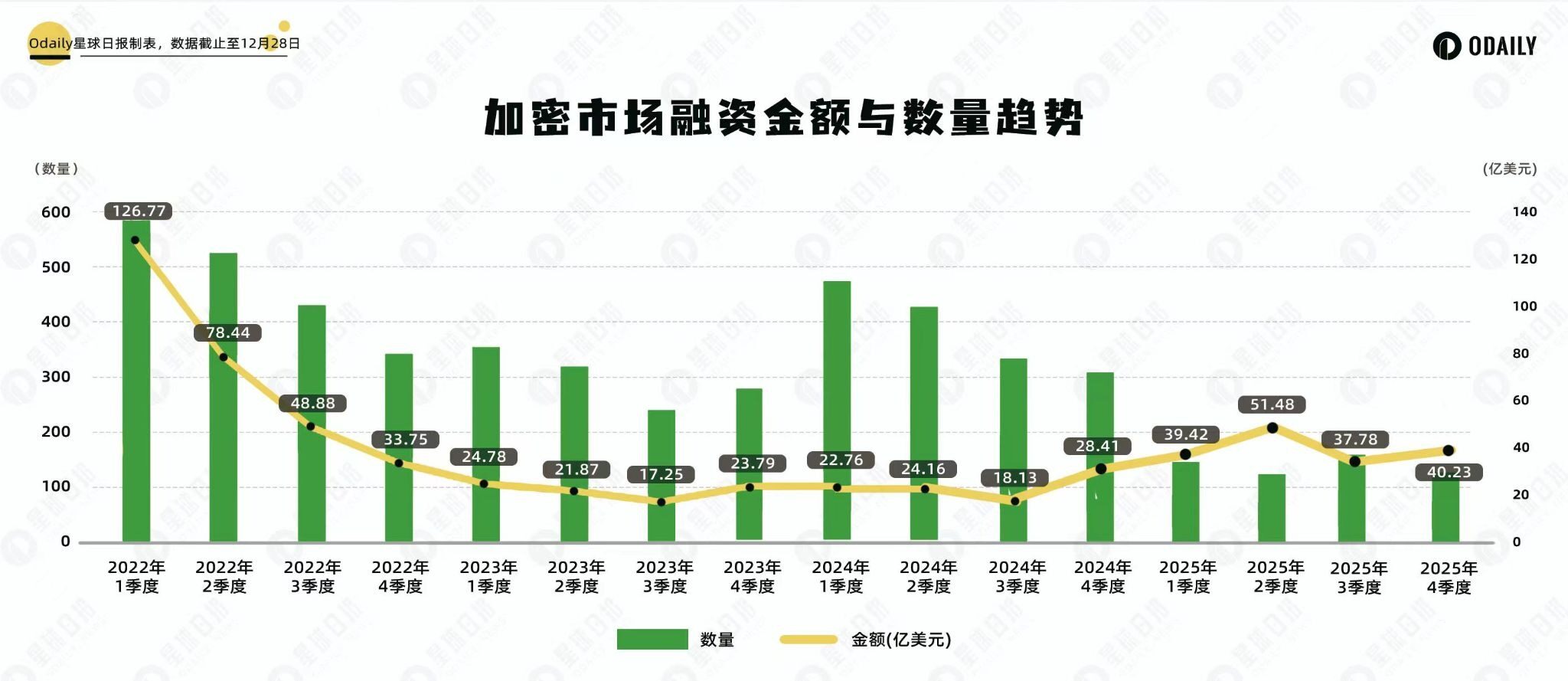
Reviewing the trends in crypto financing over the past four years, the evolution of the relationship between the primary market and secondary market performance becomes clear.

Early 2022 still benefited from the residual heat of the bull market, with both the number of financing events and the amounts raised remaining high; subsequently, as Bitcoin entered a downward cycle, financing activity gradually萎缩. Between 2022 and 2023, investment and financing activities were highly correlated with price movements, remaining overall低迷 under bear market pressure.

2024 became a significant turning point, marking the first divergence between the amount raised and the number of deals.

This year, with the restart of the Bitcoin halving narrative, the number of financing events明显回暖, but the amount raised remained consistently克制. Quarterly financing规模 hovered in the range of $1.8 billion to $2.8 billion, even similar to levels during the bear market. The main reason was that during this period, the crypto market行情 was dominated by Bitcoin and the Meme sector, which stood in stark contrast to the performance of the previous cycle. In the previous cycle, VC-backed projects were often the core of market hotspots, whereas in 2024, VC projects overall performed低迷, struggling to substantially impact the market, which to some extent also抑制了大额融资的出现.

Entering 2025, the divergence phenomenon reappeared, but this time the direction reversed.

The number of financings saw a significant decline, but the amount raised began to回升. Quarterly financing规模 returned to the range of $3.7 billion to $5.1 billion. This means that the average financing size increased significantly; investors are actively reducing the number of investments and instead concentrating their bets on a few projects deemed to have certainty and scalability.

12 Sectors, $178.9 Billion: Structural Changes in the Primary Market

According to incomplete statistics from Odaily Planet Daily, the total primary market investment and financing in 2025 reached $178.9 billion, with a total of 569 financing events. To more accurately depict changes in financing preferences, we have categorized all disclosed financing projects (the actual close time is often earlier than the announcement) into 12 sectors based on business type, target audience, and business model dimensions. These include: CeFi, Infrastructure, RWA, AI, DeFi, SocialFi, Prediction Markets, PayFi, DePIN, BTCFi, L1, and GameFi.
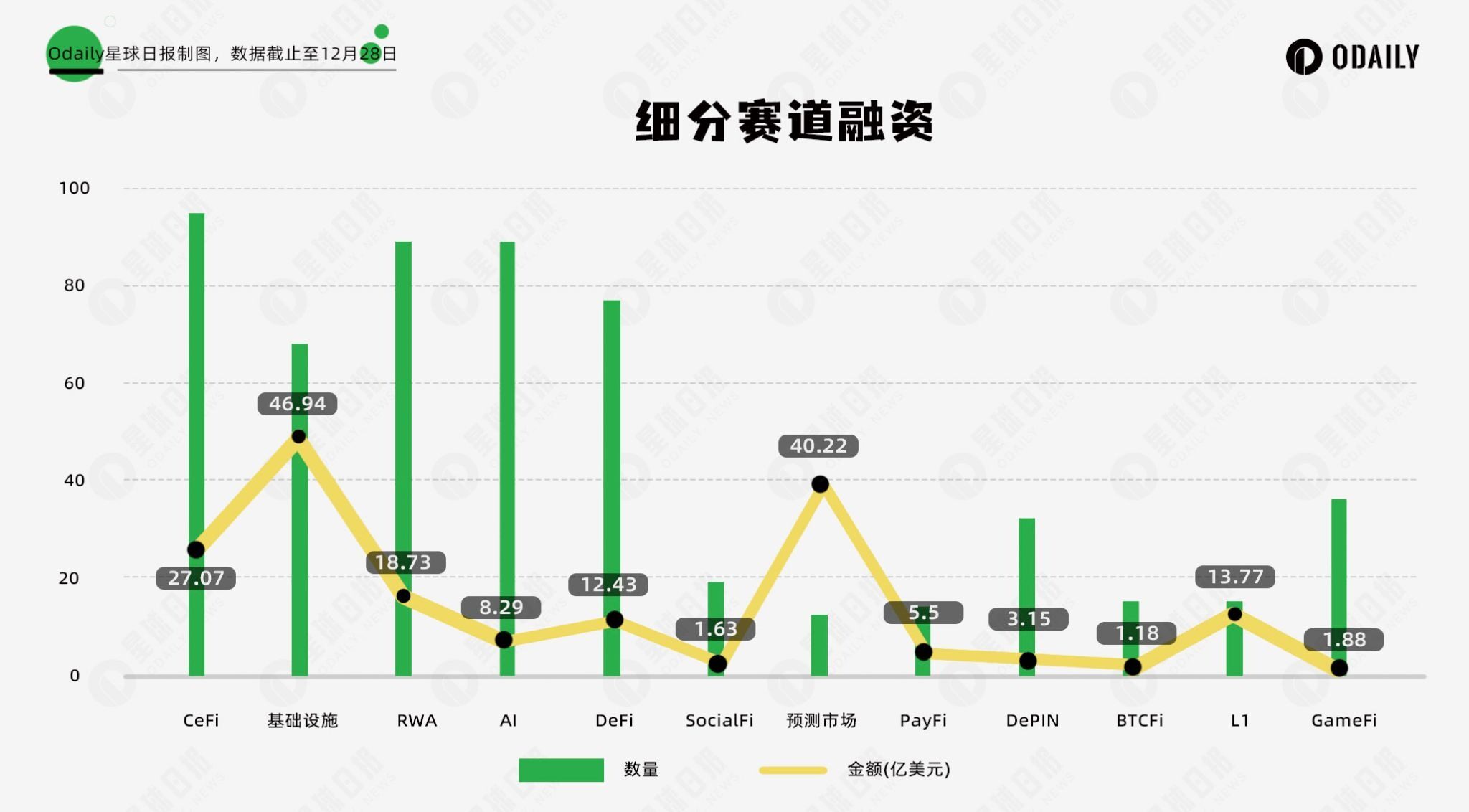
Looking at the financing situation in细分 sectors:

  • CeFi and Infrastructure ranked at the top in terms of both financing amount and number of deals. Underlying capabilities such as trading, custody, clearing, security, and cross-chain remain key areas for continuous capital investment. The market consensus on "infrastructure first" has not wavered.
  • DeFi projects continue to maintain high activity levels. The market still has high demand for innovation in new DeFi protocols, especially as the success of Hyperliquid directly demonstrated to the market that decentralized exchanges can also effectively handle large-scale capital inflows. Perp DEX has become a new financing hotspot.
  • AI and RWA have become new narrative pillars. The former aligns with the main theme of the global tech cycle, while the latter directly benefits from the institutional红利 of tokenizing traditional financial assets. Both paths share a common characteristic: their growth logic no longer relies entirely on the crypto-native market but extends into the broader tech and traditional financial systems.
  • The real dark horse is the Prediction Market sector. Although the number of projects in this sector is not particularly突出 compared to others, the amount raised jumped to become the second-largest sector,仅次于 infrastructure. This indicates that capital is being高度集中地押注 on a few leading projects.
  • In contrast, once-hot sectors like DePIN and GameFi, while still seeing many projects emerge, have experienced a sharp decline in financing appeal, as capital shifts towards areas with greater certainty and economies of scale.

Overall, the primary market is shifting from "casting a wide net" to "intensive cultivation."

Polymarket: Consensus Changes Behind the Top Financing of 2025

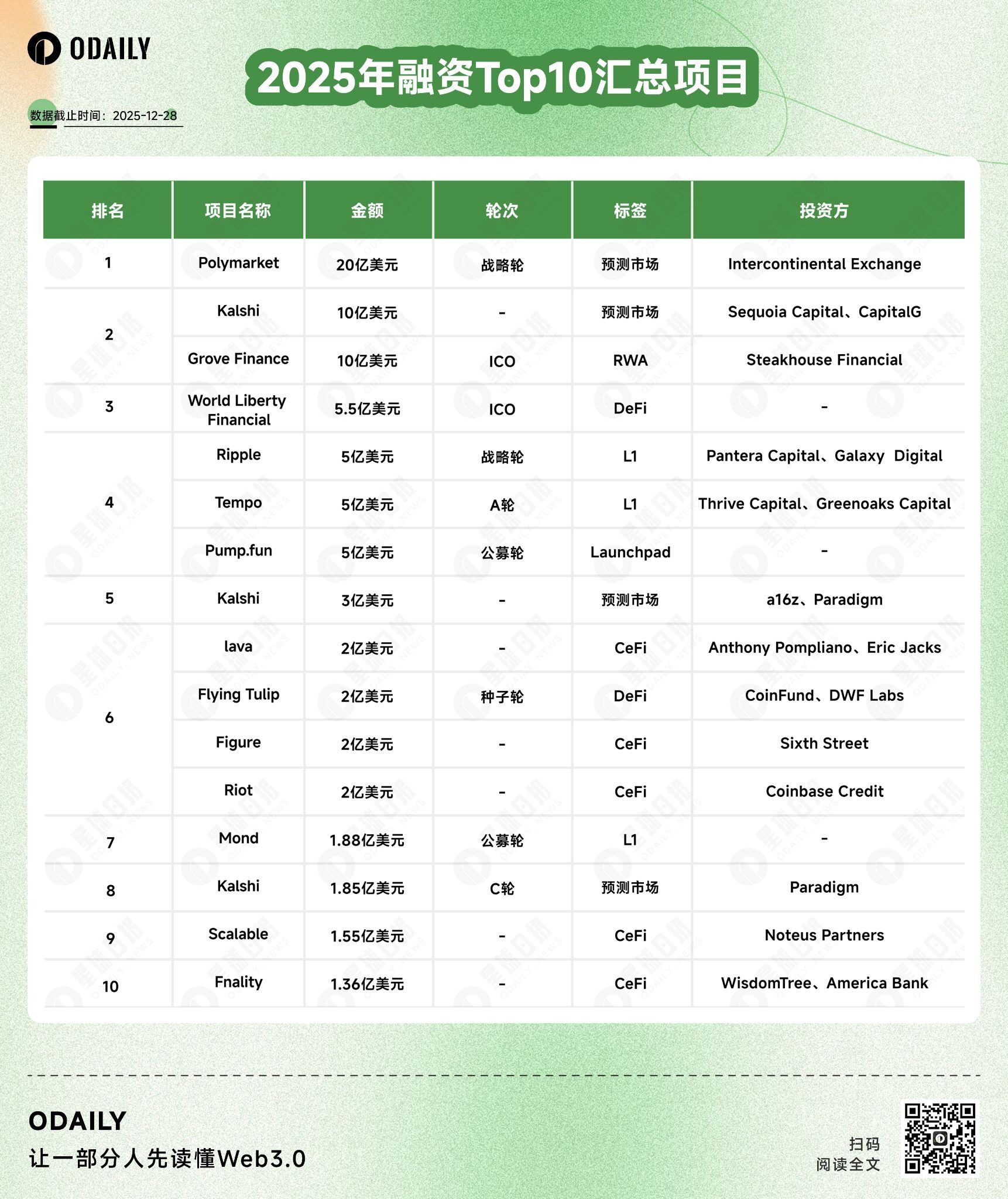
From the list of Top 10 financing amounts in 2025, it can be seen that Polymarket and Kalshi almost constitute the entire narrative of 2025 financing.

Among them, Polymarket has completed nearly $2.5 billion in multiple rounds of financing, with investors including知名加密风投 funds like Polychain, Dragonfly, and Coinbase; Kalshi began to gain momentum in 2025, completing approximately $1.5 billion in financing, supported by Paradigm, a16z, and Coinbase. Unlike Polymarket, Kalshi emphasizes compliance with federal regulation. However, what they share is that prediction markets are being viewed as a financial form with real demand and have now become the most vibrant and positively trending sector.

In the L1 sector, capital preferences similarly persist. On the list, besides the established public chain Ripple, others like Tempo and Mond are new-generation projects. Among them, Mond has already issued tokens, while Tempo has not. This reflects investors' continued investment in underlying infrastructure, with high-performance L1s still seen as the long-term cornerstone for ecosystem expansion.
Conclusion

Overall, the primary market in 2025 did not cool down but is undergoing active convergence and restructuring.

Capital is still flowing, but it is no longer chasing quantity; instead, it is being allocated集中 around certainty, compliance, and scalability potential. This change does not necessarily mean fewer opportunities but may instead signal that the crypto market is entering a more rational and mature stage.


Связанные с этим вопросы

QWhat were the two key legislative developments that supported the growth of the cryptocurrency market in 2025?

AThe two key legislative developments were the formal enactment of the stablecoin-related bill, which provided a clear legal framework for 'on-chain dollars,' and the steady advancement of the cryptocurrency market structure bill, which incorporated crypto assets into a classified regulatory framework.

QHow did the trend of financing events and amounts change from 2024 to 2025?

AIn 2024, there was a first divergence where the number of financing events increased significantly, but the total amount raised remained restrained. In 2025, a second divergence occurred in the opposite direction: the number of financing events dropped significantly, but the total amount of financing increased, indicating a rise in the average deal size as investors concentrated their bets on fewer projects.

QWhich two sectors emerged as new narrative focal points in the 2025 crypto funding landscape, and what was their common characteristic?

AAI and RWA (Real World Assets) emerged as new narrative focal points. Their common characteristic was that their growth logic no longer relied entirely on the crypto-native market but extended into the broader technology and traditional financial systems.

QWhich sector, despite having a relatively low number of projects, saw a massive concentration of funding, becoming the second-largest sector by amount raised?

AThe prediction market sector, with projects like Polymarket and Kalshi, saw a massive concentration of funding, making it the second-largest sector by amount raised, just behind infrastructure.

QWhat overall shift in investment strategy does the 2025 crypto venture capital market represent?

AThe market shifted from a 'wide net' strategy of numerous small bets to a 'precision cultivation' strategy, where capital is concentrated and allocated around projects with regulatory clarity, certainty, and potential for scale, indicating a move towards a more rational and mature stage.

Похожее

Stuck Polymarket: The Real Test After Riding the Traffic Boom Has Arrived

Polymarket, a leading prediction market platform, is facing significant technical challenges as its growth outpaces its current infrastructure on Polygon. Users are experiencing laggy transactions, unresponsive orders, and delayed confirmations, severely impacting the trading experience. In response, DeFi Engineering VP Josh Stevens outlined a comprehensive engineering overhaul. The plan includes reducing on-chain data delays, fixing order cancellation issues, rebuilding the central limit order book (CLOB), improving website performance, and developing a unified SDK and API. A major revelation was the ongoing "chain migration," indicating a potential move away from Polygon. The core issue is that Polymarket has evolved from a simple prediction market into a high-frequency trading platform, making Polygon's limitations—such as block space, gas fees, and block time—a ceiling for further growth. The migration is not just a simple chain switch but a fundamental rebuild of its trading system to support more complex products like perpetual contracts (Perps). This announcement has sparked competition among chains like Solana, Sui, and Algorand, all vying to host Polymarket. For Polygon, losing this key application, which contributes significantly to its gas fee revenue, would be a major setback. The real test for Polymarket is no longer attracting users but proving it can provide a stable, reliable trading environment that retains them.

Odaily星球日报1 мин. назад

Stuck Polymarket: The Real Test After Riding the Traffic Boom Has Arrived

Odaily星球日报1 мин. назад

Lowering Expectations for BTC's Next Bull Market

The author, Alex Xu, explains his decision to significantly reduce his Bitcoin holdings (from full to ~30% of his portfolio) during the current bull cycle, citing a lowered long-term outlook for BTC's price appreciation in the next cycle. He outlines six key reasons for this reduced expectation: 1. **Diminished Growth Drivers:** The narrative of exponential user adoption has largely played out with institutional ETF adoption. The next major growth phase—adoption by sovereign national reserves or central banks—seems unlikely in the near future. 2. **Personal Opportunity Cost:** More attractive investment opportunities have emerged in other assets, such as undervalued companies. 3. **Industry-Wide Contraction:** The broader crypto industry is struggling, with most Web3 business models (SocialFi, GameFi, DePIN) failing. This overall萧条 (depression) reduces the fundamental demand and consensus for Bitcoin. 4. **Strain on Major Buyer:** MicroStrategy, a major corporate buyer of BTC, faces rising financing expenses for its debt, which could slow its purchasing rate and create significant marginal pressure on the market. 5. **Increased Competition from Gold:** The emergence of "tokenized gold" has closed the functional gap (portability, divisibility) between physical gold and Bitcoin, offering a strong competitor in the non-sovereign store-of-value space. 6. **Security Budget Concerns:** The block reward halving continues to exacerbate the long-standing issue of funding Bitcoin's network security, with new fee source explorations like Ordinals and L2s largely failing. The author's decision to hold a significant (though reduced) position reflects a cautious, not bearish, outlook. He remains open to increasing his exposure if the fundamental reasons for his skepticism change or if new positive catalysts emerge.

marsbit40 мин. назад

Lowering Expectations for BTC's Next Bull Market

marsbit40 мин. назад

Can Iran 'Control' the Strait of Hormuz?

Iran has announced a comprehensive plan to assert control over the strategic Strait of Hormuz, a critical global oil shipping chokepoint. The proposed measures include requiring all vessels to obtain Iranian permission for passage, imposing fees for security, environmental protection, and navigation management—preferably paid in Iranian rials—and absolutely banning Israeli ships. Vessels from countries deemed hostile by Iran’s top security bodies may also be barred. Analysts suggest Iran’s motives are multifaceted: increasing pressure on the U.S. and Israel by leveraging control over oil transit to influence global prices and inflation; creating a new revenue stream, potentially exceeding $7.7 billion annually, to counter Western sanctions and support postwar reconstruction; and using transit permissions as bargaining chips in future negotiations, notably with the U.S. However, the plan faces significant practical and diplomatic challenges. Enforcing comprehensive interception and fee collection in the busy waterway, patrolled by international military forces, would be difficult. The U.S. has already countering with a blockade of Iranian ports and threats to intercept any ship paying fees, potentially strangling Iran’s oil exports and fee revenue. Broad international opposition, led by European and Gulf states, and legal controversies further complicate implementation. The proposal may ultimately serve more as a negotiating tactic than a feasible policy, with its execution remaining highly uncertain.

marsbit1 ч. назад

Can Iran 'Control' the Strait of Hormuz?

marsbit1 ч. назад

Торговля

Спот
Фьючерсы
活动图片