Mapping Ethereum’s macro sensitivity – Oil, liquidity & why ETH absorbs it all

ambcryptoОпубликовано 2026-03-16Обновлено 2026-03-16

Введение

The Ethereum market is undergoing a significant structural shift, with derivatives now dominating price discovery. Futures trading on major exchanges like Binance has grown to be over 12 times larger than spot trading. This surge in leveraged activity makes the market more fragile, as evidenced by recent liquidations totaling $135 million, which can trigger rapid price cascades. Concurrently, Ethereum is displaying heightened sensitivity to macroeconomic forces. Rising oil prices above $100 and tightening global liquidity are pressuring risk assets. Due to its critical role as $58.54 billion in collateral within DeFi protocols, ETH is deeply embedded in the financial infrastructure. This positions it as a key gauge for macro risk in the altcoin market, causing its price to react more to geopolitical shocks, energy volatility, and institutional hedging flows than purely crypto-native demand.

Ethereum’s market structure continued shifting toward derivatives dominance at the press time.

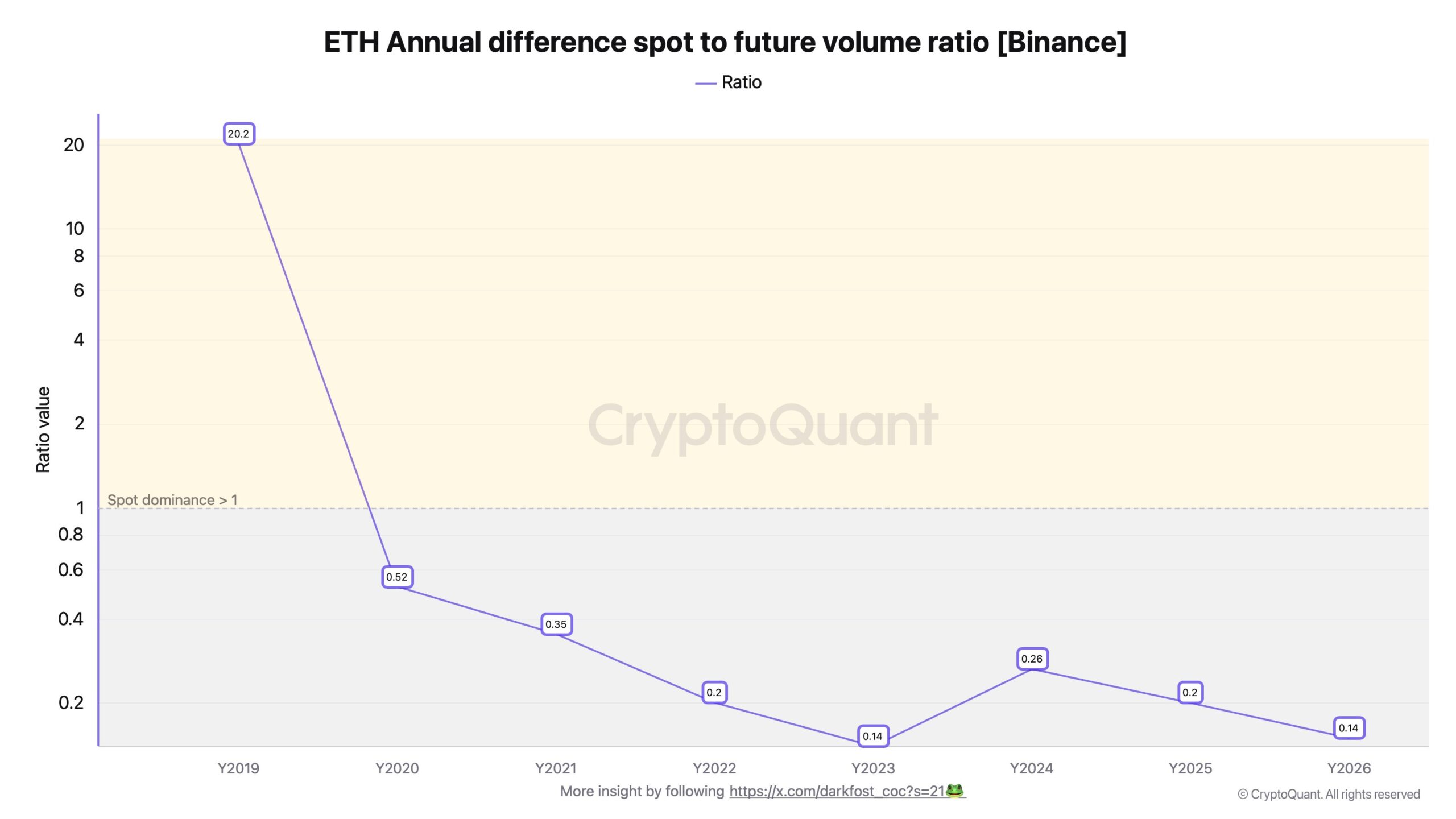
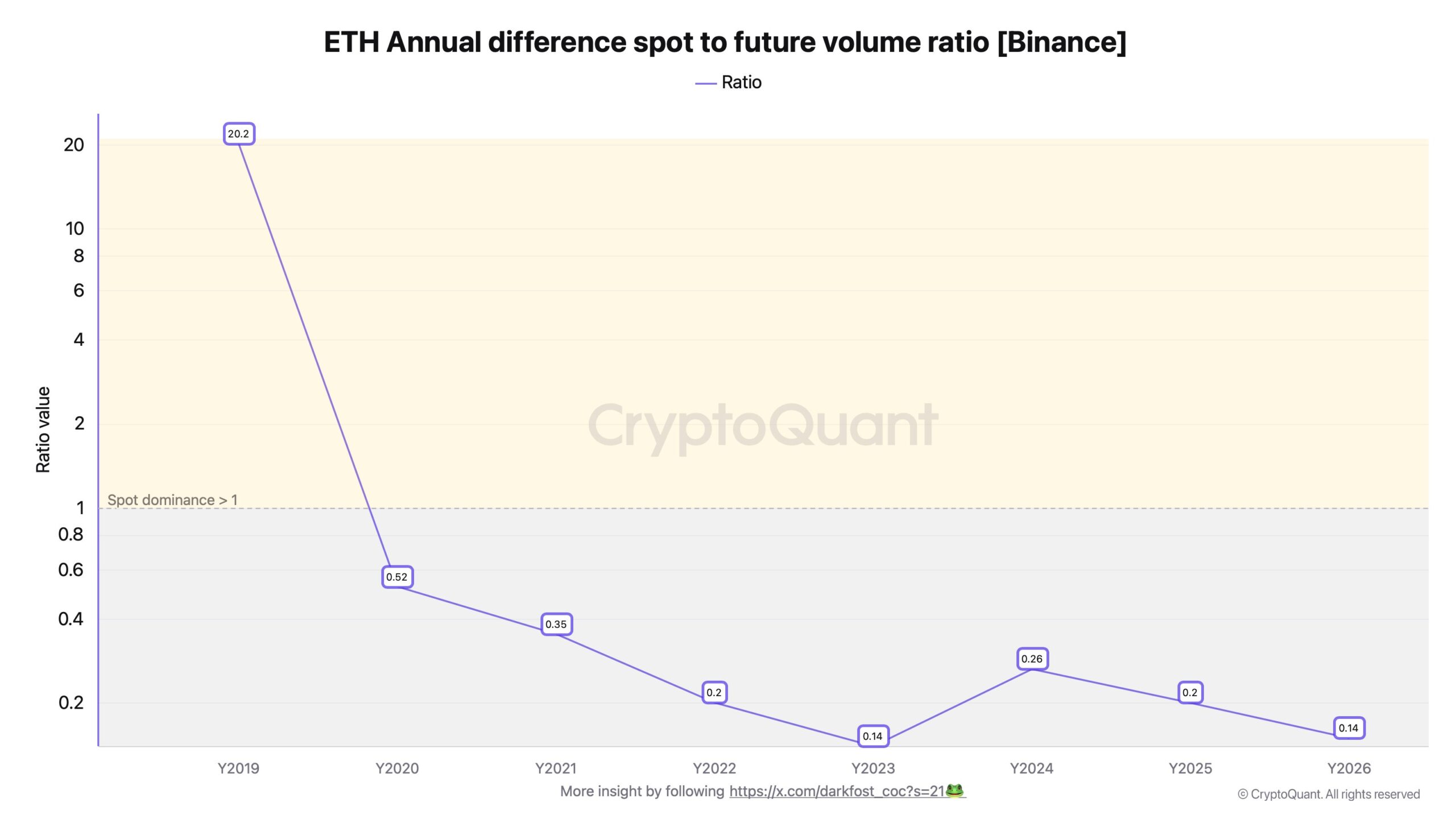
The Spot-to-Futures Volume Ratio on Binance collapsed from 20.2 in 2019 to 0.14 in 2026. This steep decline showed futures markets steadily absorbing price discovery.

As derivatives expand, futures volume exceeded spot activity by more than sixfold.
Source: Darkfost/ X

Meanwhile, positioning across leverage markets has adjusted sharply.

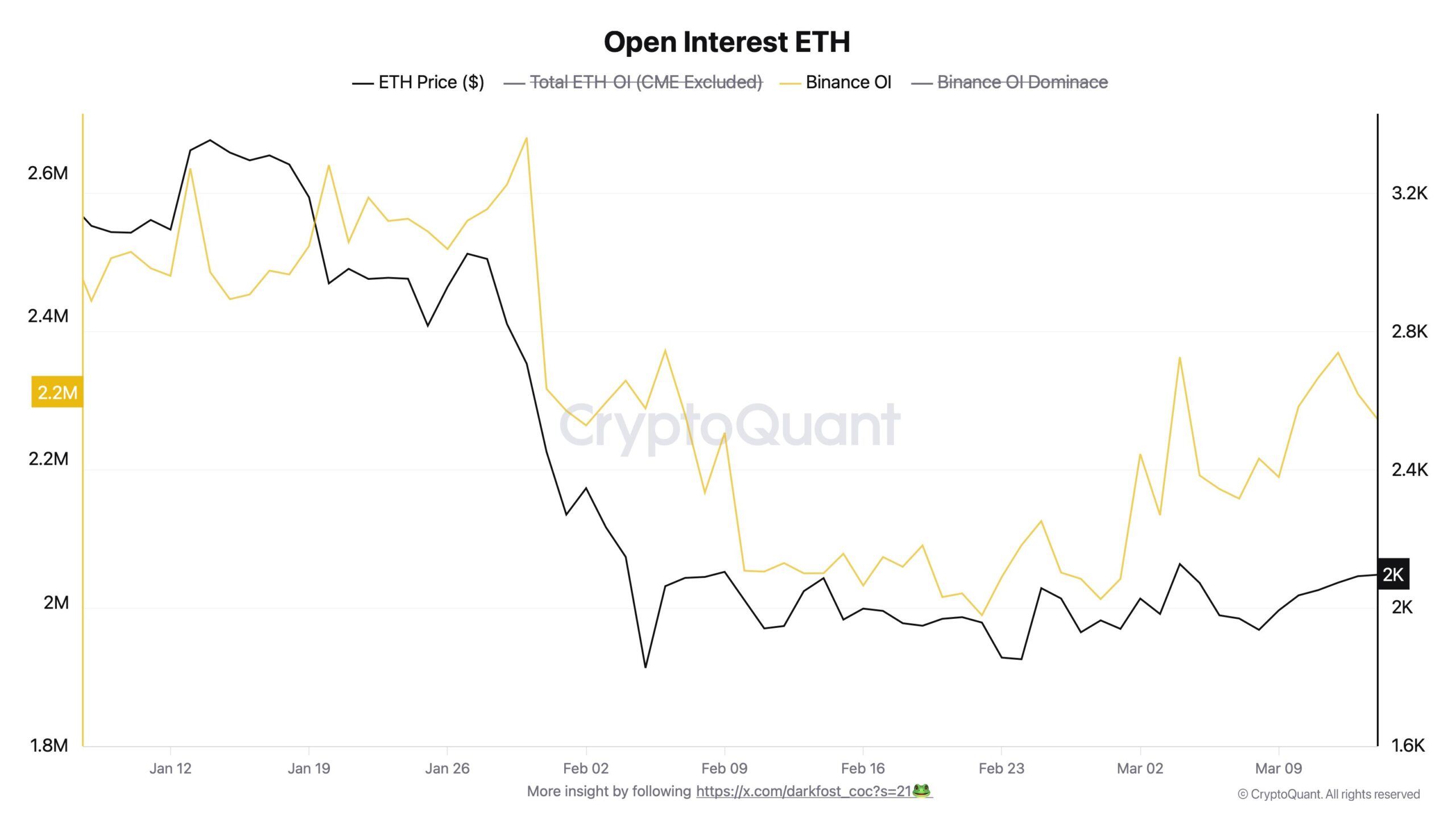
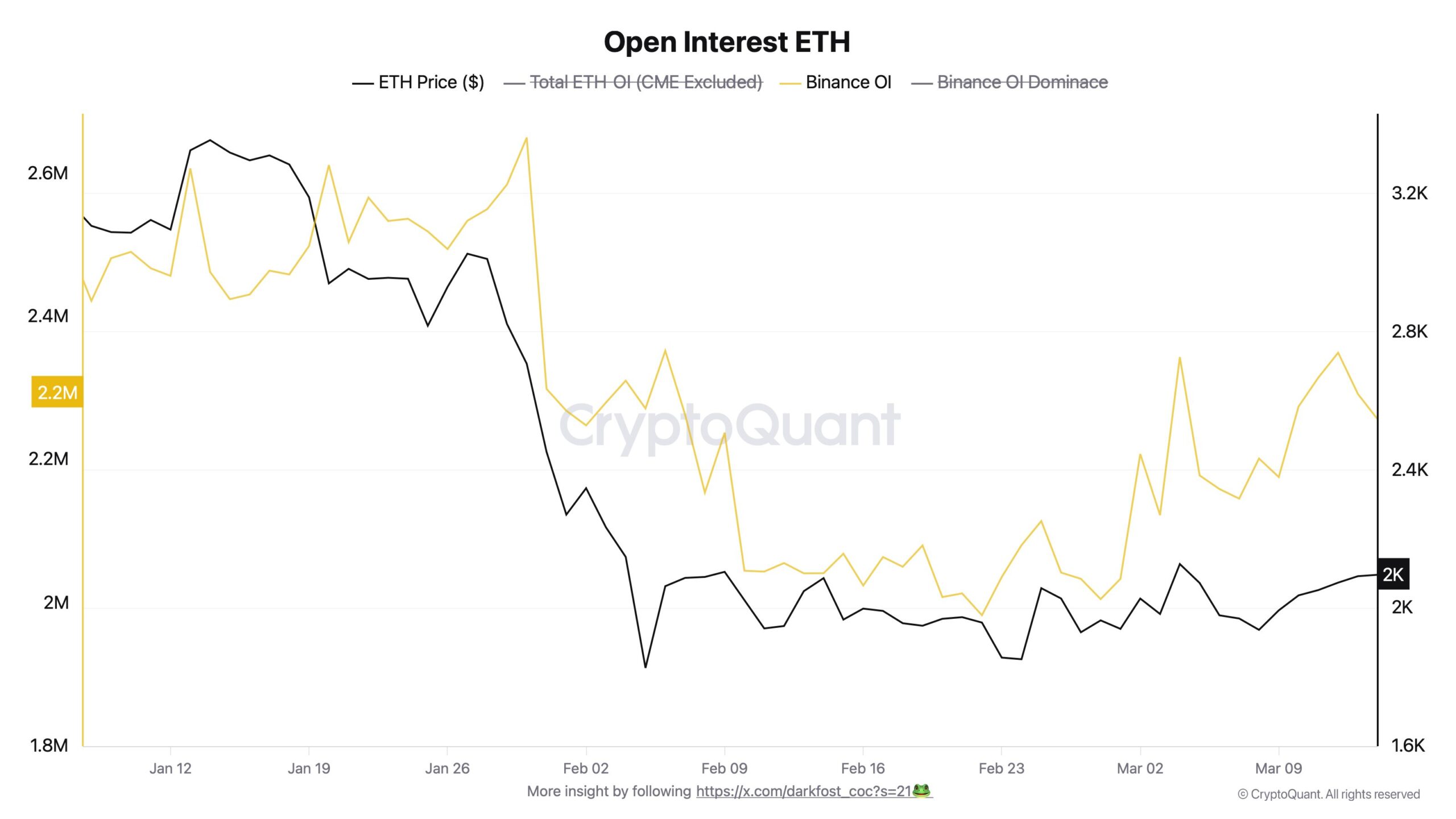
Since January, Binance Open Interest has dropped by roughly 400,000 ETH, equivalent to nearly $4 billion in leaving futures exposure. Yet futures activity remains elevated, signaling that traders rotate positions rather than abandoning leverage entirely.
Source: Darkfost/ X

Alongside this shift, macro pressure is intensifying.

Brent crude climbed above $100 as geopolitical tensions rose. Higher energy costs tighten liquidity conditions globally.

As liquidity compresses and yields rise, investors reduce exposure to risk assets. Within this environment, Ethereum [ETH] increasingly reacts to macro capital flows rather than purely crypto-native demand.

Derivatives now drive Ethereum price discovery

Ethereum’s price discovery is steadily shifting toward derivatives markets.

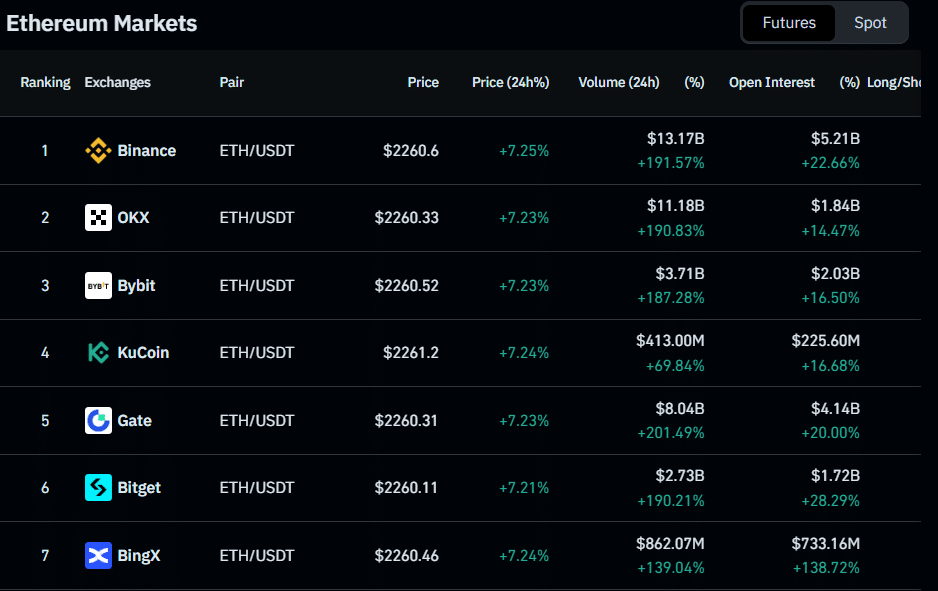
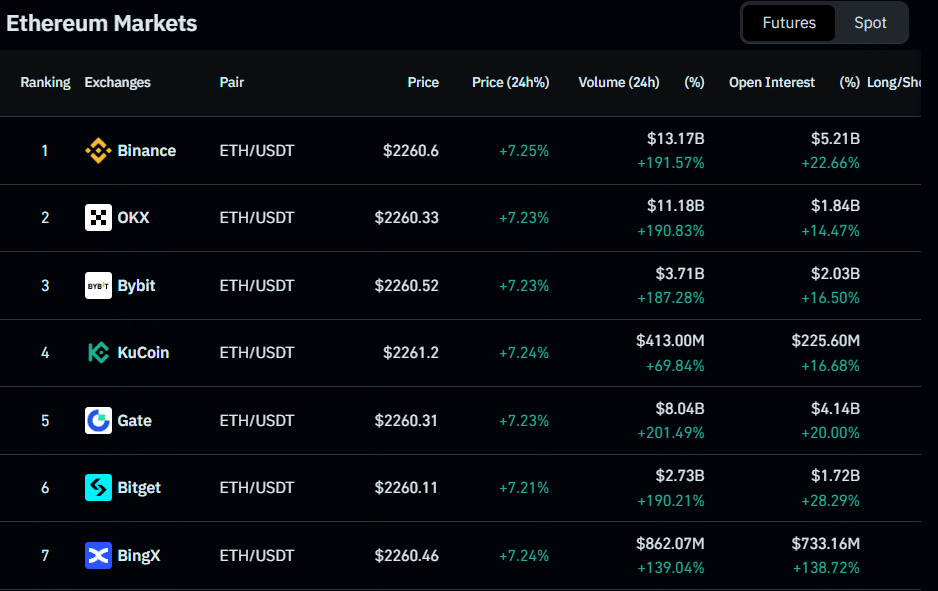
Aggregated Futures Volume reached over $57 billion in 24 hours, signaling where most trading activity now concentrates.

Meanwhile, Spot markets remain comparatively thin. On Binance, Futures Turnover hit $13.17 billion, while Spot Volume reached only $1.1 billion.

This imbalance places derivatives activity roughly 12.5 times larger than physical trading.
Source: CoinGlass

As liquidity concentrates in perpetual contracts, short-term positioning increasingly drives price action. Within this structure, leveraged exposure becomes fragile.

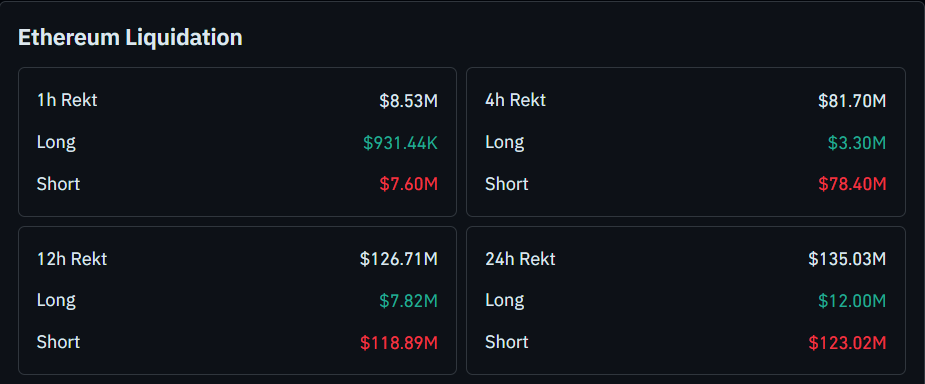
Recent liquidations totaled $135.03 million in 24 hours, triggering rapid cascades across derivatives markets.

Source: CoinGlass

As these liquidations unfold, volatility often accelerates. Ethereum, therefore, reacts more to leveraged positioning dynamics than steady spot accumulation.

Ethereum emerges as the altcoin market’s macro risk gauge

Oil markets are tightening as Brent crude pushes firmly above the $100 threshold. Such energy spikes often revive inflation concerns and pressure global liquidity conditions.

Meanwhile, the U.S. Dollar Index stabilizes near 100.39 while 10-year Treasury yields hover around 4.28%. These shifts gradually push investors toward defensive positioning across financial markets.

As liquidity tightens, risk assets typically absorb the pressure first.

Within this macro environment, Ethereum shows heightened sensitivity compared with most altcoins. ETH secures roughly $58.54 billion in collateral across DeFi protocols such as Aave and Lido.

This structural role keeps ETH deeply embedded in trading and lending infrastructure. As institutional desks hedge exposures through ETH markets, geopolitical shocks and energy volatility increasingly ripple into Ethereum’s price behavior.


Final Summary

  • Ethereum [ETH] derivatives markets now dominate price formation as futures volume exceeds spot activity by over sixfold, while leverage-driven liquidations increasingly amplify short-term volatility.
  • Ethereum is becoming a macro-sensitive altcoin as rising oil prices, tightening liquidity, and institutional hedging flows increasingly shape ETH market behavior.

Связанные с этим вопросы

QHow has the Spot-to-Futures Volume Ratio on Binance changed from 2019 to 2026, and what does this indicate?

AThe Spot-to-Futures Volume Ratio on Binance collapsed from 20.2 in 2019 to 0.14 in 2026, indicating that futures markets have steadily absorbed price discovery and now dominate trading activity.

QWhat is the current relationship between futures volume and spot activity for Ethereum trading?

AFutures volume now exceeds spot activity by more than sixfold, with derivatives activity being roughly 12.5 times larger than physical trading.
QHow much Binance Open Interest has left Ethereum futures markets since January, and what does this suggest about trader behavior?

ABinance Open Interest has dropped by roughly 400,000 ETH (nearly $4 billion) since January, suggesting that traders are rotating positions rather than abandoning leverage entirely.

QWhy is Ethereum increasingly reacting to macro capital flows according to the article?

AEthereum is increasingly reacting to macro capital flows due to tightening global liquidity conditions from rising oil prices and geopolitical tensions, which cause investors to reduce exposure to risk assets.

QWhat role does Ethereum's $58.54 billion in DeFi collateral play in its market behavior?

AEthereum's $58.54 billion in collateral across DeFi protocols like Aave and Lido embeds it deeply in trading and lending infrastructure, making it more sensitive to institutional hedging flows and macro shocks.

Похожее

How Many Tokens Away Is Yang Zhilin from the 'Moon Chasing the Light'?

The article explores the intense competition between two leading Chinese AI companies, DeepSeek and Kimi (Moon Dark Side), and the mounting pressure on Yang Zhilin, the founder of Kimi. While DeepSeek re-emerged after 15 months of silence with its powerful V4 model—boasting 1.6 trillion parameters and low-cost, long-context capabilities—Kimi has been focusing on long-context processing and multi-agent systems with its K2.6 model. Yang faces a threefold challenge: technological rivalry, commercialization pressure, and investor expectations. Despite Kimi’s high valuation (reaching $18 billion), its revenue heavily relies on a single product with low paid conversion rates, while DeepSeek’s strategic silence and open-source influence have strengthened its market position and valuation prospects, now targeting over $20 billion. Both companies reflect broader trends in China’s AI ecosystem: Kimi aims for global influence through open-source contributions and agent-based advancements, while DeepSeek prioritizes foundational innovation and hardware independence, notably shifting to Huawei’s chips. Their competition is seen as vital for China’s AI progress, with the gap between top Chinese and U.S. models narrowing to just 2.7% on the Elo rating scale. Ultimately, the article argues that this rivalry, though anxiety-inducing for leaders like Zhilin, is essential for driving innovation and solidifying China’s role in the global AI landscape.

marsbit1 ч. назад

How Many Tokens Away Is Yang Zhilin from the 'Moon Chasing the Light'?

marsbit1 ч. назад

TechFlow Intelligence Bureau: ChatGPT Helps Amateur Mathematician Crack 60-Year-Old Problem, CFTC Sues New York Regulator Over Coinbase and Gemini

An amateur mathematician, with the assistance of ChatGPT, has solved a combinatorial mathematics puzzle originally proposed by Hungarian mathematician Paul Erdős in the 1960s. This marks another milestone in AI-aided mathematical research, demonstrating the evolving capabilities of large language models in formal reasoning. In other AI developments, OpenAI introduced a new privacy filter tool for enterprise API usage, automatically screening sensitive data. Meanwhile, the Qwen3.6-27B model achieved 100 tokens per second on a single RTX 5090 GPU using quantization, significantly lowering the cost barrier for local AI deployment. In crypto and Web3, the U.S. CFTC sued New York’s financial regulator, challenging its oversight of Coinbase and Gemini—a first-of-its-kind federal-state regulatory clash. Following a vulnerability, KelpDAO and major DeFi protocols established a recovery fund. Tether froze $344 million in assets linked to Iran’s central bank upon U.S. Treasury request, highlighting the centralized control risks in stablecoins. Separately, Litecoin underwent a 3-hour chain reorganization to undo a privacy-layer exploit. In the U.S., former President Trump invoked the Defense Production Act to address power grid bottlenecks affecting AI data centers and dismissed the entire National Science Board, raising concerns over research independence. A retail trader gained 250% on a $600k Intel options bet amid AI-related speculation. Xiaomi announced its first performance electric vehicle, targeting rivals like Tesla. Meanwhile, iPhone users reported devices automatically reinstalling a hidden app daily, suspected to be MDM-related. A Chinese securities report noted that A-share institutional crowding has reached its second-longest streak since 2007, signaling high valuations and potential style rotation. The day’s developments reflect a dual narrative: AI is enabling unprecedented individual breakthroughs, while centralized power structures—whether governmental or corporate—are becoming more assertive, underscoring that decentralization is as much a political-economic challenge as a technical one.

marsbit2 ч. назад

TechFlow Intelligence Bureau: ChatGPT Helps Amateur Mathematician Crack 60-Year-Old Problem, CFTC Sues New York Regulator Over Coinbase and Gemini

marsbit2 ч. назад

Торговля

Спот
Фьючерсы

Популярные статьи

Как купить S

Добро пожаловать на HTX.com! Мы сделали приобретение Sonic (S) простым и удобным. Следуйте нашему пошаговому руководству и отправляйтесь в свое крипто-путешествие.Шаг 1: Создайте аккаунт на HTXИспользуйте свой адрес электронной почты или номер телефона, чтобы зарегистрироваться и бесплатно создать аккаунт на HTX. Пройдите удобную регистрацию и откройте для себя весь функционал.Создать аккаунтШаг 2: Перейдите в Купить криптовалюту и выберите свой способ оплатыКредитная/Дебетовая Карта: Используйте свою карту Visa или Mastercard для мгновенной покупки Sonic (S).Баланс: Используйте средства с баланса вашего аккаунта HTX для простой торговли.Третьи Лица: Мы добавили популярные способы оплаты, такие как Google Pay и Apple Pay, для повышения удобства.P2P: Торгуйте напрямую с другими пользователями на HTX.Внебиржевая Торговля (OTC): Мы предлагаем индивидуальные услуги и конкурентоспособные обменные курсы для трейдеров.Шаг 3: Хранение Sonic (S)После приобретения вами Sonic (S) храните их в своем аккаунте на HTX. В качестве альтернативы вы можете отправить их куда-либо с помощью перевода в блокчейне или использовать для торговли с другими криптовалютами.Шаг 4: Торговля Sonic (S)С легкостью торгуйте Sonic (S) на спотовом рынке HTX. Просто зайдите в свой аккаунт, выберите торговую пару, совершайте сделки и следите за ними в режиме реального времени. Мы предлагаем удобный интерфейс как для начинающих, так и для опытных трейдеров.

1.2k просмотров всегоОпубликовано 2025.01.15Обновлено 2025.03.21

Как купить S

Sonic: Обновления под руководством Андре Кронье – новая звезда Layer-1 на фоне спада рынка

Он решает проблемы масштабируемости, совместимости между блокчейнами и стимулов для разработчиков с помощью технологических инноваций.

2.2k просмотров всегоОпубликовано 2025.04.09Обновлено 2025.04.09

Sonic: Обновления под руководством Андре Кронье – новая звезда Layer-1 на фоне спада рынка

HTX Learn: Пройдите обучение по "Sonic" и разделите 1000 USDT

HTX Learn — ваш проводник в мир перспективных проектов, и мы запускаем специальное мероприятие "Учитесь и Зарабатывайте", посвящённое этим проектам. Наше новое направление .

1.8k просмотров всегоОпубликовано 2025.04.10Обновлено 2025.04.10

HTX Learn: Пройдите обучение по "Sonic" и разделите 1000 USDT

Обсуждения

Добро пожаловать в Сообщество HTX. Здесь вы сможете быть в курсе последних новостей о развитии платформы и получить доступ к профессиональной аналитической информации о рынке. Мнения пользователей о цене на S (S) представлены ниже.

活动图片