Lighter jumps 11% as buybacks tighten supply: Is a breakout toward $1 next?

ambcryptoОпубликовано 2026-04-02Обновлено 2026-04-02

Введение

LIT (Lighter) surged 11.31% to $0.8818 as cumulative buybacks reached 9.55 million tokens, reducing circulating supply by nearly 4%. This consistent token removal, including over 606K LIT bought back recently, has tightened supply and supported price stability. The rebound from the $0.80 support level indicates weakening bearish momentum, with potential to challenge the $1.00 resistance. Open Interest rose 33.62% to $143 million, reflecting increased leveraged participation and trader confidence. Positive funding rates show longs are dominant, reinforcing structural recovery. Improved technicals and sustained demand suggest a breakout toward $1 is likely.

Lighter has surged 11.31% to $0.8818 as cumulative buybacks reached 9.55 million LIT, rising from 7.48 million earlier in March.

This steady accumulation reflects consistent demand from the protocol, which continues removing tokens from circulation. As a result, nearly 4% of supply now sits absorbed, reducing immediate sell-side availability.

Recent purchases, including over 606K LIT within a week, have reinforced this pattern of sustained accumulation. Lower average buyback prices between $0.80 and $0.95 further increased efficiency, allowing more tokens to exit the market per dollar spent.

This tightening supply condition is now aligned with LIT’s recovery, suggesting structural support continues strengthening beneath current levels.

LIT rebounds as channel weakens

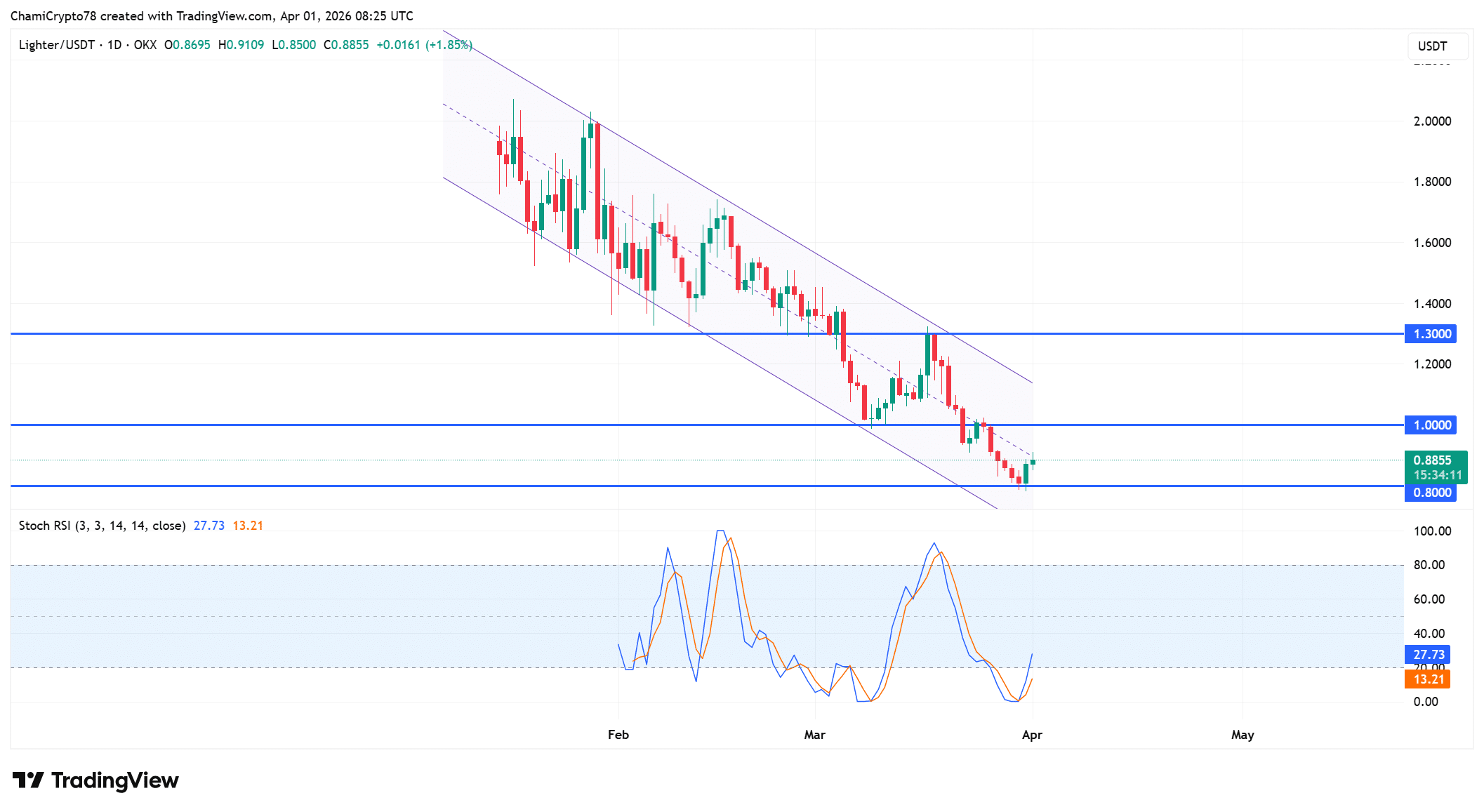
Lighter has rebounded from the $0.80 support zone after respecting the lower boundary of its descending channel. This reaction follows a series of lower lows, which had defined the broader downtrend since February.

However, recent candles showed reduced downside extension, indicating that bearish pressure was weakening near demand. At press time, LIT traded around $0.88 while attempting to reclaim short-term structure inside the channel.

The breakdown pace has slowed, which reflects a shift in seller control. If this recovery continues, price would likely challenge the $1.00 resistance, which aligns with previous consolidation zones.

Above that, $1.30 remains the next key level where prior rejection occurred. Stoch RSI has rebounded from deeply oversold conditions, with readings now at 27.73 and 13.21.

This shift follows a prolonged period of suppressed momentum, where price consistently printed lower lows. The indicator now shows a clear upward turn, reflecting renewed buying activity entering the market.

Source: TradingView

Open Interest expands with participation

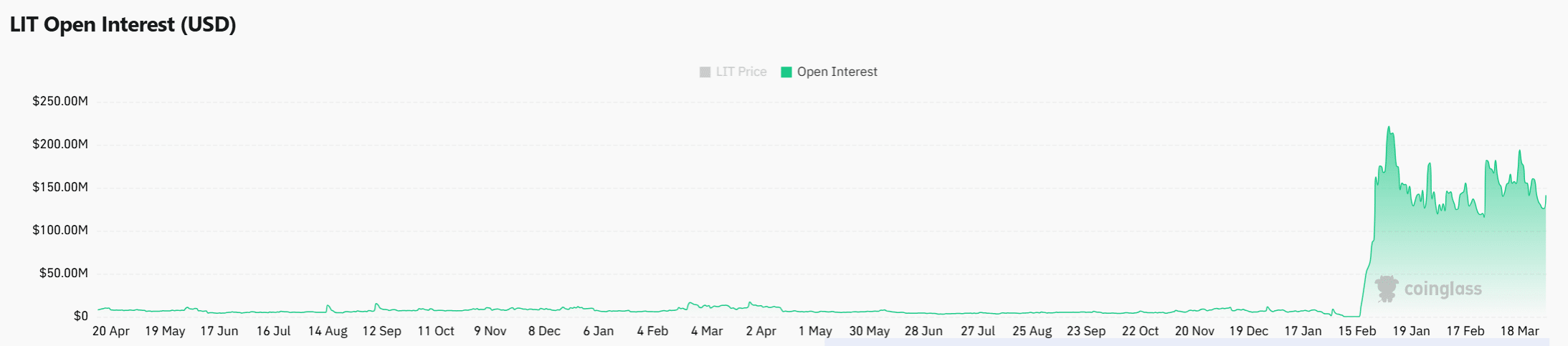
Open interest has surged 33.62% to $143 million, signaling a sharp increase in leveraged participation. This rise occurs alongside price recovery, which indicates that new positions are entering rather than closing out.

Traders now show growing interest in LIT, as capital flows into derivatives markets at a faster pace. This expansion reflects stronger engagement and rising conviction among participants.

Source: CoinGlass

Unlike declining Open Interest scenarios, which often signal uncertainty, this increase supports ongoing activity around current levels.

Funding stays positive as longs dominate

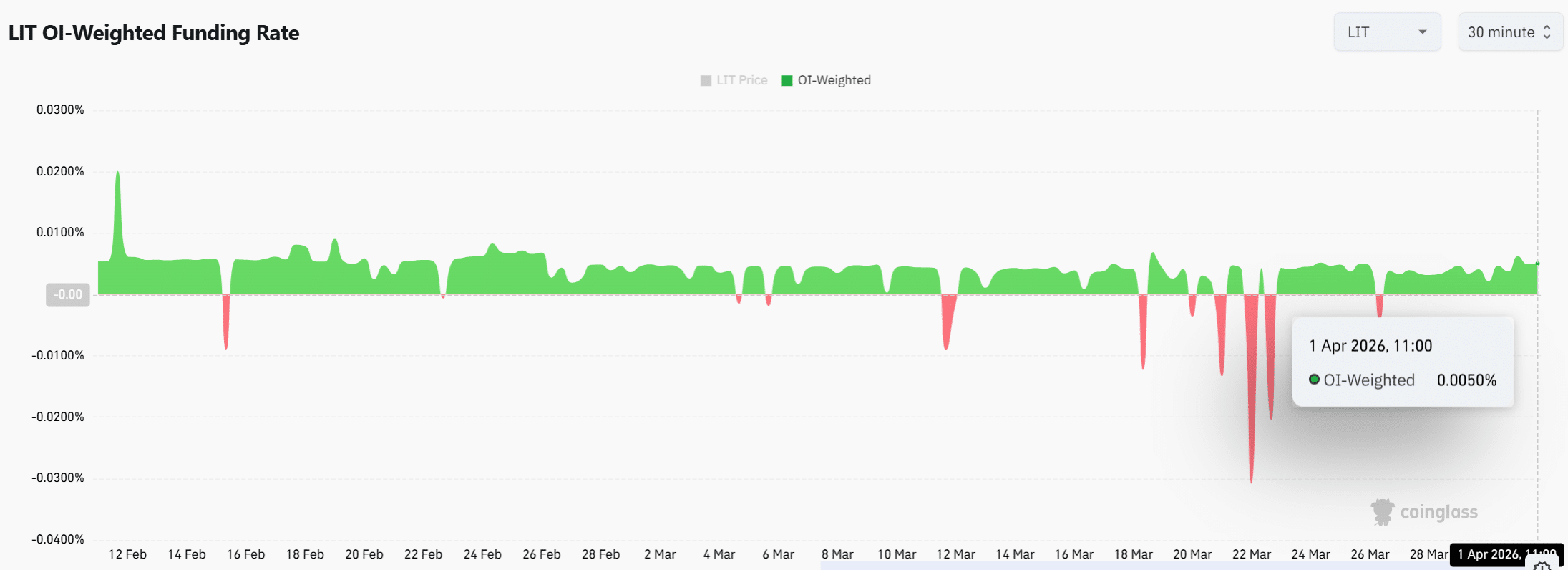
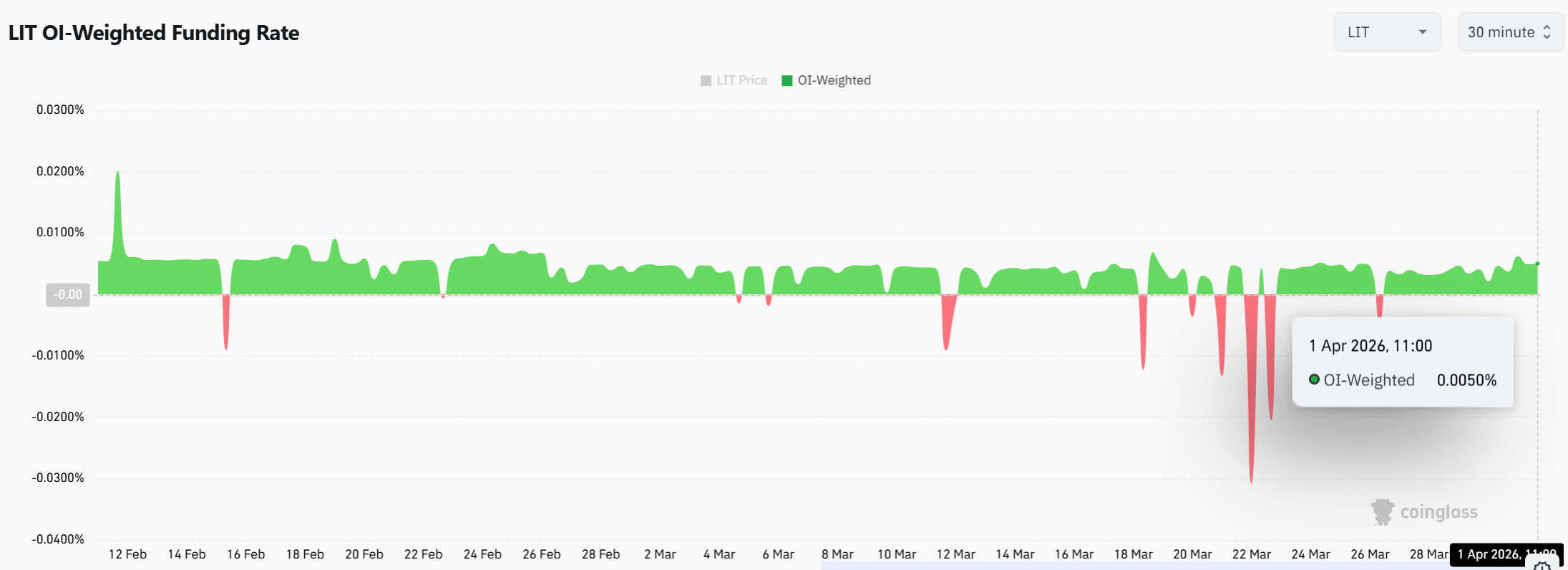
OI-Weighted Funding Rates sat at 0.0050% at the time of writing, maintaining positive positioning across derivatives markets. This sustained level indicated that long traders continued paying premiums to hold positions, reflecting confidence in upward price direction.

Earlier negative spikes had revealed aggressive short pressure, which often preceded liquidation events. However, current conditions show that sentiment has stabilized, with longs maintaining control.

This shift suggests that bearish conviction has weakened after repeated failures to push price lower. As funding remains positive, it reinforces the broader structure where buyers gradually regain dominance across leveraged markets.

Source: CoinGlass

LIT now shows strengthening structure as buybacks tighten supply while participation expands across derivatives markets. Price has stabilized above $0.80 and continues pushing higher with improving conditions.

This alignment suggests recovery remains supported, positioning LIT to challenge the $1.00 resistance zone.


Final Summary

  • Sustained buybacks continue tightening supply, which supports price stability.
  • Rising participation alongside improving structure suggests that buyers are regaining control, which could drive continuation toward higher resistance zones.

Связанные с этим вопросы

QWhat is the main reason for LIT's 11.31% price surge to $0.8818?

AThe main reason is cumulative buybacks reaching 9.55 million LIT, which has tightened the token's circulating supply and reduced immediate sell-side availability.

QHow much of LIT's total supply has been absorbed by the buyback program?

ANearly 4% of LIT's total supply has been absorbed by the buyback program.

QWhat key resistance level is LIT positioned to challenge if its recovery continues?

AIf the recovery continues, LIT is positioned to challenge the $1.00 resistance level, with $1.30 being the next key level beyond that.

QWhat does the 33.62% increase in Open Interest to $143 million indicate?

AThe 33.62% surge in Open Interest indicates a sharp increase in leveraged participation and new positions entering the market, reflecting stronger trader engagement and rising conviction.

QWhat does the positive OI-Weighted Funding Rate of 0.0050% signify for market sentiment?

AThe positive funding rate signifies that long traders are paying premiums to hold their positions, reflecting confidence in an upward price direction and indicating that buyers are regaining dominance.

Похожее

Stuck Polymarket: The Real Test After Riding the Traffic Boom Has Arrived

Polymarket, a leading prediction market platform, is facing significant technical challenges as its growth outpaces its current infrastructure on Polygon. Users are experiencing laggy transactions, unresponsive orders, and delayed confirmations, severely impacting the trading experience. In response, DeFi Engineering VP Josh Stevens outlined a comprehensive engineering overhaul. The plan includes reducing on-chain data delays, fixing order cancellation issues, rebuilding the central limit order book (CLOB), improving website performance, and developing a unified SDK and API. A major revelation was the ongoing "chain migration," indicating a potential move away from Polygon. The core issue is that Polymarket has evolved from a simple prediction market into a high-frequency trading platform, making Polygon's limitations—such as block space, gas fees, and block time—a ceiling for further growth. The migration is not just a simple chain switch but a fundamental rebuild of its trading system to support more complex products like perpetual contracts (Perps). This announcement has sparked competition among chains like Solana, Sui, and Algorand, all vying to host Polymarket. For Polygon, losing this key application, which contributes significantly to its gas fee revenue, would be a major setback. The real test for Polymarket is no longer attracting users but proving it can provide a stable, reliable trading environment that retains them.

Odaily星球日报53 мин. назад

Stuck Polymarket: The Real Test After Riding the Traffic Boom Has Arrived

Odaily星球日报53 мин. назад

Lowering Expectations for BTC's Next Bull Market

The author, Alex Xu, explains his decision to significantly reduce his Bitcoin holdings (from full to ~30% of his portfolio) during the current bull cycle, citing a lowered long-term outlook for BTC's price appreciation in the next cycle. He outlines six key reasons for this reduced expectation: 1. **Diminished Growth Drivers:** The narrative of exponential user adoption has largely played out with institutional ETF adoption. The next major growth phase—adoption by sovereign national reserves or central banks—seems unlikely in the near future. 2. **Personal Opportunity Cost:** More attractive investment opportunities have emerged in other assets, such as undervalued companies. 3. **Industry-Wide Contraction:** The broader crypto industry is struggling, with most Web3 business models (SocialFi, GameFi, DePIN) failing. This overall萧条 (depression) reduces the fundamental demand and consensus for Bitcoin. 4. **Strain on Major Buyer:** MicroStrategy, a major corporate buyer of BTC, faces rising financing expenses for its debt, which could slow its purchasing rate and create significant marginal pressure on the market. 5. **Increased Competition from Gold:** The emergence of "tokenized gold" has closed the functional gap (portability, divisibility) between physical gold and Bitcoin, offering a strong competitor in the non-sovereign store-of-value space. 6. **Security Budget Concerns:** The block reward halving continues to exacerbate the long-standing issue of funding Bitcoin's network security, with new fee source explorations like Ordinals and L2s largely failing. The author's decision to hold a significant (though reduced) position reflects a cautious, not bearish, outlook. He remains open to increasing his exposure if the fundamental reasons for his skepticism change or if new positive catalysts emerge.

marsbit1 ч. назад

Lowering Expectations for BTC's Next Bull Market

marsbit1 ч. назад

Can Iran 'Control' the Strait of Hormuz?

Iran has announced a comprehensive plan to assert control over the strategic Strait of Hormuz, a critical global oil shipping chokepoint. The proposed measures include requiring all vessels to obtain Iranian permission for passage, imposing fees for security, environmental protection, and navigation management—preferably paid in Iranian rials—and absolutely banning Israeli ships. Vessels from countries deemed hostile by Iran’s top security bodies may also be barred. Analysts suggest Iran’s motives are multifaceted: increasing pressure on the U.S. and Israel by leveraging control over oil transit to influence global prices and inflation; creating a new revenue stream, potentially exceeding $7.7 billion annually, to counter Western sanctions and support postwar reconstruction; and using transit permissions as bargaining chips in future negotiations, notably with the U.S. However, the plan faces significant practical and diplomatic challenges. Enforcing comprehensive interception and fee collection in the busy waterway, patrolled by international military forces, would be difficult. The U.S. has already countering with a blockade of Iranian ports and threats to intercept any ship paying fees, potentially strangling Iran’s oil exports and fee revenue. Broad international opposition, led by European and Gulf states, and legal controversies further complicate implementation. The proposal may ultimately serve more as a negotiating tactic than a feasible policy, with its execution remaining highly uncertain.

marsbit2 ч. назад

Can Iran 'Control' the Strait of Hormuz?

marsbit2 ч. назад

Торговля

Спот
Фьючерсы
活动图片