Author: Wenser
Original Title: Binance Launches Tesla Contracts, Targeting Nasdaq and NYSE
Following Nasdaq and NYSE's successive applications for tokenized stock trading, the leading crypto exchange Binance recently sounded the "counterattack horn of CeFi against TradFi."
On January 24, a Binance spokesperson stated that they are "exploring relisting stock tokens"; two days later, Binance officially announced that "Tesla (TSLA) stock perpetual contracts will be launched on January 28, with leverage of up to 5x."
It is worth mentioning that this is Binance's bold attempt after discontinuing support for stock tokens in July 2021, marking a span of 5 years. Times have changed, and the current market regulatory environment, infrastructure construction, and other aspects have undergone earth-shaking transformations.
Binance's move may signify that the "liquidity battle" between CEXs and traditional stock exchanges has begun. Odaily Planet Daily will provide a brief analysis of this matter in this article for readers' reference.
Tesla Once Again Becomes Binance's Testing Ground for Tokenized Stock Trading
The short-lived "stock token experiment" in 2021 left Binance not only with the pressure of facing regulatory compliance forces but also with a setback for CeFi forces against the TradFi势力 of traditional financial markets.
Today, 5 years later, Binance's restart of stock token contract trading harbors greater ambitions. The reasons lie in the following three significant changes:
First, the "crypto-friendly attitude" of U.S. government regulatory agencies. After the Biden administration stepped down, the Trump administration ignited a "crypto storm" in the U.S. and globally, creating a "new crypto regulatory environment" through personnel appointments, organizational restructuring, legislation, and other means, clearing the atmosphere of the U.S. crypto market;
Second, the booming development of tokenized stock trading. According to information from the rwa.xyz website, the total market capitalization of tokenized stocks is currently reported at $1.096 billion, with trading volume exceeding $1.86 billion in the past 30 days, monthly active addresses surpassing 107,700, and the number of holders exceeding 170,000. Compared to the market cap of less than $500 million in December 2024, it has achieved the milestone of doubling in about a year. With Nasdaq and NYSE's related applications likely to be approved by the U.S. SEC this year, the tokenized stock market size is expected to experience explosive growth;
Third, the improvement of infrastructure such as stablecoins, oracles, and on-chain/off-chain settlement systems. After the signing and passage of the GENIUS Act (stablecoin bill) in 2025, oracle projects like Chainlink and Pyth Network being selected as official partners of the U.S. Department of Commerce, and the opening of applications for U.S. banking system and crypto banking licenses, among other events, compared to 2021, there are no longer technical hiccups in the development, listing, settlement, and leverage of stock tokens.
Based on the above conditions, following its previous integration with the tokenized stock trading platform ONDO Global Market, Binance has once again opened the door to "stock contract trading." The deeper implications of Binance's move may lie in the following two aspects:
First, seeking "new user growth." According to Binance's official website information, its total user base has climbed to 306 million people, accounting for more than half of the global crypto population of approximately 600 million. Undoubtedly, Binance has entered a "user growth bottleneck period," which is also one of the main reasons it has long started using traditional internet user acquisition methods for promotion. Compared to the hundreds of millions or even billions of stock investors and institutions globally, the crypto crowd is still a "niche group." To continue expanding and sustaining growth, Binance's exploration of TradFi new products is both accidental and inevitable.
Second, seeking "new business growth." In 2025, Binance's total platform trading volume reached $34 trillion, even exceeding the annual trading volume of stablecoins in 2025 (the latter was $33 trillion), making it worthy of the title "world's largest centralized exchange." However, detailed data shows that Binance's spot-related trading volume was about $7.1 trillion, accounting for only 1/5 of the total trading volume; in other words, the bulk of Binance's trading volume still lies in contract, options, and other derivative trades; this is determined by Binance's own CEX business model and also reflects the significant role of derivative products in stimulating trading volume and earning platform fees. The stock market, with a scale of tens of trillions, is the "next piece of cake" that Binance covets.
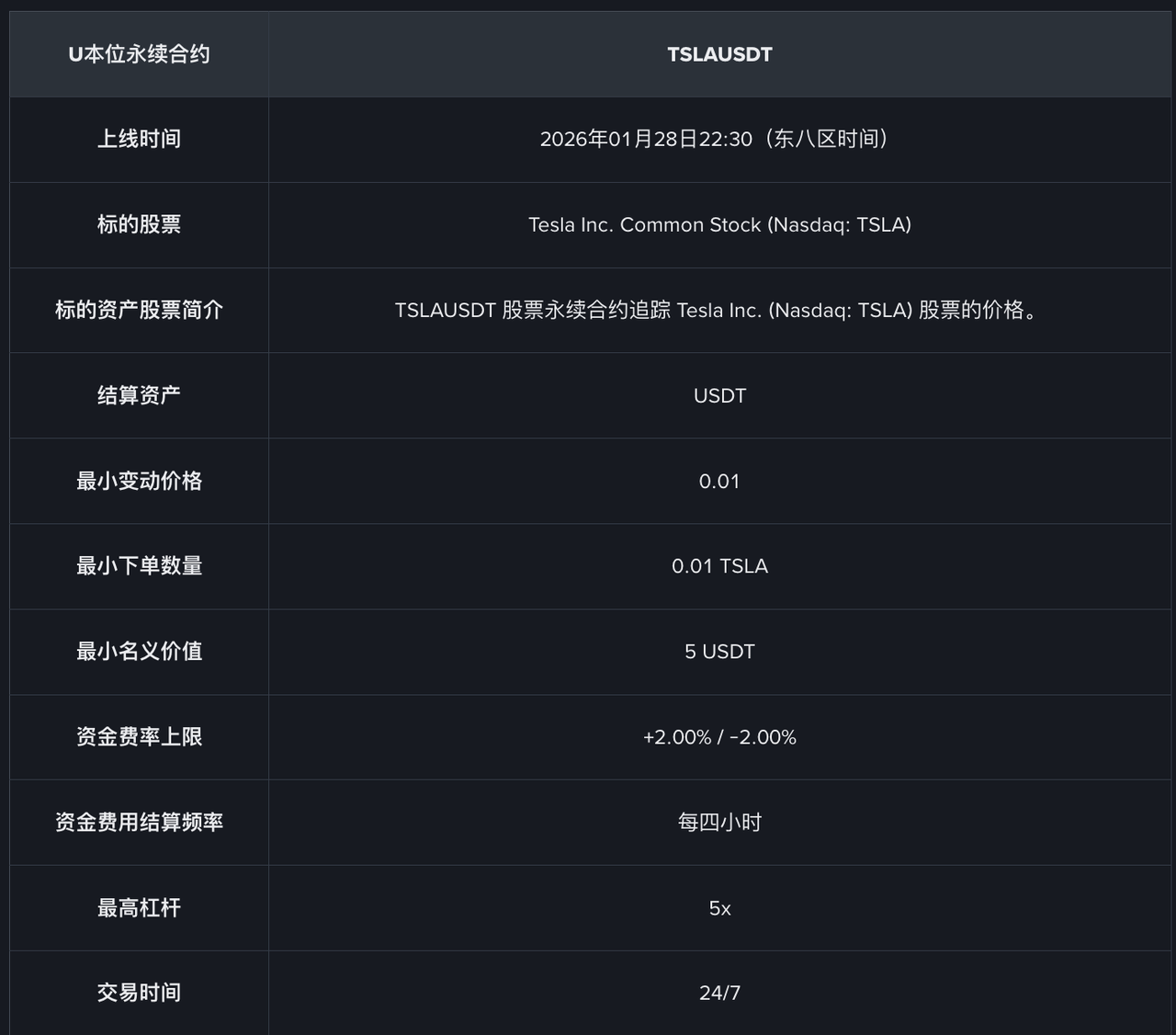
With both timing and conditions favorable, Binance naturally顺势而为地 (seized the opportunity to) reopen stock contract trading. Choosing Tesla (TSLA) contracts as the first target also seems to have a meaning of "getting back up where you fell." As the most growth-potential U.S. stock under Musk, the launch of Tesla contracts can also, to some extent, boost the topic discussion度 of Binance's restart of stock contract trading.
On the other hand, the considerable trading volumes of many CEX competitors might have also made Binance feel a slight sense of crisis.
Data shows that Bitget's U.S. stock contract section cumulative trading volume has exceeded $15 billion, with the top 3 popular trading varieties being Tesla (TSLA), Meta Platforms (META), and Apple (AAPL), with cumulative turnover of $5.4 billion, $3 billion, and $1.7 billion respectively; as of January 5, Gate's stock token section cumulative trading volume exceeded $13.5 billion, with nearly 80 trading pairs listed.
Conclusion: A Battle of Liquidity Offense and Defense, Binance vs. Nasdaq and NYSE, a David vs. Goliath Struggle
Finally, the author boldly predicts that there will inevitably be a fierce battle between crypto CEXs like Binance and traditional financial stock exchanges like Nasdaq and NYSE. Of course, this war has not yet fully begun, but what they are competing for is not just a numbers game of users, but also a platform liquidity war involving capital and fees.
Although compared to the annual trading volume of Nasdaq and NYSE, which amounts to tens of trillions, the trading volume and market size of crypto CEXs like Binance lag by more than an order of magnitude. From the perspective of brand recognition, market scale, and trading volume, this is an outright "David vs. Goliath" war; however, in terms of user experience, product iteration, and regulatory adaptability, CEXs like Binance undoubtedly possess better flexibility.
Of course, the premise of victory is that regulatory forces do not "take sides," and this liquidity battle might be a protracted war—testing not only short-term wealth creation effects but also long-term deep interconnection capabilities with the world economic situation. As for who the final winner will be and who will become the rule-maker of the new game, let's wait and see.
Twitter:https://twitter.com/BitpushNewsCN
Bitpush TG Discussion Group:https://t.me/BitPushCommunity
Bitpush TG Subscription: https://t.me/bitpush