Japan’s FY2026 Reform To Reshape Crypto Assets Taxation System – Report

bitcoinistОпубликовано 2025-12-27Обновлено 2025-12-27

Введение

Japan's FY2026 tax reform, proposed by the ruling coalition, will significantly restructure the crypto asset taxation system. Key changes include reclassifying digital assets as financial products instead of speculative assets and introducing a separate taxation system for specific transactions, similar to stocks. This system will apply to crypto spot trading, derivatives, and ETFs, while NFTs and reward-based activities like staking may remain under comprehensive taxation as miscellaneous income (currently taxed up to 55%). The reform also allows loss carryforward deductions for up to three years and may introduce an exit tax for unrealized gains upon leaving Japan. Not all digital assets will be covered, as the new rules target "specified crypto assets" within a defined scope.

Japan’s upcoming tax reform is expected to restructure the way crypto assets are treated in the country next year, changing digital assets classification and introducing a separate taxation system for different transactions.

Japan Proposes New Taxation System

On Friday, local news media outlets shared key details of Japan’s upcoming FY2026 Tax Reform Outline, published by the Liberal Democratic Party and the Japan Innovation Party on December 19.

CoinPost reported that the 2026 tax reform will introduce significant changes to current taxation system related to the classification and regulation of crypto assets, which have been long requested by Japanese investors.

Notably, the plan has proposed classifying digital assets as financial products, which indicates a shift from their previous treatment as speculative assets. As a result, the reform is exploring the introduction of a separate taxation system to crypto income, similar to stocks and investment trusts.

According to the report, separate taxation and comprehensive taxation may not cover the same transactions. Under the existing system, crypto gains are taxed as “miscellaneous income,” with rates reaching up to 55%. The regular taxation system and miscellaneous income reporting may still apply depending on the transaction type.

The reform outlines that crypto spot trading, derivative transactions, and Exchange-Traded Funds (ETFs) would be subject for the separate taxation system. However, there’s no specific mention of reward-based transactions like staking or lending, suggesting that the applicable income category and taxation method for these transactions will require future addressing.

Its worth noting that taxation for these transactions is split between the time of acquisition and the time of sale. When crypto assets are received as a reward for activities like staking, it is valued at market price at the time of acquisition and taxed as miscellaneous income. If the rewards are sold later, the resulting capital gain is subject to additional taxation.

Meanwhile, Non-Fungible Tokens (NFTs) will likely remain subject to the comprehensive taxation, as the reform doesn’t explicitly mention them, suggesting that NFTs trading and similar activities could continue to be treated as miscellaneous income and fall under the comprehensive taxation.

Tax Reform To Separate ‘Specified Crypto Assets’

The local news outlet also highlighted that the separate taxation system may apply only to limited cryptocurrencies, as the reform stipulates the new taxation and reporting system for crypto trading business “businesses based on the premise of ‘trading in specified crypto assets.’”

This could suggest that the “specified crypto assets” mentioned in the tax reform outline may not include all digital assets, but could be limited to those within a certain institutionally defined scope.

“Based on the outline’s wording, it is an important point to note that not all cryptocurrency transactions will uniformly fall under the new system; rather, a system design delineating a specific scope is likely to be implemented,” the report detailed.

Moreover, the 2026 tax reform outlined a proposal to allows losses from crypto transactions to be eligible for carryforward deductions for up to three years, similar to FX and stock policies in Japan.

The introduction of carryforward deductions is expected to make tax adjustments easier, as investors previously had to offset unrealized losses against gains in profitable years to reduce taxable income.

Lastly, the report noted the potential introduction of an exit tax in the future. Under the current system, crypto assets are not subject exit tax upon leaving Japan. However, the reclassification as financial instruments under the Financial Instruments and Exchange Act could open the door to a system where unrealized gains become taxable upon departure

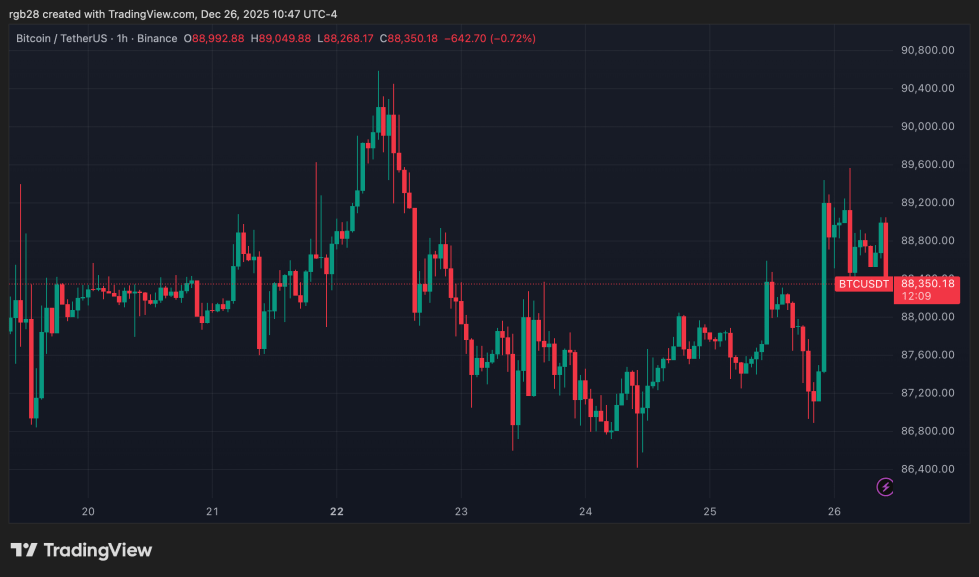
Bitcoin (BTC) is trading at $88,350 in the one-week chart. Source: BTCUSDT on TradingView

Связанные с этим вопросы

QWhat is the main change proposed in Japan's FY2026 tax reform regarding the classification of crypto assets?

AThe reform proposes to classify digital assets as financial products, shifting from their previous treatment as speculative assets.

QHow are crypto gains currently taxed in Japan, and what is the maximum tax rate?

ACrypto gains are currently taxed as 'miscellaneous income' with rates reaching up to 55%.

QWhich specific crypto transactions are expected to be subject to the new separate taxation system?

ACrypto spot trading, derivative transactions, and Exchange-Traded Funds (ETFs) are expected to be subject to the separate taxation system.

QWhat significant new provision for losses from crypto transactions is outlined in the reform?

AThe reform proposes that losses from crypto transactions be eligible for carryforward deductions for up to three years.

QHow might the reclassification of crypto assets potentially lead to an 'exit tax' in the future?

AReclassifying crypto as financial instruments could open the door to a system where unrealized gains become taxable upon an individual's departure from Japan, similar to an exit tax.

Похожее

The Essence of AI Layoffs: Why More AI Adoption Leads to More Corporate Anxiety?

The author, awaiting potential inclusion on an 8000-person layoff list, analyzes the true nature of recent "AI-driven" layoffs. They argue that while AI use, particularly tools like Claude for code generation, has skyrocketed and boosted developer output (e.g., 2-5x more code commits), this has not translated into proportional business growth or revenue. The core issue is a misalignment between increased "Input" (code) and tangible "Outcomes" (user value, revenue). AI acts as a costly B2B SaaS, inflating operational expenses without guaranteed returns. Two key problems emerge: 1) The friction that once filtered out bad ideas is gone, as AI allows cheap pursuit of even weak concepts. 2) Organizational "alignment tax"—the difficulty of coordinating across teams—becomes crippling when development velocity outpaces consensus-building. Thus, layoffs serve two immediate purposes: 1) To offset ballooning AI costs (Token consumption) and maintain cash flow, as rising input costs without outcome growth destroys unit economics. 2) To reduce organizational bloat and alignment friction by simply removing teams, thereby speeding up execution in the short term. Therefore, these layoffs are fundamentally caused by AI, even if AI doesn't directly replace roles. They represent a painful correction until companies learn to convert AI-driven productivity into real business outcomes and streamline organizational coordination to match the new pace of work. The cycle will continue until this learning curve is mastered.

marsbit30 мин. назад

The Essence of AI Layoffs: Why More AI Adoption Leads to More Corporate Anxiety?

marsbit30 мин. назад

Can the Solana Foundation and Google's Collaboration on Pay.sh Bridge the Payment Link Between Web2 and Web3 in the Agent Economy?

Solana Foundation, in collaboration with Google Cloud, has launched Pay.sh, a payment gateway designed to bridge the gap between AI agents and enterprise-grade service infrastructure. The initiative aims to solve a key bottleneck in the "agent economy": existing payment systems are ill-suited for autonomous AI agents. Traditional methods like credit cards require human verification, while newer on-chain protocols like x402 and MPP create a separate, Web3-native system that raises barriers for service providers. Pay.sh functions as a universal payment layer. It allows users to fund a Solana wallet via credit card or stablecoin, which then acts as an identity and payment proxy for AI agents. When an agent needs to access a paid API service (e.g., Google Cloud, Alibaba Cloud), Pay.sh handles the transaction seamlessly. It leverages the HTTP 402 status code ("Payment Required") to initiate payments, intelligently choosing between one-time transfers (x402-style) or session-based authorizations (MPC-style) based on the service's billing model. This spares agents from manual account registration and API key management. A key feature for service providers is low integration effort. They can adopt Pay.sh by providing a declarative configuration file, enabling features like tiered pricing, free tiers, and automatic revenue splitting to multiple addresses (e.g., for royalties, cloud costs). Providers can also list their APIs in a central Pay Skill Registry for agent discovery. The collaboration with Google Cloud provides crucial infrastructure for API proxying, traffic routing, and compliance logging, aiming to keep agent activities within regulated boundaries. By connecting Web2 services with Web3 payment rails, Pay.sh positions the Solana wallet as a foundational identity and payment tool for AI agents, potentially driving more transaction volume to the Solana ecosystem. However, the report notes challenges. The service registry currently lacks robust vetting, risking exposure to unauthorized or malicious third-party APIs. Pay.sh also inherits security and compatibility risks from its underlying payment protocols (x402, MPC). Furthermore, adoption may be hindered by varying regional data privacy and payment compliance regulations among API providers. Despite these hurdles, Pay.sh represents a significant step towards integrating Web2 and Web3 for autonomous agent commerce.

marsbit37 мин. назад

Can the Solana Foundation and Google's Collaboration on Pay.sh Bridge the Payment Link Between Web2 and Web3 in the Agent Economy?

marsbit37 мин. назад

Bitcoin's Bull-Bear Cycle Indicator Turns Positive for the First Time in 7 Months: End of Bear Market or False Breakout?

Bitcoin's "Bull-Bear Market Cycle Indicator" from CryptoQuant has turned positive for the first time since October 2025. This gauge, based on the P&L Index relative to its 365-day moving average, suggests a potential shift from a bear market phase. Concurrently, the Bull Score Index rose to a neutral reading of 50 in late April. The indicator's move into positive territory follows a roughly 35% price rebound from a low near $60,000 in February to above $81,000. The recovery over approximately three months was faster than the 12-month period observed during the 2022 bear market. However, analysts caution against premature optimism, citing a historical precedent from March 2022. Back then, the Bull Score Index briefly hit 50, but it proved to be a false signal as Bitcoin's price subsequently plunged further. Structural differences exist in the current cycle, including consistent inflows into spot Bitcoin ETFs and an increase in large holder addresses. Yet, some models, referencing the four-year halving cycle, suggest a potential deeper bottom near $50,000 might still be possible around late 2026. In summary, while on-chain data shows marked improvement and the worst panic may be over, market participants remain cautious. A convincing trend reversal confirmation likely requires Bitcoin to sustainably break above key resistance, such as the 200-day moving average near $82,000.

marsbit44 мин. назад

Bitcoin's Bull-Bear Cycle Indicator Turns Positive for the First Time in 7 Months: End of Bear Market or False Breakout?

marsbit44 мин. назад

How to Automate Any Workflow with Claude Skills (Complete Tutorial)

This is a comprehensive guide to mastering Claude Skills, a feature for creating permanent, reusable instruction sets that automate specific workflows. Unlike simple saved prompts, Skills function like trained employees, delivering consistent, high-quality outputs by defining the entire task process, standards, error handling, and output format. The guide is structured in four phases: **Phase 1: Installation (5 minutes).** Skills are folders containing a `SKILL.md` file. The user is instructed to find a relevant Skill online, install it, test it on a real task, and compare its performance to one-off prompts. **Phase 2: Building Your First Custom Skill.** Start by rigorously defining the Skill's purpose, trigger phrases, and providing a concrete example of perfect output. The `SKILL.md` file has two parts: a YAML frontmatter with a specific name/description/triggers, and a detailed, step-by-step workflow written in natural language with examples and quality standards. **Phase 3: Testing & Optimization for Production.** Test the Skill in three scenarios: 1) a standard, common task; 2) edge cases with missing or conflicting data; and 3) a pressure test with maximum complexity. Any failure indicates a needed instruction. Implement a weekly optimization cycle to continuously refine the Skill based on real usage. **Phase 4: Building a Complete Skill Library.** The goal is to create a team of Skills for all repetitive tasks. Examples are given for industries like real estate, marketing, finance, consulting, and e-commerce. The user should list their tasks, prioritize them, and build one new Skill per week, maintaining a master document to track their library. The conclusion emphasizes the compounding time savings: ten Skills saving 30 minutes each per week reclaims over 260 hours (6.5 work weeks) per year, fundamentally transforming one's work system.

marsbit1 ч. назад

How to Automate Any Workflow with Claude Skills (Complete Tutorial)

marsbit1 ч. назад

Торговля

Спот
Фьючерсы

Популярные статьи

Как купить S

Добро пожаловать на HTX.com! Мы сделали приобретение Sonic (S) простым и удобным. Следуйте нашему пошаговому руководству и отправляйтесь в свое крипто-путешествие.Шаг 1: Создайте аккаунт на HTXИспользуйте свой адрес электронной почты или номер телефона, чтобы зарегистрироваться и бесплатно создать аккаунт на HTX. Пройдите удобную регистрацию и откройте для себя весь функционал.Создать аккаунтШаг 2: Перейдите в Купить криптовалюту и выберите свой способ оплатыКредитная/Дебетовая Карта: Используйте свою карту Visa или Mastercard для мгновенной покупки Sonic (S).Баланс: Используйте средства с баланса вашего аккаунта HTX для простой торговли.Третьи Лица: Мы добавили популярные способы оплаты, такие как Google Pay и Apple Pay, для повышения удобства.P2P: Торгуйте напрямую с другими пользователями на HTX.Внебиржевая Торговля (OTC): Мы предлагаем индивидуальные услуги и конкурентоспособные обменные курсы для трейдеров.Шаг 3: Хранение Sonic (S)После приобретения вами Sonic (S) храните их в своем аккаунте на HTX. В качестве альтернативы вы можете отправить их куда-либо с помощью перевода в блокчейне или использовать для торговли с другими криптовалютами.Шаг 4: Торговля Sonic (S)С легкостью торгуйте Sonic (S) на спотовом рынке HTX. Просто зайдите в свой аккаунт, выберите торговую пару, совершайте сделки и следите за ними в режиме реального времени. Мы предлагаем удобный интерфейс как для начинающих, так и для опытных трейдеров.

1.3k просмотров всегоОпубликовано 2025.01.15Обновлено 2025.03.21

Как купить S

Sonic: Обновления под руководством Андре Кронье – новая звезда Layer-1 на фоне спада рынка

Он решает проблемы масштабируемости, совместимости между блокчейнами и стимулов для разработчиков с помощью технологических инноваций.

2.2k просмотров всегоОпубликовано 2025.04.09Обновлено 2025.04.09

Sonic: Обновления под руководством Андре Кронье – новая звезда Layer-1 на фоне спада рынка

HTX Learn: Пройдите обучение по "Sonic" и разделите 1000 USDT

HTX Learn — ваш проводник в мир перспективных проектов, и мы запускаем специальное мероприятие "Учитесь и Зарабатывайте", посвящённое этим проектам. Наше новое направление .

1.8k просмотров всегоОпубликовано 2025.04.10Обновлено 2025.04.10

HTX Learn: Пройдите обучение по "Sonic" и разделите 1000 USDT

Обсуждения

Добро пожаловать в Сообщество HTX. Здесь вы сможете быть в курсе последних новостей о развитии платформы и получить доступ к профессиональной аналитической информации о рынке. Мнения пользователей о цене на S (S) представлены ниже.

活动图片