Is the Crypto Market Doomed to Face Pressure in Q1? Progress of the CLARITY Act Becomes a Key Factor

marsbitОпубликовано 2026-01-13Обновлено 2026-01-13

Введение

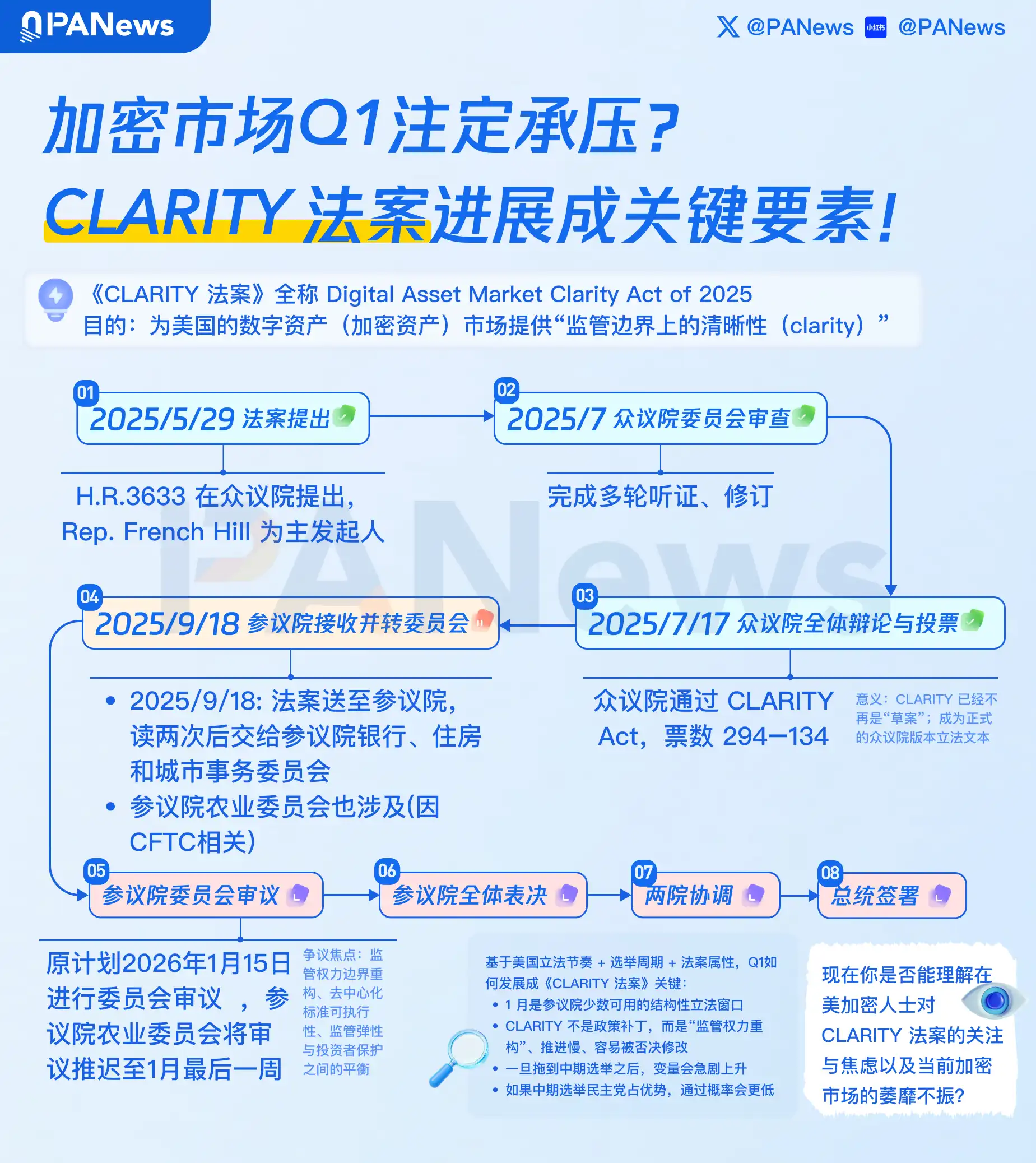
The CLARITY Act, introduced in the U.S. House of Representatives on May 29, 2025, aims to provide regulatory clarity for the digital asset market. It is currently stalled in the Senate after being received and referred to committee. Market participants are concerned that without significant progress in Q1, the bill faces increasing obstacles. Key reasons include the limited legislative window in the Senate from January to March, which is typically reserved for complex, non-urgent bills like CLARITY. If no substantive committee action occurs in January, the bill risks being sidelined by the legislative schedule. The Act is not a minor policy adjustment but a restructuring of regulatory authority, making it slow-moving, highly amendable, and prone to delays rather than outright rejection. If delayed until after the midterm elections, its prospects become even more uncertain due to potential shifts in Congressional power. Should Democrats gain influence post-election, the bill’s chances would likely decrease. Democratic leadership generally favors broader SEC authority, regulatory flexibility, and is hesitant to limit enforcement discretion—contrary to CLARITY’s goal of defining regulatory boundaries and reducing regulation by enforcement. In a Democrat-led Senate, the bill could be substantially rewritten, broken into smaller pieces, or indefinitely postponed. These factors explain the anxiety among U.S. crypto stakeholders and contribute to current market pessimism.

The purpose of the "CLARITY Act" is to provide "clarity at the regulatory boundaries" for the digital asset (crypto asset) market in the United States. It was introduced in the House of Representatives on May 29, 2025, primarily sponsored by Rep. French Hill, and is currently stuck at "received in the Senate and referred to committee." The market is widely concerned that if the CLARITY Act does not make significant progress in Q1, delays will make the situation increasingly unfavorable!

The reasons are multiple:

January is one of the few structural legislative windows for the Senate


Every year from January to March is the main period for the Senate to handle highly complex, non-urgent bills. The CLARITY Act falls into the category of a "highly complex + highly controversial + non-urgent" market structure bill, naturally ranking lower in priority. If it fails to enter substantive advancement (such as clear action at the committee level) in January, it is very likely to be "naturally squeezed out" by the overall legislative schedule.

CLARITY is not a policy patch, but a "regulatory power restructuring"
The characteristics of such bills are: slow progress, repeated demands for amendments, and a high tendency to be postponed rather than rejected.

Once delayed until after the midterm elections, variables will increase sharply


Midterm elections = a reset of the congressional power structure. Bills that have been advanced but not completed will have their priorities reshuffled. The CLARITY Act, which has not yet taken effect, has not formed strong bipartisan consensus, and highly relies on the support of the current committee, is very likely to be "re-evaluated" or even redrafted after a change in the power structure.

If the Democratic Party gains an advantage in the midterm elections, the probability of passage will be even lower The mainstream stance of the Democratic Party tends to: strengthen the coverage of securities laws, retain regulatory agency interpretation flexibility, and be highly cautious about "limiting the space for law enforcement agencies through legislation."
The core effect of the CLARITY Act, however, is to: predefine some regulatory boundaries, limit "regulation by enforcement," and reduce the SEC's discretionary power in gray areas. Therefore, in a Senate environment dominated by Democrats, the CLARITY Act is more likely to: be required to undergo substantial revisions (effectively a rewrite), be broken down into multiple sub-bills, or be shelved for a long time.

Can you now understand the attention and anxiety of crypto professionals in the U.S. regarding the CLARITY Act and the current sluggishness of the crypto market?
Связанные с этим вопросы

QWhat is the main purpose of the CLARITY Act mentioned in the article?

AThe CLARITY Act aims to provide regulatory clarity and establish clear boundaries for the digital asset (crypto asset) market in the United States.

QWhy is January considered a critical legislative window for the CLARITY Act in the Senate?

AJanuary is one of the few structural legislative windows in the Senate, as the period from January to March is typically used to handle highly complex, non-urgent bills. If the CLARITY Act does not see substantial progress (such as committee-level action) by January, it risks being pushed out of the legislative schedule.

QHow might the midterm elections impact the progression of the CLARITY Act?

AThe midterm elections could lead to a reset of congressional power structures, causing bills that are in progress but not yet passed to have their priorities reshuffled. The CLARITY Act, which lacks strong bipartisan consensus and relies heavily on current committee support, is particularly vulnerable to being re-evaluated or even redrafted after the elections.

QWhy would the CLARITY Act face lower chances of passing if Democrats gain an advantage in the midterm elections?

ADemocrats generally favor strengthening securities law coverage, preserving regulatory agency flexibility, and are cautious about limiting enforcement agency discretion through legislation. The CLARITY Act, which aims to predefine regulatory boundaries and restrict 'regulation by enforcement,' would likely face significant amendments, be broken into sub-bills, or be shelved indefinitely in a Democrat-dominated Senate.

QWhat are the key characteristics of the CLARITY Act that make its legislative process challenging?

AThe CLARITY Act is a highly complex and controversial market structure bill that is non-urgent, making it low priority. It involves a 'regulatory power restructuring,' which leads to slow progress, frequent demands for revisions, and a high likelihood of delays rather than outright rejection.

Похожее

SpaceX, OpenAI, Anthropic: The Three AI Giants Racing for IPO, Which One Is Worth Betting On?

SpaceX, OpenAI, and Anthropic are poised for historic IPOs within weeks, potentially raising a combined $180 billion—a sum exceeding the entire internet bubble's fundraising. The hosts of the Limitless Podcast argue this isn't just individual company financing but an unprecedented capital concentration for AI infrastructure, driven by an insatiable need for compute, data centers, power, and chips. SpaceX's IPO is notable for reportedly changing market index rules to allow faster inclusion, potentially funneling trillions in passive retirement funds into its stock, despite its unproven space-based data center business model. In contrast, Anthropic demonstrates explosive growth, with ARR reportedly hitting $45 billion and approaching profitability, fueled by strong enterprise adoption of products like Claude Code. Google's separate $80 billion raise highlights the immense capital pressure, even for giants. The discussion acknowledges bubble risks but leans optimistic. The hosts contend the massive spending is building essential physical infrastructure for the next technological era. A key bottleneck isn't capital but the real-world limits of chip manufacturing and construction speed. As long as demand for AI compute outstrips supply, this investment cycle represents a foundational build-out rather than a purely financial bubble. All three companies are seen as foundational bets on the future, with Anthropic often cited as the most immediately compelling due to its proven revenue trajectory.

marsbit2 ч. назад

SpaceX, OpenAI, Anthropic: The Three AI Giants Racing for IPO, Which One Is Worth Betting On?

marsbit2 ч. назад

From 'Old Guys' to 'New Favorites': How AI Is Revaluing Old Infrastructure from Dell to Nokia?

From "Vintage Tech" to "New AI Darlings": How AI Revalues Old Infrastructure One year ago, tech giants like Dell, Nokia, Cisco, and Western Data were seen as slow-growth, low-valuation stories, far from the AI spotlight dominated by players like Nvidia. Now, these legacy tech stocks are gaining market attention, sparking debate on whether this is genuine industry revaluation or a temporary narrative. As AI moves from model parameters to real-world data centers, the market is recognizing companies with proven delivery and infrastructure capabilities. This shift marks a change in the AI investment thesis: from pure model and GPU focus to the complex systems engineering required for deployment. Companies like Dell, HPE, and Corning are being revalued not for being "sexy" AI innovators, but for their decades of accumulated expertise in supply chains, enterprise delivery, and infrastructure—assets that have become critical in the AI buildout phase. The revaluation is unfolding across three key infrastructure lines: 1. **Servers & System Integration:** Dell and HPE are emerging as crucial system integrators or "general contractors" for AI data centers, translating GPU orders into complete, deployable server racks integrated with power, cooling, and networking. 2. **Networking & Connectivity:** AI's scale demands robust high-speed connections. Corning (fiber optics), Nokia (AI-RAN, 6G), and Cisco (data center switches) are gaining importance for enabling efficient data transfer within and between AI clusters. 3. **Storage:** Beyond high-speed memory (HBM/DRAM), the AI data explosion is driving demand for high-capacity hard drives (HDDs) from companies like Western Digital and Seagate to handle training data, logs, and cold storage cost-effectively. For this revaluation to be substantive and not just a narrative, three criteria are key: 1) Concrete AI-related order and revenue growth (e.g., Dell's AI server sales), 2) Upward revisions to company financial guidance, and 3) Sustainable improvements in profit quality, not just top-line revenue spikes. In essence, AI's transition to a real construction phase is re-pricing "old assets" against "new demand." The opportunity, however, is selective. Only those legacy firms that are demonstrably integrated into the capital expenditure chains of data center and enterprise AI deployment are likely to experience a true "logic re-rating" rather than just a temporary valuation bounce.

marsbit2 ч. назад

From 'Old Guys' to 'New Favorites': How AI Is Revaluing Old Infrastructure from Dell to Nokia?

marsbit2 ч. назад

The Merger of Codex and ChatGPT Marks the Beginning of a Major Reshuffle in Programming Tools

OpenAI is shifting its strategic focus from ChatGPT to Codex, merging them along with the browser tool Atlas into a unified desktop super-app. This move signals an internal belief that Codex, originally a programming tool, represents the next evolution of AI more than conversational models like ChatGPT. Over the past year, Codex's weekly active users have surged past 5 million. The key distinction is that while ChatGPT answers questions, Codex executes tasks. Enterprises increasingly value this ability to get work done over simply receiving advice. Consequently, Codex is attracting professionals beyond developers, including analysts, bankers, marketers, and product managers. OpenAI's reorganization and increased investment in Codex stem from recognizing that the future of AI competition lies in execution capabilities, not just conversation. The company is launching role-specific plugins (e.g., for data analysis, sales, design) to transform Codex into a broad knowledge work platform that automates and redefines white-collar workflows. Beyond being a tool, Codex reflects OpenAI's ambition to redefine software. New features like "Sites"—which generates interactive websites from documents—and collaborative "Annotations" aim to create a paradigm where the AI understands the goal and handles the tools and steps, functioning more like a digital colleague than traditional software. The ultimate goal is a unified experience where the user cares only about the completed task.

marsbit2 ч. назад

The Merger of Codex and ChatGPT Marks the Beginning of a Major Reshuffle in Programming Tools

marsbit2 ч. назад

Торговля

Спот
Фьючерсы
活动图片