Is Crypto Trading Taxation Becoming a Reality? An In-Depth Analysis of the 2026 Global Crypto Tax Regulations

marsbitОпубликовано 2026-01-13Обновлено 2026-01-13

Введение

"Tax on Crypto Trading Becomes Reality? In-Depth Analysis of 2026 Global Crypto Tax Regulations" Hong Kong recently announced a consultation to implement the OECD's Crypto-Asset Reporting Framework (CARF) and revised Common Reporting Standard (CRS). The goal is to automatically exchange tax-related information on crypto asset transactions with partner jurisdictions starting in 2028, with revised CRS rules taking effect in 2029. Furthermore, from January 1, 2026, the UK and over 40 other countries will begin enforcing new tax rules, requiring local crypto service providers to collect user wallet and transaction data for future international tax information exchange. For example, UK-based exchanges must collect detailed records of all customer transactions. HM Revenue & Customs (HMRC) will use this data to cross-check tax returns for compliance, with sanctions for violations. This data may also be used for identity verification, anti-money laundering, and criminal investigations, significantly impacting the anonymity and compliance landscape of the crypto industry. CARF is an international standard developed by the OECD under G20 mandate to enhance tax transparency for crypto assets. It aims to collect standardized information on often opaque, cross-border crypto transactions and automatically exchange it annually with the tax authorities in the user's jurisdiction of tax residence. The framework covers a broad range of crypto assets, including stablecoins, crypto-derived fi...

Original Author: ChandlerZ, Foresight News

Recently, Hong Kong, China announced through a government gazette that the authorities are conducting consultations on the implementation of the Organisation for Economic Co-operation and Development (OECD)'s Crypto-Asset Reporting Framework (CARF) and related amendments to the Common Reporting Standard (CRS).

It was pointed out that since 2018, Hong Kong has been automatically exchanging financial account information with partner tax jurisdictions annually under the Common Reporting Standard developed by the OECD, enabling relevant tax authorities to use this information for tax assessments, as well as detecting and combating tax evasion. The future goal is to automatically exchange tax-related information on crypto asset transactions with relevant partner tax jurisdictions starting from 2028, and to implement the revised new CRS rules from 2029.

Additionally, starting from January 1, 2026, the first batch of over 40 countries, including the UK, will implement new crypto asset tax regulatory rules, requiring local crypto service providers to begin collecting user crypto wallet and transaction data in preparation for subsequent cross-border tax information exchange.

Taking the UK as an example, crypto exchanges operating in the UK must begin collecting detailed transaction records and complete information for all UK customers. HMRC will use the collected data to cross-check users' tax returns to ensure tax compliance, and violators will face sanctions. Industry insiders point out that the relevant data may be used for identity verification, anti-money laundering, and criminal investigations in the future, having a profound impact on the anonymity and compliance environment of the crypto industry.

"Is crypto trading taxation becoming a reality?" A wide-ranging discussion has begun in the market. If Hong Kong reports, will mainland China also report? Will crypto trading be subject to back taxes in the future?

What is the CARF Global Taxation Framework

The "Crypto-Asset Reporting Framework" is a set of international standards for crypto asset tax information transparency developed by the OECD under the authorization of the G20. Its core purpose is to bring crypto asset transactions, which were previously difficult for tax authorities to penetrate and highly prone to cross-border flow, into a network of information that can be collected in a standardized manner and automatically exchanged between tax authorities. The OECD adopted and published the rules and commentary of CARF in 2022, clarifying that its design goal is to collect taxpayer-related information in a unified manner and automatically exchange it annually with the jurisdictions where taxpayers are tax residents, thereby reducing the risk of cross-border crypto asset tax evasion and underreporting.

In the context of CARF, crypto assets are not equivalent to Bitcoin or Ethereum in the narrow sense; any digital value carrier that can be held and transferred in a decentralized manner without the involvement of traditional financial intermediaries is within the scope. Its coverage is deliberately made closer to the real market form, including stablecoins, derivatives issued in the form of crypto assets, and even bringing some NFTs into the observation scope that may trigger similar tax risks.

Corresponding to the coverage, CARF's reporting obligations focus on market intermediaries that provide key services for transactions and exchanges. The OECD's approach is to anchor compliance at the link that is most capable of mastering transaction value and counterparty information. Any entity or individual that commercially facilitates or executes exchange transactions of relevant crypto assets for customers (including exchanges between crypto assets and fiat currency, as well as swaps between crypto assets) may in principle be identified as a Reporting Crypto Asset Service Provider and bear the obligations of data collection, due diligence, and reporting.

What is the relationship between CARF and the previously discussed CRS?

Understanding CARF requires placing it within the larger global tax information exchange system for comparison. The previous wave of tax supplements for Hong Kong and US stocks occurred under the mechanism of the Common Reporting Standard (CRS).

Over the past decade, cross-border tax transparency has mainly relied on the CRS standard. Countries require banks, securities firms, funds, and other financial institutions to identify account holders who are non-resident taxpayers and report key information such as account balance, interest, dividends, and disposal gains to their domestic tax authorities annually, which are then automatically exchanged with the other country's tax authorities.

China began fully implementing CRS in September 2018, exchanging resident financial account information with over 100 countries and regions. After data declaration, tax authorities issued notices based on CRS and other data, requiring users to explain the situation and pay back taxes.

CRS operates relatively maturely in the traditional financial system, but a large amount of crypto asset transactions, exchanges, and transfers occur outside the bank account system, especially forming an independent value circulation network between centralized trading platforms, custodial wallets, and on-chain transfers, making it difficult for CRS alone to achieve the same level of penetration. CARF supplements the on-chain and crypto asset market structure that CRS originally had difficulty covering.

While launching CARF, the OECD conducted the first systematic revision of CRS. On the one hand, it brought new financial products such as electronic money products and central bank digital currencies (CBDCs) into the scope of CRS; on the other hand, it adjusted the caliber for paths that indirectly invest in crypto assets through derivatives or investment vehicles to avoid the market circumventing information declaration and exchange through product structures. Overall, CARF is responsible for the transaction and service provider dimensions of the native crypto asset market, while the revised CRS continues to be responsible for the relevant risk exposures that may be carried within the financial account system. Together, they form a more complete automatic exchange puzzle.

The OECD pointed out that after the technical transmission format and supporting guidance for CARF and the revised CRS are perfected, the first batch of cross-border automatic exchanges is expected to start in 2027; before that, multiple jurisdictions will first implement domestic data collection and reporting requirements to prepare the data foundation for subsequent cross-border exchanges.

At the EU level, DAC8 was approved by member states in October 2023 and published in the official gazette in the same month. Its system design is based on the OECD's CARF international standards, aiming to incorporate crypto asset user information into automatic exchanges between member states' tax authorities.

Will Mainland China also join?

As of early December 2025, 76 countries/regions globally have committed to adopting CARF. The UK and the EU will be the first to implement this framework (data collection starting in 2026, first exchange in 2027); Singapore, the UAE, and Hong Kong, China follow closely, planning to collect data in 2027 and fully implement in 2028; Switzerland has postponed the implementation to 2027 and is still prudently assessing exchange partners; the US IRS's CARF joining proposal is still under internal review.

This means that China is not on the first batch of exchange lists, and CARF data will not be automatically exchanged with Chinese tax authorities through the CARF mechanism.
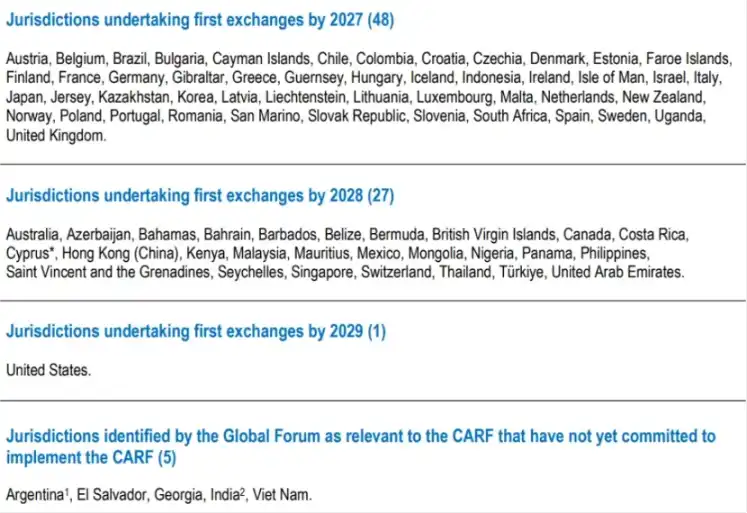
China has accumulated mature systems and collection and management experience under the CRS automatic exchange system, indicating that it has the infrastructure in terms of legal design, due diligence caliber, data exchange governance, and information security to undertake international standards.

The problem is that the compliance anchor of CARF mainly falls on regulated crypto asset service providers, while mainland China has long adopted a strong regulatory or even prohibitive governance approach towards virtual currency-related businesses. There is no locally licensed trading platform system that can be routinely included in CARF.

Hong Kong's advancement of CARF may increase the intensity of tax resident identification and information reporting for customers by crypto service providers in Hong Kong, but this does not automatically mean that the relevant information will naturally flow back to mainland tax authorities. Whether cross-border exchange occurs still depends on whether mainland China chooses to participate and establish exchange relationships with relevant jurisdictions, as well as arrangements between the two places regarding data usage restrictions, privacy protection, and technical对接.

But it is equally important to emphasize that not having joined does not mean it can be ignored. Even without the automatic exchange path of CARF, cross-border tax information may still flow through existing tax treaties and international collection and management cooperation frameworks, through case-by-case requests, joint law enforcement, or other cooperation methods. As major jurisdictions around the world begin to systematically collect crypto asset transaction and transfer data, the clues available to tax authorities will be more complete, and cross-border risk identification capabilities will also improve simultaneously.

For individuals and institutions, the most realistic change is that as long as the main operational path relies on centralized trading platforms, custody services, or fiat currency gateways, the traceability and追溯性 of transaction data will become increasingly stronger, and the compliance exposure will shift from a probability event to a常态.

Связанные с этим вопросы

QWhat is the Crypto-Asset Reporting Framework (CARF) and what is its main purpose?

AThe Crypto-Asset Reporting Framework (CARF) is a set of international standards for tax information transparency on crypto assets, developed by the OECD under the G20's mandate. Its core purpose is to bring crypto asset transactions, which are difficult for tax authorities to track and easily cross borders, into a standardized information network that can be collected and automatically exchanged between tax authorities. This aims to reduce the risk of cross-border tax evasion and underreporting related to crypto assets.

QWhen will the first batch of countries, including the UK, begin implementing the new crypto tax rules, and what are the key requirements?

AThe first batch of countries, including the UK and over 40 others, will begin implementing the new crypto tax rules on January 1, 2026. Key requirements include mandating local crypto service providers to start collecting detailed transaction records and complete information of users' crypto wallets and transactions to prepare for subsequent cross-border tax information exchange.

QHow does CARF complement the existing Common Reporting Standard (CRS)?

ACARF complements the Common Reporting Standard (CRS) by addressing the gaps in CRS's coverage of crypto assets. While CRS focuses on traditional financial accounts and has been effective in the banking and securities sectors, it struggles to track crypto asset transactions that occur outside the traditional banking system. CARF specifically targets the native crypto asset market, requiring crypto service providers to report transactions. The revised CRS also now includes some crypto-related financial products, ensuring a more comprehensive automatic exchange of information between the two frameworks.

QIs mainland China currently part of the CARF automatic exchange system?

ANo, as of the information in the article, mainland China is not among the first batch of over 76 countries committed to adopting CARF and will not receive data through the CARF automatic exchange mechanism. This is primarily because China's strong regulatory stance has prohibited licensed crypto trading platforms domestically, which are the key entities required to report under CARF.

QWhat is the significance of Hong Kong's move to implement CARF and CRS revisions for potential data flow to mainland China?

AHong Kong's implementation of CARF and CRS revisions means that crypto service providers in Hong Kong will enhance their identification of client tax residency and information reporting. However, this does not automatically mean the data will be shared with mainland China's tax authorities. Any cross-border exchange would depend on whether mainland China chooses to participate in CARF and establishes a specific data exchange relationship with Hong Kong, involving agreements on data usage limits, privacy protection, and technical integration.

Похожее

Заявление о фонде Hyperliquid ETF привлекает внимание, поскольку нарратив HYPE набирает обороты на X

Сводка (на русском): Сообщение в X от AlphaOnChain от 20 июня 2026 года привлекло внимание к теме ETF на Hyperliquid (HYPE). В посте утверждается, что три ETF на HYPE, запущенные в мае 2026 года, уже аккумулировали совместные активы на сумму 158 миллионов долларов США. Согласно данным, крупнейшими продуктами являются ETF Bitwise HYPE (88 млн долларов) и 21Shares HYPE ETF (66 млн долларов). Этот слух подчеркивает растущий интерес рынка к альткойн-нарративу HYPE. Hyperliquid известен своей экосистемой, ориентированной на децентрализованную торговлю perpetual-контрактами и инфраструктуру бирж. Возможный приток средств в ETF-продукты может указывать на то, что институциональный и розничный спрос начинает смещаться за пределы биткойна и Ethereum в сторону более рискованных активов. Ключевая оговорка статьи заключается в необходимости проверки данных. Поскольку информация исходит из социальных сетей, а не из официальных заявлений эмитентов или данных фондов, к цифрам следует относиться с осторожностью. Публикация скорее отражает растущее внимание к нарративу Hyperliquid, а не является подтвержденным фактом. Для трейдеров важно это различие: краткосрочные движения могут быть вызваны ажиотажем в соцсетях, но устойчивый рост, как правило, требует подтвержденного спроса, ликвидности и развития экосистемы.

bitcoinist22 мин. назад

Заявление о фонде Hyperliquid ETF привлекает внимание, поскольку нарратив HYPE набирает обороты на X

bitcoinist22 мин. назад

Как Codex использует компьютер? Три подхода и границы доступа

Статья объясняет три способа, которыми Codex взаимодействует с компьютером: Computer Use, расширение для Chrome и встроенный браузер. Каждый предназначен для разных задач и уровней доступа. **Computer Use** — самый широкий по охвату. Он позволяет Codex видеть и управлять графическим интерфейсом macOS/Windows, работать с нативными приложениями, системными настройками и даже iOS-симулятором. Это решение для задач без API, но оно медленнее и требует самого высокого уровня доверия. **Расширение для Chrome** дает доступ к уже авторизованным сессиям, кукам и вкладкам браузера. Идеально для работы с Gmail, LinkedIn, Salesforce, внутренними панелями или исследований, требующих входа в аккаунт. Оно работает в контексте вашего браузера. **Встроенный браузер** изолирован, не использует ваши логины и cookies. Он идеален для разработки и отладки: работы с локальным сервером, проверки верстки, визуальных багов и оставления дизайн-комментариев прямо на странице. **Appshots** — не четвертый способ управления, а инструмент для указания контекста (например, скриншот окна), чтобы Codex понял, о чем речь, без предоставления прав на управление. **Ключевой принцип:** выбирать самый узкий и безопасный способ для задачи. Использовать плагины или MCP, если возможно. Для веб-разработки — встроенный браузер. Для задач, требующих авторизации — Chrome. Computer Use — это "последняя миля" для задач, где недоступны структурированные инструменты.

marsbit35 мин. назад

Как Codex использует компьютер? Три подхода и границы доступа

marsbit35 мин. назад

«Железное правило» поставок оборудования для чипов нарушается

В течение долгого времени в цепочке поставок полупроводников существовало негласное правило: производители оборудования соглашались на значительные уступки в цене для внедрения новых устройств (Design-in), а затем сталкивались с постоянным давлением на снижение цен при повторных заказах (Repeat Order) со стороны фабрик. Однако этот принцип «рынка покупателя» начинает меняться. Например, несколько поставщиков оборудования первого уровня SK Hynix запросили повышение цен на 3-4%. Основная причина — дисбаланс спроса и предложения, вызванный бумом вычислений ИИ. Способность фабрик расширять производство напрямую определяет возможность выполнения крупных заказов на ИИ-чипы, превращая «покупку оборудования» в срочную гонку вооружений. Наиболее яркий пример — ажиотажный спрос на оборудование для термокомпрессионной сборки (TCB), критически важное для производства памяти HBM4. Ключевые игроки, такие как Hanmi Semiconductor, Hanwha Semitech и ASMPT, получают крупные заказы от SK Hynix. Хотя ожидалось, что более совершенная гибридная сборка (Hybrid Bonding) заменит TCB, этот переход замедлился. TCB остаётся основным выбором для массового производства HBM4, отчасти из-за возможного ослабления стандартов высоты штабелирования, а также благодаря постоянному совершенствованию самой технологии TCB. Дефицит распространяется и на другое оборудование. Корейские производители тестового оборудования столкнулись с острой нехваткой ключевых компонентов, таких как ПЛИС (FPGA), CPU и драйверные ИС, сроки поставок которых выросли до 52 недель. Это создаёт парадоксальную ситуацию: производство оборудования для тестирования полупроводников сдерживается нехваткой самих полупроводников, которые в первую очередь распределяются среди крупных заказчиков из сферы ИИ и центров обработки данных. В целом, отрасль вступает в масштабный восходящий цикл, движимый спросом на ИИ. По прогнозам SEMI, продажи оборудования для производства полупроводников достигнут рекордных 156 миллиардов долларов к 2027 году. Рост инвестиций сосредоточен в трёх ключевых направлениях: расширение мощностей для передовой логики (TSMC, Intel, Samsung), масштабирование производства HBM (SK Hynix, Micron) и наращивание мощностей передовой упаковки, такой как CoWoS. Таким образом, ведущие производители оборудования продают не просто машины, а самый дефицитный ресурс эпохи ИИ — возможность реализации производственных мощностей. Те, кто контролирует ключевые технологические этапы (передовая литография, сборка HBM, передовая упаковка), получают беспрецедентную переговорную силу, меняя баланс сил в отрасли.

marsbit47 мин. назад

«Железное правило» поставок оборудования для чипов нарушается

marsbit47 мин. назад

Еженедельный разблокировка токенов: XPL разблокирует токены на миллионы долларов

**Токен-разблокировка на неделе: Plasma и SoSoValue разблокируют токены на миллионы долларов** На этой неделе два проекта проведут значительные разблокировки токенов. **SoSoValue** (XPL) разблокирует около 13,03 млн токенов на сумму приблизительно 3,87 млн долларов. SoSoValue — это исследовательская инвестиционная платформа на базе искусственного интеллекта, объединяющая эффективность CeFi и прозрачность DeFi для решения проблем информационной перегрузки и управления мультичейн-активами. **Plasma** (PLS) проведет крупную разблокировку около 110 млн токенов на сумму примерно 10,42 млн долларов. Plasma — это блокчейн Layer 1, созданный специально для глобальных платежей в стейблкоинах. Он предлагает высокую пропускную способность, нативные функции для стейблкоинов, полную совместимость с EVM, а также поддерживает настраиваемые Gas-токены, бесплатные переводы USDT и приватные платежи. Оба проекта предоставили графики предстоящих выпусков токенов.

marsbit1 ч. назад

Еженедельный разблокировка токенов: XPL разблокирует токены на миллионы долларов

marsbit1 ч. назад

Биткоин должен удержаться на уровне $60 тысяч, чтобы избежать серьёзного обвала, предупреждает аналитик TradingView

Биткоин снова приблизился к уровню, который многие трейдеры считают психологически и технически важным. Аналитик weslad на TradingView отметил, что BTCUSDT достиг новой зоны спроса, которая может определить его следующее значительное движение. Пока цена удерживается выше $60 000, высока вероятность восстановления до области предложения около $81 000, что вернет актив к началу недавнего падения. Однако предупреждение звучит четко: уровень $60 000 — это критическая черта для быков. Решительное закрытие ниже этой отметки аннулирует бычий сценарий и откроет путь к более глубокому падению. Удержание зоны поддержки может сигнализировать об истощении недавнего распродажи, тогда как ее пробитие способно спровоцировать срабатывание стоп-лоссов и смену рыночных настроений. Таким образом, текущая ситуация представляет собой бинарный тест поддержки: удержание зоны сохраняет шансы на восстановление, а ее потеря, вероятно, приведет к более глубокой коррекции.

bitcoinist2 ч. назад

Биткоин должен удержаться на уровне $60 тысяч, чтобы избежать серьёзного обвала, предупреждает аналитик TradingView

bitcoinist2 ч. назад

Торговля

Спот
Фьючерсы
活动图片