Is Crypto Over? Don't Give Up, Liquidity Relief Is Coming

Odaily星球日报Опубликовано 2026-02-02Обновлено 2026-02-02

Введение

The article "False Narratives....and Other Thoughts" by Raoul Pal addresses the current downturn in the crypto market, arguing against the mainstream narrative that the crypto cycle is over. Pal explains that the recent price decline in Bitcoin and other cryptocurrencies is not an isolated event but is correlated with a similar drop in SaaS stocks, as shown by comparative charts. He identifies the root cause as a temporary liquidity squeeze in the U.S. financial system, exacerbated by government shutdowns, TGA (Treasury General Account) rebuilding without monetary offset, and gold absorbing marginal liquidity that would otherwise support risk assets like crypto. Pal emphasizes that this liquidity crunch is temporary. He anticipates a resolution to the government shutdown soon, which will remove the last major obstacle to liquidity recovery. Following this, he expects a return of liquidity through measures such as eSLR adjustments, TGA drawdowns, fiscal stimulus, and eventual rate cuts. He advises investors to be patient, stressing that in a full market cycle, time is more critical than price movements. The article also corrects a misperception about potential Fed Chair Kevin Warsh, arguing he is not a hawk and would likely support rate cuts aligned with strategies to boost economic growth. Despite current market conditions, Pal remains highly optimistic about the crypto market's prospects through 2026, driven by anticipated pro-growth policies.

Original Author:Raoul Pal, CEO of Real Vision and GMI

Compiled by:CryptoLeo(@LeoAndCrypto)

This morning, Raoul Pal, CEO of Real Vision and GMI (Raoul Pal's investment bible), published an article titled "False Narratives....and Other Thoughts". Through data comparison and macro analysis, he explained the recent downturn and crisis in the crypto industry, indicating that the industry winter will soon pass, and everyone needs to be patient and not lose confidence in the industry. Odaily Planet Daily translates it as follows:

These were the insights I wrote for GMI over the weekend, hoping to bring you some confidence. I would have kept this content for GMI and Pro Macro discussions, but I know you all need this to ease your tense nerves.

Mainstream Narrative: Is Crypto Over?

The mainstream view is that Bitcoin and cryptocurrencies have crashed, this cycle is over, everything is finished, and it can't be like before. Cryptocurrencies have decoupled from other assets, this is CZ's fault, it's BlackRock's fault, etc. This is undoubtedly an attractive narrative trap, especially when mainstream coin prices are plummeting every day.

But yesterday, a GMI hedge fund client sent me a message asking if they should buy the dip in SaaS stocks, or, as everyone is saying, if Claude Code has already killed the SaaS industry.

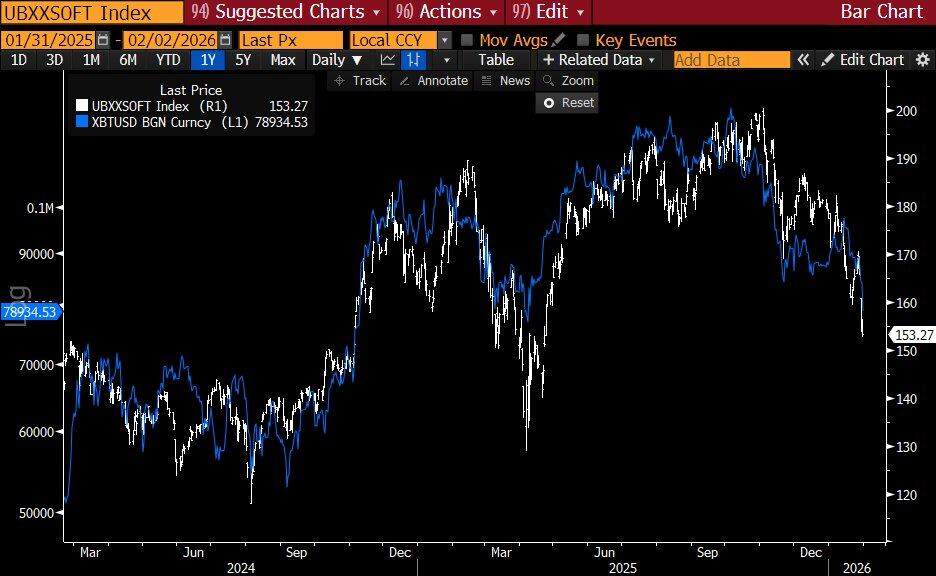
So I started researching SaaS, and in the process, I found conclusions that debunk both the mainstream narrative about Bitcoin and the narrative about the SaaS industry. The charts for SaaS and BTC look exactly the same?

UBS SaaS Index vs. Bitcoin Trend

Indicating there is another factor that everyone is ignoring affecting this trend.

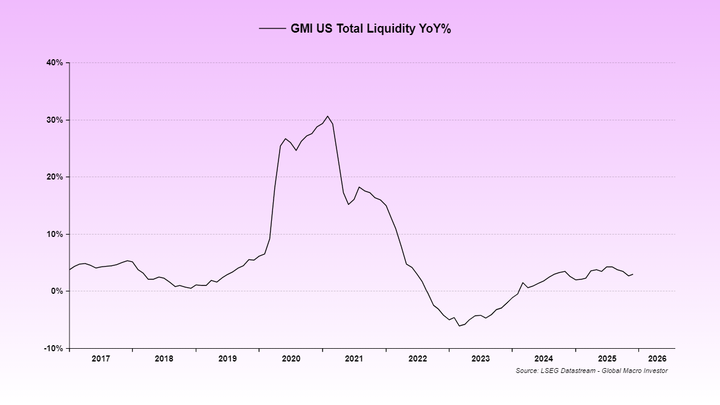
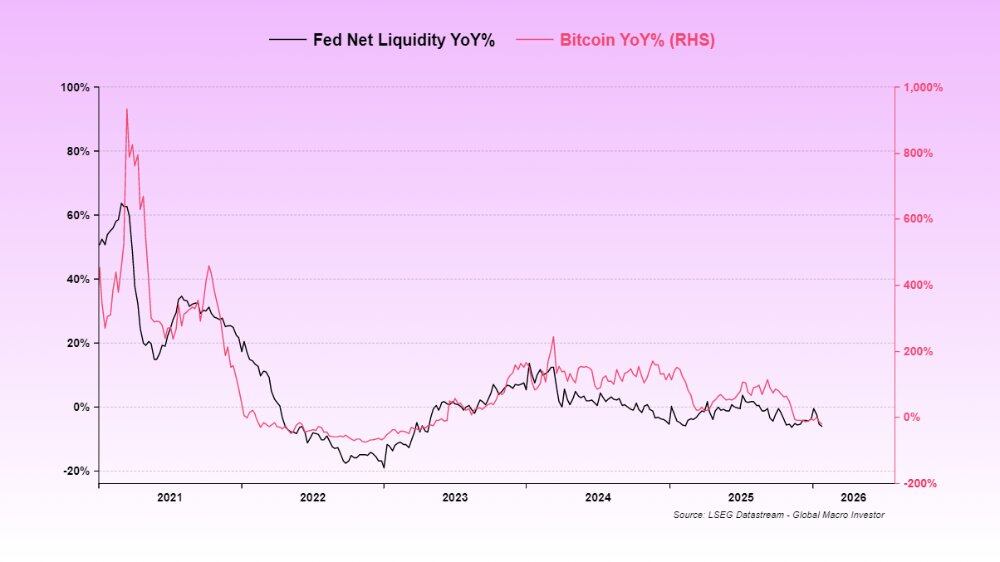
This factor is: Due to two shutdowns and issues with the US financial system's infrastructure (the reverse repo mechanism's liquidity was only fully replenished in 2024), US liquidity has been constrained. Therefore, the TGA (Treasury General Account) rebuilding in July and August had no corresponding monetary offset measures, leading to a reduction in liquidity.

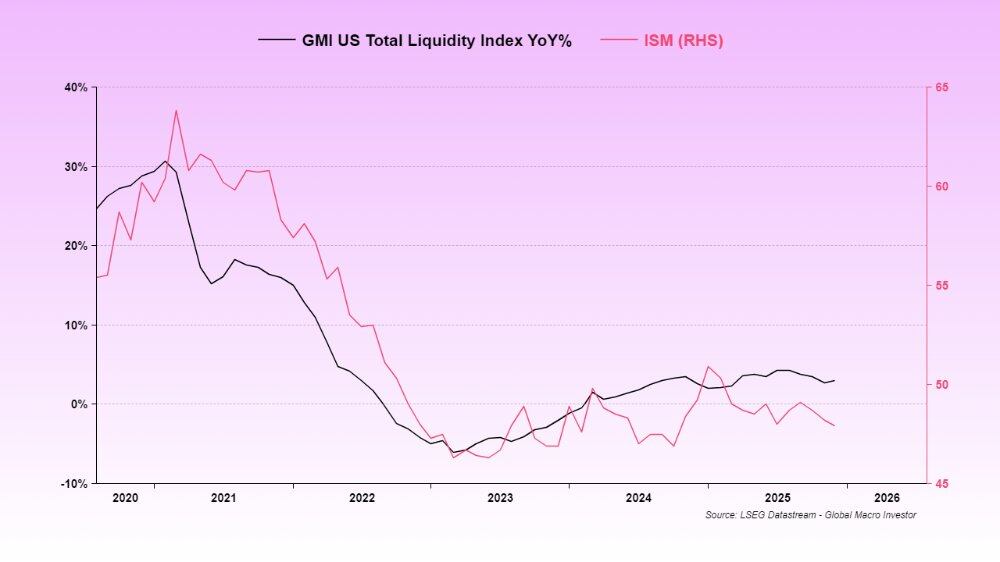
So far, the low liquidity is the reason the ISM Manufacturing Index has remained low.

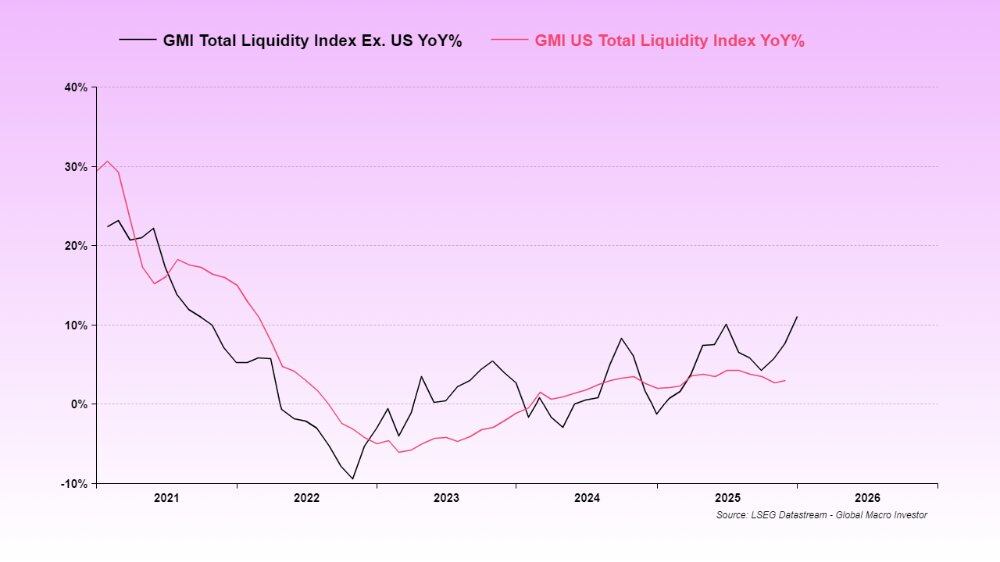
We usually use the Global Total Liquidity indicator because it has the highest long-term correlation with BTC and the Nasdaq, but at this stage, US Total Liquidity seems more important because the US is the main provider of global liquidity.

In this cycle, the GMI Global Total Liquidity Index leads the US Total Liquidity Index and is about to rebound (thus also driving the ISM index).

This is exactly what is affecting SaaS and BTC. Both assets are among the longest-duration assets in existence and have fallen due to the temporary withdrawal of liquidity.

Gold's rise has essentially sucked out the marginal liquidity from the system that might have flowed into the Bitcoin and SaaS markets. There isn't enough liquidity to support these assets, so high-risk assets are getting hit and falling. There's really no way around it.

Now, the US government is happening again, and the Treasury Department has taken preventive measures: after the last government shutdown, no TGA funds were used, and instead, the asset scale was increased (i.e., further loss of liquidity). This is the crisis we are facing now. It has caused violent price fluctuations, and our beloved cryptocurrency still lacks liquidity.

However,种种迹象表明,this government shutdown will be resolved this week, which will clear the last liquidity obstacle.

Odaily Note: US House Speaker Johnson said in an interview on NBC News' "Meet the Press" on Sunday that he believes he has secured Republican support votes to ensure the shutdown of some government agencies ends by Tuesday.

I have mentioned the risks of this government shutdown many times before, but it will soon be over, and then we can continue to deal with the upcoming liquidity injection, which includes measures from eSLR, partial TGA回流 (TGA回流 likely means TGA runoff or drawdown, context suggests funds returning to system), fiscal stimulus, interest rate cuts, etc., all related to the mid-term elections.

Odaily Note: US regulators' bill to relax leverage ratio requirements to ease capital pressure on several major banks like Bank of America (BAC.US).

In a full trading cycle, time is often more important than price. Price can be hit hard, but as time passes and the cycle evolves, everything will be resolved and eventually settle.

This is why I have always emphasized "patience". Events need to develop. Focusing solely on profit and loss ratios will only affect your mental health, not your investment portfolio.

The Fed's False Narrative

Regarding interest rate cuts, another false narrative is that Kevin Warsh is a hawk. This is complete nonsense; these statements are mainly from over 18 years ago.

Warsh's job and mission were to execute the strategies of the Greenspan era. Both Trump and Besant have said (details not discussed here, but the main direction is rate cuts) to keep the economy hot and assume that the productivity gains from AI will suppress core CPI increases (just like the 1995-2000 era).

Odaily Note: Greenspan is one of the longest-serving chairs in Fed history. His advocated monetary policy (controlling inflation + promoting maximum employment) was highly flexible but practically more anti-inflation prioritized, while also actively injecting liquidity during crises.

He doesn't like the balance sheet, but the system is reserve-constrained, so he likely won't change its current practices, otherwise it would destroy the credit market.

Warsh will cut rates and do nothing else. He will not interfere with Trump and Besant's actions to manage liquidity through banks. Fed Governor Milan will likely forcefully push for a full eSLR cut to accelerate this process.

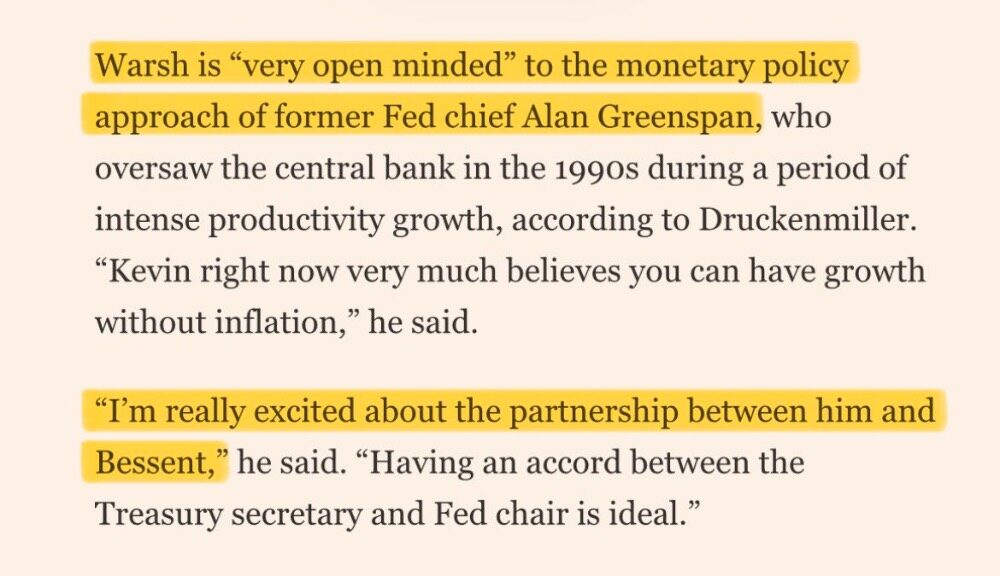
If you don't believe me, believe Druck ↓

The above shows "investment guru" Stanley Druckenmiller's content on Warsh's monetary policy philosophy and his agreement with Besant upon becoming Fed Chair.

I know how difficult it is to hear optimistic narratives when the crypto market looks so dark. My SUI holdings are terrible, we don't know what or who to believe anymore. First, we have been through this many times before. When BTC falls 30%, altcoins can fall even 70%. But if they are high-quality alts, their rebound is also faster.

Mea Culpa (My Mistake)

GMI's mistake was not considering US liquidity as the current driving factor; usually, Global Total Liquidity dominates the entire cycle. But now the situation is clear, anything is possible.

The two are not unrelated. We just couldn't predict the combination punch of a series of events (reverse repo draining liquidity > TGA rebuilding > government shutdown > gold rising > another shutdown), or we failed to anticipate its impact.

It's almost over, and soon we can get back to normal work.

We cannot guarantee that every link is error-free (now with a deeper understanding), and we are still very bullish on the 2026 outlook because we understand the Trump/Besant/Warsh strategy. These three have repeatedly told us: we just need to listen and be patient. In full-cycle investing, time is more important than price.

If you are not a cycle investor and don't have such strong risk tolerance, that's completely fine. Everyone has their own style, but Julien (GMI Head of Macro Research) and I are not good at swing trading (we don't care about intra-cycle fluctuations), but we are proven and have a verifiable track record in full-cycle investing, leading the industry for the past 21 years. (Warning: We also make mistakes, like in 2009). Now is not the time to give up. Good luck, and let's achieve greater results in 2026.

Liquidity relief is on the way!

Связанные с этим вопросы

QWhat is the main reason for the recent downturn in the crypto market according to Raoul Pal?

AThe main reason is the suppression of U.S. liquidity due to two government shutdowns and issues with the U.S. financial plumbing system, which was not fully offset by monetary measures, leading to a reduction in liquidity available for risk assets like crypto and SaaS stocks.

QWhat specific event does Raoul Pal point to as the catalyst that will soon resolve the liquidity crisis?

AHe points to the resolution of the current U.S. government shutdown, which is expected to be resolved imminently, as the event that will clear the final liquidity hurdle.

QHow does Raoul Pal characterize the relationship between time and price in a full market cycle?

AHe states that in a full cycle, time is more important than price. Price can be hit hard, but as time passes and the cycle plays out, things get resolved and eventually work themselves out.

QWhat was the key mistake that GMI made in its analysis, as admitted in the article?

AThe key mistake was not identifying U.S. liquidity as the current driving factor, as it is now more dominant than global aggregate liquidity in this part of the cycle, and failing to predict the combined impact of a series of events (RRP drain, TGA rebuild, shutdown, gold rally, another shutdown).

QWhat is the overall outlook for the crypto market in 2026 according to the author's conclusion?

AThe overall outlook for 2026 is very bullish, based on an understanding of the anticipated strategies of Trump, Besant, and a potential Fed Chair Warsh, which are expected to involve liquidity injections, fiscal stimulus, and rate cuts.

Похожее

Has the 'Digital Gold' Narrative for BTC Failed?

**Title: Has the "Digital Gold" Narrative for Bitcoin Failed?** The article argues that Bitcoin's "digital gold" narrative remains valid despite a recent sharp price decline (from a peak near $126k in Oct 2025 to briefly under $61k in Feb 2026). It presents a long-term investment framework based on three core points: **1. Viewing Bitcoin as an Asset:** Bitcoin is presented as a superior potential store of value compared to gold. Key arguments are its absolute scarcity (21 million cap), superior portability, and transparent auditability via its public ledger. While acknowledging its current use in early, volatile stages (~3-4% global adoption), the author draws parallels to the early, disruptive phases of the internet and e-commerce. **2. Understanding the Recent Downturn:** The current ~50% correction is framed as a predictable, consensus-driven cycle following its post-halving peak (the 2024 halving preceded the Oct 2025 high). A crucial factor is a historic "changing of hands": the influx of new institutional buyers via ETFs allowed early, low-cost holders (miners, OG believers) to take profits. The author notes that while severe, Bitcoin's historical drawdowns (e.g., 93% in 2011, 77% in 2021-22) have been progressively smaller, suggesting maturing holder structure and decreasing volatility over time. **3. The Long-Term Perspective:** The long-term thesis hinges on Bitcoin capturing a portion of gold's market value. With Bitcoin's market cap at ~$1.4 trillion (at $70k) versus gold's ~$20 trillion, significant upside potential exists if the "digital gold" narrative is partially realized. However, the author strongly cautions that short-term risks remain, the bottom is unpredictable, and high volatility is inherent. The real risk is not Bitcoin failing but poor personal position management (over-leverage, wrong capital) and a lack of deep understanding, which can force investors out during severe downturns. The conclusion uses Amazon's 95% crash post-2000 dot-com bubble and subsequent 42x recovery as an analogy. The ultimate question is not if Bitcoin's price will rise, but if an investor's strategy and conviction can withstand the volatility to see the long-term play out. The recent divergence (gold up, Bitcoin down) is posed not as a narrative failure, but as potential evidence of this ongoing, painful transition from a speculative asset to a mainstream allocation.

marsbit10 ч. назад

Has the 'Digital Gold' Narrative for BTC Failed?

marsbit10 ч. назад

Has BTC's 'Digital Gold' Narrative Failed?

The article discusses Bitcoin's "digital gold" narrative, its recent price drop, and long-term outlook through the perspective of "Jason". It argues the narrative is not a failure but that Bitcoin represents a superior, new asset class due to its fixed supply (21 million), portability, and auditability. The piece compares its current ~3-4% global adoption rate to early internet/e-commerce, suggesting significant growth potential. Regarding the 2025-2026 price decline (from ~$126k to briefly under $61k), the author views it as a predictable, consensus-driven sell-off within Bitcoin's ~4-year cycle post-halving, exacerbated by a major "handover" from early, low-cost holders to new institutional buyers via ETFs. A key observation is that historical peak-to-trough drawdowns have lessened over time (e.g., 93% in 2011 to ~50% in 2026), indicating maturing volatility as holder structure changes. For the long term, the author uses a simple framework: Bitcoin's total market cap (~$1.4T at $70k) is only about 7% of gold's (~$20T). Even capturing 30-50% of gold's value would imply substantial upside. However, the article strongly cautions against viewing this as investment advice, emphasizing extreme volatility and the critical importance of risk management, position sizing, and deep fundamental understanding to survive severe drawdowns. It concludes by drawing a parallel to Amazon's 95% crash in 2000 and subsequent 42x recovery, stressing that the key is surviving market cycles to realize long-term potential.

链捕手10 ч. назад

Has BTC's 'Digital Gold' Narrative Failed?

链捕手10 ч. назад

From Code to Cognition: A Ten-Thousand-Word Guide to the Evolution of the Robot Brain

"From Code to Cognition: The Evolution of Robot Brains" The journey of robotic intelligence has shifted dramatically from manually coded systems to AI-driven brains. For decades, robots relied on layered software stacks—perception, state estimation, planning, control—each handcrafted. While predictable, they lacked adaptability. The 2010s saw deep learning revolutionize perception (e.g., object detection) and control (via reinforcement learning), but learned skills remained narrow. The arrival of Large Language Models (LLMs) marked a turning point. LLMs acted as high-level planners, interpreting natural language instructions and generating sequences of actions for traditional robotic systems to execute. However, true integration came with Visual-Language-Action (VLA) models, which fused vision, language, and motion prediction into a single network. Pioneered by models like RT-2 and open-source projects like OpenVLA, VLAs enable robots to reason and act directly from visual input and commands. The most advanced humanoid robots now employ a "dual-brain" architecture: a slow-thinking, large VLA (System 2) for reasoning and planning, and a fast-reacting, small network (System 1) for high-frequency motion control, sometimes with an even lower-level System 0 for balance. This split balances cognition with the physics of real-time movement. Computation is split between onboard hardware (e.g., NVIDIA Jetson) for safety-critical control loops and cloud/edge servers for non-critical tasks like learning and interfaces. A crucial driver is the open-source ecosystem—models like GR00T and OpenVLA allow startups to build upon pre-trained brains and fine-tune them with their own data, accelerating development. Despite progress, current systems struggle with recovery from errors, sample inefficiency, and long-horizon tasks. This has spurred the rise of **World Models**—neural networks that predict the consequences of actions. By simulating possible futures before acting (like NVIDIA Cosmos or Meta V-JEPA), robots can plan, recover, and generalize better. This represents the next frontier: shifting intelligence from learned reactions to an internal model of physics and cause-and-effect. The field is rapidly evolving. While not yet at its "ChatGPT moment," the convergence of cheaper hardware, scalable simulation, and world models points toward robots that are increasingly capable, adaptive, and useful. The question is shifting from "what can robots do?" to "what *should* they do?"

marsbit11 ч. назад

From Code to Cognition: A Ten-Thousand-Word Guide to the Evolution of the Robot Brain

marsbit11 ч. назад

Торговля

Спот
Фьючерсы
活动图片