Is Chainlink Ready to Reverse Its Downtrend?

TheNewsCryptoОпубликовано 2026-02-26Обновлено 2026-02-26

Введение

Chainlink (LINK) is trading around $9.24, showing modest gains amid a broader cryptocurrency market rise. It remains above a key monthly support level between $7 and $7.3, which has historically attracted accumulation. However, LINK continues to trade below its 50-day ($10.63) and 200-day ($16.21) moving averages, both of which are declining, indicating sustained downward pressure. Technical indicators like the RSI (near 49) and MACD show neutral to weak momentum, with no strong bullish signals yet. The price is consolidating within a range, with near-term support at $8.20–$8.80 and resistance at $10.00. Overall, LINK appears to be in a phase of short-term consolidation without a decisive trend.

As the cryptocurrency market rose today, supported by a strong short squeeze and resumed institutional inflows, Chainlink (LINK) has shown modest upside, trading around $9.24, with a daily low of $9.08 and a high of $9.54.

While short-term volatility continues to draw attention, LINK remains positioned above a key monthly low between $7 and $7.3. Strong accumulation and buying interest have historically been seen in this area on longer timeframes. It now represents an important structural level, separating broader downside risk from the potential for a sustained recovery if maintained.

Major altcoins followed Bitcoin’s move, posting notable gains as overall market sentiment shifted away from extreme fear levels. At the time of writing, LINK is priced at $9.25 with a market cap of $6.5 billion. Still, the token’s price action continues to reflect consolidation below key moving averages.

On the daily timeframe, Chainlink remains below its 50-day MA near $10.63 and the 200-day MA around $16.21, with the bearish crossover structure still intact. Both moving averages are sloping downwards, a pattern typically associated with sustained downward pressure. The 50-day MA is currently acting as near-term resistance.
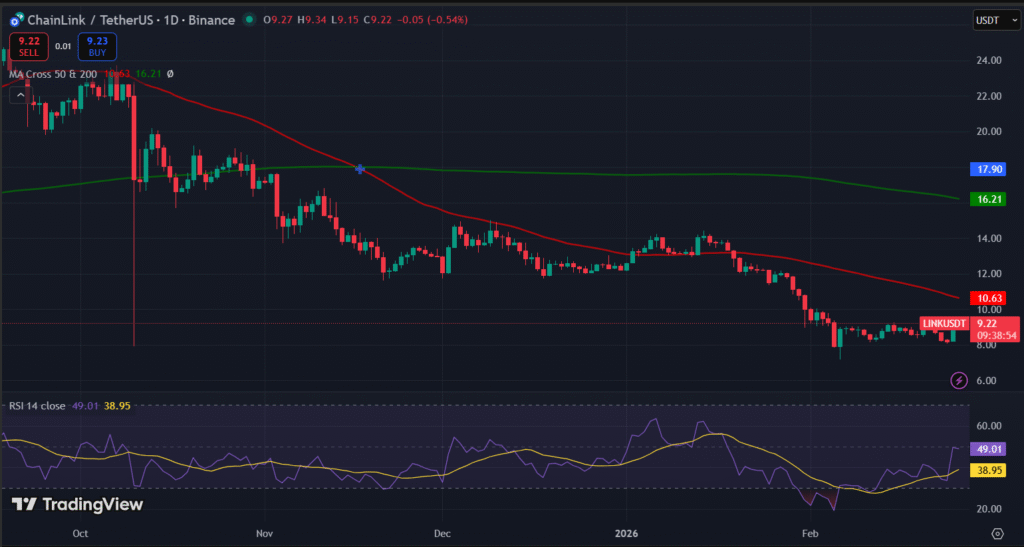
The RSI on the daily chart is near neutral at roughly 49, having rebounded from oversold territory earlier. This indicates that recent selling pressure has eased, but that bullish momentum has not yet strengthened meaningfully.

Zooming in, the MACD indicator remains close to the zero line, with no confirmed bullish crossover. This suggests limited directional momentum in either direction at present.
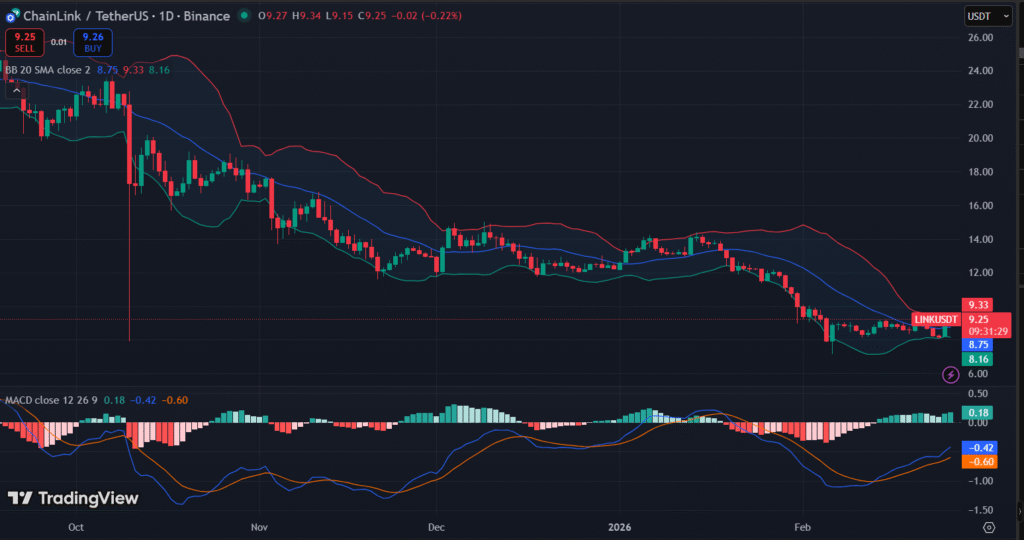
Meanwhile, Bollinger Bands are moderately wide, and the price is trading nearer to the lower band, reflecting recent consolidation and volatility contraction. Price hugging the lower band typically suggests the market is range-bound, rather than signaling a breakout.

If LINK continues the seesaw movement, the immediate support levels are found near the $8.80–$8.20 range, with additional support below these levels if selling pressure intensifies. If momentum picks up further, near-term resistance lies at $10.00, with the 50-day MA serving as a key technical barrier. Overall, Chainlink’s price action suggests continued consolidation in the short term.


TagsAltcoinChainlinkCrypto MarketLINK

Связанные с этим вопросы

QWhat is the current price of Chainlink (LINK) and its key daily trading range as mentioned in the article?

AChainlink is trading around $9.24, with a daily low of $9.08 and a high of $9.54.

QAccording to the technical analysis, what are the moving averages acting as resistance for LINK?

AThe 50-day moving average near $10.63 and the 200-day moving average around $16.21 are acting as resistance, with the 50-day MA serving as near-term resistance.

QWhat does the RSI level of approximately 49 indicate about LINK's momentum?

AAn RSI near 49 indicates that recent selling pressure has eased, but bullish momentum has not yet strengthened meaningfully, placing it in a neutral territory.

QWhat key support level does the article identify for LINK if selling pressure increases?

AThe immediate support levels are found near the $8.80–$8.20 range, with additional support below these levels if selling pressure intensifies.

QWhat overall market condition contributed to the rise in major altcoins including Chainlink?

AMajor altcoins rose due to a strong short squeeze and resumed institutional inflows, which shifted overall market sentiment away from extreme fear levels.

Похожее

Why Do You Always Lose Money on Polymarket? Because You're Betting on News, While the Pros Read the Rules

Why do you always lose money on Polymarket? Because you bet on news, while the pros study the rules. This article explains how top traders ("che tou") profit by meticulously analyzing market rules, not just predicting events. Polymarket, a prediction market platform, often sees disputes over event outcomes due to ambiguous rule wording. For instance, a market asking "Who will be the leader of Venezuela by the end of 2026?" was misinterpreted by many who bet on Delcy Rodríguez, assuming she held power. However, the rules specified "officially holds" as the formally appointed, sworn-in individual. Since Nicolás Maduro was still recognized as president officially, he won the market—even being in prison. To resolve such disputes, Polymarket uses a decentralized arbitration system via UMA protocol. The process involves: 1. Proposal: Anyone can propose a market outcome by staking 750 USDC, earning 5 USDC if unchallenged. 2. Dispute: A 2-hour window allows challenges with a 750 USDC stake; successful challengers earn 250 USDC. 3. Discussion: A 48-hour period on UMA Discord for evidence and debate. 4. Voting: UMA token holders vote in two 24-hour phases (blind then public). Outcomes require >65% consensus and 5M tokens voted; otherwise, four re-votes occur before Polymarket intervention. 5. Settlement: Results are final and automatic. Unlike traditional courts, Polymarket’s system lacks separation between arbitrators and stakeholders—voters often hold market positions, creating conflicts of interest. This leads to herd mentality in discussions and non-transparent outcomes without explanatory rulings, preventing precedent formation. Thus, success on Polymarket hinges on deep rule interpretation, not just event prediction, exploiting gaps between reality and contractual wording.

marsbit1 ч. назад

Why Do You Always Lose Money on Polymarket? Because You're Betting on News, While the Pros Read the Rules

marsbit1 ч. назад

DeepSeek Funding: Liang Wenfeng's 'Realist' Pivot

DeepSeek, a leading Chinese AI company, has initiated its first external funding round, aiming to raise at least $300 million at a valuation of no less than $10 billion. This move marks a significant shift from its founder Liang Wenfeng’s previous idealistic stance of rejecting external capital to maintain independence. Despite strong financial backing from its parent company, quantitative trading firm幻方量化 (Huanfang Quant), which provided an estimated $700 million in revenue in 2025 alone, DeepSeek faces mounting challenges. Key issues include a 15-month gap in major model updates, delays in its flagship V4 release, and the loss of several core researchers to competitors offering significantly higher compensation. The company is also undergoing a strategic pivot by migrating its infrastructure from NVIDIA’s CUDA to Huawei’s Ascend platform, a move aligned with China’s push for technological self-reliance amid U.S. export controls. However, DeepSeek lags behind rivals like智谱AI and MiniMax—both now publicly listed—in areas such as product ecosystem, multimodal capabilities, and commercialization. The funding round, though relatively small in scale, is seen as a way to establish a market-validated valuation anchor, making employee stock options more competitive and facilitating talent retention. It also signals DeepSeek’s transition from a pure research-oriented organization to a commercially-driven player in the global AI ecosystem.

marsbit2 ч. назад

DeepSeek Funding: Liang Wenfeng's 'Realist' Pivot

marsbit2 ч. назад

Торговля

Спот
Фьючерсы
活动图片