If U.S. Treasury Yields Soar Above 5%, Will Bitcoin Fall Below $50,000?

marsbitОпубликовано 2026-03-25Обновлено 2026-03-25

Введение

An article explores the potential impact of rising U.S. Treasury yields above 5% on Bitcoin's price, suggesting it could fall below $50,000. The analysis is prompted by the recent U.S.-Israel conflict with Iran, which has driven oil prices higher and fueled inflation fears, pushing bond yields up. Historically, prolonged oil-related conflicts lead to sustained yield increases and pressure on risk assets like stocks. Given Bitcoin's high correlation with the S&P 500, similar downward pressure is expected. Technical analysis indicates a bearish flag pattern for Bitcoin, with a break below it potentially leading to a drop to $50,000 or lower. Prediction markets also show a high probability of Bitcoin falling below $55,000 in 2026. However, BitMEX co-founder Arthur Hayes notes that prolonged conflict might force the Fed to print more money, which could ultimately benefit Bitcoin.

Written by: Cointelegraph

Compiled by: AiddiaoJP, Foresight News

During the war between the U.S. and Iran, Bitcoin has been one of the strongest performing assets. However, as the bond market shows signs of being 'out of control,' Bitcoin's upward momentum is beginning to show signs of exhaustion.

Key Points:

  • If the U.S.-Iran war prolongs, the benchmark U.S. Treasury yield could rise by 200 basis points.
  • Historical experience suggests that oil-related conflicts tend to push up inflation and suppress risk appetite. Based on this, it is speculated that Bitcoin's price could fall below $50,000 in 2026.

Oil Supply Shock Could Push U.S. Treasury Yields Above 5%

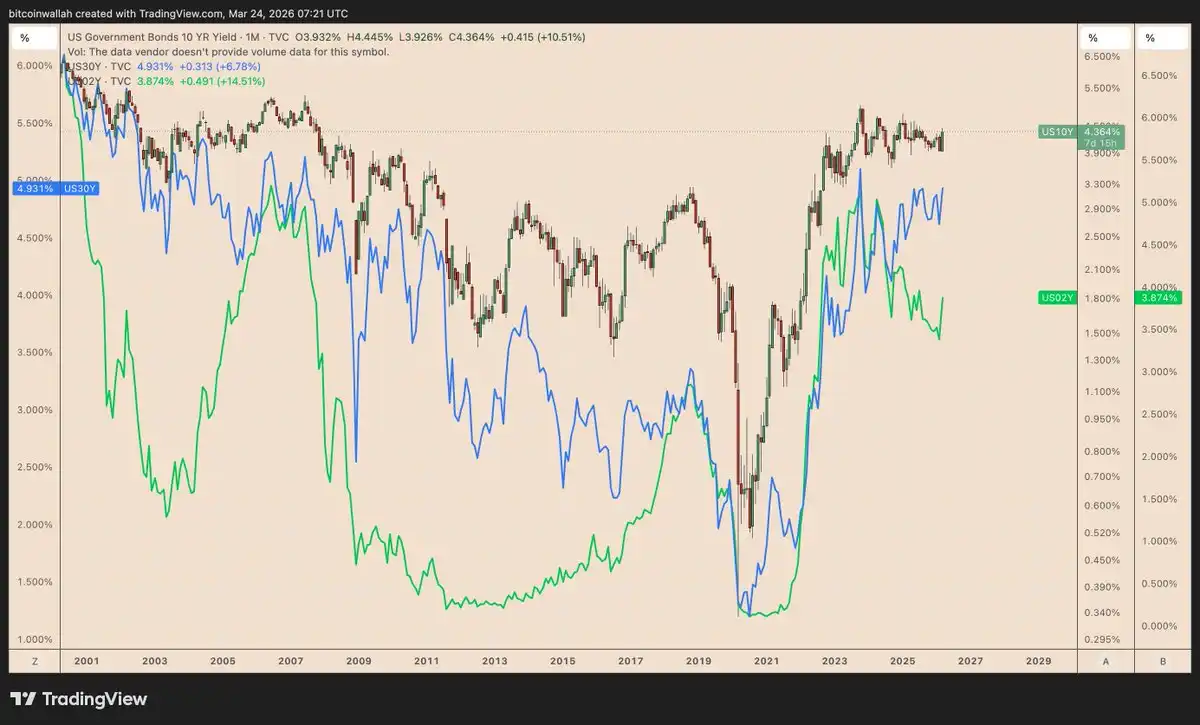
Since the U.S. and Israel launched attacks on Iran on February 28, the benchmark 10-year U.S. Treasury yield has climbed to about 4.42%, hitting a nine-month high.

Monthly performance of U.S. 2-year, 10-year, and 30-year Treasury yields. Source: TradingView

Among them, the 30-year Treasury yield rose to about 4.97%, and the 2-year Treasury yield also increased to the range of 3.95% to 3.98%.

Affected by the war, oil prices have surged, exacerbating market concerns about rising inflation, thereby pushing Treasury yields higher. Against this backdrop, the market widely expects no rate cuts within 2026.

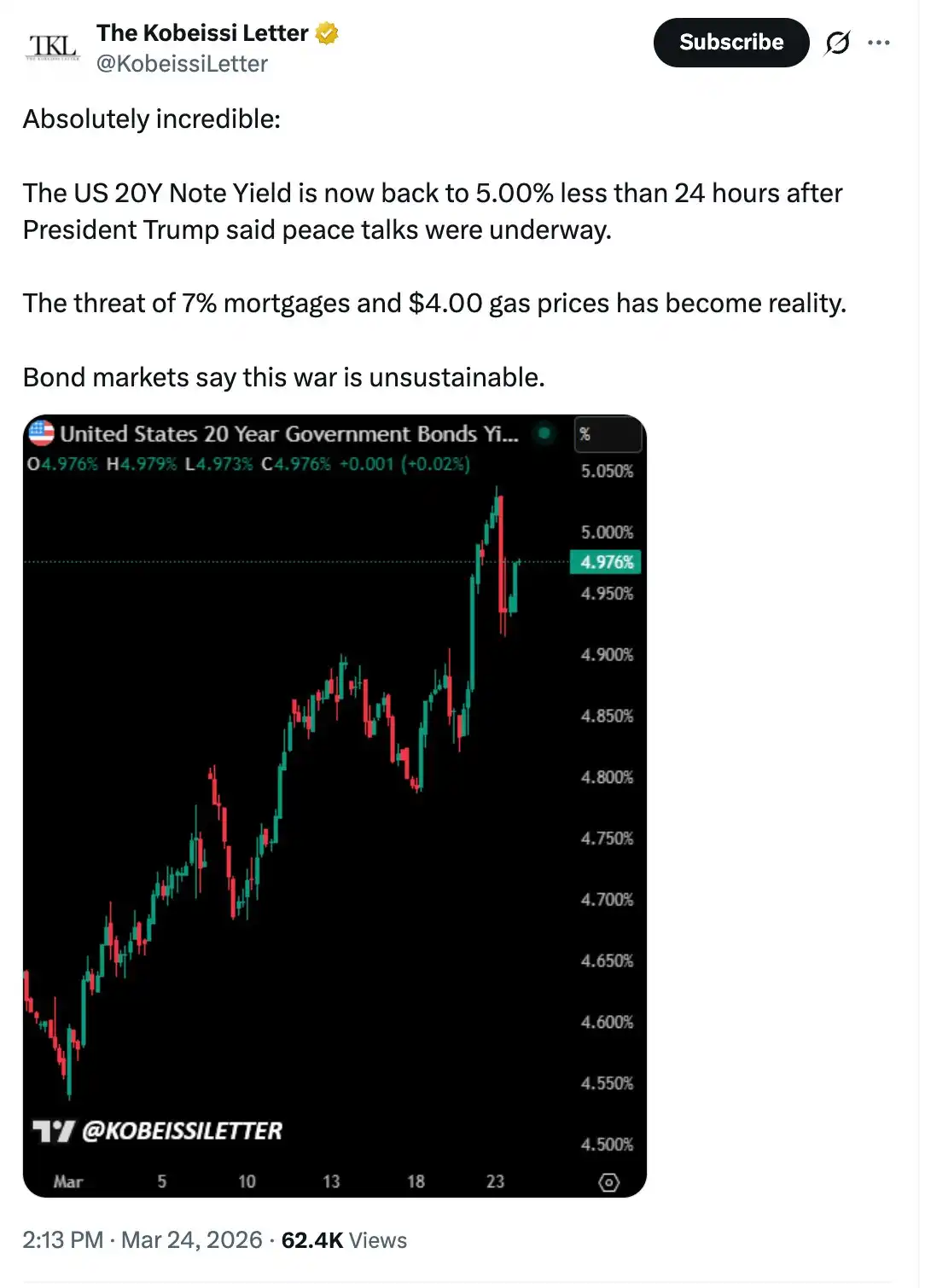
U.S. President Donald Trump announced a five-day suspension of operations, temporarily alleviating immediate concerns about strikes on Iranian energy facilities. However, as Iran denies any negotiations and cross-border attacks continue as of Tuesday, the conflict situation remains effectively uncontrolled.

Source: X

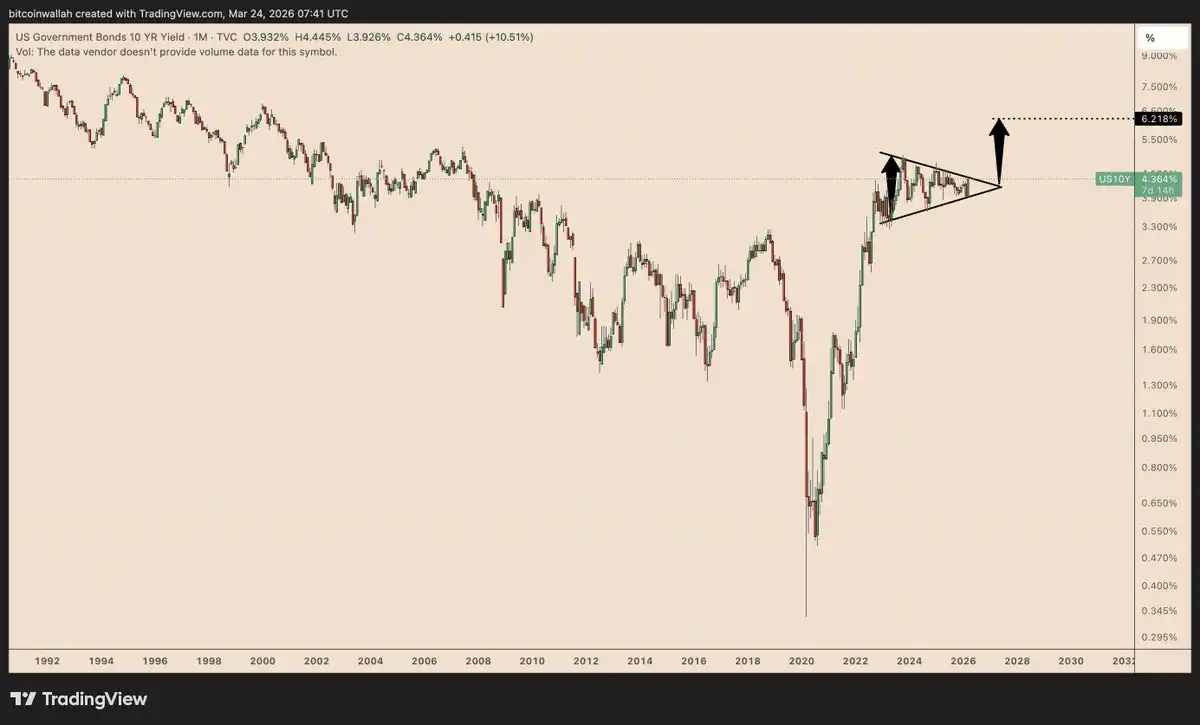
Market observers have expressed concerns, believing that U.S. Treasury yields face further upside risks. Technical analysts further pointed out that if the 10-year Treasury yield breaks through the current symmetrical triangle pattern, it could rise by 200 basis points to 6.4%.

Monthly chart of U.S. 10-year Treasury yield. Source: TradingView

Rising yields increase the opportunity cost of holding risk assets such as stocks and Bitcoin. If Bitcoin continues to exhibit risk asset attributes, a break above 5% in the 10-year Treasury yield could trigger selling pressure in the Bitcoin market.

Historical Cases of Oil-Related Shocks

Historically, short-term oil-related conflicts typically cause sharp but brief fluctuations in Treasury yields and stock markets, while long-term supply shocks can push yields up persistently and suppress stock markets continuously.

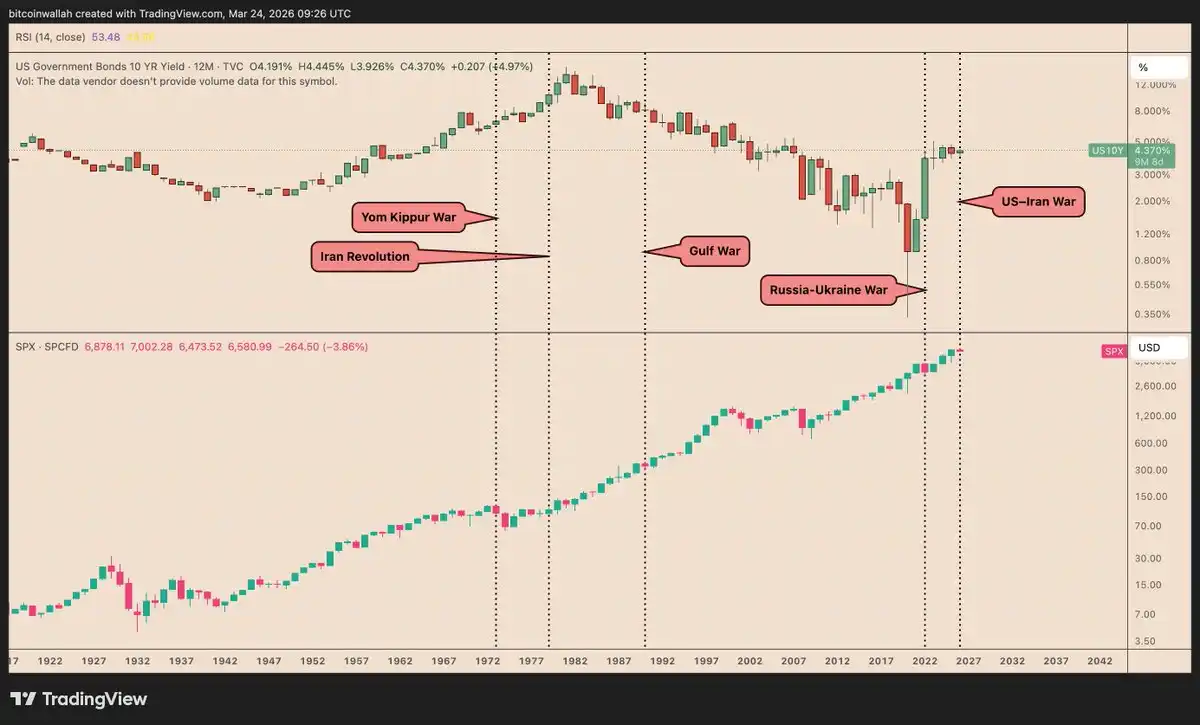
During the 1973 Yom Kippur War and the Arab oil embargo, Treasury yields initially rose slightly, then climbed significantly as inflation intensified, with the S&P 500 index falling about 41% to 48% during the 'stagflation' phase.

Annual chart of U.S. 10-year Treasury yield and S&P 500 index. Source: TradingView

During the 1979 Iranian Revolution, the bond market reaction was more intense, with the 10-year Treasury yield rising about 150 to 200 basis points in the following year, while the stock market correction was relatively moderate.

During the 1990-1991 Gulf War, the 10-year Treasury yield rose about 50 to 70 basis points, and the S&P 500 index fell about 16% to 20%, rebounding after the conflict was brought under control.

After the outbreak of the Russia-Ukraine conflict in 2022, there was also a rise in Treasury yields and a short-term drop of 5% to 10% in the S&P 500 index.

The current conflict between the U.S., Israel, and Iran seems to be in the early stages of these historical patterns. If the conflict escalates further and oil prices remain high, Treasury yields could rise further, and risk assets may face a new round of downward pressure.

Bitcoin still maintains a high correlation with the S&P 500 index. Therefore, unless the conflict situation eases quickly, Bitcoin's price is likely to face greater downward pressure.

To What Level Could Bitcoin's Price Drop?

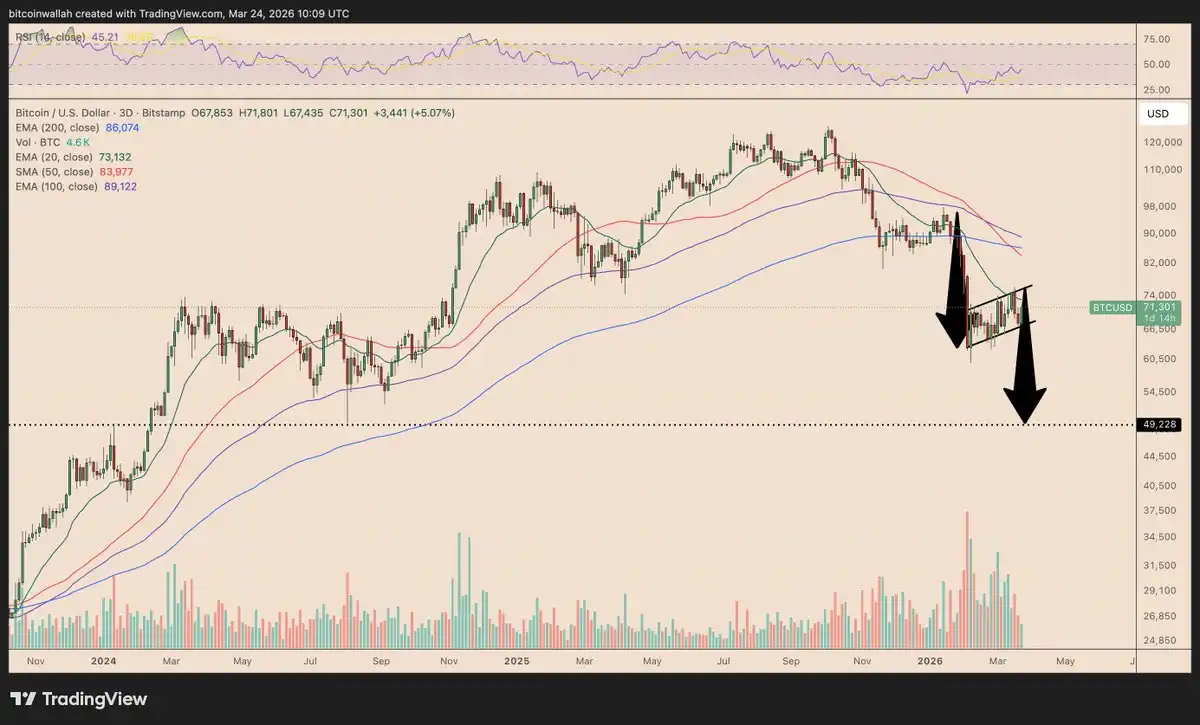
From a technical analysis perspective, if Bitcoin's price breaks below the current bear flag pattern, it could further drop to $50,000 or even lower in the coming months.

Bitcoin/USD three-day price chart. Source: TradingView

This technical expectation is largely consistent with trading data from prediction markets. Currently, traders estimate a 70% probability that Bitcoin will fall below $55,000 in 2026, and a 46% probability it will fall below $45,000.

BitMEX co-founder Arthur Hayes stated that if the U.S.-Iran war prolongs, it could force the Federal Reserve to adopt loose monetary policies, which would be a positive factor for Bitcoin.

He noted: 'The longer the conflict lasts, the more likely the Fed is to print money to support the U.S. war machine.' He further added:

'When central banks start printing money, I will choose to buy Bitcoin.'

Связанные с этим вопросы

QWhat is the main concern regarding US Treasury yields and Bitcoin's price according to the article?

AThe article suggests that if the US 10-year Treasury yield rises above 5%, it could trigger selling pressure in the Bitcoin market, potentially causing its price to fall below $50,000.

QHow have oil-related conflicts historically impacted Treasury yields and risk assets like stocks?

AHistorically, short-term oil-related conflicts caused sharp but brief volatility in yields and stocks, while prolonged supply shocks led to sustained yield increases and prolonged stock market declines, as seen during the 1973 Yom Kippur War and the 1979 Iranian Revolution.

QWhat technical pattern does the article mention for Bitcoin's price, and what is the predicted downside target?

AThe article mentions a bearish flag pattern for Bitcoin's price. If this pattern breaks down, the price could decline to $50,000 or lower in the coming months.

QAccording to market traders, what is the probability of Bitcoin falling below $55,000 and $45,000 in 2026?

ATraders estimate a 70% probability of Bitcoin falling below $55,000 and a 46% probability of it dropping below $45,000 in 2026.

QWhat contrasting view does BitMEX co-founder Arthur Hayes present regarding the impact of prolonged US-Iran war on Bitcoin?

AArthur Hayes argues that a prolonged US-Iran war could force the Federal Reserve to adopt loose monetary policy and print money, which would ultimately be bullish for Bitcoin as he states, 'When central banks start printing money, I will choose to buy Bitcoin.'

Похожее

You Bet on the News, the Pros Read the Rules: The True Cognitive Gap in Losing Money on Polymarket

The article explains that the key to profiting on Polymarket, a prediction market platform, lies not just predicting real-world events correctly, but in meticulously understanding the specific rules that govern how each market will be resolved. It illustrates this with examples, such as a market on Venezuela's 2026 leader, where the official rules defining "officially holds" the office overruled the intuitive answer of who was in practical control. Other examples include debates over the definition of a "token" or what constitutes an "agreement." The core argument is that a "reality vs. rules" gap creates pricing discrepancies that savvy traders ("车头" or "whales") exploit. The platform has a formal dispute resolution process managed by UMA token holders to settle ambiguous outcomes. This process involves proposal submission, a challenge window, a discussion period, and a final vote. However, the article highlights a critical flaw in this system compared to a traditional court: the lack of separation between the arbiters (UMA voters) and the interested parties (traders with financial stakes in the outcome). This conflict of interest undermines the discussion phase, leads to herd mentality, and results in opaque final decisions without explanatory rulings. Consequently, the system lacks a body of precedent, making it difficult for users to learn from past disputes. The ultimate takeaway is that success on Polymarket requires a lawyer-like scrutiny of the rules to identify and capitalize on the cognitive gap between how events appear and how they are contractually defined for settlement.

marsbit49 мин. назад

You Bet on the News, the Pros Read the Rules: The True Cognitive Gap in Losing Money on Polymarket

marsbit49 мин. назад

Will the Fed Still Cut Interest Rates? Tonight's Data Is Crucial

The core debate surrounding the Federal Reserve's potential interest rate cuts is intensifying amid geopolitical conflict and rebounding inflation. The key question is whether high energy prices will cause persistent inflation or weaken consumer demand enough to force the Fed to cut rates. Citigroup presents a bullish case for cuts, arguing that oil supply disruptions from the Strait of Hormuz are temporary and will not lead to lasting inflationary pressure. They point to receding bond yields and oil prices as evidence the market is pricing in a short-lived shock. Citi's data also shows tightening financial conditions, a stabilizing labor market, and healthy tax returns, supporting their view that the path to lower rates remains open. Conversely, Deutsche Bank offers a starkly contrasting, more hawkish outlook. They argue the Fed's current policy is already neutral and expect rates to remain unchanged indefinitely. Their view is based on stalled disinflation progress and a shift toward more hawkish rhetoric from key Fed officials like Waller, who cited risks from prolonged Middle East conflict and tariffs. Other officials, including Williams and Hammack, signaled rates would likely stay on hold for a "considerable time." The market pricing has shifted dramatically, now forecasting zero cuts in 2026. The imminent release of the March retail sales "control group" data is highlighted as a critical test. This metric, which excludes gas station sales, will reveal if high gasoline prices are eroding consumer spending in other areas. A weak reading could support the case for imminent rate cuts, while a strong one would bolster the argument for the Fed to hold steady. This data is pivotal for determining the near-term policy path.

marsbit1 ч. назад

Will the Fed Still Cut Interest Rates? Tonight's Data Is Crucial

marsbit1 ч. назад

Торговля

Спот
Фьючерсы

Популярные статьи

Как купить WAR

Добро пожаловать на HTX.com! Мы сделали приобретение WeStarter (WAR) простым и удобным. Следуйте нашему пошаговому руководству и отправляйтесь в свое крипто-путешествие.Шаг 1: Создайте аккаунт на HTXИспользуйте свой адрес электронной почты или номер телефона, чтобы зарегистрироваться и бесплатно создать аккаунт на HTX. Пройдите удобную регистрацию и откройте для себя весь функционал.Создать аккаунтШаг 2: Перейдите в Купить криптовалюту и выберите свой способ оплатыКредитная/Дебетовая Карта: Используйте свою карту Visa или Mastercard для мгновенной покупки WeStarter (WAR).Баланс: Используйте средства с баланса вашего аккаунта HTX для простой торговли.Третьи Лица: Мы добавили популярные способы оплаты, такие как Google Pay и Apple Pay, для повышения удобства.P2P: Торгуйте напрямую с другими пользователями на HTX.Внебиржевая Торговля (OTC): Мы предлагаем индивидуальные услуги и конкурентоспособные обменные курсы для трейдеров.Шаг 3: Хранение WeStarter (WAR)После приобретения вами WeStarter (WAR) храните их в своем аккаунте на HTX. В качестве альтернативы вы можете отправить их куда-либо с помощью перевода в блокчейне или использовать для торговли с другими криптовалютами.Шаг 4: Торговля WeStarter (WAR)С легкостью торгуйте WeStarter (WAR) на спотовом рынке HTX. Просто зайдите в свой аккаунт, выберите торговую пару, совершайте сделки и следите за ними в режиме реального времени. Мы предлагаем удобный интерфейс как для начинающих, так и для опытных трейдеров.

235 просмотров всегоОпубликовано 2024.12.11Обновлено 2025.02.23

Как купить WAR

Обсуждения

Добро пожаловать в Сообщество HTX. Здесь вы сможете быть в курсе последних новостей о развитии платформы и получить доступ к профессиональной аналитической информации о рынке. Мнения пользователей о цене на WAR (WAR) представлены ниже.

活动图片