If MSCI Removes MSTR, Will the Stock Price Actually Fall? Historical Backtesting Reveals a Surprising Answer

marsbitОпубликовано 2025-12-15Обновлено 2025-12-15

Введение

The article examines whether MSCI's potential removal of MicroStrategy (MSTR) from its index would actually cause a significant drop in its share price, based on historical backtesting. MSCI index changes can trigger forced selling by passive funds, reducing liquidity and investor confidence. However, historical data from the November 2025 MSCI rebalancing shows that most of the price decline for removed stocks occurred during the pre-announcement anticipation phase (average drop of 24.5%), not after the official announcement (average drop of only 0.7%) or on the effective date. Some stocks even rebounded after removal. MSTR has already fallen 51% from its October high, suggesting the market may have already priced in the risk of removal. Additionally, Nasdaq 100's recent decision to retain MSTR indicates strong fundamentals and liquidity. The core driver of MSTR’s price remains Bitcoin’s performance. If MSCI retains MSTR on January 15, it could be a positive surprise. The current setup may present an asymmetric risk-reward opportunity for MSTR.

The discussion about whether MSCI should remove MicroStrategy from its index has become a Sword of Damocles hanging over the company.

The market seems to be waiting for the official announcement on January 15th to deliver the final verdict on $MSTR.

How influential is MSCI really? If removed, will MicroStrategy's stock actually fall? I backtested historical data, and the answer is surprising.

Let's state the conclusion first: even if MSCI removes MSTR, it's highly likely that MSTR won't experience a significant drop because of it.

I. Why We Care About MSCI

First, we need to understand why MSCI's decision is so important.

The MSCI index is not just a simple list of stocks; it's the benchmark for trillions of dollars in global asset allocation.

1⃣ Forced Buying and Selling by Passive Funds:

Globally, trillions of dollars in ETFs (like iShares, Vanguard) and index funds strictly track the MSCI USA Index.

Once MSCI announces the removal of a stock, these funds must unconditionally sell that stock on the effective date (usually at the market close on the last day of the month), regardless of cost.

2⃣ A Double Blow to Liquidity and Attention:

Removal typically means the company is kicked out of the "core asset" club. Many actively managed funds, constrained by risk control rules (e.g., only allowed to invest in major index constituents), are also forced to follow suit and reduce their positions. This leads to decreased stock liquidity and a lower valuation benchmark.

II. Echoes from History: The Big Drop Often Happens *Before* the Announcement

However, based on my backtest of data from the last MSCI index review, the decline often doesn't begin on the day of the index adjustment.

The rule in financial markets is: the price always moves ahead of the news.

The most recent MSCI index adjustment occurred this November, removing companies like Whirlpool, Sensata, and ZoomInfo.

The timeline for an MSCI index adjustment is as follows:

November 5th: Announcement of the changes

November 25th: Changes become effective

Through calculation, I found that the maximum decline for the removed stocks did not occur *after* the removal took effect, but rather during the anticipation phase *before* the announcement.

The data is shown in the chart below
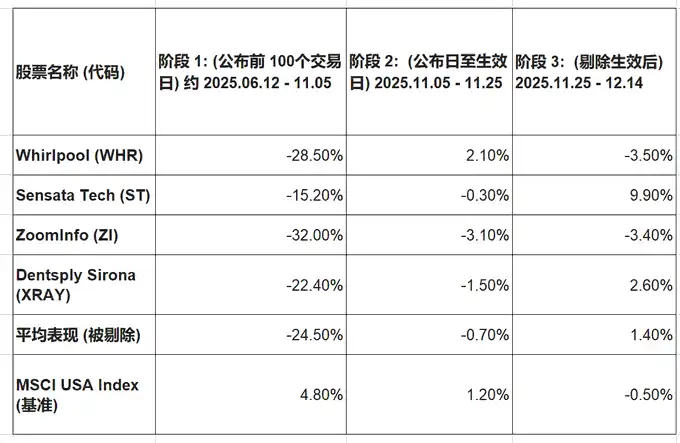
Phase 1 (Panic Brewing Period, 100 days before announcement):

During this period, stocks that were eventually removed fell by an average of 24.5%. The market anticipated the removal outcome in advance through deteriorating fundamentals and shrinking market capitalization.

Smart money had already front-run the move.

Phase 2 (Bad News Realization Period, Announcement day to Effective day):

When MSCI officially announced the removal list, stock performance was反而 stable, with an average decline of only 0.7%.甚至, individual stocks like Whirlpool (WHR)反而 saw a 2.1% rebound after the announcement.

Phase 3 (Post-Effect Recovery Period):

After the official removal took effect, some oversold individual stocks (like Sensata) even recorded gains of nearly 10%.

Overall, the average decline was 24.5% *before* the announcement, and 0.7% *after* the announcement.

Back to our protagonist 【MSTR】

MSCI announced in October that it was considering removing stocks of MSTR's type from the index.

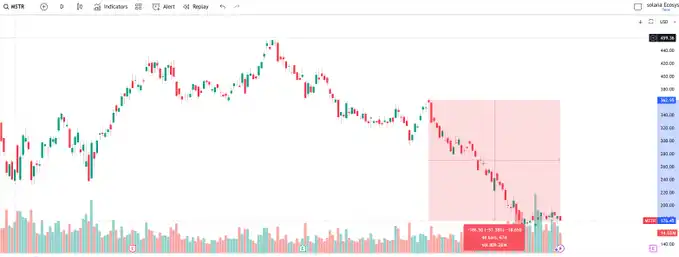
And MSTR's stock price has fallen 51% from its October high, far exceeding the decline in BTC over the same period.

Just like other companies removed from the MSCI index, the market has already started front-running the passive funds *before* MSCI's decision.
III. The Signal from the Nasdaq 100

When analyzing whether MicroStrategy will truly be removed by MSCI,

we cannot ignore a key leading indicator: the Nasdaq 100 index.

Although the Nasdaq 100 and MSCI USA indices have different construction rules, their core logic is highly overlapping: both place extreme importance on market capitalization and liquidity.

This past Friday, the Nasdaq 100 index announced it would retain MicroStrategy's constituent status.

This means that, from an index compilation perspective, MicroStrategy's average daily trading volume and free-float market capitalization still meet the stringent standards for being among the top 100 largest non-financial technology companies in the US.

Since MicroStrategy managed to hold its ground in the Nasdaq 100, it indicates that its fundamentals and liquidity have not deteriorated to an irreparable point.

Although MSCI has its own qualitative industry classification considerations, in terms of hard metrics, MicroStrategy still possesses strong competitiveness.

Conclusion

MSCI potentially removing MSTR from its index is definitely a significant negative.

But negatives are often提前 priced in by the market. According to historical backtesting, the impact on the stock price after the negative news materializes is反而 not significant.

The core variable真正 affecting MSTR's direction right now is still the trend of BTC.

甚至, because MSCI's potential removal of MSTR is still only in the discussion phase, if the announcement on January 15th next year ends up retaining MSTR's constituent status, that would be a major positive. Retention = big rise! Removal = small fall. I believe MSTR presents an opportunity for asymmetric returns in the period ahead.


Связанные с этим вопросы

QWhat is the main conclusion of the article regarding MSTR's stock price if it is removed from the MSCI index?

AThe main conclusion is that even if MSCI removes MSTR from its index, MSTR's stock price is unlikely to fall significantly, as the negative impact has likely already been priced in by the market.

QAccording to the historical backtest, when did the largest average price drop occur for stocks removed from the MSCI index?

AThe largest average price drop of 24.5% occurred during the 'panic fermentation phase,' which is the 100 days before the official announcement of the removal.

QWhat is the significance of the Nasdaq 100 index's recent decision regarding MSTR?

AThe Nasdaq 100 index's decision to retain MSTR as a component is a key leading indicator, suggesting that MSTR's average trading volume and free-float market cap still meet the stringent standards for a top-100 non-financial tech company, which could influence MSCI's decision.

QWhat does the article identify as the core variable that will truly influence MSTR's future price movement?

AThe article identifies the price movement of Bitcoin (BTC) as the core variable that will truly influence MSTR's future price direction.

QWhat potential asymmetric opportunity does the article suggest exists for MSTR?

AThe article suggests an asymmetric opportunity exists because if MSCI announces on January 15th that it will retain MSTR, it would be a major positive catalyst causing the stock to rise significantly, whereas a removal is expected to have only a minor negative impact, creating a favorable risk-reward scenario.

Похожее

Stuck Polymarket: The Real Test After Riding the Traffic Boom Has Arrived

Polymarket, a leading prediction market platform, is facing significant technical challenges as its growth outpaces its current infrastructure on Polygon. Users are experiencing laggy transactions, unresponsive orders, and delayed confirmations, severely impacting the trading experience. In response, DeFi Engineering VP Josh Stevens outlined a comprehensive engineering overhaul. The plan includes reducing on-chain data delays, fixing order cancellation issues, rebuilding the central limit order book (CLOB), improving website performance, and developing a unified SDK and API. A major revelation was the ongoing "chain migration," indicating a potential move away from Polygon. The core issue is that Polymarket has evolved from a simple prediction market into a high-frequency trading platform, making Polygon's limitations—such as block space, gas fees, and block time—a ceiling for further growth. The migration is not just a simple chain switch but a fundamental rebuild of its trading system to support more complex products like perpetual contracts (Perps). This announcement has sparked competition among chains like Solana, Sui, and Algorand, all vying to host Polymarket. For Polygon, losing this key application, which contributes significantly to its gas fee revenue, would be a major setback. The real test for Polymarket is no longer attracting users but proving it can provide a stable, reliable trading environment that retains them.

Odaily星球日报1 ч. назад

Stuck Polymarket: The Real Test After Riding the Traffic Boom Has Arrived

Odaily星球日报1 ч. назад

Lowering Expectations for BTC's Next Bull Market

The author, Alex Xu, explains his decision to significantly reduce his Bitcoin holdings (from full to ~30% of his portfolio) during the current bull cycle, citing a lowered long-term outlook for BTC's price appreciation in the next cycle. He outlines six key reasons for this reduced expectation: 1. **Diminished Growth Drivers:** The narrative of exponential user adoption has largely played out with institutional ETF adoption. The next major growth phase—adoption by sovereign national reserves or central banks—seems unlikely in the near future. 2. **Personal Opportunity Cost:** More attractive investment opportunities have emerged in other assets, such as undervalued companies. 3. **Industry-Wide Contraction:** The broader crypto industry is struggling, with most Web3 business models (SocialFi, GameFi, DePIN) failing. This overall萧条 (depression) reduces the fundamental demand and consensus for Bitcoin. 4. **Strain on Major Buyer:** MicroStrategy, a major corporate buyer of BTC, faces rising financing expenses for its debt, which could slow its purchasing rate and create significant marginal pressure on the market. 5. **Increased Competition from Gold:** The emergence of "tokenized gold" has closed the functional gap (portability, divisibility) between physical gold and Bitcoin, offering a strong competitor in the non-sovereign store-of-value space. 6. **Security Budget Concerns:** The block reward halving continues to exacerbate the long-standing issue of funding Bitcoin's network security, with new fee source explorations like Ordinals and L2s largely failing. The author's decision to hold a significant (though reduced) position reflects a cautious, not bearish, outlook. He remains open to increasing his exposure if the fundamental reasons for his skepticism change or if new positive catalysts emerge.

marsbit1 ч. назад

Lowering Expectations for BTC's Next Bull Market

marsbit1 ч. назад

Торговля

Спот
Фьючерсы

Популярные статьи

Как купить USDS

Добро пожаловать на HTX.com! Мы сделали приобретение USDS (USDS) простым и удобным. Следуйте нашему пошаговому руководству и отправляйтесь в свое крипто-путешествие.Шаг 1: Создайте аккаунт на HTXИспользуйте свой адрес электронной почты или номер телефона, чтобы зарегистрироваться и бесплатно создать аккаунт на HTX. Пройдите удобную регистрацию и откройте для себя весь функционал.Создать аккаунтШаг 2: Перейдите в Купить криптовалюту и выберите свой способ оплатыКредитная/Дебетовая Карта: Используйте свою карту Visa или Mastercard для мгновенной покупки USDS (USDS).Баланс: Используйте средства с баланса вашего аккаунта HTX для простой торговли.Третьи Лица: Мы добавили популярные способы оплаты, такие как Google Pay и Apple Pay, для повышения удобства.P2P: Торгуйте напрямую с другими пользователями на HTX.Внебиржевая Торговля (OTC): Мы предлагаем индивидуальные услуги и конкурентоспособные обменные курсы для трейдеров.Шаг 3: Хранение USDS (USDS)После приобретения вами USDS (USDS) храните их в своем аккаунте на HTX. В качестве альтернативы вы можете отправить их куда-либо с помощью перевода в блокчейне или использовать для торговли с другими криптовалютами.Шаг 4: Торговля USDS (USDS)С легкостью торгуйте USDS (USDS) на спотовом рынке HTX. Просто зайдите в свой аккаунт, выберите торговую пару, совершайте сделки и следите за ними в режиме реального времени. Мы предлагаем удобный интерфейс как для начинающих, так и для опытных трейдеров.

84 просмотров всегоОпубликовано 2026.04.13Обновлено 2026.04.13

Как купить USDS

Неделя обучения по популярным токенам 12: Крипто-конференция на 25 апреля 2026 года в Mar-a-Lago привлекает внимание, волна мем-монет вновь поднимается

Сообщество с большим нетерпением ожидает крипто-конференцию на 25 апреля 2026 года в Mar-a-Lago, многие рассматривают это как возможность «купить монету = приблизиться к президенту».

948 просмотров всегоОпубликовано 2026.04.14Обновлено 2026.04.14

Неделя обучения по популярным токенам 12: Крипто-конференция на 25 апреля 2026 года в Mar-a-Lago привлекает внимание, волна мем-монет вновь поднимается

Обсуждения

Добро пожаловать в Сообщество HTX. Здесь вы сможете быть в курсе последних новостей о развитии платформы и получить доступ к профессиональной аналитической информации о рынке. Мнения пользователей о цене на A (A) представлены ниже.

活动图片