How to Systematically Track High-Win-Rate Addresses on Polymarket?

marsbitОпубликовано 2026-03-02Обновлено 2026-03-02

Введение

This article explores methods to systematically identify and track high-success-rate addresses on Polymarket, a blockchain-based prediction market where all transactions are publicly recorded on-chain. It highlights that while data is transparent, the key challenge lies in extracting meaningful signals from vast datasets to detect addresses with potential informational advantages. The piece outlines common characteristics of such addresses: new wallets making large, concentrated bets; specialization in specific verticals; abnormal changes in position size; and exceptionally precise timing, repeatedly entering positions hours before major news breaks. A three-step systematic approach is recommended: First, filter addresses based on sustained profitability (e.g., 30-day positive returns, >55% win rate) using leaderboards like Polymarket Analytics. Second, analyze their holdings in specific event markets, focusing on addresses that are consistently among the top holders before full market pricing. Third, scrutinize their on-chain behavior: entry timing relative to news, position-building patterns (e.g., rapid, concentrated entries), holding periods, and trading focus. Advanced strategies include monitoring exit behavior (e.g., large, unexplained sell-offs), conducting wallet clustering analysis to find linked addresses, tracking unusual volume spikes in low-liquidity markets, and cross-referencing on-chain activity with external real-world data for validation. The goal is to ...

An address on Polymarket turned $35,000 into $442,000, achieving a 12.6x return. Notably, the position was established hours before a major market movement, and the trades were largely settled before the news spread to mainstream channels. This is not an isolated incident. Before the news of the "Venezuela Raid" political event became public, three addresses made moves in advance and collectively profited $630,000 from the same event.

If such trading occurred in traditional financial markets, one might easily think of information asymmetry. However, in prediction markets, all fund flows and position changes are recorded on the public blockchain; there are no hidden accounts or private transactions.

Being public does not mean there is no gap. The key is not whether you can see the trades, but whether you can discern the truly informative signals from the massive amount of data.
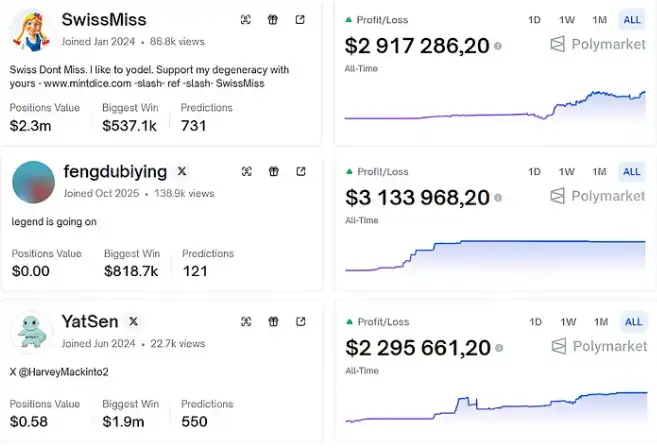
Every Trade on Polymarket is Public Data

Many prediction market participants still view Polymarket as a traditional betting platform: watch the odds, pick a direction, and bet on the outcome. But Polymarket's underlying structure is completely different from DraftKings or ordinary sports betting. All transactions occur on-chain; fund flows, position sizes, and entry/exit timings are all publicly viewable. The operational paths of the most accurate and timely addresses are not post-hoc speculation but real-time on-chain records.
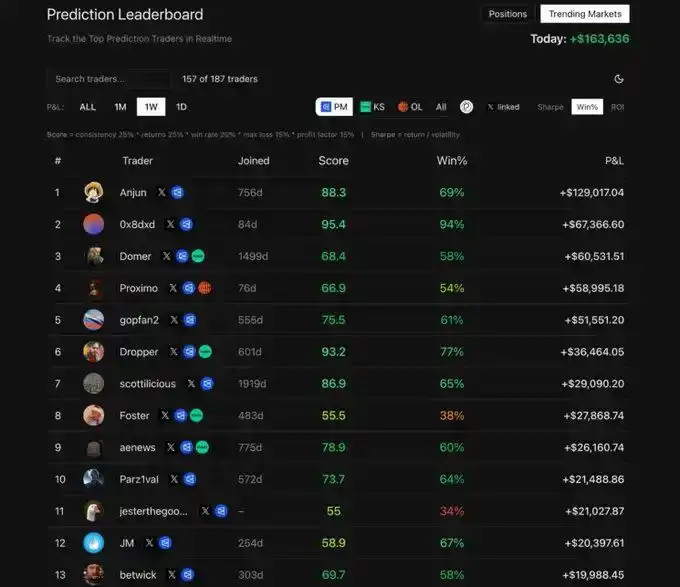
Polymarket's API is also open. Transaction records, market data, and historical trades can be directly called by anyone; there is no permission barrier.

Therefore, the gap is not about who can see the data, but about who can extract meaning from it. On-chain information is public, but what is truly valuable is the ability to identify wallets worth tracking continuously and to recognize behavioral changes before prices fully reflect them.

What Characteristics Do True "Informed Addresses" Typically Have?

It is important to emphasize that not all profitable wallets imply insider information. Some traders have solid research capabilities, while others rely on quantitative models and algorithmic advantages. However, when profitability is repeatedly coupled with specific behavioral patterns, one can observe structural features that distinguish them from mere "luck."

· Type 1: New Addresses Combined with Unusually Large Bets

A wallet created just days ago, with very few transactions, suddenly invests a large amount of capital in a low-liquidity niche market. This behavior is uncommon. Especially in the absence of public catalysts, large, concentrated positions often carry stronger informational significance.

· Type 2: Highly Vertical Trading Focus

Some addresses do not operate across markets but focus long-term on a specific niche, maintaining a stable and significant win rate in that area. They do not diversify across crypto prices, elections, sports, etc., but concentrate their firepower on a single theme, with more decisive position decisions.

· Type 3: Abnormal Changes in Position Size

When an address that has been betting with medium size for a long time suddenly significantly increases its position size in a particular market, this behavior often indicates a change in the strength of conviction. Position size itself is an attitude; a sudden change in scale usually reflects an upgrade in information or belief.

· Type 4: Overly Precise Timing

Occasional early positioning can be attributed to coincidence, but if an address repeatedly completes its positions hours before major news announcements, with highly consistent direction, this temporal lead is difficult to explain simply as luck. Once is random; repeated occurrences are more likely to reflect an information advantage.

How to Systematically Screen for Potential "Information-Advantaged Addresses"

· Step 1: Analyze Performance on Polymarket Leaderboards

Start with the leaderboard on Polymarket Analytics (link: https://polymarketanalytics.com/traders), sorted by 30-day P&L, using recent stable profitability as the first filter. Focus on wallet addresses with an overall positive return over 30 consecutive days, a win rate above 55%, and total profit significantly higher than total loss. Also, confirm that their trading is concentrated in markets with real liquidity, not low-volume prediction events with little participation.
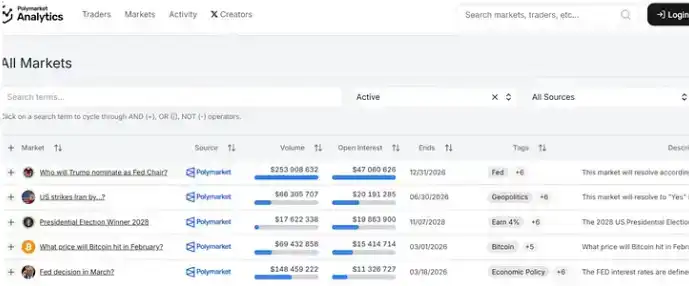
The goal at this stage is not to directly judge whether they have an information advantage, but to build a watchlist of addresses with sustained profitability. A consistent profit record is the foundation for subsequent behavioral analysis.

· Step 2: Analyze Position Structure in Specific Events

After the initial screening, drill down into specific trading events. Enter active prediction markets and check the Top Holders list for that event. Polymarket publicly displays the addresses with the largest current positions; these large positions often represent stronger conviction.
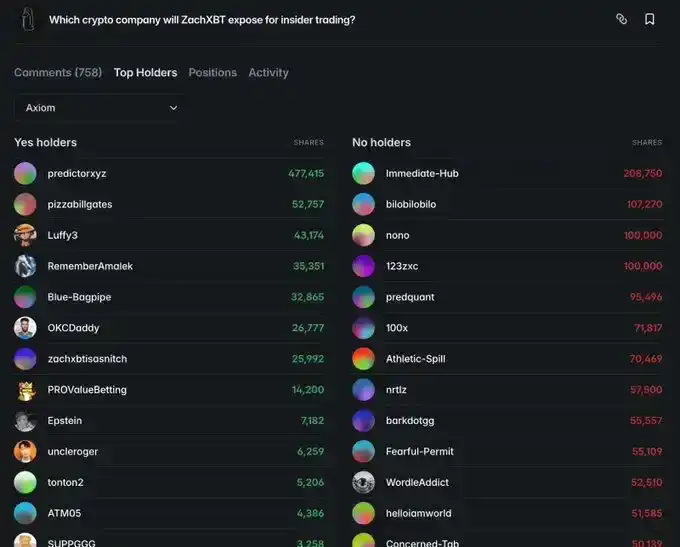
The key is not whether an address hits a single large bet, but whether its behavior is persistent. If a wallet repeatedly appears in the top holder lists for multiple significant events, and these positions were established before the market was fully priced, this repetition itself constitutes a signal.

Hitting once might be chance, but repeatedly making large, early-stage positions with consistent direction and validated outcomes often indicates a judgment system with a stable advantage.

· Step 3: Analyze Trading Behavior and Position Timing

After identifying candidate addresses, further analyze their on-chain transaction history, focusing on entry timing, position structure, and holding rhythm.
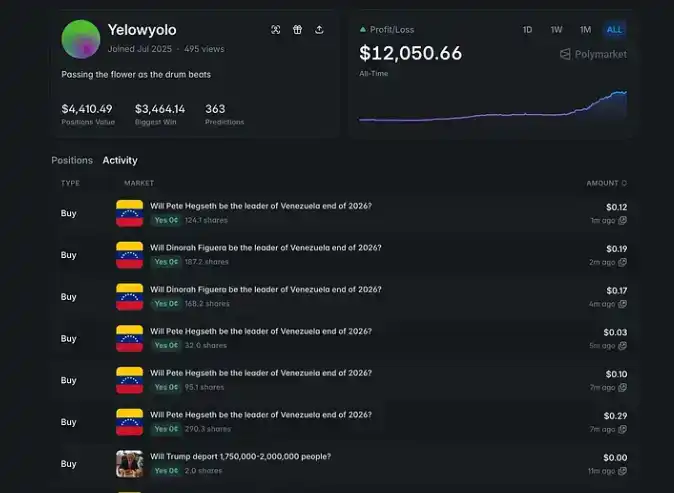
First, observe the entry time. If the purchase occurs hours before the official news release and repeats multiple times, the timing advantage itself becomes an important variable; entering after media reports is more likely to be just information following.

Second, analyze the method of position building. Mature traders typically build positions in batches and add gradually, while wallets with strong information judgment often complete concentrated layouts quickly within a short time window because their opportunity is limited.

Furthermore, pay attention to the holding period. Some high-quality addresses choose to exit during the middle of the trend发酵, rather than waiting for the tail end of extreme volatility, indicating their goal is to capture the main trend rather than marginal profits.

Finally, observe their trading scope. Addresses that are highly vertical and long-term focused on a single niche are more likely to form stable information advantages; addresses that frequently operate across sectors are more likely to rely on market sentiment rather than specific domain judgment.

Advanced Address Tracking Strategies

After mastering the basic screening methods, what truly makes the difference is the further dissection of the details of fund behavior.

First, focus on exit behavior, not just entry timing. Addresses with information advantages often not only position early but also actively reduce positions before potential negative news emerges. When a large address with a long, stable holding history suddenly significantly reduces its position without obvious catalysts, the informational content of this action is often higher than the initial buy. Especially when the reduction reaches a significant proportion, this change itself is a signal.

Second, perform wallet clustering analysis using on-chain data. Connections between addresses are not completely untraceable. Identical funding sources, similar Gas usage patterns, and transactions occurring consecutively within a very short time may reveal relationships between addresses. Many seemingly "new" accounts can often be traced back to a long-active old address through 2 or 3 fund transfers. Tracking along the fund flow path helps identify new potential high-quality accounts before the market notices.

Additionally, pay attention to abnormal volume changes in niche markets. If a market with usually small daily trading volume suddenly experiences a large influx of funds without public news, this structural increase in volume often means some participants have acted early. Analyzing the specific addresses driving the volume change can help build a new watchlist.

Finally, cross-validate on-chain behavior with external public information. The so-called "Pizza Index" once inferred potential military action from abnormal order volumes at pizzerias near the Pentagon. Similarly, flight tracking data, social media activity of key figures, adjustments to public calendars, and other information can provide corroboration or counter-verification for on-chain position behavior. The linkage between on-chain capital flows and real-world signals can often strengthen the reliability of judgment.


Связанные с этим вопросы

QWhat are the key characteristics of potentially high-performing addresses on Polymarket?

AKey characteristics include: 1) New addresses making unusually large bets, 2) High specialization in a narrow trading domain, 3) Abnormal changes in position size indicating conviction shifts, and 4) Exceptionally precise timing of trades before major news breaks.

QHow can one systematically identify addresses with potential information advantages on Polymarket?

AA systematic approach involves: 1) Analyzing the Polymarket Analytics leaderboard for consistently profitable addresses, 2) Examining specific event holders lists for large, early positions, and 3) Conducting deep analysis of transaction timing, position structure, and holding patterns.

QWhy is transaction timing particularly important when analyzing Polymarket addresses?

ATransaction timing is crucial because addresses that consistently establish positions hours before major news becomes public, rather than after media coverage begins, demonstrate a potential information advantage that cannot be easily explained by luck alone.

QWhat advanced strategies can be used for tracking high-performance addresses beyond basic screening?

AAdvanced strategies include: analyzing exit behaviors and sudden position reductions, conducting wallet clustering through on-chain data analysis, monitoring unusual volume spikes in niche markets, and cross-referencing on-chain activity with external real-world signals.

QHow does Polymarket's structure differ from traditional betting platforms in terms of data transparency?

AUnlike traditional platforms, all Polymarket transactions occur on-chain, making fund flows, position sizes, and entry/exit timestamps publicly visible and accessible through open APIs, creating a transparent environment where performance is verifiable through public blockchain data.

Похожее

It's Not Jensen Huang Who Wants to Change the PC, But the PC That's Revolting Against Itself

The 40-year-old PC industry is undergoing a fundamental transformation, driven by the rise of AI PCs. At the GTC Taipei 2026 event, NVIDIA, backed by Microsoft and major PC OEMs, announced the RTX Spark super chip for Windows PCs, marking its official entry into the PC core processor market. This move aims to redefine the AI PC by shifting its core from the CPU to an AI-focused SoC (System on Chip). NVIDIA envisions the PC evolving from a personal computer to a "personal AI"—a platform where local AI Agents can autonomously perform tasks. While Intel pioneered the AI PC concept earlier in 2026, NVIDIA's aggressive push, leveraging its vast CUDA developer ecosystem of 6 million, positions it to potentially reshape the industry's long-standing Wintel (Windows-Intel) power structure. NVIDIA's strategy extends beyond hardware; it's about embedding its CUDA, RTX, and AI software stack into the PC platform itself. The article identifies key shifts: 1) The move from a CPU-centric to an AI SoC-centric architecture, similar to Apple's approach with its M-series chips. 2) The PC's evolution from a human-operated tool to a platform for human-Agent collaboration. 3) The extension of NVIDIA's data center-centric CUDA ecosystem to personal devices via RTX Spark. Ultimately, the change is driven by the broader trend of AI moving to personal devices. Companies like Intel, AMD, Qualcomm, and Apple are all participating in this shift. NVIDIA's entry accelerates the competition, but the core driver is the technology itself finding its optimal expression in the PC. The industry is reinventing itself, with the outcome hinging on execution, ecosystem development, and the creation of compelling local AI applications.

marsbit18 мин. назад

It's Not Jensen Huang Who Wants to Change the PC, But the PC That's Revolting Against Itself

marsbit18 мин. назад

Popular Interaction Collection | Interstate Launches Points Event; Flip Early Waitlist Application (June 12)

**Interstate Launches Points Event, Flip Opens Early Waitlist Applications** *Originally published by Odaily Planet Daily, author Asher.* **Interstate**, an infrastructure platform integrating on-chain transactions for assets like Meme tokens, prediction markets, and xStocks, has launched a points event. Each trade on the platform now rewards users with points. The project has completed a $1.5 million seed round from investors including MH Ventures, Alchemy Ventures, and Marshland Capital. Users can visit the official website to connect their wallets and start earning points through trading tasks (note: the site may experience high traffic). **Flip**, an AI-powered financial assistant, has opened applications for its early waitlist. The platform allows users to manage finances via chat, helping with spending tracking, bill management, investment portfolio monitoring (including stocks and crypto), and more. Flip recently raised $1.4 million in a pre-seed round led by The House Fund and participated in a16z's Speedrun accelerator. Interested users can join the waitlist via the official website. **ArcNova**, an AI-native infrastructure platform for short-form video and entertainment, continues to offer tasks for earning points. Users can sign in daily, complete social and app tasks, and refer friends to accumulate points. The project announced a $15 million funding round in May, backed by Adaverse Ventures, Animoca Brands, and others. The task portal is accessible through the ArcNova website. These updates highlight ongoing opportunities for user engagement and potential rewards across emerging crypto and AI projects.

Odaily星球日报2 ч. назад

Popular Interaction Collection | Interstate Launches Points Event; Flip Early Waitlist Application (June 12)

Odaily星球日报2 ч. назад

Торговля

Спот
Фьючерсы

Популярные статьи

Как купить WIN

Добро пожаловать на HTX.com! Мы сделали приобретение WINkLink (WIN) простым и удобным. Следуйте нашему пошаговому руководству и отправляйтесь в свое крипто-путешествие.Шаг 1: Создайте аккаунт на HTXИспользуйте свой адрес электронной почты или номер телефона, чтобы зарегистрироваться и бесплатно создать аккаунт на HTX. Пройдите удобную регистрацию и откройте для себя весь функционал.Создать аккаунтШаг 2: Перейдите в Купить криптовалюту и выберите свой способ оплатыКредитная/Дебетовая Карта: Используйте свою карту Visa или Mastercard для мгновенной покупки WINkLink (WIN).Баланс: Используйте средства с баланса вашего аккаунта HTX для простой торговли.Третьи Лица: Мы добавили популярные способы оплаты, такие как Google Pay и Apple Pay, для повышения удобства.P2P: Торгуйте напрямую с другими пользователями на HTX.Внебиржевая Торговля (OTC): Мы предлагаем индивидуальные услуги и конкурентоспособные обменные курсы для трейдеров.Шаг 3: Хранение WINkLink (WIN)После приобретения вами WINkLink (WIN) храните их в своем аккаунте на HTX. В качестве альтернативы вы можете отправить их куда-либо с помощью перевода в блокчейне или использовать для торговли с другими криптовалютами.Шаг 4: Торговля WINkLink (WIN)С легкостью торгуйте WINkLink (WIN) на спотовом рынке HTX. Просто зайдите в свой аккаунт, выберите торговую пару, совершайте сделки и следите за ними в режиме реального времени. Мы предлагаем удобный интерфейс как для начинающих, так и для опытных трейдеров.

647 просмотров всегоОпубликовано 2024.04.17Обновлено 2026.06.02

Как купить WIN

Обсуждения

Добро пожаловать в Сообщество HTX. Здесь вы сможете быть в курсе последних новостей о развитии платформы и получить доступ к профессиональной аналитической информации о рынке. Мнения пользователей о цене на WIN (WIN) представлены ниже.

活动图片